
How to Stop a Panic Attack in the Moment (2026)
Learn how to stop a panic attack using 4-7-8 breathing, 5-4-3-2-1 grounding, and the dive reflex. Evidence-based steps that work within minutes, in 2026.

Key Takeaways
- A quiet space (helpful but not required — these work in public too)
- Your breath (always available)
- Cold water or an ice cube (optional but powerful)
- 5 to 10 minutes of focused attention
- No prior training needed
Panic attacks peak within 10 minutes and rarely last longer than 20 to 30 minutes — but in the middle of one, those minutes feel endless. This guide gives you step-by-step techniques to stop a panic attack in the moment, plus tools to reduce how often they happen.
TL;DR: The fastest way to stop a panic attack is to interrupt your nervous system's alarm signal. In 2026, the most evidence-backed in-the-moment techniques are controlled breathing (specifically 4-7-8 or box breathing), grounding with the 5-4-3-2-1 method, and cold water on your face or wrists. None of these require a therapist present. They work because they directly slow the sympathetic nervous system response that's driving your symptoms. Knowing how to stop a panic attack before it peaks can cut episode duration from 20 minutes down to under 5.
Why this matters
Panic attacks affect roughly 11% of adults in any given year, according to data from the National Institute of Mental Health. They're not dangerous on their own — your heart is not stopping, you're not dying — but the physical symptoms (racing heart, chest tightness, dizziness, shortness of breath) are real and they're being produced by your own nervous system in a false-alarm state. The good news: because the symptoms are nervous-system-driven, nervous-system tools can shut them down fast.
For ongoing anxiety and panic, AI therapy for anxiety and panic attacks can give you personalized coping sessions between episodes.
What you'll need
- A quiet space (helpful but not required — these work in public too)
- Your breath (always available)
- Cold water or an ice cube (optional but powerful)
- 5 to 10 minutes of focused attention
- No prior training needed
The steps
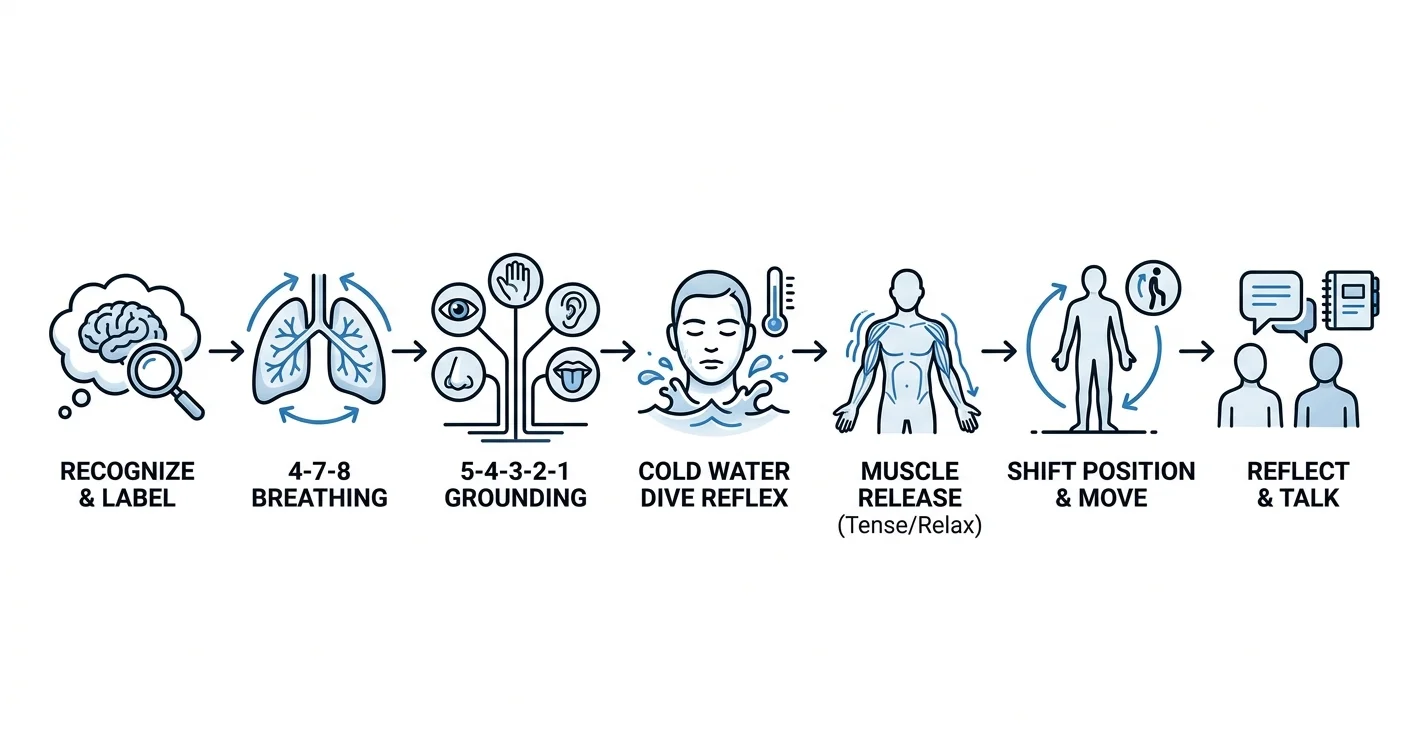
Step 1: Recognize it for what it is
The moment you notice your heart rate spike, your chest tighten, or a wave of dread hit — say to yourself, out loud or internally: "This is a panic attack. It will peak and pass. I am not in danger."
This single step matters more than people expect. Research on panic disorder consistently shows that catastrophic thinking ("I'm having a heart attack") amplifies and extends the attack. Naming it accurately — panic, not danger — starts to deactivate the threat response in your brain's amygdala. You're not suppressing the feeling; you're giving your nervous system accurate information to work with.
Common mistake: Trying to "push through" or distract yourself without acknowledging what's happening. That tends to extend the episode.
Step 2: Drop into 4-7-8 breathing
Inhale through your nose for 4 counts. Hold for 7 counts. Exhale slowly through your mouth for 8 counts. Repeat 3 to 4 cycles.
This specific ratio works because the extended exhale activates the vagus nerve, which directly signals your heart rate to slow. The 8-count exhale is the active ingredient. If 7 seconds feels too long for the hold, use a simplified version: inhale for 4, exhale for 8. The ratio is what matters, not the exact numbers.
Expected outcome: Heart rate noticeably slows within 60 to 90 seconds. The sensation of suffocation begins to lift as your CO2 levels re-balance.
Common mistake: Breathing too fast or too shallow during the exhale. Slow it down more than feels natural.
For a deeper look at breathing tools, breathing exercises for anxiety relief covers additional techniques with step-by-step instructions.
Step 3: Run the 5-4-3-2-1 grounding method
Shift your attention to your senses, in this order:
- 5 things you can see — name them specifically ("grey ceiling tile", "blue pen")
- 4 things you can physically feel — the chair under you, your feet on the floor
- 3 things you can hear — traffic outside, the hum of a fan
- 2 things you can smell — or two things you'd like to smell if nothing is present
- 1 thing you can taste
This works by forcing your prefrontal cortex — your rational brain — back online. During a panic attack, your amygdala has essentially hijacked your thinking. Grounding interrupts that hijack by demanding specific, real-world sensory input. For more on this mechanism, see the piece on amygdala hijack — what it is and how to regain control.
Expected outcome: A sense of "returning" to the room. Thoughts feel less catastrophic. This usually takes 2 to 3 full minutes to work properly.
Common mistake: Rushing through the list. Take 10 to 15 seconds per item. Speed defeats the purpose.
Step 4: Use cold water or the dive reflex
If you can access water, splash cold water on your face, or hold your wrists under cold running water for 30 seconds. If you have ice, hold a cube in your palm.
This activates the mammalian dive reflex — a hardwired physiological response that slows heart rate and redirects blood flow. It's one of the fastest physical interventions available outside of medication. The effect is measurable within 30 seconds and doesn't require any mental effort, which makes it especially useful when your thoughts are too scattered to follow the breathing steps properly.
Expected outcome: Immediate heart rate reduction. Many people describe it as a "reset" sensation.
Common mistake: Using lukewarm water. It needs to be noticeably cold to trigger the reflex.
Step 5: Progressive muscle release — quick version
Start from your feet. Tense the muscles in your feet as hard as you can for 5 seconds, then release completely. Move to your calves, thighs, stomach, fists, and shoulders — same pattern. Tense for 5, release.
The full version of progressive muscle relaxation for stress takes 15 to 20 minutes. In a panic attack, you don't have that time, so a 60-second rapid pass through the major muscle groups is enough. The tense-release cycle gives your body a physical outlet for the adrenaline flooding your system, and the release creates a noticeable contrast that signals safety to your nervous system.
Expected outcome: Muscle tension drops visibly. Shaking or trembling often reduces within 2 minutes.
Common mistake: Skipping the release phase — the release is where the benefit lives, not the tension.
Step 6: Shift your position and move gently
If you're sitting, stand up. If you're standing, sit or lie down. Walk slowly for 30 seconds. Change your physical orientation in whatever direction is the opposite of your current one.
Movement signals your body that the "threat" is gone. A frozen, rigid body posture maintains the alarm state. Even a small, deliberate movement — three slow steps across a room — begins to metabolize the adrenaline and tells your nervous system the danger has passed.
Expected outcome: The sense of being "stuck" in the panic begins to dissolve within 1 to 2 minutes of gentle movement.
Common mistake: Pacing fast or agitated movement, which can actually extend the attack by keeping adrenaline elevated.
Step 7: Talk it through afterward — while it's still fresh
Within 30 minutes of the attack ending, identify one trigger and one thing that helped most. Write it down or say it aloud.
In 2026, you don't need to wait for a therapy appointment to process a panic attack. Lovon lets you talk through what just happened with an AI voice companion built around evidence-based anxiety tools — immediately, whenever you need it. That post-episode window is when reflection is most useful and when patterns become visible. Over time, tracking what precedes attacks is the core of the cognitive-behavioral approach to reducing their frequency.
Expected outcome: Reduced fear of future attacks. Avoidance behavior decreases when attacks feel less unpredictable.
Troubleshooting
"The breathing makes me feel more panicked." This happens when you focus too hard on your breath and hyperventilate slightly. Switch to the 5-4-3-2-1 method first, then return to breathing once your attention is grounded.
"I can't focus on anything during an attack." Use the cold water step immediately — it's the only technique here that doesn't require mental focus. Once heart rate drops, the other steps become accessible.
"My attacks come with no warning." Nocturnal or no-warning attacks are common with panic disorder. Keep a glass of cold water on your nightstand and practice the breathing pattern daily so it's automatic when you need it.
"I've tried breathing before and it doesn't work." Breathing fails when the exhale isn't long enough. Most people exhale for 2 to 3 seconds when anxious. The 8-count exhale is more than twice as long as what feels instinctive — that's exactly why it works.
"The attack comes back 20 minutes later." A second wave usually means the first attack wasn't fully resolved — you distracted yourself rather than working through it. Return to Step 1 and run the full sequence again.
"I feel exhausted and low after the attack passes." Post-panic fatigue is normal. Your body just flooded itself with adrenaline and then had to process all of it. Rest, drink water, and eat something small. This is not a sign that something went wrong.
Tools and resources
- Lovon app — voice-based AI support for anxiety and panic, available on demand at lovon.app
- AI counseling for stress management — ongoing tools for stress reduction between episodes
- Coping tools for stress — what works and what does not — evidence review of the most common anxiety coping strategies
- A therapist or psychiatrist for diagnosis and clinical treatment (Lovon is not a substitute for licensed clinical care)
What to do next
Stopping an attack in the moment is the short game. The long game is understanding why your nervous system keeps triggering false alarms. How your nervous system processes threat and safety explains the polyvagal theory behind anxiety responses and gives you a model for long-term regulation — not just in-the-moment rescue.
FAQ
What's the fastest way to stop a panic attack? Cold water on your face activates the dive reflex and slows your heart rate within 30 seconds — it's the fastest single technique available. Pair it with 4-7-8 breathing for the most immediate combined effect.
Can you stop a panic attack before it peaks? Yes. If you catch the early warning signs — heart rate increase, a sudden feeling of dread, tingling in hands — and start controlled breathing immediately, you can often prevent the attack from reaching full intensity. The 4-second inhale, 8-second exhale pattern is most effective in this window.
How long does a panic attack last if you do nothing? Most panic attacks peak within 10 minutes and fully resolve within 20 to 30 minutes on their own. Using the techniques in this guide can cut that to under 5 minutes.
Is breathing into a paper bag actually useful? The paper bag method was once common advice but is no longer recommended. It can raise CO2 to uncomfortable or unsafe levels. Controlled breathing — especially the extended exhale — is safer and more effective.
What causes panic attacks to happen out of nowhere? Nocturnal or "out of nowhere" panic attacks are usually triggered by subtle physiological cues (slight CO2 changes during sleep, mild dehydration, caffeine) that the nervous system misreads as danger. They're not random — the trigger is just happening below conscious awareness.
Are panic attacks dangerous to your heart? No. Panic attacks feel like cardiac events but are not. The American Heart Association notes that while anxiety can cause chest pain and rapid heart rate, panic attacks do not cause heart attacks in otherwise healthy people. If you are unsure whether you're experiencing panic or a cardiac event, seek medical attention.
How do I know if I have panic disorder vs. general anxiety? Panic disorder is defined by recurrent, unexpected panic attacks plus at least one month of persistent worry about future attacks or changing behavior to avoid them. General anxiety disorder involves chronic worry without the discrete attack pattern. A licensed clinician can diagnose which applies to you.
Will these techniques work every time? They work most of the time when practiced consistently. The effectiveness of breathing techniques specifically increases with regular daily practice — your nervous system learns the pattern and responds to it faster. Techniques you only use during attacks are less reliable than ones you've practiced outside of them.
One last thing
The fear of having another panic attack often causes more daily interference than the attacks themselves. In 2026, research on panic disorder consistently shows that avoidance behavior — skipping situations where you've panicked before — is what turns occasional panic attacks into panic disorder. The goal of every technique here isn't just to end an attack. It's to build enough confidence in your own ability to handle one that you stop organizing your life around avoiding them.
Related guides
How AI Support Helps You Heal
AI emotional support isn't about replacing human connection — it's about filling the gaps. The moments when you need to talk at 2 AM, when you don't want to burden your friends again, or when you simply need someone to listen without judgment.
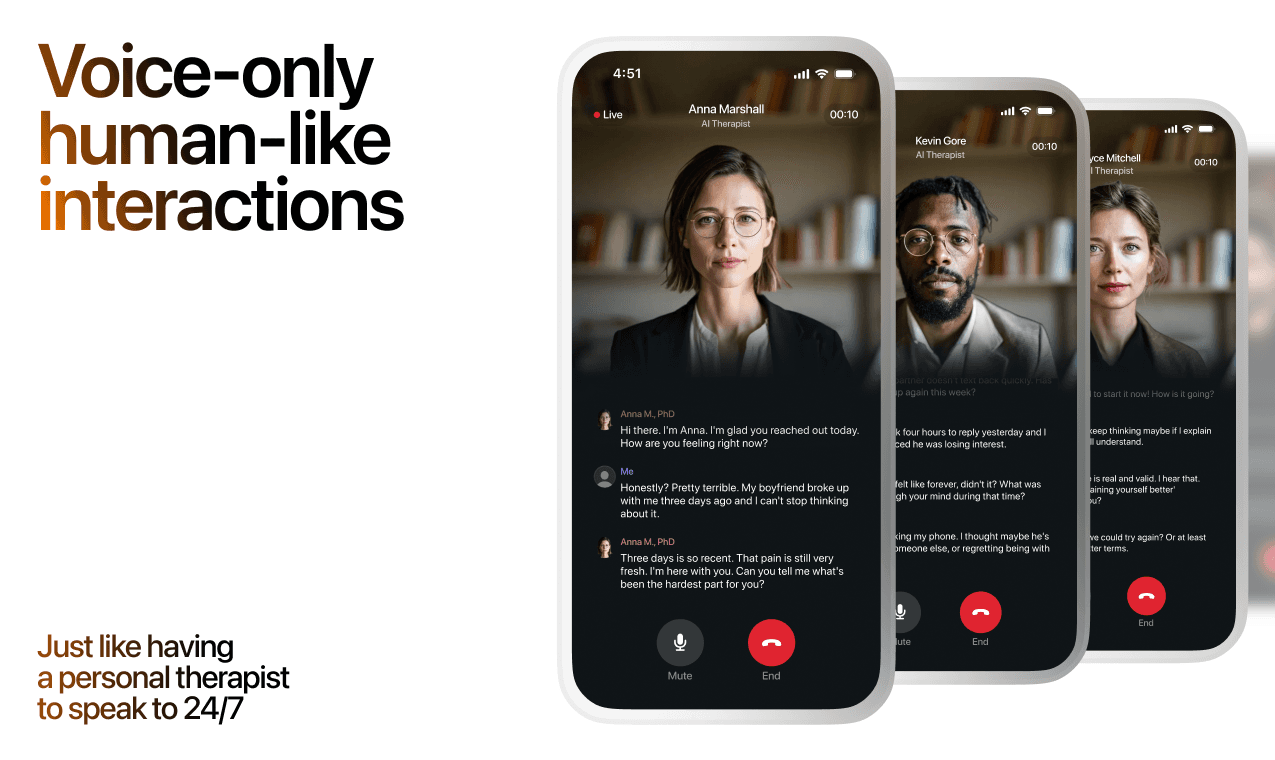
Here's what happens in a typical Lovon session:
You share what's on your mind
There's no script, no intake form, no waiting room. You speak or type whatever you're feeling — in your own words, at your own pace.
Lovon validates and explores
Using frameworks from CBT (Cognitive Behavioral Therapy) and motivational interviewing, Lovon acknowledges your feelings first, then gently helps you explore them. No dismissive "just move on" advice.
You build coping skills together
Lovon doesn't just listen — it actively works with you on evidence-based techniques: thought reframing, urge surfing, behavioral experiments, and more.
What a Session with Lovon Looks Like
When to Seek Professional Help
AI support is a valuable tool, but it's not a replacement for professional care. Please consider reaching out to a licensed therapist if you experience any of the following:
- Persistent thoughts of self-harm or suicide
- Inability to perform daily activities (work, eating, sleeping) for more than 2 weeks
- Turning to alcohol or substances to cope
- Intense anger or desire to harm your ex-partner
- Complete emotional numbness that doesn't improve over time
Crisis Resources (US): If you're in immediate danger, call 988 (Suicide & Crisis Lifeline) or text HOME to 741741 (Crisis Text Line). Available 24/7, free, and confidential.
Outside the US? Find a crisis line in your country
Ready to Start?
Your healing journey can begin right now
A 7-day trial. No judgment. Just a safe space to process what you're going through.
Frequently Asked Questions
Is Lovon a replacement for a real therapist?
Is my conversation with Lovon AI private?
How is Lovon different from ChatGPT for emotional support?
Can I use Lovon if I'm already seeing a therapist?
Can I try Lovon before subscribing?
About the Author
The Lovon Editorial Team
Mental Health & Wellness Content Team
The Lovon Editorial Team develops mental health and wellness content designed to make psychological concepts accessible and actionable. Our goal is to bridge the gap between clinical research and everyday life - helping you understand why your mind works the way it does and what you can do about it....
Related articles
- How to Get Out of a Depressive Episode (2026 Guide)
Learn how to get out of a depressive episode on your own with 7 evidence-based steps — from nervous system regulation to…
- How long does an anxiety attack usually last?
How long does an anxiety attack last? There is no set time. Learn why the 5 to 20 minutes cited for most panic attacks…
- Amygdala Reactivity Reduction Through Evidence-Based Techniques
The amygdala, a small almond-shaped structure deep within the brain, acts as your neurological alarm system—constantly…
- App for Panic Disorder: 2026 Verdict on What Works
App for panic disorder in 2026: Lovon wins for real-time voice support, text apps and meditation apps rank lower. See…
See also
Quizzes
- Alexithymia Test: Can You Name What You Feel?
See where your feelings lose their names, in 3 minutes.
- Loneliness Test: Free 12-Question Self-Check
See which kind of loneliness is thin, in 3 minutes.
Free tools
- How to Reconnect With an Old Friend
A chat for how to reconnect with an old friend, starting with the text you have been meaning to send for a year. Tell it…
- Words of Encouragement for Him When He Is Struggling
Words of encouragement for him that fit what he is actually going through, for when your usual lines are not landing…
From the wiki
- What does it mean when you dream about your ex?
Dreaming about your ex usually reflects emotional processing, not prophecy and not a message from them. Your sleeping…
Disclaimer: This article is for informational purposes only and does not constitute medical advice, diagnosis, or treatment. Always seek the advice of your physician or other qualified health provider with any questions you may have regarding a medical condition. If you are in crisis or think you may have an emergency, call 988 (Suicide & Crisis Lifeline) or go to the nearest emergency room. Outside the US? Find a crisis line in your country.