
How to Support a Partner with Depression (2026 Guide)
Learn how to support a partner with depression in 2026: 7 concrete steps, what to say, where to set limits, and when to get professional help for both of you.

Key Takeaways
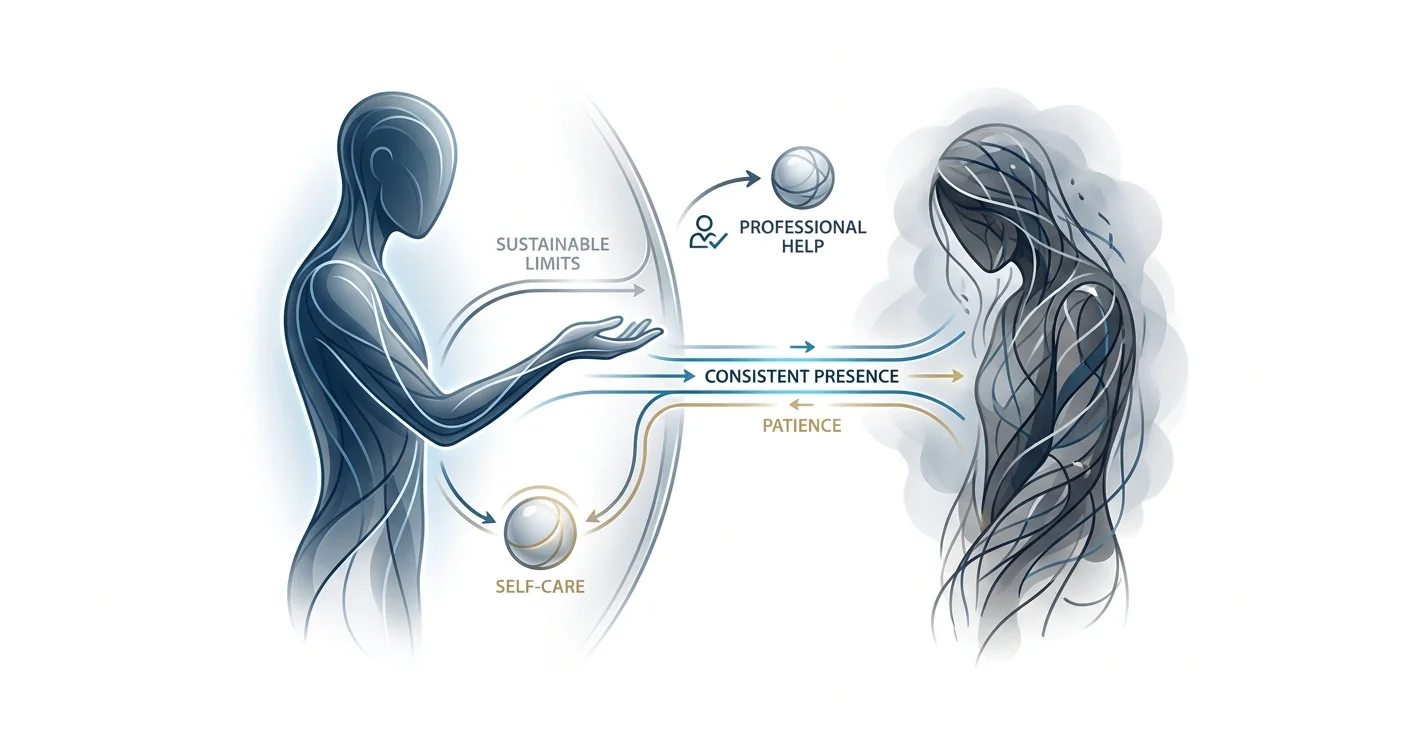
- Patience: recovery from depression is not linear; expect setbacks
- Basic knowledge of what depression actually looks like day to day
- A communication approach grounded in listening, not problem-solving
- Clear personal limits that protect your own wellbeing
- Access to professional support — for your partner and ideally for yourself
Supporting a partner with depression is one of the hardest things you can do in a relationship — not because you're doing it wrong, but because depression resists easy fixes. This guide gives you concrete, psychologist-informed steps to show up well without losing yourself in the process.
TL;DR: Learning how to support a partner with depression in 2026 means showing up consistently, setting sustainable limits, and knowing when professional help is the right next move. The biggest mistakes are trying to "fix" their mood, going silent out of fear of saying the wrong thing, and ignoring your own mental health. Presence and patience beat advice almost every time.
Why this matters
Depression affects roughly 1 in 5 adults in the US at some point in their lives, and its impact spreads directly to partners. Caregiving without structure leads to caregiver burnout — a real clinical pattern where the supporter's own mental health deteriorates. Getting this right protects both of you.
What you'll need
- Patience: recovery from depression is not linear; expect setbacks
- Basic knowledge of what depression actually looks like day to day
- A communication approach grounded in listening, not problem-solving
- Clear personal limits that protect your own wellbeing
- Access to professional support — for your partner and ideally for yourself
- Time: small, consistent actions across weeks and months matter more than grand gestures
The steps
1. Learn what depression actually looks like
Depression is not sadness you can cheer someone out of. It is a clinical condition that affects energy, motivation, sleep, appetite, concentration, and self-worth — often all at once. Your partner may be irritable rather than visibly sad. They may seem distant, sleep 12 hours, or struggle to do basic tasks they used to find easy.
Understanding this changes how you interpret their behavior. What looks like laziness or withdrawal is usually the illness talking. The moment you stop taking their symptoms personally, your responses become steadier and more helpful.
Common mistake: Assuming your partner is choosing to feel this way or could snap out of it if they tried hard enough. This framing causes harm even when it's unspoken.
2. Ask before you offer — and listen more than you speak
Before launching into suggestions, ask one question: "Do you want me to help problem-solve, or do you just need me to listen right now?" This single habit reduces friction significantly.
Active listening means reflecting back what you hear without adding an agenda. "It sounds like today was exhausting" lands differently than "Have you tried going for a walk?" Your partner's brain is already generating plenty of self-critical noise. A calm, non-judgmental presence is more restorative than any advice.
Aim for a 4:1 ratio — four listening responses for every one suggestion you offer.
Common mistake: Jumping to solutions because silence feels unbearable. Silence is often what your partner needs most.
3. Stay consistent with small, low-pressure contact
Depression pulls people into isolation. Your job is not to force connection but to keep the door open. Send a text that needs no reply. Sit in the same room without demanding conversation. Bring them a glass of water.
Consistency over time signals safety. When your partner knows you will still be there on the hard days — without making them feel like a burden — trust builds gradually. One reliable check-in per day beats three intense conversations per week followed by silence.
Expected outcome: Over 4 to 8 weeks of consistent, low-pressure contact, most partners with depression report feeling less alone, which is a clinically meaningful shift in mood regulation.
Common mistake: Pulling back when your partner pushes you away. Withdrawal reads as confirmation of their depression-driven belief that they are a burden.
4. Encourage professional support — without pressure
You are not your partner's therapist. Saying this plainly is not a limitation — it is the most honest and loving thing you can do. Consistent encouragement toward professional help is one of the highest-impact actions available to you in 2026.
Frame it from care, not frustration: "I love you and I want you to have more support than I can give." Offer to help research options, attend an initial appointment, or sit with them while they make a call. Reducing friction on the practical steps matters — depression specifically impairs the executive function needed to initiate tasks.
If cost is a barrier, options vary widely. The how much is therapy without insurance in 2026 guide breaks down realistic price ranges and lower-cost paths.
Common mistake: Issuing ultimatums tied to them getting help. This adds shame to an already shame-heavy experience and typically backfires.
5. Set limits on what you can sustainably give
Caregiving without limits ends in resentment and burnout — two outcomes that hurt your partner more than any temporary discomfort from hearing "I need a break tonight."
Decide in advance: how many evenings per week can you be the primary emotional support? What conversations are you not equipped to handle? What needs to go to a professional? These are not selfish questions. They are the infrastructure that makes long-term support possible.
Communicate your limits calmly and at a neutral moment, not mid-conflict. "I care about you deeply, and I also need one evening a week to recharge" is not rejection — it is sustainability planning.
Expected outcome: Partners who communicate clear, kind limits report lower burnout rates and longer-lasting relationships through depressive episodes.
6. Take care of your own mental health
This step is not a bonus — it is load-bearing. You cannot consistently regulate your emotional responses, stay patient, and show up with warmth if your own mental health is being ignored.
This might mean talking to a friend, seeing your own therapist, or using a tool like Lovon for on-demand emotional support on the days when you need to process what you're carrying without burdening your partner further. Lovon's AI voice support is built for exactly this kind of everyday emotional weight — the stress and grief of loving someone who is struggling.
For additional support between sessions, AI therapy for depression support explains how AI-powered tools can supplement — not replace — the professional care your partner needs.
Common mistake: Treating your own mental health as optional. After 6 to 12 months of unsupported caregiving, secondary depression in partners is common.
7. Know the warning signs that need immediate action
If your partner expresses thoughts of suicide, self-harm, or hopelessness about the future, act immediately. This is not a moment for watchful waiting.
- Contact their therapist or psychiatrist directly
- Call or text 988 (Suicide and Crisis Lifeline, US, available 24/7 in 2026)
- If there is immediate danger, call 911
Depression exists on a spectrum. Most episodes do not escalate to crisis — but you need to know the threshold and act without hesitation when you see it.
Troubleshooting
Your partner refuses all professional help. Keep the conversation open without pressure. Ask what feels like the biggest barrier — cost, stigma, time, fear of judgment. Address the specific barrier, not the general resistance. Offer to try one session together with an AI-based tool to reduce the first-step anxiety.
You're running out of empathy. This is not a moral failure — it is a physiological signal that you are depleted. Step back, rest, and get your own support before re-engaging. You are not obligated to give what you do not have.
Your partner's depression is affecting your relationship's communication. Depression commonly distorts how partners hear each other — perceived criticism where none was intended, withdrawal during conflict. AI couples therapy for communication problems covers structured approaches for couples navigating this together.
You're unsure whether your support is helping. Ask your partner directly during a calm moment: "Is there anything I do that helps, and anything I do that makes it harder?" Their answer will be more accurate than any outside framework.
Your partner's mood fluctuates and you can't read the pattern. Depressive episodes genuinely have unpredictable rhythms. Keep a simple log — note what days were harder and what preceded them. Sleep disruption, social withdrawal, and dietary changes are common early signals. Patterns often emerge across 3 to 4 weeks.
You feel resentful and guilty about feeling resentful. Both feelings are normal. Resentment is your nervous system telling you a limit has been crossed. Guilt is your values reminding you you care. Neither feeling makes you a bad partner. Talking them through with a therapist or an AI support tool helps discharge them before they harden.
Tools and resources
- 988 Suicide and Crisis Lifeline — call or text 988, free, US, 24/7 in 2026
- Lovon AI voice support — on-demand emotional support for both partners; useful when processing caregiver stress at any hour
- AI therapy for depression support — explains what AI tools can realistically offer someone with depression
- AI relationship advice for communication issues — practical help for the communication breakdowns depression causes in relationships
- Coping tools for stress — what works and what does not — relevant for the supporting partner managing their own stress load
What to do next
If your partner is in an active depressive episode right now, start with Step 2 — just listen tonight. Save the conversations about professional help and limits for a calmer moment. For a deeper look at how relationship patterns interact with depression, the pursuer-withdrawer pattern guide explains one of the most common cycles that intensifies when one partner is depressed.
FAQ
What's the best thing to say to a partner with depression? "I'm here, and you don't have to explain anything right now" is one of the most effective phrases you can use. It removes the pressure to perform recovery and signals unconditional presence — which is what depression most directly undermines.
Is it normal to feel frustrated with a depressed partner? Yes, and feeling frustrated does not mean you love them less. Frustration is a natural response to helplessness. What matters is whether you express that frustration at the illness rather than at the person — and whether you get your own support so frustration doesn't accumulate into resentment.
How do I support a partner with depression without losing myself? Set clear limits on your caregiving capacity before you hit empty, maintain at least one activity per week that is entirely yours, and get your own emotional support independently of your partner. Sustainable support requires a functioning supporter.
Should I push my partner to get therapy? Gentle, repeated encouragement — not pressure — is the right approach in 2026. Offer to reduce friction on the practical steps (research, scheduling, cost). Ultimatums typically increase shame and resistance. One exception: if your partner is in crisis, professional intervention is non-negotiable and you act immediately.
Can depression destroy a relationship? Untreated depression over a long period does strain relationships — particularly through communication breakdown, reduced intimacy, and caregiver burnout. But depression that is actively managed, with both partners getting support, does not have to end a relationship. Many couples report that navigating a depressive episode together builds deeper trust.
How long does it take to support a partner through depression? There is no single timeline. A single depressive episode treated with therapy typically lasts 6 to 12 months before significant improvement. Recurrent depression requires ongoing management. Your support structure needs to be built for the long version, not a sprint.
What if my partner refuses help and their depression is affecting me? You are allowed to make decisions about your own wellbeing regardless of what your partner chooses. If their untreated depression is causing harm to your mental health, that is a fact you are allowed to name — to them, to a therapist, and to yourself.
Is AI therapy useful for depression? AI tools like Lovon are not a replacement for licensed clinical care, particularly for moderate to severe depression. They are most useful for on-demand emotional processing, coping practice between sessions, and accessible first-step support when traditional therapy isn't immediately available. The free AI therapist for depression guide covers what to realistically expect.
One last thing
Research consistently shows that the quality of social support — specifically whether a depressed person feels understood rather than managed — is one of the strongest predictors of recovery speed. You do not need to say the perfect thing. You need to show up imperfectly and consistently. In 2026, "I don't know what to say, but I'm not going anywhere" is still one of the most therapeutic sentences in any relationship.
Related guides
How AI Support Helps You Heal
AI emotional support isn't about replacing human connection — it's about filling the gaps. The moments when you need to talk at 2 AM, when you don't want to burden your friends again, or when you simply need someone to listen without judgment.
Here's what happens in a typical Lovon session:
You share what's on your mind
There's no script, no intake form, no waiting room. You speak or type whatever you're feeling — in your own words, at your own pace.
Lovon validates and explores
Using frameworks from CBT (Cognitive Behavioral Therapy) and motivational interviewing, Lovon acknowledges your feelings first, then gently helps you explore them. No dismissive "just move on" advice.
You build coping skills together
Lovon doesn't just listen — it actively works with you on evidence-based techniques: thought reframing, urge surfing, behavioral experiments, and more.
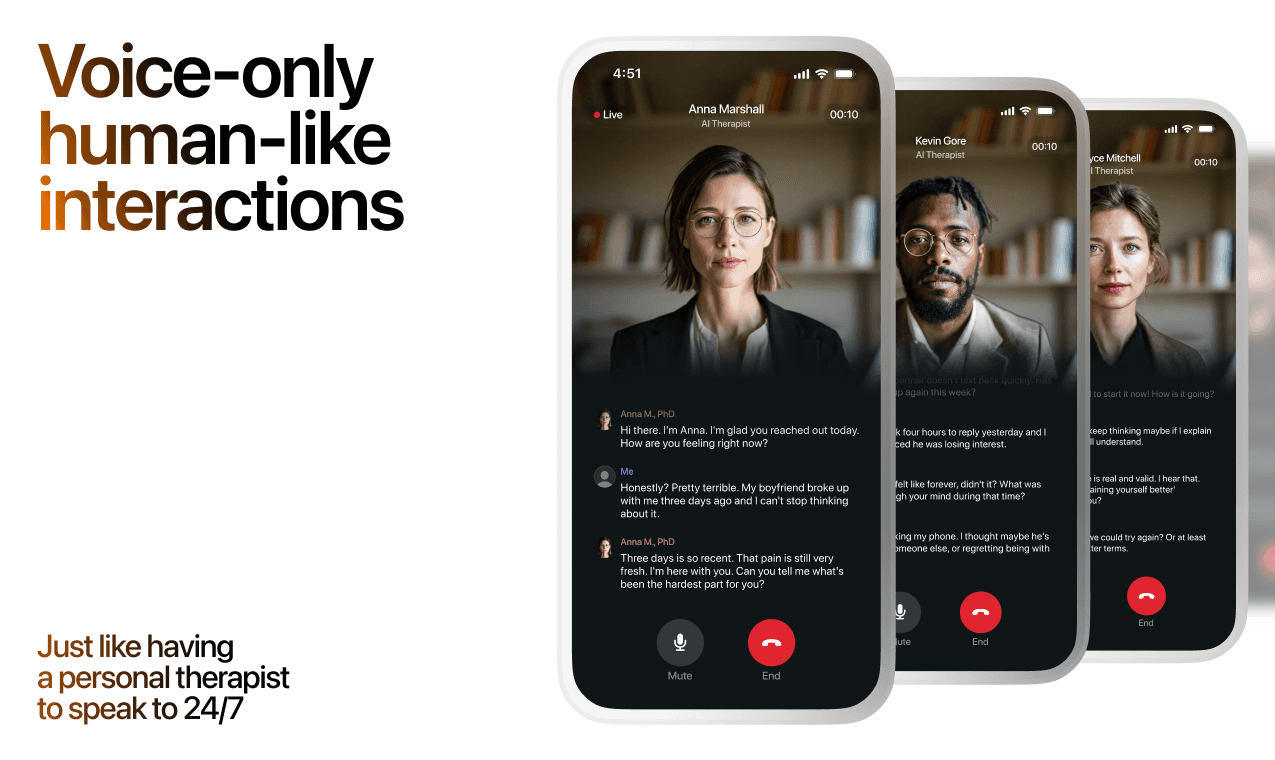
What a Session with Lovon Looks Like
When to Seek Professional Help
AI support is a valuable tool, but it's not a replacement for professional care. Please consider reaching out to a licensed therapist if you experience any of the following:
- Persistent thoughts of self-harm or suicide
- Inability to perform daily activities (work, eating, sleeping) for more than 2 weeks
- Turning to alcohol or substances to cope
- Intense anger or desire to harm your ex-partner
- Complete emotional numbness that doesn't improve over time
Crisis Resources (US): If you're in immediate danger, call 988 (Suicide & Crisis Lifeline) or text HOME to 741741 (Crisis Text Line). Available 24/7, free, and confidential.
Outside the US? Find a crisis line in your country
Ready to Start?
Your healing journey can begin right now
A 7-day trial. No judgment. Just a safe space to process what you're going through.
Frequently Asked Questions
Is Lovon a replacement for a real therapist?
Is my conversation with Lovon AI private?
How is Lovon different from ChatGPT for emotional support?
Can I use Lovon if I'm already seeing a therapist?
Can I try Lovon before subscribing?
About the Author
The Lovon Editorial Team
Mental Health & Wellness Content Team
The Lovon Editorial Team develops mental health and wellness content designed to make psychological concepts accessible and actionable. Our goal is to bridge the gap between clinical research and everyday life - helping you understand why your mind works the way it does and what you can do about it....
Related articles
- Couples Therapy Intake Process: Observation Session Followed by Individual Breakout Sessions
The couples therapy intake process often feels mysterious to those scheduling their first appointment. Many couples…
- How to Regulate Emotions After a Fight (2026 Method)
Regulate emotions after a fight with a 20-minute pause, box breathing, and grounding - the 2026 method that stops repeat…
- AI Relationship Coach for Parents of Teenagers (2026)
Lovon's ai relationship coach for parents of teenagers helps you de-escalate conflict and set boundaries anytime in 2026…
- How to Stop Yelling at Your Partner (2026 Guide)
Learn how to stop yelling at your partner with a step-by-step 2026 method: spot the trigger, call a pause, reset your…
See also
Quizzes
- Emotional Intelligence Test: Your EQ in a Relationship
Find where your EQ slips when things get tense.
- Overfunctioning in Relationship Test: 12 Questions
See how far the load has tilted, in 3 minutes.
Free tools
- Conflict Script Builder
Pick the situation and what you want out of it, and get three lines you can say out loud: an opener, a response for when…
- How to Reconnect With Your Partner
Nothing is wrong enough to name, which is why it has gone unaddressed. Tell it what it looks like now and roughly when…
From the wiki
- How to break up with someone you still love?
Loving someone does not mean the relationship works. If you have circled the same decision for months and the reasons…
Disclaimer: This article is for informational purposes only and does not constitute medical advice, diagnosis, or treatment. Always seek the advice of your physician or other qualified health provider with any questions you may have regarding a medical condition. If you are in crisis or think you may have an emergency, call 988 (Suicide & Crisis Lifeline) or go to the nearest emergency room. Outside the US? Find a crisis line in your country.