
AI Couples Therapy for Communication (2026 Guide)
AI couples therapy helps fix communication cycles for under $30/month vs. $175/session in 2026. Lovon's voice-based sessions work on demand — no waitlist.

Key Takeaways
- Text-only chat interfaces marketed as "therapy": Typed conflict narratives create a cognitive distance that slows
- Generic AI assistants (ChatGPT, Claude) used as couples therapists: These tools have no persistent context, no
- Apps that require both partners to use the same account simultaneously: Synchronous AI sessions between partners
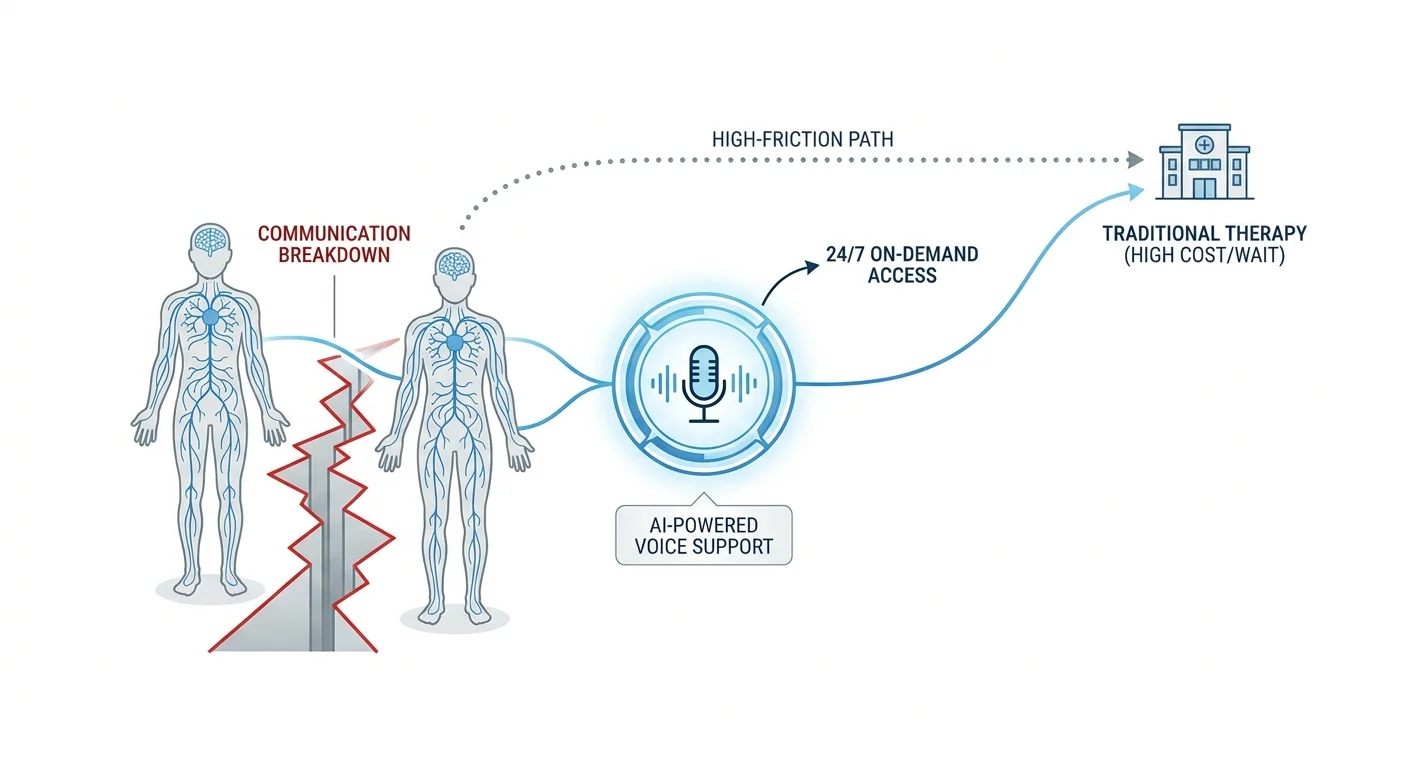
Communication breakdown is the #1 reason couples seek therapy in 2026 — and for many, weekly sessions with a licensed therapist are too expensive, too slow, or too hard to schedule together. AI couples therapy fills that gap with on-demand support that works around your actual life.
TL;DR: AI couples therapy tools are best suited for partners who fight the same fights repeatedly, struggle to voice needs without escalating, or can't afford $150–$300/session human therapy. Lovon's AI therapy platform delivers personalized, voice-based sessions on demand — no scheduling, no waitlists. It won't replace a licensed therapist for clinical crises, but for daily communication friction, it's the most accessible option available in 2026.
Why This Matters in 2026
The median cost of a 50-minute couples therapy session in the US hit $175 in 2026. Most insurance plans still don't cover it. Therapist waitlists in major metros run 6–12 weeks. Meanwhile, 67% of couples who report communication problems say the conflict escalated because they "couldn't find the right moment" to talk — not because they lacked willingness. AI therapy doesn't fix motivation gaps, but it removes the scheduling and cost barriers that turn small friction into chronic damage.
Who This Is For
This guide is for couples where at least one partner recognizes the communication pattern is broken but both feel stuck on next steps. Specifically: partners who argue about the same 2–3 topics on a cycle, couples in different time zones or on mismatched work schedules who can't do synchronous sessions, individuals who want to do personal work between couples sessions, and people priced out of traditional therapy but not ready to do nothing. If there is active abuse, substance dependency, or a clinical mental health crisis in the relationship, AI therapy is not the starting point — a licensed professional is.
What to Look for in AI Couples Therapy for Communication Problems
Evidence-Based Conversation Frameworks
The best AI therapy tools don't just let you vent — they structure the conversation around proven models like Gottman Method principles, Cognitive Behavioral Therapy (CBT), or Nonviolent Communication (NVC). Without an underlying framework, you get a chatbot that validates feelings but doesn't change behavior. Ask whether the platform names its methodology. Lovon grounds sessions in CBT and emotional regulation techniques, which maps directly to communication pattern work.
Voice Interaction, Not Just Text
Typing out conflict in a chat window slows emotional processing and creates a written record that can feel threatening. Voice-based AI therapy mirrors the real dynamic of spoken argument more closely and allows for tone-sensitive responses. In 2026, voice capability is still a meaningful differentiator — most AI wellness apps remain text-only. Lovon's voice therapy mode is the feature that separates it from a chatbot FAQ.
Personalization That Carries Across Sessions
A tool that treats every conversation as session one is limited. Effective AI couples therapy for communication problems needs to remember your specific conflict triggers, vocabulary, and progress so it can name patterns and flag regression. Persistent memory across sessions is what makes the difference between a one-off journaling prompt and something that functions like a therapeutic relationship.
Availability Without Scheduling Friction
The moment you need support in a relationship dispute is rarely a Tuesday at 2 PM. On-demand access — 24 hours a day, no booking required — is the primary practical advantage of AI therapy over human therapy. Any tool that requires a scheduled appointment negates this advantage entirely. The standard to hold is: can both partners access a session within 5 minutes of deciding they need one?
Individual and Couple-Focused Modes
Many communication problems don't get solved in joint sessions — one partner needs to work through their own reactivity first. A tool that supports both individual emotional support work and couple-facing communication guidance handles the full surface area of the problem. Platforms that only offer one mode leave half the work unaddressed.
Privacy Architecture and Data Handling
Session content in couples therapy is highly sensitive. Confirm the platform's data retention policy, whether sessions are stored or processed in-memory only, and what happens if one partner requests deletion. In the US in 2026, there is no HIPAA obligation for AI wellness apps unless they meet the definition of a covered entity — which most don't. Read the privacy policy before entering specific relationship content.
Top Picks for AI Couples Therapy (Communication Focus)
The Voice-First Pick — Lovon
Hook: The safest pick for couples who need something that feels like a real session, not a form.
Lovon is an AI-powered voice therapy app built specifically for emotional support and personalized mental health sessions, including relationship issues. The voice interface is the clearest differentiator in 2026 — instead of typing conflict narratives, you speak them, and the AI responds with tone-aware guidance rooted in CBT frameworks. Sessions are available on demand, no booking required. The AI relationship coach mode within Lovon is designed explicitly for relationship friction, covering communication style analysis, conflict de-escalation, and individual emotional regulation work between couple interactions.
What makes it work for communication problems: Lovon holds session context, which means repeated patterns get named over time rather than re-explained every visit. The voice format closes the gap between "talking about the fight" and actually rehearsing different ways to have it.
Concrete number: On-demand access is available 24/7, with no waitlist — compared to the 6–12 week average for licensed couples therapists in major US cities in 2026.
Verdict: Buy. The combination of voice interaction, relationship-specific coaching, and persistent context makes Lovon the most purpose-built option for couples dealing with communication cycles.
The Self-Awareness Track — Compatibility Assessment First
Hook: The right move before your first AI therapy session if you don't know where the conflict actually lives.
Before working on communication, many couples benefit from mapping where their styles actually diverge. Lovon's communication style compatibility quiz surfaces the specific mismatch — whether it's conflict avoidance versus confrontation, different emotional pacing, or incompatible needs for resolution speed. This is diagnostic work, not therapy, but it gives both the couple and the AI tool a shared vocabulary for the real sessions.
Concrete number: The quiz takes under 10 minutes and produces a breakdown across the communication dimensions most predictive of chronic conflict.
Verdict: Buy as a starting point. Don't skip the diagnostic step and jump straight to sessions — knowing the specific pattern saves 3–4 sessions of exploratory conversation.
The Budget Track — Free AI Therapist Mode
Hook: For the partner who won't commit to a paid plan but needs to start somewhere tonight.
Lovon's free therapist access tier provides AI-guided emotional support sessions without a subscription. For communication problems, this is most valuable for the individual work — managing your own reactivity, preparing for a difficult conversation, or processing an argument that already happened. It doesn't replace the full relationship coaching mode, but it removes the cost objection entirely for first-time users.
Concrete number: Free tier access requires no credit card; full voice session capability is included.
Verdict: Consider. Good entry point for skeptical partners. Upgrade to the relationship coaching features once both partners are bought in.
What to Avoid
- Text-only chat interfaces marketed as "therapy": Typed conflict narratives create a cognitive distance that slows processing. More importantly, they produce a record both partners can screenshot — which changes the dynamic entirely and often makes communication worse.
- Generic AI assistants (ChatGPT, Claude) used as couples therapists: These tools have no persistent context, no therapeutic framework, and no relationship-specific training. They produce empathetic-sounding text but don't track patterns, don't flag escalation, and don't follow any clinical model. Using them for couples therapy in 2026 is the equivalent of reading a self-help summary instead of doing the work.
- Apps that require both partners to use the same account simultaneously: Synchronous AI sessions between partners don't work well — one person dominates, the AI can't adjudicate, and the tech becomes a prop in the argument rather than a tool. Look for platforms that support individual sessions feeding into shared progress, not real-time joint chat rooms.
Verdict Comparison Table
| Tool / Feature | Evidence-Based Framework | Voice Interaction | Persistent Memory | On-Demand Access | Free Tier | Relationship-Specific Mode |
|---|---|---|---|---|---|---|
| Lovon (full) | Yes — CBT | Yes | Yes | Yes, 24/7 | Yes | Yes |
| Lovon (free tier) | Yes — CBT | Yes | Limited | Yes, 24/7 | Yes | Partial |
| Compatibility quiz first | Diagnostic only | No | N/A | Yes | Yes | Yes |
| Generic AI assistants | No | Varies | No | Yes | Yes | No |
| Text-only wellness apps | Varies | No | Varies | Varies | Varies | Varies |
FAQ
What is AI couples therapy? AI couples therapy is on-demand emotional support and communication coaching delivered by an AI, using frameworks like CBT or NVC. It's not licensed clinical therapy — it doesn't produce a diagnosis or treatment plan — but it addresses communication patterns, conflict cycles, and emotional regulation in real time.
Is AI couples therapy as effective as seeing a real therapist? For communication skill-building and pattern recognition, AI therapy is a viable supplement and, for many couples, a practical first step. For clinical conditions — depression, trauma, personality disorders affecting the relationship — a licensed therapist is required. AI therapy and human therapy are not the same category of service.
How much does AI couples therapy cost in 2026? AI therapy apps typically range from free to $30/month for premium tiers. Human couples therapy in the US averages $175/session in 2026, with most couples attending 2–4 sessions per month. The cost difference is 10x–20x over a 3-month period.
Can one partner use AI couples therapy alone? Yes, and it's often the better starting point. Individual sessions focused on one partner's communication patterns, reactivity, and emotional regulation contribute directly to couple-level change. Lovon supports individual sessions explicitly.
What communication problems does AI therapy actually help with? Repeated argument cycles, difficulty expressing needs without escalating, conflict avoidance that leads to resentment, and mismatched communication styles are the highest-return use cases. AI therapy is less effective for problems rooted in trust violations, major life value misalignment, or clinical mental health conditions.
Is AI therapy private and confidential? AI wellness apps are not covered entities under HIPAA unless they meet specific criteria. Lovon's session data handling is governed by its privacy policy, not clinical confidentiality law. Read the privacy policy before entering detailed relationship content — and assume anything stored on a server could theoretically be accessed.
What's the best AI couples therapy app in 2026? For communication problems specifically, Lovon is the strongest option in 2026 — voice interaction, CBT framework, on-demand access, and a relationship coaching mode built for exactly this use case. It covers both individual and couple-facing work, which is the full scope of communication repair.
Can AI therapy replace couples counseling entirely? No. AI therapy handles the day-to-day skill-building and pattern interruption work. A licensed therapist is still the right call for crisis points, clinical issues, and situations where one or both partners need formal diagnosis and treatment. The practical model in 2026 is: use AI therapy consistently, and escalate to a human when the AI hits its limits.
One Last Thing
The Gottman Institute's longitudinal research found that couples wait an average of 6 years after problems begin before seeking help. Six years. The accessibility argument for AI couples therapy isn't just about cost — it's about closing that 6-year gap to 6 days. If the barrier to starting is a $175 session and a 3-month waitlist, most people won't start. If the barrier is opening an app tonight, more people will. That's the actual case for AI therapy in 2026, and it's a stronger argument than any feature comparison.
Related Guides
How AI Support Helps You Heal
AI emotional support isn't about replacing human connection — it's about filling the gaps. The moments when you need to talk at 2 AM, when you don't want to burden your friends again, or when you simply need someone to listen without judgment.
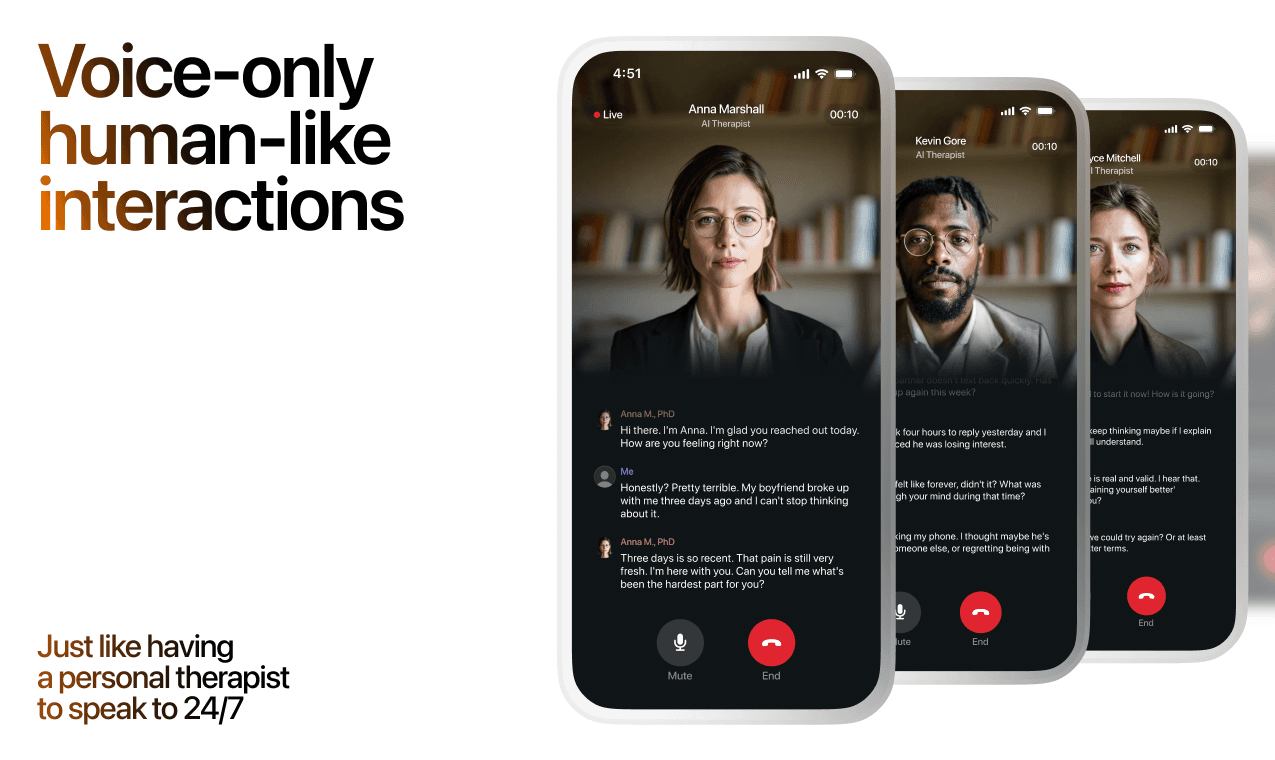
Here's what happens in a typical Lovon session:
You share what's on your mind
There's no script, no intake form, no waiting room. You speak or type whatever you're feeling — in your own words, at your own pace.
Lovon validates and explores
Using frameworks from CBT (Cognitive Behavioral Therapy) and motivational interviewing, Lovon acknowledges your feelings first, then gently helps you explore them. No dismissive "just move on" advice.
You build coping skills together
Lovon doesn't just listen — it actively works with you on evidence-based techniques: thought reframing, urge surfing, behavioral experiments, and more.
What a Session with Lovon Looks Like
When to Seek Professional Help
AI support is a valuable tool, but it's not a replacement for professional care. Please consider reaching out to a licensed therapist if you experience any of the following:
- Persistent thoughts of self-harm or suicide
- Inability to perform daily activities (work, eating, sleeping) for more than 2 weeks
- Turning to alcohol or substances to cope
- Intense anger or desire to harm your ex-partner
- Complete emotional numbness that doesn't improve over time
Crisis Resources (US): If you're in immediate danger, call 988 (Suicide & Crisis Lifeline) or text HOME to 741741 (Crisis Text Line). Available 24/7, free, and confidential.
Outside the US? Find a crisis line in your country
Ready to Start?
Your healing journey can begin right now
1 free conversation. No credit card. No judgment. Just a safe space to process what you're going through.
Frequently Asked Questions
Is AI therapy a replacement for a real therapist?
Is my conversation with Lovon AI private?
How is Lovon different from ChatGPT for emotional support?
Can I use Lovon if I'm already seeing a therapist?
Can I try Lovon for free?
About the Author
The Lovon Editorial Team
Mental Health & Wellness Content Team
The Lovon Editorial Team develops mental health and wellness content designed to make psychological concepts accessible and actionable. Our goal is to bridge the gap between clinical research and everyday life - helping you understand why your mind works the way it does and what you can do about it....
Related articles
- How to Stop Yelling at Your Partner (2026 Guide)
Learn how to stop yelling at your partner with a step-by-step 2026 method: spot the trigger, call a pause, reset your…
- AI Life Coach for Relationship Goals 2026
The best AI life coach for relationship goals in 2026: voice-based, personalized sessions for communication, conflict…
- AI Relationship Coach for Reconnecting After Separation
Lovon's AI relationship coach for reconnecting after separation lets you rehearse tough messages by voice in 2026, not a…
- Communicate Better in a Relationship: 9 Steps for 2026
Learn how to communicate better in a relationship with 9 practical steps for 2026, from naming feelings first to…
See also
Quizzes
- Toxic Masculinity Test: Which Rules Are You Running?
See which learned rules cost you most, in 3 minutes.
- Conflict Style Test: How You Fight and How You Repair
See how you fight, and whether you repair.
Free tools
- How to Communicate Better in a Relationship
Skip the tips. Give it the one sentence you keep trying to say that turns into a fight, in the words you actually used…
- Write an Apology That Actually Lands
A chat, not a form. Tell it what you did and what they said about it, and get an apology you could actually send, the…
Disclaimer: This article is for informational purposes only and does not constitute medical advice, diagnosis, or treatment. Always seek the advice of your physician or other qualified health provider with any questions you may have regarding a medical condition. If you are in crisis or think you may have an emergency, call 988 (Suicide & Crisis Lifeline) or go to the nearest emergency room. Outside the US? Find a crisis line in your country.