
Why Do I Attract Emotionally Unavailable People (2026)
Why do you attract emotionally unavailable people? The pattern traces to attachment style, not bad luck. Get the 2026 fix, step by step, inside.

Key Takeaways
- 15-20 minutes of uninterrupted time to look back honestly, not defensively
- A list of your last 3-4 romantic relationships, however short
- A notes app or journal for the pattern-mapping step below
- Willingness to sit with an uncomfortable answer instead of explaining it away
You keep ending up with people who can't or won't show up emotionally, and you want to know why the pattern repeats. This guide breaks down the psychology behind it and gives you a concrete way to interrupt the cycle in 2026.
TL;DR
Attracting emotionally unavailable people usually traces back to attachment style, not bad luck: anxious and avoidant patterns are drawn to each other because the anxiety of one partner and the distance of the other feel familiar, not because either person is broken. Verdict: this is a learnable pattern, not a personality flaw — an attachment style quiz plus a structured screening habit changes the outcome for most people within a few dating cycles. If you want a faster way to process the pattern as it happens, an AI voice companion like Lovon gives you somewhere to talk it through the same night a red flag shows up, not three weeks later at your next appointment.
Why this matters
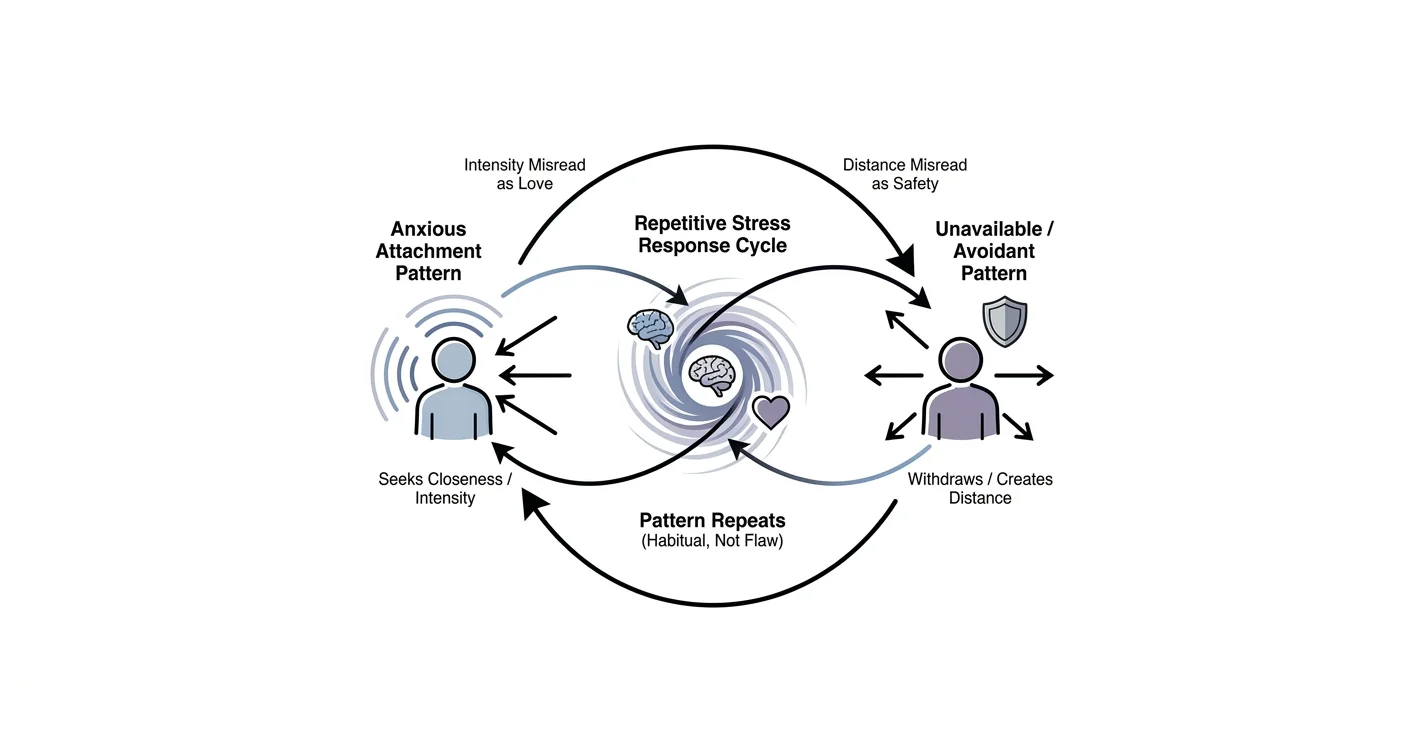
The pull toward unavailable partners isn't random. Foundational attachment research (Hazan & Shaver, 1987) found that roughly 56% of adults identify as securely attached, 25% as avoidant, and 19% as anxious — and those last two groups tend to seek each other out. Anxious attachment reads intensity as love. Avoidant attachment reads distance as safety. Put those two people in a room and the chemistry feels electric, because it's actually just two nervous systems doing what they learned to do young.
The problem is that this feeling gets mislabeled as "chemistry" or "the real thing" when it's really a stress response. Breaking it starts with naming the pattern, not fighting your feelings about the next person you meet.
What you'll need
- 15-20 minutes of uninterrupted time to look back honestly, not defensively
- A list of your last 3-4 romantic relationships, however short
- An attachment style quiz result, or a rough guess if you haven't taken one
- A notes app or journal for the pattern-mapping step below
- Willingness to sit with an uncomfortable answer instead of explaining it away
The steps
1. Map your last three relationships side by side
Write down how each one started, how available the person seemed in month one versus month three, and how it ended. Most people doing this exercise in 2026 notice the same shape repeating: hot start, slow fade, confusing ending. Naming the shape out loud takes it out of the realm of "bad luck" and puts it in the realm of pattern.
Common mistake: stopping at "he was just a narcissist" or "she was just commitment-phobic." That's a label, not an analysis. Look at what you did in month one that made the unavailability easy to miss.
2. Identify your attachment style honestly
If you tend to over-text, over-apologize, or feel panicked by silence, you're likely leaning anxious. If you feel suffocated by closeness and relieved when a partner backs off, you're likely leaning avoidant yourself, which changes the read on why you're choosing unavailable people in the first place. Attachment style isn't fixed for life, but it doesn't shift until you can name it.
This step matters because anxious-avoidant pairings are the most common unhappy combination in dating research, and knowing which side you're on tells you what to fix first.
3. Separate intensity from safety
Unavailable partners often create intensity fast: heavy attention early, pulling back later, a cycle that keeps your nervous system on alert. That alert feeling gets misread as "this must be important." Safety, by contrast, feels calmer and slower — which can register as boring if you've spent years mistaking adrenaline for attraction.
Expected outcome: after mapping two or three past relationships this way, most people can point to the exact week the intensity spiked and the exact week the withdrawal started. That gap is the tell.
4. Watch for love bombing in the first six weeks
Fast declarations, constant contact, and grand gestures within the first few weeks are a documented early warning sign, not a compliment. If you want the specific behaviors to watch for, love bombing red flags lays out the timeline pattern that separates real interest from a manufactured high.
Common mistake: treating the intensity of the opening month as proof of long-term compatibility. Intensity and availability are two different variables.
5. Build a screening habit for the first 90 days
Instead of asking "how do I feel about this person," ask three concrete questions by week four: Do they follow through on plans without prompting? Do they bring up the future in any form? Do they stay present during a disagreement instead of going quiet for days? Answering "no" to two of three by day 90 of 2026's dating pool is a strong signal, not a coincidence.
Expected outcome: you catch unavailability at week six instead of month six, before the attachment has deepened.
6. Practice tolerating a calmer connection
If a secure partner feels flat or under-stimulating at first, that's often withdrawal from the intensity your nervous system is used to, not a sign of low compatibility. Give a calmer connection at least six to eight weeks before deciding it's "missing something."
Common mistake: ending a promising, steady connection in week two because it doesn't produce the same adrenaline spike an unavailable partner did.
Troubleshooting
"I know the pattern intellectually but I keep picking the same type." Knowing the pattern and interrupting it in real time are different skills. Talking through the moment you feel the pull — not just the aftermath — is what actually rewires the response.
"Every available person feels boring to me." That's a calibration problem, not a compatibility problem. Give it eight weeks minimum before trusting that read.
"I keep staying long after the red flags show up." This usually means the fear of being alone outweighs the discomfort of staying. Address the fear directly instead of managing the relationship around it.
"I mistake chaos for chemistry." Chaos produces a stronger physiological reaction than calm does, especially for anxious attachment. That reaction is not a reliable measure of a good match.
"I don't know if I'm anxious, avoidant, or both." Mixed presentations are common. A short structured quiz gives you a clearer starting point than guessing from memory.
"I fall for it again within weeks of the last one ending." Rebound timing skips the reflection step entirely. Build in a minimum gap before dating again, even if it's uncomfortable.
Tools and resources
- Attachment style quiz — a two-minute starting point for identifying your pattern
- Anxious attachment signs and coping strategies — for the over-texting, panic-at-silence side of the pattern
- Love bombing red flags — for spotting manufactured intensity in the first weeks
- Lovon's AI voice companion — for talking through the moment a red flag appears instead of journaling about it alone at 1am
Lovon isn't a replacement for licensed clinical care, but as an AI voice companion built with input from PhD psychologists, it gives you a place to say "I think I'm doing it again" out loud the same day it happens, which is usually the hardest part to get right on your own.
What to do next
Once you've mapped the pattern and named your attachment style, the next useful step is understanding the other side of the equation — the partners themselves. Avoidant attachment patterns and how to change them breaks down what's actually happening on the withdrawing side, which makes it easier to spot early instead of six months in.
FAQ
Why do I keep attracting emotionally unavailable people? It's usually an attachment pattern, not bad luck — anxious attachment reads intensity as love, and unavailable partners tend to create intensity fast, then withdraw. Mapping your last three relationships side by side is the fastest way to confirm whether this is your pattern.
Is this the same as being a narcissist magnet? Not exactly. Some unavailable partners show narcissistic traits, but plenty are simply avoidant, which is a different (and more common) presentation. The behaviors overlap enough that they're easy to confuse.
Can anxious attachment be changed? Yes — attachment style is shaped early but isn't fixed, and consistent awareness plus practice with calmer relationships shifts it over time, though it rarely changes overnight.
How long does it take to break the pattern? Most people notice a real shift after consciously screening three to five new connections using the 90-day questions above, though timelines vary.
Should I avoid dating until I fix this? No. The fix happens through practicing the screening habit in real dating situations, not by waiting on the sidelines indefinitely.
What's the difference between chemistry and trauma bonding? Chemistry with a secure partner tends to feel calm and grows steadily. Trauma bonding produces a sharper high followed by anxiety during any silence or distance — that swing is the tell.
Does therapy help with this specific pattern? Yes, attachment-focused work is one of the most researched areas in relationship therapy, and talking through the pattern as it happens — rather than only after a breakup — tends to speed up the shift.
Can an AI app help with this, or do I need a human therapist? An AI voice companion like Lovon is useful for processing the pattern in the moment and between sessions, but it's not a replacement for licensed clinical care if the pattern connects to deeper trauma.
One last thing
The detail most people miss: the moment you feel the strongest pull toward someone in the first three weeks is usually the exact moment to slow down, not lean in. That instinct to speed up when it feels intense is the pattern talking, not your judgment.
Related guides
How AI Support Helps You Heal
AI emotional support isn't about replacing human connection — it's about filling the gaps. The moments when you need to talk at 2 AM, when you don't want to burden your friends again, or when you simply need someone to listen without judgment.
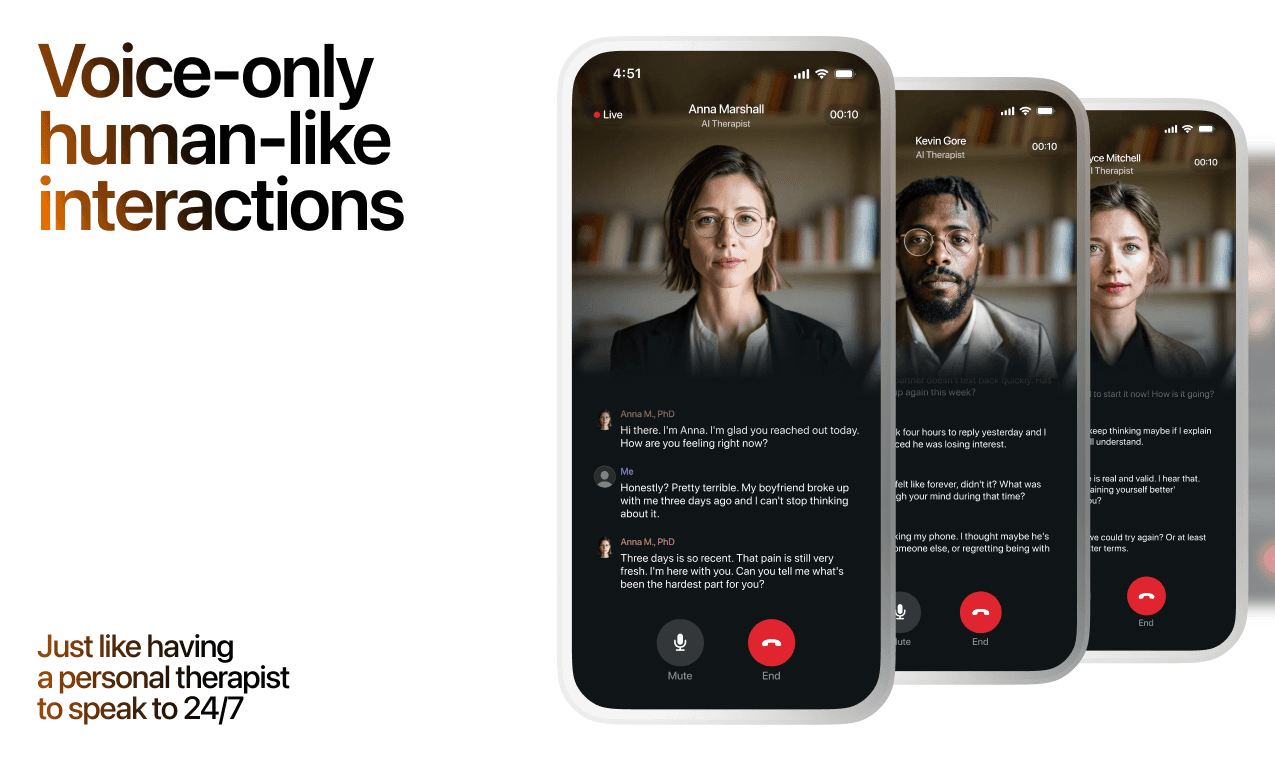
Here's what happens in a typical Lovon session:
You share what's on your mind
There's no script, no intake form, no waiting room. You speak or type whatever you're feeling — in your own words, at your own pace.
Lovon validates and explores
Using frameworks from CBT (Cognitive Behavioral Therapy) and motivational interviewing, Lovon acknowledges your feelings first, then gently helps you explore them. No dismissive "just move on" advice.
You build coping skills together
Lovon doesn't just listen — it actively works with you on evidence-based techniques: thought reframing, urge surfing, behavioral experiments, and more.
What a Session with Lovon Looks Like
When to Seek Professional Help
AI support is a valuable tool, but it's not a replacement for professional care. Please consider reaching out to a licensed therapist if you experience any of the following:
- Persistent thoughts of self-harm or suicide
- Inability to perform daily activities (work, eating, sleeping) for more than 2 weeks
- Turning to alcohol or substances to cope
- Intense anger or desire to harm your ex-partner
- Complete emotional numbness that doesn't improve over time
Crisis Resources (US): If you're in immediate danger, call 988 (Suicide & Crisis Lifeline) or text HOME to 741741 (Crisis Text Line). Available 24/7, free, and confidential.
Outside the US? Find a crisis line in your country
Ready to Start?
Your healing journey can begin right now
A 7-day trial. No judgment. Just a safe space to process what you're going through.
Frequently Asked Questions
Is Lovon a replacement for a real therapist?
Is my conversation with Lovon AI private?
How is Lovon different from ChatGPT for emotional support?
Can I use Lovon if I'm already seeing a therapist?
Can I try Lovon before subscribing?
About the Author
The Lovon Editorial Team
Mental Health & Wellness Content Team
The Lovon Editorial Team develops mental health and wellness content designed to make psychological concepts accessible and actionable. Our goal is to bridge the gap between clinical research and everyday life - helping you understand why your mind works the way it does and what you can do about it....
Related articles
- How to Develop Secure Attachment in 2026: 7 Steps
How to develop secure attachment in 2026: 7 practical steps, a real timeline (8-12 weeks), and fixes for anxious and…
- Anxious Attachment in Dating: Patterns to Watch (2026)
Anxious attachment in dating: spot the protest behaviors, triggers, and fixes that work in 2026. A step-by-step guide…
- Emotionally Unavailable Partner: Signs & Fixes (2026)
Spot an emotionally unavailable partner fast: signs, a 7-step fix, and when to walk away. Practical 2026 guide with real…
- Anxious Attachment Triggers: How to Defuse Them (2026)
Anxious attachment triggers explained: a 6-step sequence to name, regulate, and defuse them in 2026, plus…
See also
Quizzes
- Emotionally Unavailable Test: 12-Question Self-Check
See which part of you closes off, in three minutes.
- Am I Ready for a Relationship? 12-Question Check
Check what you are actually ready for, in 2 minutes.
Free tools
- AI Dating Coach
This is a free AI dating coach you can use right on this page. Say what is happening and how far along you are, and it…
- Attachment Trigger Plan for Anxious and Avoidant Patterns
Pick your pattern, tick the moments that set it off, and finish one card for each: your body signal, the thing you will…
From the wiki
- Is he in love with me?
There is no reliable tell in how fast he texts or how intense things feel. What tracks with love is consistency…
Disclaimer: This article is for informational purposes only and does not constitute medical advice, diagnosis, or treatment. Always seek the advice of your physician or other qualified health provider with any questions you may have regarding a medical condition. If you are in crisis or think you may have an emergency, call 988 (Suicide & Crisis Lifeline) or go to the nearest emergency room. Outside the US? Find a crisis line in your country.