
How to Talk to an AI Therapist for the First Time (2026)
How to talk to an AI therapist: step-by-step guide for your first session in 2026, plus what to say, what to avoid, and troubleshooting tips.

Key Takeaways
- A phone or device with the app installed and a stable connection
- 10-15 minutes where you won't be interrupted
- Headphones, if you're not somewhere fully private
- One honest sentence about how you're feeling — that's the only "material" required
- Realistic expectations: this is support and coping tools, not a diagnosis or a prescription
Starting a conversation with an AI therapist feels strange the first time — you're talking out loud to something that isn't human, and you don't know what to say. This guide walks you through exactly what to do, step by step, so the first session feels less like a tech demo and more like an actual place to unload.
TL;DR
How to talk to an AI therapist: pick a quiet, private spot, open the app, and start with one plain sentence about how you're feeling right now — not a backstory, not a diagnosis, just the feeling. Apps like Lovon use voice conversation instead of typing, which tends to get people talking faster because it mimics an actual conversation instead of a text thread. Verdict: worth trying if you want same-day emotional support between therapy sessions or when you can't access a licensed therapist — it is not a replacement for clinical care, but as a first step in 2026 it lowers the barrier to actually saying the thing out loud.
Why this matters
Most people stall before they ever say a word. They open the app, stare at the screen, and close it — not because the tool doesn't work, but because they don't know how to start.
That hesitation is normal. Talking about stress, anxiety, or a rough day to anything — human or AI — requires a small amount of courage the first time. The difference with an AI voice therapist is there's no appointment to book and no waiting room. You can talk about a bad morning at 7am before work or a spiraling thought at 1am, and the best mental health app for anxiety in 2026 category exists specifically to fill that gap. Getting the first session right matters because it sets whether you come back tomorrow.
What you'll need
- A phone or device with the app installed and a stable connection
- 10-15 minutes where you won't be interrupted
- Headphones, if you're not somewhere fully private
- One honest sentence about how you're feeling — that's the only "material" required
- Realistic expectations: this is support and coping tools, not a diagnosis or a prescription
The steps
1. Pick a private, low-distraction space
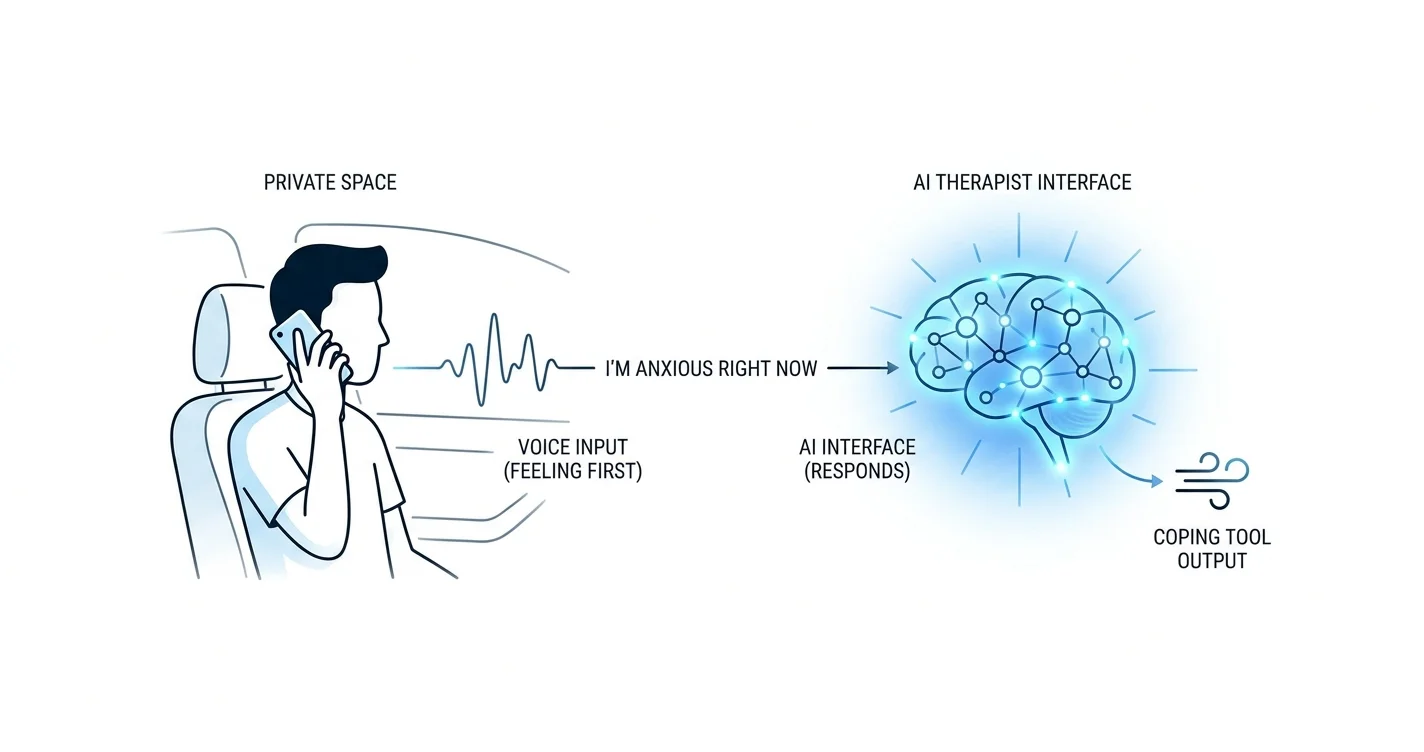
You'll open up more when you're not worried about being overheard. A parked car, a closed bedroom door, or a walk with headphones all work. Sessions that start in a rushed or public setting tend to stay surface-level — the person talks about the weather instead of what's actually wrong. Expected outcome: within the first minute, your shoulders should drop slightly just from being somewhere safe to talk. Common mistake: trying to squeeze a first session into a 3-minute bathroom break at work.
2. Say the feeling first, not the story
Skip the backstory. Instead of explaining the last five years of your relationship, start with "I'm anxious and I don't know why" or "I had a panic attack this morning." This gives the conversation somewhere to go immediately instead of stalling on context. An AI voice companion like Lovon is built to ask follow-up questions once it has a starting point — you don't need to hand it a full case file. Expected outcome: the AI responds with a clarifying question within seconds. Common mistake: over-explaining before saying how you actually feel.
3. Talk out loud, at normal speed
Voice-based sessions work because they mimic how people actually process emotion — through speech, not typing. Talk the way you'd talk to a friend: pauses, half-sentences, and all. AI voice therapy differs from text-based apps specifically because tone and hesitation carry information a chat box can't capture. Expected outcome: the conversation starts to feel less scripted after 2-3 exchanges. Common mistake: writing a mental script beforehand — it makes the session sound rehearsed instead of real.
4. Let it ask, don't just report
A good first session isn't a monologue. When the AI asks "what does that feel like in your body" or "when did that start," answer in the moment instead of deflecting. This is where coping tools and self-reflection prompts usually surface. Expected outcome: by minute 5-7, you should notice at least one question that makes you pause and actually think. Common mistake: answering every question with "I don't know" as a reflex instead of sitting with it for a second.
5. Name one thing you want out of the session
Before you wrap up, say what you're hoping for — calm, clarity, a coping tool, or just to be heard. Naming it out loud shapes how the rest of the conversation goes and gives you something concrete to check against afterward. Expected outcome: the session should end with at least one usable takeaway, not just a summary of what you said. Common mistake: ending the session mid-thought because you ran out of time, instead of budgeting the full 10-15 minutes.
6. Use the coping tool it suggests, same day
If the session ends with a breathing exercise, grounding technique, or reframe, try it within a few hours — not next week. Tools lose most of their value if they sit unused. Expected outcome: you notice a small, measurable shift — calmer heart rate, less racing thoughts — within 10 minutes of using the tool. Common mistake: treating the suggestion as a nice idea instead of an actual action.
7. Come back before the next crisis, not just during one
The biggest shift in how people use AI therapy for anxiety in 2026 is treating it as daily maintenance instead of an emergency button. A 5-minute check-in on an ordinary Tuesday builds more consistency than only showing up during a spiral. Expected outcome: sessions get shorter and more specific over time because the AI has context from prior conversations. Common mistake: only opening the app when things are already at a breaking point.
Troubleshooting
- I don't know what to say and freeze up. Say exactly that — "I don't know where to start" is a valid opening line, and the AI will prompt you from there.
- It feels robotic or repetitive. Give it more specific detail instead of one-word answers; the responses get sharper the more context you give.
- I feel silly talking out loud to an app. That fades by session two or three for most people — the awkwardness is front-loaded, not permanent.
- I'm in crisis, not just stressed. An AI therapist is not built for emergencies — contact a crisis line or licensed provider immediately instead.
- I want a human therapist eventually but can't afford it right now. Check how much therapy costs without insurance in 2026 to plan the transition, and use the AI as a bridge in the meantime.
- I keep comparing it to a real therapist and feeling let down. It's a different tool for a different moment — same-day support, not clinical treatment — so measure it against that, not against years of licensed care.
Tools and resources
- The Lovon app itself, for the actual voice sessions
- Free AI therapy vs. paid therapy: what to expect — useful before you decide how much to rely on either
- A quiet space and headphones, more important than any feature inside the app
- A note in your phone with the one thing you want to say before you open the session — reduces freeze-up
What to do next
Once the first session feels natural, the real value shows up in repetition, not in one perfect conversation. Read how to start AI therapy for the first time for a broader walkthrough of setting up a routine around it, especially if anxiety or stress is a daily pattern rather than a one-off event.
FAQ
What's the best way to start a conversation with an AI therapist? Say how you feel in one plain sentence before anything else — "I'm stressed and can't sleep" works better than a long backstory. The AI builds the conversation from that single point.
Is talking to an AI therapist actually helpful? For everyday stress, anxiety, and low mood, it gives structured coping tools and a place to think out loud, which many people find genuinely calming. It is not a substitute for licensed clinical treatment of serious conditions.
How much does it cost to use an AI therapist app? Costs vary by app and plan — check current pricing directly on the app before assuming a free tier covers everything you need.
Is AI therapy better than text-based therapy apps? Voice-based AI therapy tends to capture tone and hesitation that typed chat misses, which can make sessions feel closer to a real conversation. Text apps still work well for people who process better in writing.
How long should a first AI therapy session last? Budget 10-15 minutes for the first one — enough time to get past the awkward opening and reach an actual useful exchange.
Can an AI therapist diagnose a mental health condition? No. Apps like Lovon are built for emotional support and coping tools, not diagnosis, and are explicit that they don't replace a licensed clinician.
What if I don't feel comfortable talking out loud? Start in a private space like a parked car or with headphones on a walk — most discomfort comes from environment, not the tool itself, and it usually fades after a session or two.
Should I use an AI therapist every day or only during hard moments? Daily short check-ins tend to work better than only reaching for it during a crisis, since the AI builds context over repeated conversations rather than starting cold each time.
One last thing
The single biggest predictor of whether someone keeps using an AI therapist isn't the technology — it's whether the first session started with an honest sentence instead of a rehearsed one. People who open with "I don't actually know what to say" tend to have better first sessions than people who show up with a prepared speech, because the AI has something real to respond to instead of a performance.
Related guides
How AI Support Helps You Heal
AI emotional support isn't about replacing human connection — it's about filling the gaps. The moments when you need to talk at 2 AM, when you don't want to burden your friends again, or when you simply need someone to listen without judgment.
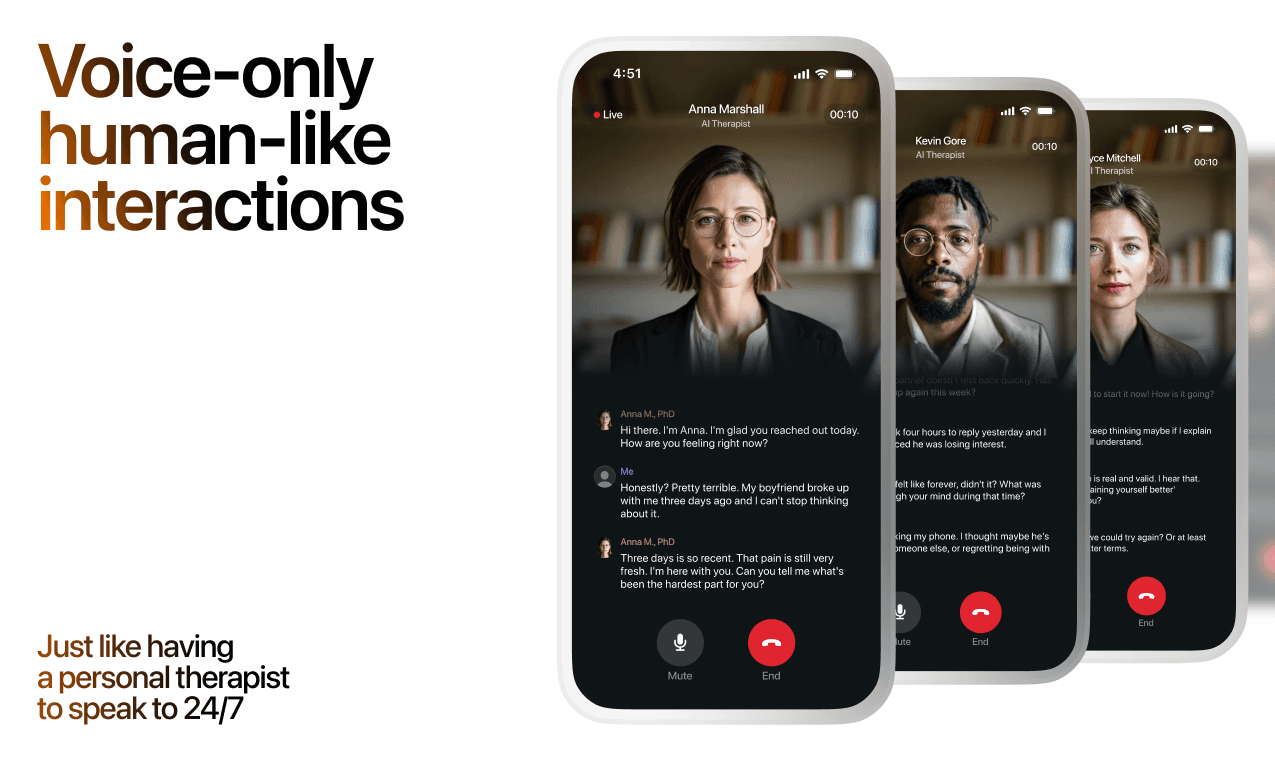
Here's what happens in a typical Lovon session:
You share what's on your mind
There's no script, no intake form, no waiting room. You speak or type whatever you're feeling — in your own words, at your own pace.
Lovon validates and explores
Using frameworks from CBT (Cognitive Behavioral Therapy) and motivational interviewing, Lovon acknowledges your feelings first, then gently helps you explore them. No dismissive "just move on" advice.
You build coping skills together
Lovon doesn't just listen — it actively works with you on evidence-based techniques: thought reframing, urge surfing, behavioral experiments, and more.
What a Session with Lovon Looks Like
When to Seek Professional Help
AI support is a valuable tool, but it's not a replacement for professional care. Please consider reaching out to a licensed therapist if you experience any of the following:
- Persistent thoughts of self-harm or suicide
- Inability to perform daily activities (work, eating, sleeping) for more than 2 weeks
- Turning to alcohol or substances to cope
- Intense anger or desire to harm your ex-partner
- Complete emotional numbness that doesn't improve over time
Crisis Resources (US): If you're in immediate danger, call 988 (Suicide & Crisis Lifeline) or text HOME to 741741 (Crisis Text Line). Available 24/7, free, and confidential.
Outside the US? Find a crisis line in your country
Ready to Start?
Your healing journey can begin right now
A 7-day trial. No judgment. Just a safe space to process what you're going through.
Frequently Asked Questions
Is Lovon a replacement for a real therapist?
Is my conversation with Lovon AI private?
How is Lovon different from ChatGPT for emotional support?
Can I use Lovon if I'm already seeing a therapist?
Can I try Lovon before subscribing?
About the Author

The Lovon Editorial Team
Mental Health & Wellness Content Team
The Lovon Editorial Team develops mental health and wellness content designed to make psychological concepts accessible and actionable. Our goal is to bridge the gap between clinical research and everyday life - helping you understand why your mind works the way it does and what you can do about it....
Related articles
- AI Therapy for Social Anxiety 2026: Verdict + Top Picks
AI therapy for social anxiety in 2026: which voice-based tools help, what to avoid, and when to see a licensed therapist…
- AI Support App for Chronic Loneliness in Men (2026)
The best AI support app for chronic loneliness in men in 2026: voice-first, 24/7, no appointment needed. See the verdict…
- AI Therapist for Work Stress: How to Use It in 2026
Learn how to use an ai therapist for work stress the right way in 2026 - specific triggers, grounding steps, and when…
- AI Life Coach for First-Time Managers: 2026 Verdict
First-time managers face imposter syndrome and burnout with no training. See when Lovon's AI life coach helps in 2026…
See also
Quizzes
- Self Esteem Test: What Is Your Worth Resting On?
See what your sense of worth is resting on.
- Am I a People Pleaser? 12-Question Quiz
Where kindness stops and self-erasure starts.
Free tools
- How to Reconnect With an Old Friend
A chat for how to reconnect with an old friend, starting with the text you have been meaning to send for a year. Tell it…
- Vent to an AI
Need to vent and there is nobody to call, or nobody you want to tell? Type it here. You are talking to an AI listener…
From the wiki
- Why do I feel lonely all of a sudden?
Sudden loneliness usually traces back to something that quietly ended in the last few months: a routine, a shared class…
Disclaimer: This article is for informational purposes only and does not constitute medical advice, diagnosis, or treatment. Always seek the advice of your physician or other qualified health provider with any questions you may have regarding a medical condition. If you are in crisis or think you may have an emergency, call 988 (Suicide & Crisis Lifeline) or go to the nearest emergency room. Outside the US? Find a crisis line in your country.