
Self-Worth vs Self-Esteem: The Real Difference (2026)
Self-worth vs self-esteem explained with a 6-step exercise. Verdict: build self-worth first in 2026 — self-esteem alone is unstable and collapses under failure.

Key Takeaways
- 10-15 minutes a day for two weeks — this is a pattern-recognition exercise, not an overnight fix
- A notebook or notes app to track when your mood swings with outcomes
- Honesty about at least one area where you tie your value to performance (career, looks, relationships)
- "I did the exercises but still feel worthless after one bad day." One good week doesn't undo years of conditional
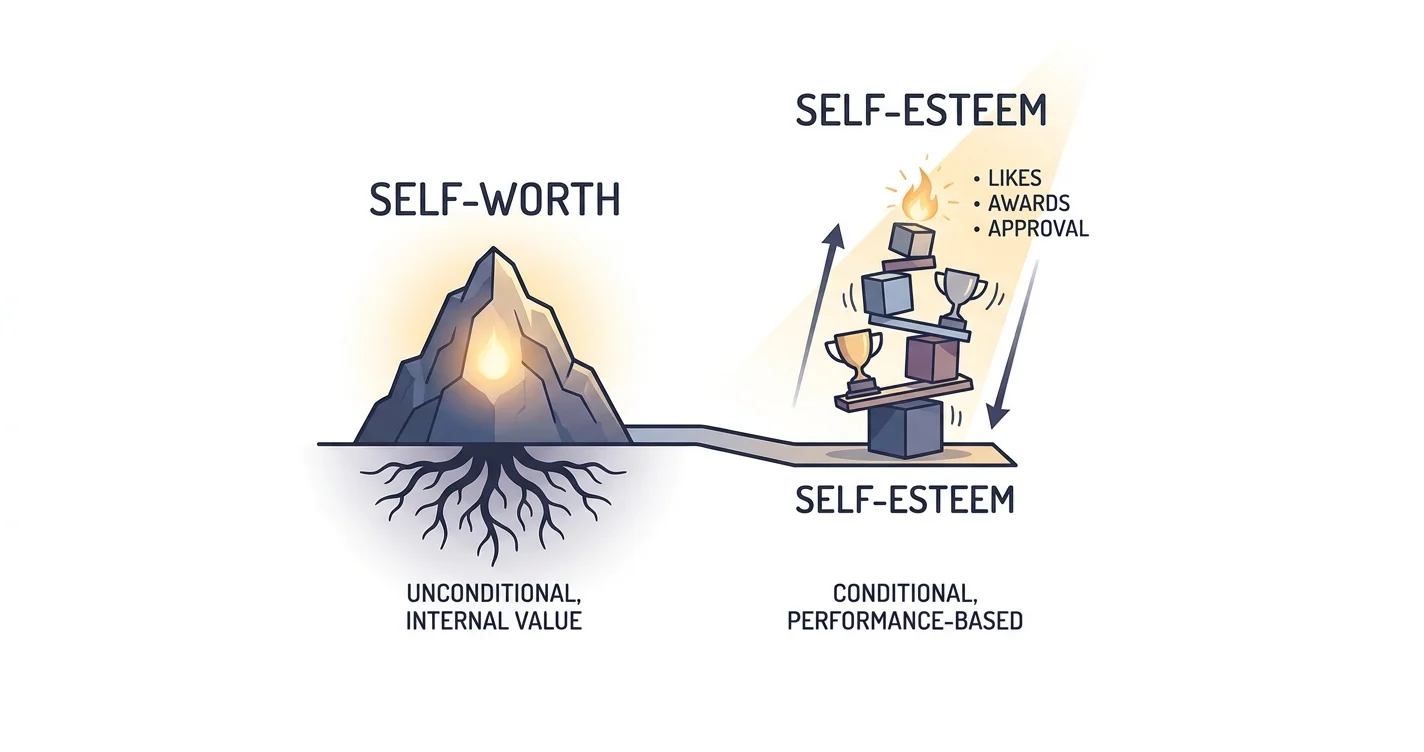
Self-worth is the quiet belief that you matter regardless of what you do. Self-esteem is the score you give yourself based on performance, looks, or approval — and mixing the two up is why so many people feel empty even after hitting every goal on their list.
TL;DR: Self-worth vs self-esteem comes down to source: self-worth is unconditional and internal, self-esteem is conditional and tied to achievement, comparison, or external validation. If your confidence collapses every time you fail a task or get criticized, you're likely running on self-esteem alone. Verdict: build self-worth first — self-esteem without it is fragile. In 2026, therapists increasingly flag this distinction as the root cause behind anxiety and burnout cases that don't respond to typical confidence-building advice.
Why this matters
People chase self-esteem — better job title, better body, more followers — and still feel hollow. That's because self-esteem is a moving target. It rises when you win and drops when you don't, which means it was never stable to begin with.
Self-worth doesn't move. It's the baseline conviction that you're valuable even on your worst day, even unemployed, even mid-breakup. Clinicians in 2026 point to weak self-worth as a driver behind chronic people-pleasing, relationship anxiety, and the kind of burnout that doesn't lift with a vacation. If you've read about cognitive distortions, you've probably seen how "I failed, therefore I am a failure" thinking is a self-esteem trap dressed up as self-worth.
What you'll need
- 10-15 minutes a day for two weeks — this is a pattern-recognition exercise, not an overnight fix
- A notebook or notes app to track when your mood swings with outcomes
- Honesty about at least one area where you tie your value to performance (career, looks, relationships)
- Optional: a structured tool like an AI life coach for confidence and self-esteem if you want prompts instead of building the exercise from scratch
The steps
1. Track when your confidence spikes or crashes
For seven days, jot down every moment your mood about yourself shifts — a compliment, a mistake, a scale number, a like count. This surfaces exactly what your self-worth is currently anchored to.
Most people find 80-90% of their emotional swings trace back to three or four triggers: work performance, appearance, a specific relationship, or money. Common mistake: journaling vague feelings ("I felt bad") instead of the trigger ("I felt bad after my manager didn't reply to my email"). Specificity is the whole point.
2. Separate the event from your identity
Write the trigger, then write two sentences: what happened, and what you told yourself it meant about you. "I got passed over for the promotion" versus "I am not good enough" are two different claims — only the first one is a fact.
This step exposes the self-esteem trap directly: attaching a permanent identity label to a temporary outcome. Do this for every entry from step one. It takes about five minutes per entry and rewires how automatically you jump to self-judgment.
3. Name one thing about you that doesn't depend on output
List three qualities that stay true whether you succeed or fail this week — things like "I show up for people I care about" or "I keep trying even when it's hard." These are self-worth statements, not self-esteem statements, because they don't require a win to be true.
People usually freeze here, because most of us were praised growing up for results, not character. If you're stuck, look at how you treat a friend who's struggling — that's usually a mirror of the compassion you're withholding from yourself.
4. Replace one performance-based habit with a values-based one
Pick one behavior currently driven by proving something (over-checking social metrics, over-scheduling to feel productive) and swap it for a values-based version for one week. Instead of "post until it performs," try "post because it's honest," and stop measuring the aftermath.
Expect discomfort here — withdrawal from validation-seeking feels like anxiety at first because your nervous system has learned to associate approval with safety. That's a nervous system pattern worth understanding on its own; the guide on nervous system dysregulation covers why this discomfort shows up physically, not just emotionally.
5. Practice a daily unconditional check-in
Each morning, say (out loud or written) one sentence that affirms your worth with zero condition attached: "I'm worth care today regardless of what I get done." Not a goal, not a to-do — a statement of fact.
Repetition matters more than intensity here. Two weeks of a 30-second daily check-in outperforms one long journaling session, because self-worth is rebuilt through consistency, not intensity.
6. Set one boundary that self-esteem would never let you set
Self-esteem says yes to everything to stay likable. Self-worth says no when a request conflicts with your capacity or values. Pick one low-stakes situation this week — declining an extra task, ending a draining call on time — and hold the boundary without over-explaining.
If boundaries are new territory, the practical framework in healthy relationship boundaries walks through language you can borrow instead of improvising under pressure.
Troubleshooting
- "I did the exercises but still feel worthless after one bad day." One good week doesn't undo years of conditional self-worth. Expect the shift to take months, not days, and track trend lines instead of daily snapshots.
- "I can list my values but don't believe them." That's normal at first — belief follows repeated action, not the reverse. Keep doing step five even when it feels hollow; the feeling catches up later.
- "Every compliment still feels like it doesn't count." That's a self-esteem symptom, not a self-worth one — you're discounting external validation because you don't trust the internal source yet. Revisit step three until the list feels automatic.
- "I keep comparing my progress to other people's." Comparison is a self-esteem reflex. Redirect it by asking whether the comparison changes your values from step three — it usually doesn't, which proves the comparison was noise.
- "This feels too slow when I'm anxious right now." For acute anxiety in the moment, pair this work with grounding techniques like the ones in box breathing — self-worth work is long-term, breathing techniques handle the immediate spike.
- "My low self-worth is tangled up with a specific relationship." That's common with people-pleasing patterns; the guide on people-pleasing as a trauma response addresses the overlap directly.
Tools and resources
- A daily prompt structure through how to use an AI life coach for motivation if you want accountability without waiting for a weekly session
- Voice-based reflection through Lovon, which lets you talk through a specific trigger the moment it happens instead of journaling hours later
- A written log — paper or digital, doesn't matter, but consistency does
- Reading on attachment patterns, since insecure attachment often shares roots with conditional self-worth — see secure attachment style traits for the contrast
What to do next
Once the six steps feel repeatable, the next layer is understanding where the conditional pattern started — usually childhood praise structures or a specific relationship. That's a deeper root-cause conversation, and it's where talking it through out loud, rather than journaling alone, tends to move faster. An AI voice companion session on Lovon can walk through a specific trigger from your tracking log in real time, which is often more useful than reviewing the notes by yourself days later.
FAQ
What's the actual difference between self-worth and self-esteem? Self-worth is your baseline value as a person, independent of achievement. Self-esteem is a performance-based score that rises and falls with wins, losses, and comparison. You can have high self-esteem and low self-worth at the same time — it's a common pattern in high achievers.
Is self-worth or self-esteem more important? Self-worth is the more stable foundation; self-esteem without it collapses under one bad review or breakup. Verdict: prioritize self-worth work, self-esteem tends to stabilize once it's not carrying the full weight alone.
Can you have high self-esteem and low self-worth? Yes — this is the exact profile of many burned-out high performers in 2026: confident about results, empty about identity. Success masks the gap until a failure exposes it.
How long does it take to build self-worth? Most people notice a measurable shift after 6-8 weeks of consistent practice, based on the pacing typical in therapeutic behavior-change work, though the timeline depends on how long the conditional pattern has been reinforced.
Does therapy help with self-worth issues specifically? Yes — a therapist can trace conditional self-worth back to its source (often early praise patterns or a specific relationship), which speeds up the work considerably compared to self-guided journaling alone.
Is low self-worth the same as depression? No, but they overlap — persistent low self-worth is a documented risk factor, and the piece on depression vs sadness is worth reading if the low-worth feeling has lasted more than two weeks straight.
Can an AI therapy app help with self-worth work? Yes, for the daily tracking and reflection pieces — Lovon's voice sessions work well for the moment-of-trigger check-ins described in step one, though ongoing licensed care matters for deeper or long-standing patterns.
What's a quick way to tell which one is driving my mood right now? Ask: "would I still believe this about myself if the outcome had gone the other way?" If the answer is no, you're in self-esteem territory, not self-worth.
One last thing
The fastest tell between the two isn't a quiz — it's what happens the moment something goes wrong. People with strong self-worth get disappointed by failure; people running purely on self-esteem get destabilized by it. Watch your own reaction next time something small goes sideways, and you'll know exactly which one you've been running on.
Related guides
How AI Support Helps You Heal
AI emotional support isn't about replacing human connection — it's about filling the gaps. The moments when you need to talk at 2 AM, when you don't want to burden your friends again, or when you simply need someone to listen without judgment.
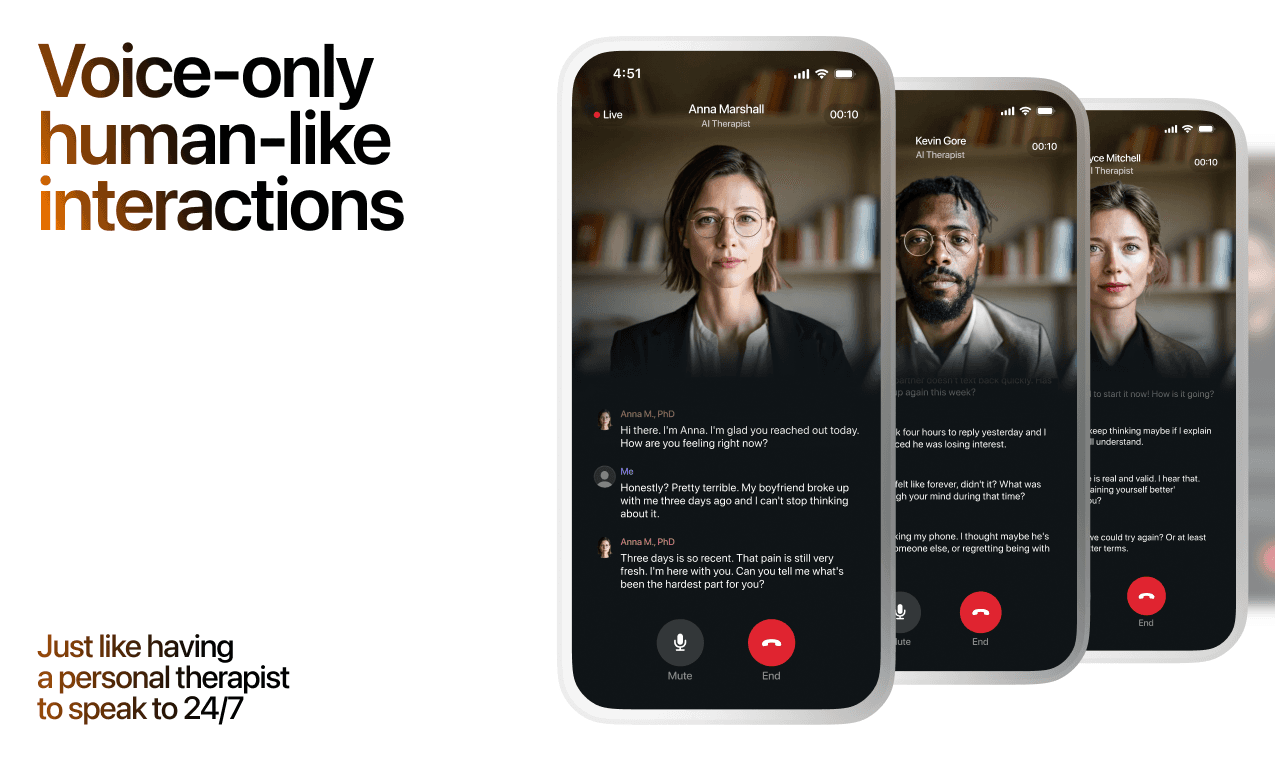
Here's what happens in a typical Lovon session:
You share what's on your mind
There's no script, no intake form, no waiting room. You speak or type whatever you're feeling — in your own words, at your own pace.
Lovon validates and explores
Using frameworks from CBT (Cognitive Behavioral Therapy) and motivational interviewing, Lovon acknowledges your feelings first, then gently helps you explore them. No dismissive "just move on" advice.
You build coping skills together
Lovon doesn't just listen — it actively works with you on evidence-based techniques: thought reframing, urge surfing, behavioral experiments, and more.
What a Session with Lovon Looks Like
When to Seek Professional Help
AI support is a valuable tool, but it's not a replacement for professional care. Please consider reaching out to a licensed therapist if you experience any of the following:
- Persistent thoughts of self-harm or suicide
- Inability to perform daily activities (work, eating, sleeping) for more than 2 weeks
- Turning to alcohol or substances to cope
- Intense anger or desire to harm your ex-partner
- Complete emotional numbness that doesn't improve over time
Crisis Resources (US): If you're in immediate danger, call 988 (Suicide & Crisis Lifeline) or text HOME to 741741 (Crisis Text Line). Available 24/7, free, and confidential.
Outside the US? Find a crisis line in your country
Ready to Start?
Your healing journey can begin right now
A 7-day trial. No judgment. Just a safe space to process what you're going through.
Frequently Asked Questions
Is Lovon a replacement for a real therapist?
Is my conversation with Lovon AI private?
How is Lovon different from ChatGPT for emotional support?
Can I use Lovon if I'm already seeing a therapist?
Can I try Lovon before subscribing?
About the Author

The Lovon Editorial Team
Mental Health & Wellness Content Team
The Lovon Editorial Team develops mental health and wellness content designed to make psychological concepts accessible and actionable. Our goal is to bridge the gap between clinical research and everyday life - helping you understand why your mind works the way it does and what you can do about it....
Related articles
- Is self-care actually selfish?
Is self care selfish? No. Learn how to tell a real need from avoidance, set a clear boundary, and respect commitments…
- Best AI apps for self-esteem and confidence in 2026
Compare the best AI apps for self-esteem and confidence. Lovon fits voice support; explore options for rehearsal…
- AI Relationship Coach for Dating Confidence: 2026 Guide
The best ai relationship coach for dating confidence in 2026 pairs voice practice with real self-worth work, not…
- AI Life Coach for a Mid-Career Pivot in Your 30s (2026)
An AI life coach for a mid-career pivot in your 30s helps you process doubt and rebuild confidence 24/7 in 2026 — see…
See also
Quizzes
- Self-Acceptance Test: What Are You Still Arguing With?
See where you are still fighting yourself, in 3 minutes.
- Perfectionism Test: What Are Your Standards Costing?
See what your standards actually cost, in 3 minutes.
Free tools
- How to Say No Politely (Without Over-Explaining)
A chat for how to say no politely when you have already decided and cannot get the word out. Tell it what you were…
- How to Come Out to Your Parents
A chat about how to come out to your parents that starts with whether now is safe, not with the speech. Tell it your…
From the wiki
- Why do I have no friends?
Usually nothing is wrong with you. Adult friendship runs on proximity and repetition, and most people lose both at once…
Disclaimer: This article is for informational purposes only and does not constitute medical advice, diagnosis, or treatment. Always seek the advice of your physician or other qualified health provider with any questions you may have regarding a medical condition. If you are in crisis or think you may have an emergency, call 988 (Suicide & Crisis Lifeline) or go to the nearest emergency room. Outside the US? Find a crisis line in your country.