
Trauma Bonding: Signs & How to Break the Cycle (2026)
Trauma bonding explained: spot the signs, break the cycle step by step, and get real support in 2026 — including on-demand help when you need it most.

Key Takeaways
- A written or mental timeline of the last three to five conflict-and-repair cycles in the relationship
- A support contact who is not inside the relationship (friend, family member, therapist, or an on-demand option)
- 15-20 minutes of uninterrupted time for the exercises below
- Honesty about at least one moment you excused behavior you wouldn't accept from anyone else
- Optional but useful: a private space to talk out loud, since verbalizing the pattern makes it harder to minimize
Trauma bonding keeps you attached to someone who hurts you, and the attachment gets stronger every time the cycle repeats. This guide breaks down the signs, walks through the steps to loosen the bond, and tells you what to do when you slip back in.
TL;DR
Trauma bonding is the emotional glue that forms when intermittent cruelty and intermittent affection come from the same person. In 2026, therapists still describe it using Patrick Carnes' original framework: intense highs after intense lows create a chemical and psychological attachment that feels like love but functions like a trap. Signs include making excuses for someone who hurt you, feeling more anxious apart from them than around them, and mistaking relief after conflict for connection. If you recognize the pattern in your relationship, the fix isn't willpower — it's naming the cycle, building distance in stages, and getting support that doesn't require you to explain yourself from scratch every time. Verdict: trauma bonding is real, common, and breakable, but it takes a structured exit plan, not just a decision to leave.
Why this matters
Most people in a trauma bond don't call it that. They call it "complicated," or "we just fight a lot," or "nobody's perfect." That language keeps the cycle invisible.
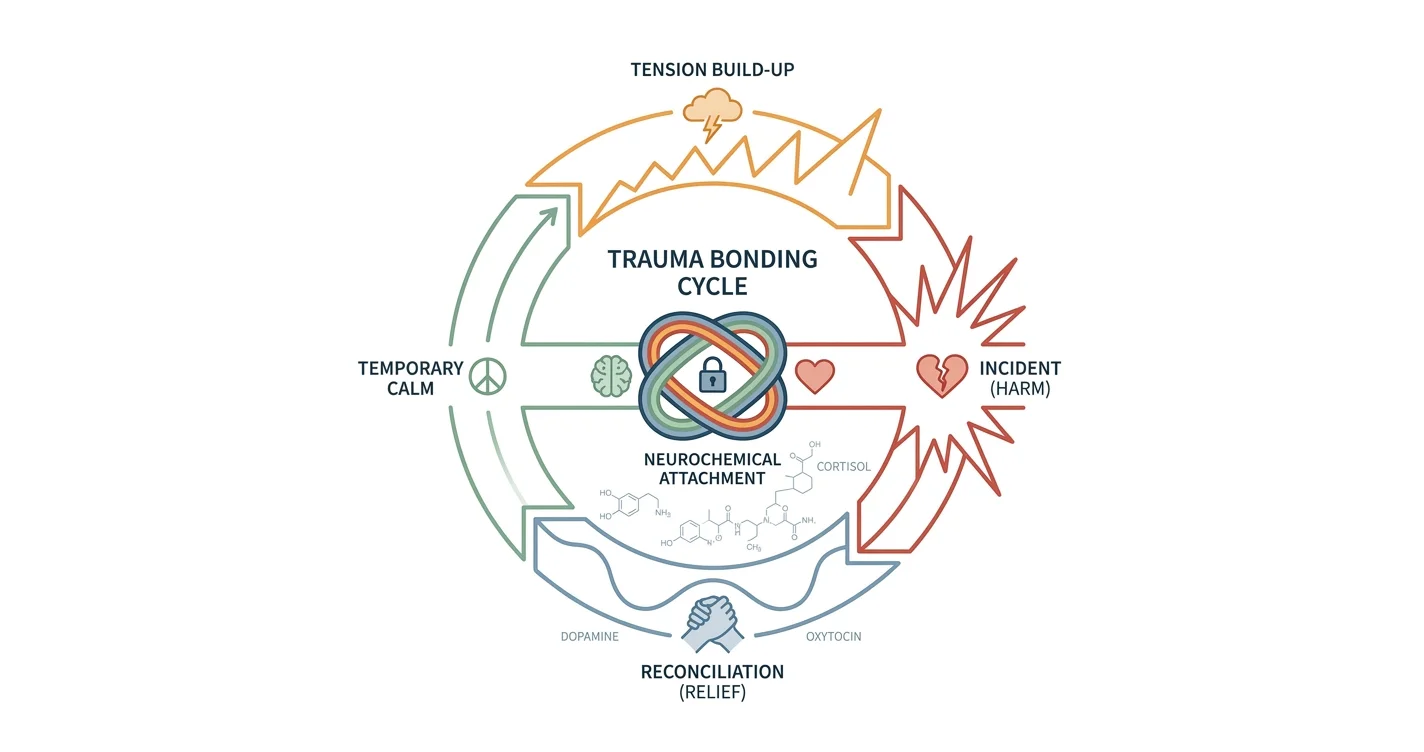
The research behind trauma bonding traces back to the same neurochemistry that explains why abuse survivors sometimes defend their abuser. Cortisol spikes during the bad moments. Oxytocin and dopamine spike during the reconciliation. Your nervous system starts reading the whole cycle as attachment, not harm. That's why leaving a trauma-bonded relationship in 2026 often feels less like breaking up and more like withdrawal.
Understanding this mechanically — not just emotionally — is the first real step out.
What you'll need
- A written or mental timeline of the last three to five conflict-and-repair cycles in the relationship
- A support contact who is not inside the relationship (friend, family member, therapist, or an on-demand option)
- 15-20 minutes of uninterrupted time for the exercises below
- Honesty about at least one moment you excused behavior you wouldn't accept from anyone else
- Optional but useful: a private space to talk out loud, since verbalizing the pattern makes it harder to minimize
If you don't have a therapist lined up yet, an AI voice session can walk you through the timeline exercise in real time instead of leaving you to journal alone at 1 a.m.
The steps
1. Name the cycle out loud
Trauma bonds survive on vagueness. The moment you say "this is a cycle of tension, incident, reconciliation, and calm" out loud or on paper, the relationship stops being a mystery and starts being a pattern you can study.
Write down the last three incidents with dates. Look for the gap between the bad moment and the good moment that followed. If the gap is under 48 hours almost every time, that's the bond talking, not chemistry.
Common mistake: People skip this step because it feels like betrayal to write the bad parts down. Skipping it is exactly how the pattern stays invisible for years instead of months.
2. Separate love from relief
After a blowup, the calm that follows can feel like the deepest closeness you've ever had. It isn't closeness — it's relief that the threat is over, which your body reads as intimacy.
Ask yourself: does this person build you up on an ordinary Tuesday, or only after they've torn you down? Love bombing and reconciliation highs use the same neurochemical shortcut, and both fade the moment tension builds again.
Common mistake: confusing intensity for depth. A relationship that swings between extremes isn't more passionate than a stable one — it's less regulated.
3. Check the excuse-making pattern
List every excuse you've made for this person's behavior in the last month: to yourself, to friends, to family. "They had a hard childhood," "they didn't mean it," "I provoked it."
Each excuse is doing a job: it protects the bond so you don't have to act on what you saw. Count them. Five or more in a month is a signal the bond is doing more work than your judgment is.
Common mistake: treating one excuse as reasonable in isolation. The pattern is the diagnosis, not any single incident.
4. Map the fear underneath
Ask what specifically you're afraid of if you pull back: being alone, being blamed publicly, losing shared friends, financial disruption, retaliation. Naming the actual fear — not the vague dread — makes it manageable in pieces.
If anxious attachment is part of your history, the fear of separation can feel like physical danger even when you're objectively safer alone. Anxious attachment patterns amplify trauma bonds because both run on the same abandonment alarm.
Common mistake: trying to logic your way past the fear instead of naming it. Fear responds to being named specifically, not argued with.
5. Build one boundary you can actually hold
Skip the dramatic exit plan for now. Pick one boundary — no contact for 72 hours after a fight, no responding to a 2 a.m. text, no explaining yourself twice — and hold it exactly once.
One held boundary teaches your nervous system that consequences without catastrophe are possible. That single data point does more than a week of thinking about leaving.
Common mistake: setting five boundaries at once and holding none of them. One boundary held beats five boundaries announced.
6. Get outside language for what's happening
Trauma bonds thrive in isolation because the person inside them loses access to outside vocabulary. Talk to someone who isn't invested in keeping the relationship intact — not to get a verdict on your relationship, but to hear your own story reflected back in someone else's words.
A structured AI voice conversation at 11 p.m., when the reconciliation high is at its strongest and your judgment is weakest, can interrupt the pull back in before you act on it.
Common mistake: only talking to people who are already close to the situation. They're often bonded to the same dynamic, even secondhand.
7. Track your baseline mood without the relationship
For one week, rate your anxiety and mood twice daily on a 1-10 scale, separate from any interaction with this person. Most people in a trauma bond discover their baseline anxiety is elevated even on "good" days — the nervous system never fully powers down.
That data point matters more in 2026 than it did a decade ago, because wearable and app-based mood tracking makes the pattern harder to deny to yourself.
Common mistake: only tracking mood during and after conflict. The baseline is the real signal.
Troubleshooting
- "I held the boundary for two days, then caved." Two days is real progress, not failure. Restart the clock the next day instead of scrapping the whole plan.
- "Everyone tells me to just leave, but it's not that simple." Trauma bonds aren't solved with one decision. Treat leaving as a series of small exits, not one clean break.
- "I feel worse after time apart, not better." That's the withdrawal phase, not proof the relationship is healthy. It typically peaks in the first one to two weeks after reduced contact.
- "They apologize and things get better every time." Better for how long? Check the gap between reconciliations. If it's shrinking, the cycle is accelerating, not healing.
- "I don't have anyone to talk to about this." On-demand support exists for exactly this gap — 2 a.m. isn't a normal therapy hour, but it's often when the pull back is strongest.
- "I keep confusing this with codependency." The two overlap but aren't identical. Codependency vs. love breaks down where the line sits.
Tools and resources
- A written cycle log (paper or notes app) — non-negotiable, this is the diagnostic tool
- One outside contact who isn't emotionally invested in the relationship staying intact
- AI voice support for real-time talk-throughs when the reconciliation high hits
- A read on narcissistic abuse signs if the cycle involves manipulation, not just conflict
- A trauma-informed understanding of childhood roots via CPTSD from childhood, since many adult trauma bonds echo early attachment wounds
What to do next
Once you've named the cycle and held one boundary, the next real work is understanding whether the root sits in childhood attachment patterns or in this specific relationship. Read through the CPTSD guide linked above before deciding whether individual work or couples work comes first — the order matters more than people expect in 2026 treatment approaches.
FAQ
What is trauma bonding, in one sentence? Trauma bonding is the attachment that forms when cycles of harm and relief repeat with the same person, making the relationship feel essential even when it's damaging.
Is trauma bonding the same as love? No. Trauma bonding produces intensity and relief, while stable love produces calm and consistency; the two can feel similar in the moment but behave differently over months.
How long does it take to break a trauma bond? There's no fixed timeline, but most people report the strongest pull to return happens in the first two to three weeks after reducing contact, then eases with consistent boundaries.
Can you be trauma bonded to a friend or family member, not just a partner? Yes. The cycle of tension, incident, and reconciliation applies to any relationship with repeated harm followed by repair, including parents and close friends.
What's the difference between trauma bonding and codependency? Trauma bonding centers on a repeating harm-relief cycle, while codependency centers on identity and self-worth being tied to managing another person's needs; they frequently overlap but aren't identical.
Does therapy actually help with trauma bonding? Structured support helps by giving you outside language for the pattern and accountability for boundaries, which is harder to sustain alone since isolation is part of how the bond survives.
Is trauma bonding a diagnosable condition? No. It's a descriptive term for a relational pattern, not a clinical diagnosis, though it's often discussed alongside conditions like CPTSD.
What's the first sign I should watch for? The clearest early sign is making excuses for behavior you wouldn't tolerate from anyone else, especially when you notice yourself doing it in real time rather than after the fact.
One last thing
The detail most people miss: trauma bonds don't get weaker with more reconciliations, they get stronger, because each cycle deepens the neurochemical groove. The person who says "it's getting better" after the tenth blowup-and-makeup is usually further into the bond, not out of it. Counting cycles, not vibes, is what tells you the truth.
Related guides
How AI Support Helps You Heal
AI emotional support isn't about replacing human connection — it's about filling the gaps. The moments when you need to talk at 2 AM, when you don't want to burden your friends again, or when you simply need someone to listen without judgment.
Here's what happens in a typical Lovon session:
You share what's on your mind
There's no script, no intake form, no waiting room. You speak or type whatever you're feeling — in your own words, at your own pace.
Lovon validates and explores
Using frameworks from CBT (Cognitive Behavioral Therapy) and motivational interviewing, Lovon acknowledges your feelings first, then gently helps you explore them. No dismissive "just move on" advice.
You build coping skills together
Lovon doesn't just listen — it actively works with you on evidence-based techniques: thought reframing, urge surfing, behavioral experiments, and more.
What a Session with Lovon Looks Like

When to Seek Professional Help
AI support is a valuable tool, but it's not a replacement for professional care. Please consider reaching out to a licensed therapist if you experience any of the following:
- Persistent thoughts of self-harm or suicide
- Inability to perform daily activities (work, eating, sleeping) for more than 2 weeks
- Turning to alcohol or substances to cope
- Intense anger or desire to harm your ex-partner
- Complete emotional numbness that doesn't improve over time
Crisis Resources (US): If you're in immediate danger, call 988 (Suicide & Crisis Lifeline) or text HOME to 741741 (Crisis Text Line). Available 24/7, free, and confidential.
Outside the US? Find a crisis line in your country
Ready to Start?
Your healing journey can begin right now
A 7-day trial. No judgment. Just a safe space to process what you're going through.
Frequently Asked Questions
Is Lovon a replacement for a real therapist?
Is my conversation with Lovon AI private?
How is Lovon different from ChatGPT for emotional support?
Can I use Lovon if I'm already seeing a therapist?
Can I try Lovon before subscribing?
About the Author
The Lovon Editorial Team
Mental Health & Wellness Content Team
The Lovon Editorial Team develops mental health and wellness content designed to make psychological concepts accessible and actionable. Our goal is to bridge the gap between clinical research and everyday life - helping you understand why your mind works the way it does and what you can do about it....
Related articles
- Narcissistic Relationship: 9 Signs You're Dating a Narcissist
Most people do not know they are in a narcissistic relationship until they are already very involved.
- Passive Aggressive Partner: How to Recognize It (2026)
Learn how to spot a passive aggressive partner in 2026 — silent treatment, sarcasm, and stonewalling patterns explained…
- Relationship PTSD: 7 Signs of Post-traumatic Stress Disorder
Most people think PTSD happens after big disasters, but PTSD from a relationship is more common than many people think.
- Toxic Family Apology Dynamics: How to Navigate False Peace
Toxic family apology dynamics create a confusing emotional landscape where apologies serve to maintain control rather…
See also
Quizzes
- Are They a Red Flag? 10 Questions to Check Your Partner
Check your partner in 3 minutes.
- Am I Dating a Narcissist? 15-Trait Quiz
Understand the pattern in 3 minutes.
Free tools
- Breakup Message Writer
A chat for saying it once. Tell it how long it has been and why now, and get a message you could actually send, plus the…
- How to Forgive Someone Who Hurt You
Forgiving, reconciling, and deciding it was fine are three different things, and they get merged. Tell it what happened…
From the wiki
- How to leave a toxic relationship?
Leaving a toxic relationship is rarely a decision problem — you usually know. What stops you is that the pull toward…
Disclaimer: This article is for informational purposes only and does not constitute medical advice, diagnosis, or treatment. Always seek the advice of your physician or other qualified health provider with any questions you may have regarding a medical condition. If you are in crisis or think you may have an emergency, call 988 (Suicide & Crisis Lifeline) or go to the nearest emergency room. Outside the US? Find a crisis line in your country.