
Am I the Problem in My Relationship? 2026 Self-Check
Wondering if you're the problem in your relationship? This 2026 self-check covers 6 real behavioral patterns — with honest verdicts and next steps to actually change.

Key Takeaways
- Do you lead with "you always" or "you never"?
- Do you bring up past grievances during current arguments?
- Does your partner regularly go quiet or defensive within the first 60 seconds of a hard conversation?
- "I'm sorry I got angry, but you shouldn't have said that."
- Apologizing to end the argument rather than because you understand the impact.
Asking "am I the problem in my relationship" is one of the most honest things you can do — and the fact that you're asking at all says something important about your self-awareness. This guide walks you through a structured self-check so you can get a clear, grounded answer instead of spiraling in your own head.
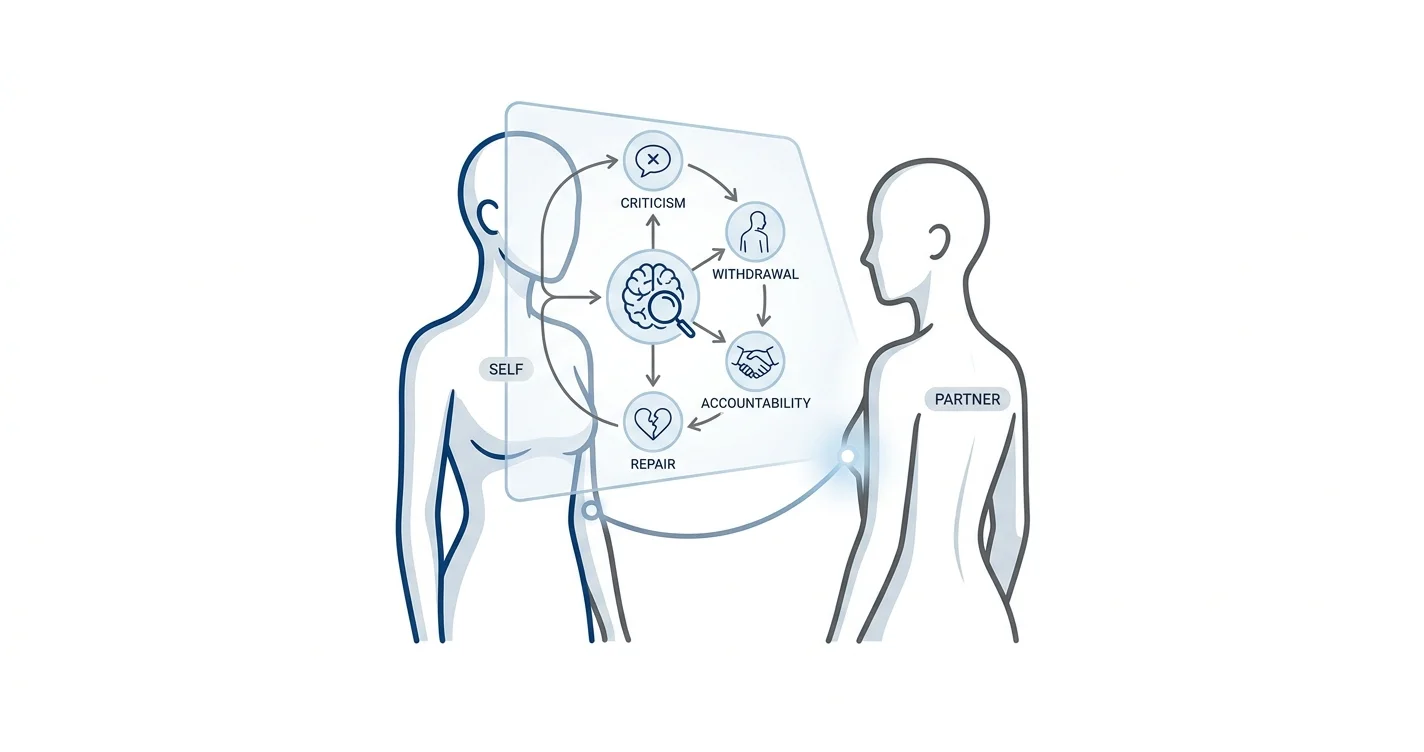
TL;DR: If you're asking whether you're the problem in your relationship in 2026, the answer is almost never a clean yes or no. This quiz-style self-check covers 6 key patterns — criticism, emotional withdrawal, accountability, communication, control, and repair — and gives you a concrete way to assess your own behavior without shame. Most people who ask this question are not the sole problem. But they often do have one or two patterns worth working on.
Why this question matters
Relationship conflict has two sides, but self-reflection only happens when at least one person stops pointing outward and looks inward. Research from the Gottman Institute consistently shows that the ability to accept influence and take responsibility — not the absence of conflict — predicts whether relationships survive. Asking "am I the problem" is the first move in that direction. It doesn't mean you're guilty. It means you're paying attention.
Who this self-check is for
This is for people in a romantic relationship — dating, living together, or married — who notice recurring friction and aren't sure how much of it they're contributing. You might be the person who always apologizes first, or the person who never does. You might feel like your partner blames you for everything, or you might quietly wonder if they're right. Either way, this structured reflection is built for you.
It is not a clinical assessment. Lovon is not a licensed clinician, and this article is not a substitute for therapy. If you're dealing with abuse, this guide does not apply — please contact the National Domestic Violence Hotline directly.
The self-check: 6 patterns to examine honestly
Work through each section. For each one, answer the question as truthfully as you can — not how you wish you'd behaved, but how you actually have behaved in the last 30 days.
1. How do you raise problems?
There's a difference between expressing a concern and launching an attack. Gottman's research identifies "harsh startup" — opening a conversation with blame or contempt — as one of the strongest predictors of relationship breakdown. Ask yourself:
- Do you lead with "you always" or "you never"?
- Do you bring up past grievances during current arguments?
- Does your partner regularly go quiet or defensive within the first 60 seconds of a hard conversation?
What it means: If you answered yes to 2 or more, your communication style may be creating a defensive cycle — not because you're a bad person, but because the delivery is triggering a threat response in your partner before the content even lands. Criticizing the person rather than the behavior is a learnable habit to change.
2. Do you take accountability without conditions?
A genuine apology does not include "but." Watch for:
- "I'm sorry I got angry, but you shouldn't have said that."
- Apologizing to end the argument rather than because you understand the impact.
- Accepting blame in the moment, then revisiting it later as ammunition.
What it means: Conditional accountability keeps the score running. Your partner may stop bringing things up not because they're resolved, but because they've learned that bringing things up doesn't go anywhere.
3. Do you withdraw or go quiet during conflict?
Emotional withdrawal — stonewalling — is as damaging as aggression. It communicates that the other person's distress doesn't warrant a response. Ask yourself:
- Do you go silent for hours or days after a fight?
- Do you leave the room, check your phone, or change the subject when things get hard?
- Does your partner frequently say they feel alone or ignored?
What it means: Withdrawal often feels self-protective. Physiologically, it usually is — your nervous system is flooded and shutting down is a real stress response. But it reads as abandonment to an anxious or hurt partner. Understanding anxious attachment style signs and coping strategies can help clarify why this dynamic escalates the way it does.
4. Do you respect your partner's autonomy?
Control doesn't always look like control. It can show up as:
- Frequently checking up on where they are or who they're with
- Criticizing their choices, friends, spending, or appearance regularly
- Making decisions that affect both of you without consulting them
- Sulking or punishing when they do something you don't like
What it means: Controlling behavior often comes from insecurity, not malice. But the impact on the other person is the same regardless of the intention. If your partner has said they feel monitored, criticized, or managed, take that seriously.
5. Do you repair after conflict?
Repair attempts — a touch, a joke, an "I don't want to fight" — are the glue of long-term relationships. The question isn't whether you fight, but whether you come back. Ask yourself:
- Do you initiate repair, or do you wait for your partner to?
- Do you accept repair bids when your partner makes them, or stay cold?
- Is there a pattern where you "win" the argument but lose closeness?
What it means: If repair is always your partner's job, you're putting the emotional labor of reconnection entirely on them. That creates exhaustion and resentment over time — even in relationships where neither person is "bad."
6. Do you take in your partner's perspective?
This is the hardest one. It's not about agreeing — it's about whether you can hold space for your partner's experience being real, even when it conflicts with yours. Ask yourself:
- When your partner says they're hurt, is your first move to explain why they shouldn't be?
- Do you find yourself building a legal case in your head while they're talking?
- Can you name, in their words, what they've said bothers them most about your relationship?
What it means: The inability to take in a partner's perspective — sometimes called "low empathic accuracy" in psychological research — is one of the strongest individual predictors of relationship dissatisfaction. It doesn't mean you lack empathy. It often means you're too defensive to use it.
Scoring your honest answers
This is not a points quiz. It's a pattern check. Here's how to read your results:
| Pattern | "Yes, I do this" | What to do |
|---|---|---|
| Harsh criticism | Regularly | Learn to name your need, not the flaw |
| Conditional accountability | Sometimes | Practice full apologies — no "but" |
| Stonewalling | Regularly | Signal a time-out instead of disappearing |
| Controlling behavior | Occasionally | Examine the fear underneath the behavior |
| No repair | Regularly | Make the first move — even a text counts |
| Low perspective-taking | Regularly | Pause and reflect before defending |
If you flagged 4 or more patterns regularly: You are contributing meaningfully to the friction in your relationship. That is fixable, but it takes consistent work — not just good intentions.
If you flagged 1–3 patterns occasionally: You're human. Most people have 1–2 defaults under stress. Awareness is the starting point.
If you flagged none: Either you're in a genuinely healthy place, or you're not being fully honest with yourself. Run through the questions again with a specific recent argument in mind.
What to avoid mistaking as self-awareness
- Over-blaming yourself to avoid conflict. Taking responsibility for everything your partner is upset about is not growth — it's appeasement. The fawn response is a trauma pattern, not accountability.
- Using this quiz as evidence against your partner. If your first move after reading this is to send it to them with a "see, you do this" message, you've missed the point.
- Confusing self-reflection with self-punishment. Identifying a pattern is useful. Spending 3 days in shame about it is not.
What to do with what you found
If this self-check turned up real patterns, the next step is not to white-knuckle your way into being better. It's to understand why those patterns exist. Most controlling, withholding, or reactive behavior in relationships has a story behind it — usually something that formed long before this relationship.
Talking it through helps. Lovon's AI voice support app lets you work through relationship patterns in real-time, at any hour, without waiting for a therapy appointment. You can explore what's driving the behavior, not just label it. For a practical starting point, the guide on how to use an AI relationship coach daily covers how to make that kind of reflection a consistent habit in 2026.
If you and your partner are both willing to work on communication together, AI couples therapy for communication problems is a lower-barrier starting point than traditional therapy — especially if cost is a factor.
FAQ
What does it mean if I'm always the one asking "am I the problem in my relationship"? It often means you have higher self-reflective capacity than your partner — or that you've been conditioned to take responsibility for relational discomfort. Both are worth examining. Being the only one asking doesn't automatically make you the only one contributing.
Can someone be the problem in every relationship they're in? Yes, in the sense that a consistent pattern follows a person across relationships. But "the problem" is rarely the right frame — it's more accurate to say someone is carrying an unprocessed pattern that shows up regardless of who the partner is. That pattern is treatable.
Is it a red flag if my partner never asks if they're the problem? It can be. People who consistently externalize blame and never question their own role tend to be harder to build real intimacy with. It's not a diagnosis — but a persistent unwillingness to self-reflect is worth noting.
How do I know if I'm being gaslit or if I'm actually the problem? Gaslighting involves your partner systematically denying your reality to make you doubt your own perceptions. A key sign: your self-doubt increases only in relation to them, not across other areas of your life. If you feel generally clear-headed and competent everywhere except this relationship, look more carefully at the relationship dynamic.
Can therapy help even if my partner won't go? Yes — and often meaningfully. Individual therapy or AI-supported reflection helps you understand your own patterns, build clearer boundaries, and communicate more effectively regardless of whether your partner changes. You can only work with what's yours.
How often should I do this kind of self-check? Monthly is reasonable for most people in ongoing relationships. After any significant conflict is another good prompt. The goal isn't to monitor yourself obsessively — it's to catch patterns before they calcify.
Is asking "am I the problem" a sign of low self-esteem? Not by itself. It becomes a problem only when the asking is compulsive and disconnected from actual evidence — when you assume guilt regardless of what happened. Grounded self-reflection and anxious self-blame feel different internally: one is curious, the other is fearful.
What if we're both contributing to the problems? That's the most common scenario. Relationships are systems — most dysfunction is co-created. Identifying your part doesn't require waiting for your partner to identify theirs. Start with what's yours.
One last thing
Research published in the Journal of Personality and Social Psychology found that people who regularly engage in self-reflection about their relationship behavior — even imperfectly — report significantly higher relationship satisfaction over a 2-year period than those who don't. The act of asking the question, in 2026 and any year, is already doing something. Don't let the discomfort of the answer stop you from using it.
Related guides
How AI Support Helps You Heal
AI emotional support isn't about replacing human connection — it's about filling the gaps. The moments when you need to talk at 2 AM, when you don't want to burden your friends again, or when you simply need someone to listen without judgment.
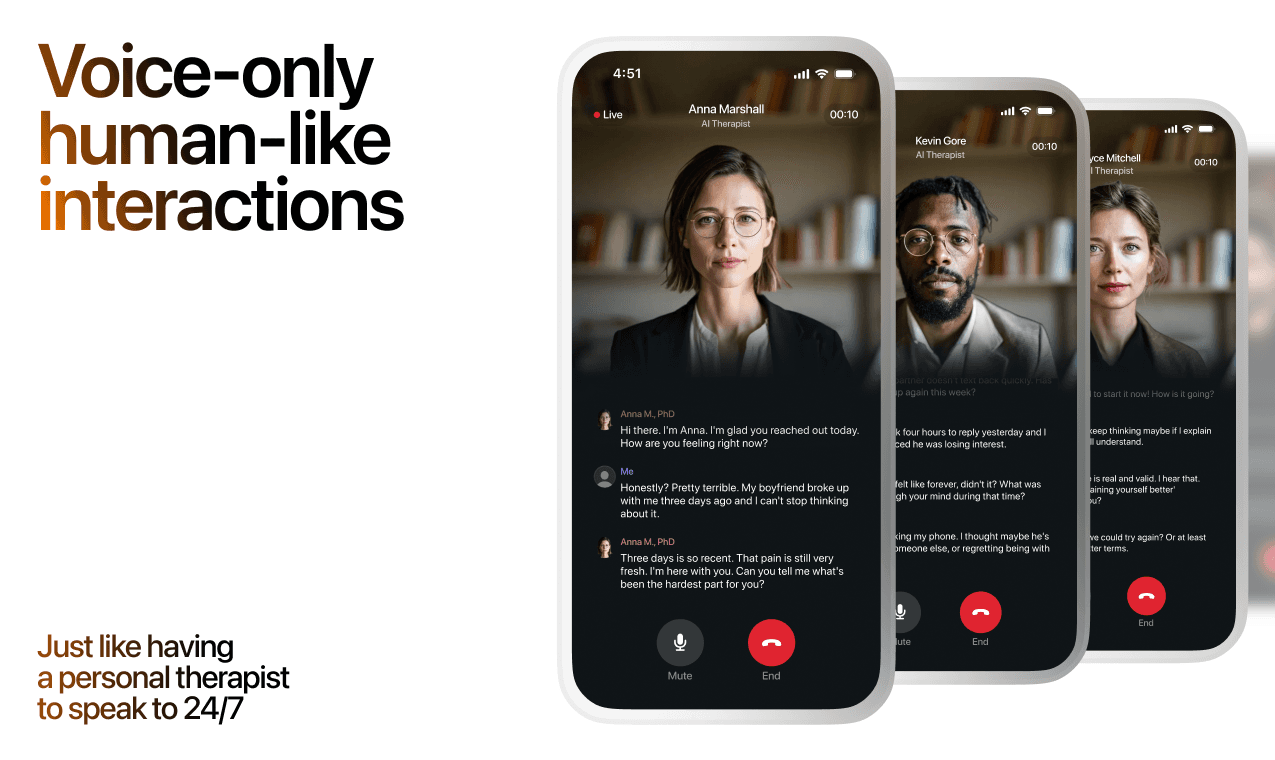
Here's what happens in a typical Lovon session:
You share what's on your mind
There's no script, no intake form, no waiting room. You speak or type whatever you're feeling — in your own words, at your own pace.
Lovon validates and explores
Using frameworks from CBT (Cognitive Behavioral Therapy) and motivational interviewing, Lovon acknowledges your feelings first, then gently helps you explore them. No dismissive "just move on" advice.
You build coping skills together
Lovon doesn't just listen — it actively works with you on evidence-based techniques: thought reframing, urge surfing, behavioral experiments, and more.
What a Session with Lovon Looks Like
When to Seek Professional Help
AI support is a valuable tool, but it's not a replacement for professional care. Please consider reaching out to a licensed therapist if you experience any of the following:
- Persistent thoughts of self-harm or suicide
- Inability to perform daily activities (work, eating, sleeping) for more than 2 weeks
- Turning to alcohol or substances to cope
- Intense anger or desire to harm your ex-partner
- Complete emotional numbness that doesn't improve over time
Crisis Resources (US): If you're in immediate danger, call 988 (Suicide & Crisis Lifeline) or text HOME to 741741 (Crisis Text Line). Available 24/7, free, and confidential.
Outside the US? Find a crisis line in your country
Ready to Start?
Your healing journey can begin right now
A 7-day trial. No judgment. Just a safe space to process what you're going through.
Frequently Asked Questions
Is Lovon a replacement for a real therapist?
Is my conversation with Lovon AI private?
How is Lovon different from ChatGPT for emotional support?
Can I use Lovon if I'm already seeing a therapist?
Can I try Lovon before subscribing?
About the Author
The Lovon Editorial Team
Mental Health & Wellness Content Team
The Lovon Editorial Team develops mental health and wellness content designed to make psychological concepts accessible and actionable. Our goal is to bridge the gap between clinical research and everyday life - helping you understand why your mind works the way it does and what you can do about it....
Related articles
- Communication Compatibility Quiz: Top Picks 2026
Take the right communication compatibility quiz in 2026. Compare top tools, learn what to look for, and turn your…
- Best Free AI Therapist for Relationships 2026
The best free AI therapist for relationships in 2026 is Lovon — voice-based, CBT-grounded, no credit card required. See…
- AI Life Coach for Relationship Goals 2026
The best AI life coach for relationship goals in 2026: voice-based, personalized sessions for communication, conflict…
- AI Relationship Coach for Dating Confidence: 2026 Guide
The best ai relationship coach for dating confidence in 2026 pairs voice practice with real self-worth work, not…
See also
Quizzes
- Am I a Red Flag? Honest Self-Check
Honest self-check in 5 minutes.
- Conflict Style Test: How You Fight and How You Repair
See how you fight, and whether you repair.
Free tools
- How to Ask for Space Without Ending It
A chat for when you need distance but not a breakup. Say the sentence you keep rehearsing and what you are afraid they…
- How to Tell Your Spouse You Want a Divorce
A chat for working out how to tell your spouse you want a divorce, after the decision rather than before it. Tell it…
From the wiki
- How to break up with someone you still love?
Loving someone does not mean the relationship works. If you have circled the same decision for months and the reasons…
Disclaimer: This article is for informational purposes only and does not constitute medical advice, diagnosis, or treatment. Always seek the advice of your physician or other qualified health provider with any questions you may have regarding a medical condition. If you are in crisis or think you may have an emergency, call 988 (Suicide & Crisis Lifeline) or go to the nearest emergency room. Outside the US? Find a crisis line in your country.