
10 Signs of a Toxic Relationship to Check in 2026
Signs of a toxic relationship include control, gaslighting, and apology cycles with no change. Run these 10 checks now, plus what to do about it in 2026.
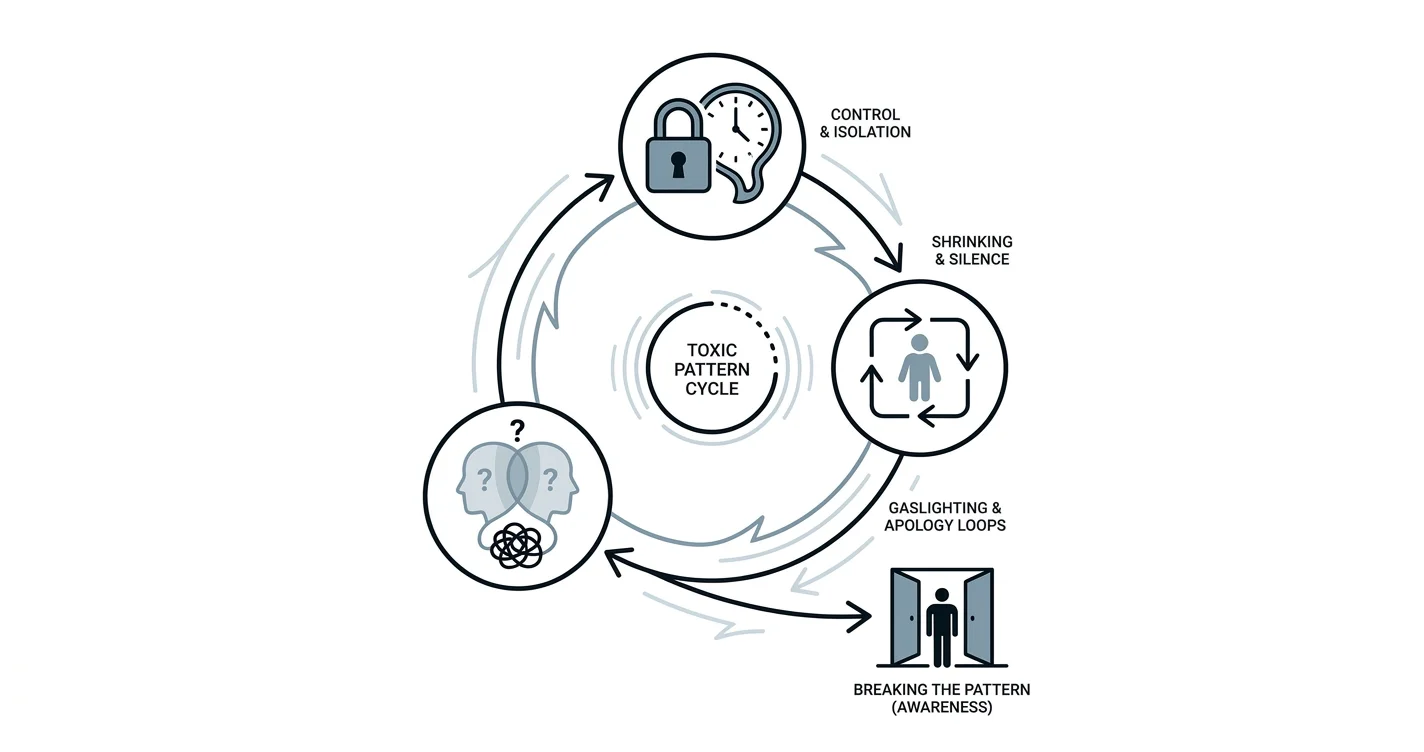

Key Takeaways
- 15 uninterrupted minutes, away from your partner
- A notes app or paper — write answers down, don't just think them
- Three real examples from the last 90 days for each sign, not hypotheticals
- Honesty about your own behavior too, not just theirs
- Optional: a private space to talk it through, whether that's a trusted friend or an AI voice conversation with Lovon
Ten specific signs separate a rough patch from a toxic relationship, and most people can check all ten in under fifteen minutes if they're honest with themselves.
TL;DR: The clearest signs of a toxic relationship are control disguised as care, gaslighting that makes you doubt your own memory, apology cycles with no real change, and a pattern where you feel smaller after time with your partner instead of steadier. If three or more of the ten signs below show up consistently over the last three months, that's not a bad week — that's a pattern worth addressing now, whether through a direct conversation, a licensed therapist, or a tool like Lovon for daily support between sessions.
Why this matters
Most people don't leave a toxic relationship because of one dramatic event. They leave — or finally get help — because they finally see the pattern laid out, and the pattern is usually invisible from inside it.
Love bombing at the start of a relationship, for example, feels like romance in the moment. It only reads as a red flag once you compare month one to month six. That's what this checklist does: it gives you a fixed set of questions so you're not relying on memory alone, which is exactly the thing toxic dynamics tend to distort.
What you'll need
- 15 uninterrupted minutes, away from your partner
- A notes app or paper — write answers down, don't just think them
- Three real examples from the last 90 days for each sign, not hypotheticals
- Honesty about your own behavior too, not just theirs
- Optional: a private space to talk it through, whether that's a trusted friend or an AI voice conversation with Lovon if you want to think out loud before deciding what to say
The 10 checks
1. Check for control disguised as concern
Control often shows up wearing the mask of care — "I just worry about you" while checking your phone, or "I don't like your friends" as a reason to isolate you. Write down every instance in the last month where a request to change your behavior was framed as protection. Three or more instances is a pattern, not a preference. Common mistake: excusing it because the tone was gentle — tone doesn't change the function.
2. Test whether apologies come with actual change
An apology that repeats the same offense within two weeks isn't an apology, it's a reset button. Track the gap between "I'm sorry" and the next repeat incident over the last three months. If the gap is shrinking instead of growing, the apology is doing nothing. Expected outcome: you'll usually find the same three or four "I'm sorry" moments on loop.
3. Look for love bombing followed by a pullback
Intense affection early on, followed by sudden coldness once you're attached, is a documented pattern, not bad luck. Compare how available your partner was in week one versus now — a steep drop after you were fully invested is the signal, not the drop-off itself. Skip this if you're less than 60 days in; the pattern needs time to show.
4. Watch how disagreements actually resolve
Healthy conflict ends in repair. Toxic conflict ends in you apologizing for bringing it up. Note the outcome of your last five disagreements — who apologized, and for what. If you're the one apologizing for raising a valid concern, that's contempt, not compromise.
5. Notice if you're shrinking to keep the peace
Walking on eggshells — rehearsing sentences before you say them, avoiding topics entirely — is a nervous-system response to unpredictability, not a personality trait. Rate, on a scale of 1-10, how much you edit yourself before speaking to your partner versus a close friend. A gap of 4 points or more is worth flagging.
6. Check for gaslighting on specific events
Gaslighting means your version of a documented event gets rewritten until you doubt it happened the way you remember. Pick one specific argument from the last month and see if your partner's account changed each time you brought it up. Consistent accounts, even if you disagree, are healthy. Shifting accounts are not.
7. Look at financial or logistical control
Access to money, transportation, or your own schedule being restricted "for your own good" is a control pattern that predates any single argument. List what you cannot do without your partner's approval right now. Anything beyond shared big decisions — a car, a bank account, your calendar — is worth naming out loud.
8. Compare the public version to the private one
A partner who's charming in front of others and cutting in private is running two versions of the relationship, and only you see the real one. Ask yourself if a friend who only saw the public version would believe your private experience. If the answer is no, that gap is the data point.
9. Ask if you feel safe disagreeing
Safety here means you can say "I don't agree" without bracing for punishment, silence, or a fight. Recall the last time you disagreed openly — what happened in the next hour. Expected healthy outcome: a conversation. Common mistake: mistaking the absence of yelling for the presence of safety; silent treatment counts too.
10. Track the pattern over 90 days, not one week
Every relationship has a bad week. The question is whether signs 1 through 9 showed up once or repeatedly across three full months. One bad week is stress. A repeating cycle across a season is the relationship's actual shape. This is the sign that turns a hunch into a decision.
Troubleshooting common confusions
"He's only like this when he's stressed" — does that count? Yes, if the stressed behavior is control, gaslighting, or contempt rather than distance or short temper. Stress explains withdrawal; it doesn't explain rewriting your memory of events.
"We fight but we always make up" — is that normal? Make-up warmth doesn't cancel a repair problem — check sign 2. If the same fight recurs every few weeks with no structural change, the making up is part of the cycle, not proof it's fine.
"I do some of these things too" — does that make it mutual? Be specific: mutual conflict is two people who both sometimes lose patience. It's not mutual if one person's behavior consistently produces fear or self-doubt in the other and the reverse isn't true.
"It's only 2 or 3 signs, not all 10" — should I worry? Control (sign 1), gaslighting (sign 6), and financial restriction (sign 7) carry more weight on their own than the others. Two or three of those specific three matter more than five minor ones.
"I can't tell if I'm overreacting" Write the events down as if describing a friend's relationship, not your own — distance often clarifies what closeness hides. If you'd tell a friend to be concerned, apply the same standard to yourself.
Tools and resources
- Written log of specific incidents over 90 days — the single most useful tool here
- A trusted third party who can point out blind spots you can't see
- Narcissistic abuse signs if several checks above came back positive and you want the fuller clinical picture
- AI relationship coach for trust issues if you want a low-stakes place to talk through what you found before deciding what to say to your partner
- A licensed therapist for anything involving safety, financial control, or fear — an app is support between sessions, not a replacement for that
FAQ
What are the clearest signs of a toxic relationship? Control disguised as concern, gaslighting about specific events, and apology cycles with no behavior change are the three clearest signs in 2026 relationship research and clinical practice. Any one of these alone is worth addressing directly.
Is fighting a lot the same as toxic? No — frequency of conflict matters less than whether conflict resolves with repair or with one person apologizing for raising the issue. Frequent fights that end in genuine resolution are healthier than rare fights that end in silence.
How many of the 10 signs mean it's actually toxic? Three or more signs showing up consistently over 90 days is the threshold most clinicians use informally, but control, gaslighting, and financial restriction each carry more weight individually than the others.
Can a toxic relationship be fixed? Some can, if both people acknowledge the specific pattern and change behavior, not just intentions — track sign 2 (apology without change) to see if effort is real. Patterns involving fear or safety usually need outside support, not self-repair.
Is love bombing always a sign of a toxic relationship? Not on its own — intense early affection is common in healthy relationships too. It becomes a signal when it's followed by a sharp pullback once you're emotionally invested, which is sign 3 above.
How is gaslighting different from a normal disagreement? A normal disagreement means two people remember an event differently but each account stays consistent over time. Gaslighting means one person's account of the same event keeps shifting specifically to make the other person doubt their memory.
Should I talk to my partner before deciding anything? If you feel physically safe, yes — bring the specific written examples from this checklist rather than general complaints, since specifics are harder to gaslight around. If any sign involves fear, financial control, or threats, prioritize a licensed professional or a trusted person first.
Where can I get support while I figure this out? A licensed therapist is the right first call for anything involving safety concerns. For daily processing between conversations or sessions, an AI voice support tool like Lovon gives you a place to think out loud at 11pm when the pattern is loudest in your head.
One last thing
The sign people miss most often isn't on most checklists: it's whether you've started rehearsing conversations with your partner in your head before you have them. That habit alone — mentally drafting what you're "allowed" to say — is a stronger toxic-relationship indicator than most single incidents, because it means your nervous system has already learned the relationship isn't safe for direct speech.
Related guides
How AI Support Helps You Heal
AI emotional support isn't about replacing human connection — it's about filling the gaps. The moments when you need to talk at 2 AM, when you don't want to burden your friends again, or when you simply need someone to listen without judgment.
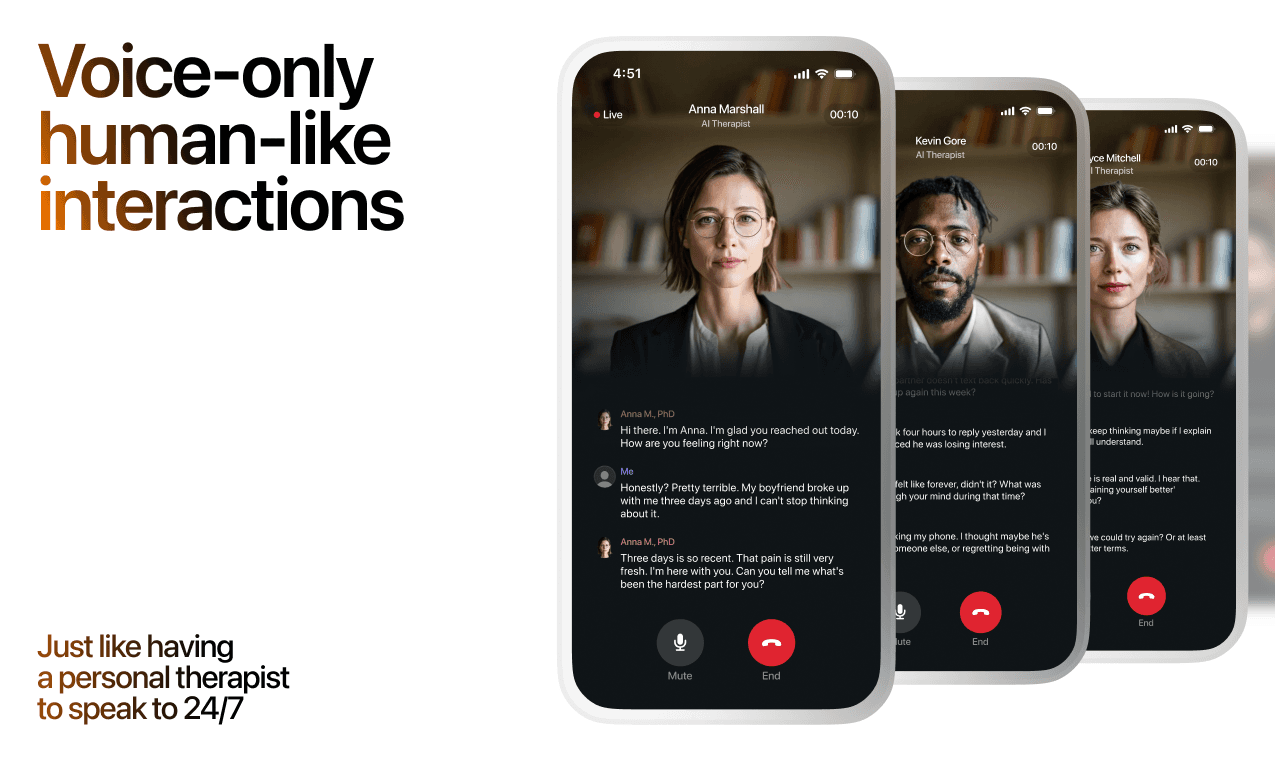
Here's what happens in a typical Lovon session:
You share what's on your mind
There's no script, no intake form, no waiting room. You speak or type whatever you're feeling — in your own words, at your own pace.
Lovon validates and explores
Using frameworks from CBT (Cognitive Behavioral Therapy) and motivational interviewing, Lovon acknowledges your feelings first, then gently helps you explore them. No dismissive "just move on" advice.
You build coping skills together
Lovon doesn't just listen — it actively works with you on evidence-based techniques: thought reframing, urge surfing, behavioral experiments, and more.
What a Session with Lovon Looks Like
When to Seek Professional Help
AI support is a valuable tool, but it's not a replacement for professional care. Please consider reaching out to a licensed therapist if you experience any of the following:
- Persistent thoughts of self-harm or suicide
- Inability to perform daily activities (work, eating, sleeping) for more than 2 weeks
- Turning to alcohol or substances to cope
- Intense anger or desire to harm your ex-partner
- Complete emotional numbness that doesn't improve over time
Crisis Resources (US): If you're in immediate danger, call 988 (Suicide & Crisis Lifeline) or text HOME to 741741 (Crisis Text Line). Available 24/7, free, and confidential.
Outside the US? Find a crisis line in your country
Ready to Start?
Your healing journey can begin right now
A 7-day trial. No judgment. Just a safe space to process what you're going through.
Frequently Asked Questions
Is Lovon a replacement for a real therapist?
Is my conversation with Lovon AI private?
How is Lovon different from ChatGPT for emotional support?
Can I use Lovon if I'm already seeing a therapist?
Can I try Lovon before subscribing?
About the Author
The Lovon Editorial Team
Mental Health & Wellness Content Team
The Lovon Editorial Team develops mental health and wellness content designed to make psychological concepts accessible and actionable. Our goal is to bridge the gap between clinical research and everyday life - helping you understand why your mind works the way it does and what you can do about it....
Related articles
- Rebuild Self-Esteem After a Toxic Relationship (2026)
Rebuild self-esteem after a toxic relationship with 6 concrete steps, common setbacks, and fixes. A 2026 guide with real…
- 10 Signs of a Toxic Relationship: Spotting Unhealthy Patterns
Everyone wants a relationship where they receive support and positive emotions. While many relationships begin that way…
- Narcissistic Abuse: Examples, Signs, and What a Narcissist Does
Relationships with a narcissist can start in a positive way because at first you may ignore some warning signs.
- Toxic Family Dynamics Operating Through Power and Control Triggering Old Coping Patterns During Holidays
The holiday season can feel like stepping into a time machine for many people navigating toxic family dynamics. When you…
See also
Quizzes
- Is My Relationship Healthy? 15-Question Check-In
Check your relationship health in 3 minutes.
- Are They a Red Flag? 10 Questions to Check Your Partner
Check your partner in 3 minutes.
Free tools
- How to Respond to Gaslighting
Say what happened and what they say happened. You get what is actually established separated from what is being…
- What Leaving Would Actually Take
Four short lists: money, a place, the shared things, and people. Mark each item sorted or not. You get the itemized…
From the wiki
- How to leave a toxic relationship?
Leaving a toxic relationship is rarely a decision problem — you usually know. What stops you is that the pull toward…
Disclaimer: This article is for informational purposes only and does not constitute medical advice, diagnosis, or treatment. Always seek the advice of your physician or other qualified health provider with any questions you may have regarding a medical condition. If you are in crisis or think you may have an emergency, call 988 (Suicide & Crisis Lifeline) or go to the nearest emergency room. Outside the US? Find a crisis line in your country.