
ADHD and Relationships: Common Challenges & Fixes 2026
ADHD and relationships clash over time blindness, RSD, and emotional dysregulation. Get step-by-step fixes that actually work for both partners in 2026.

Key Takeaways
- Honest acknowledgment from both partners that ADHD symptoms are real and neurological
- 15–20 minutes of uninterrupted time at least 3 times per week for structured check-ins
- A communication framework (provided in Step 3 below)
- Willingness to track patterns without blame
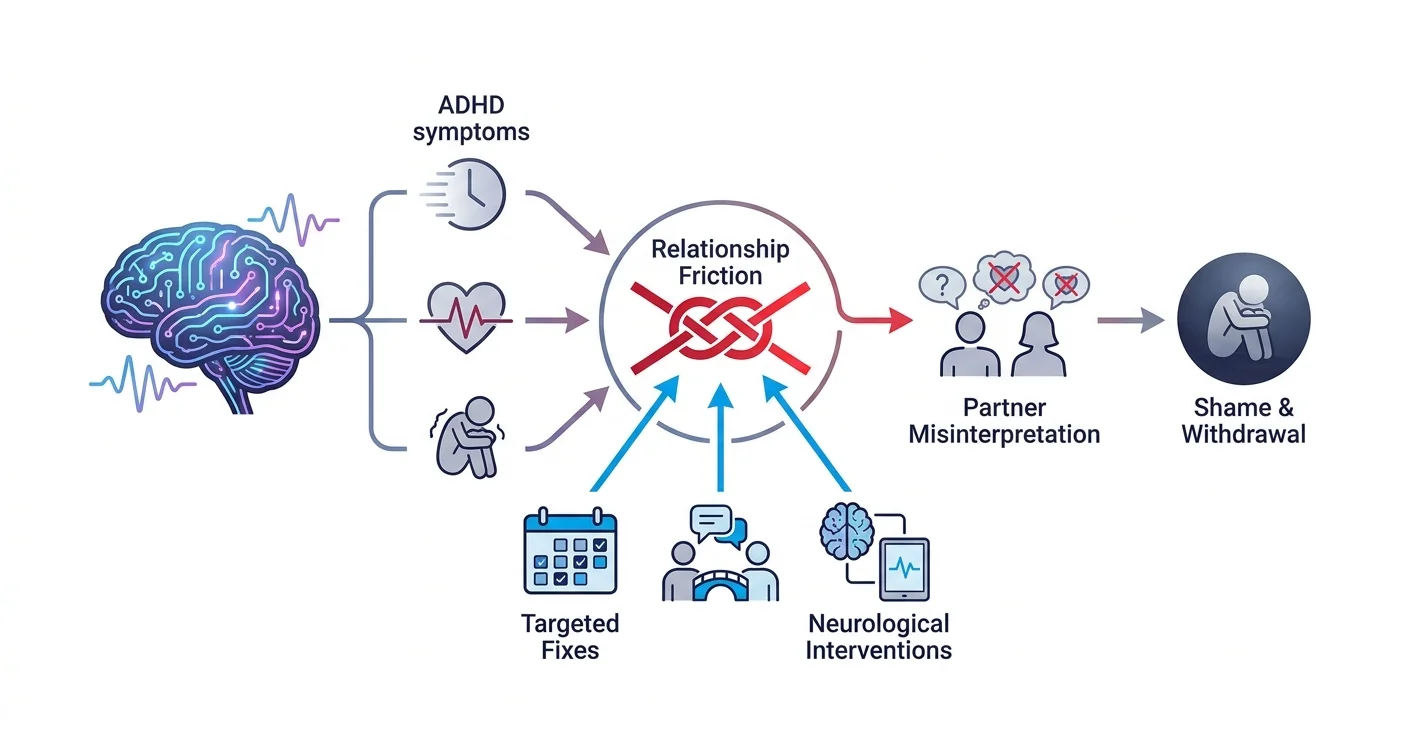
ADHD and relationships create a specific pattern of friction — not because either person is bad at loving, but because the ADHD brain processes time, emotions, and attention differently than most relationship advice assumes.
TL;DR: ADHD and relationships clash most around four things: emotional dysregulation, time blindness, inconsistent attention, and rejection sensitivity. These patterns are neurological, not character flaws. In 2026, adults with ADHD have more targeted tools than ever — from communication scripts to AI-assisted emotional coaching — to interrupt the cycles before they become breakup triggers. This guide walks you through the specific fixes, step by step.
Why ADHD disrupts close relationships
About 4.4% of adults in the U.S. have diagnosable ADHD, and the majority are in long-term relationships. The problems that surface — forgetting plans, zoning out mid-conversation, explosive reactions to small criticisms — are not signs of not caring. They are predictable symptoms of a brain that struggles with working memory, impulse control, and emotional regulation.
The non-ADHD partner frequently interprets these behaviors as disrespect or low investment. The ADHD partner frequently feels misunderstood, ashamed, and blamed for something they cannot simply will away. That cycle — behavior, misinterpretation, shame, withdrawal — is what breaks relationships, not the ADHD itself.
The fixes below are practical. Each step names a specific challenge, explains the mechanism, and gives you a concrete action.
What you'll need
- Honest acknowledgment from both partners that ADHD symptoms are real and neurological
- 15–20 minutes of uninterrupted time at least 3 times per week for structured check-ins
- A communication framework (provided in Step 3 below)
- An emotional regulation tool — journaling, voice check-ins, or an app like Lovon that gives you on-demand support between those conversations
- Willingness to track patterns without blame
The steps
Step 1 — Name which symptoms are actually causing the friction
Before you can fix a pattern, you need to identify which ADHD symptom is driving it. "We keep fighting" is not actionable. "I forget to respond to texts, and my partner feels ignored" is.
The four most relationship-damaging ADHD symptoms are: time blindness (losing track of commitments), hyperfocus flip (intense attention early in the relationship that drops off and feels like withdrawal), emotional dysregulation (disproportionate reactions to conflict), and rejection sensitive dysphoria, or RSD (extreme emotional pain triggered by perceived criticism).
Write down the last three conflicts. For each one, identify which of those four symptoms was most active. You will almost always see a pattern in two sessions of this exercise. That pattern tells you where to spend 80% of your repair energy.
Common mistake: Labeling everything as "communication issues." Communication is a symptom, not a root cause. Treating it without addressing the underlying ADHD driver wastes months.
Step 2 — Separate ADHD behavior from intent
The single most productive reframe in ADHD relationships is this: behavior is not intent. Forgetting an anniversary is not evidence of indifference. Interrupting is not evidence of disrespect. The ADHD brain's executive function deficit creates the behavior; the intent is usually entirely separate.
This does not mean the non-ADHD partner must absorb everything without complaint. It means both partners need a shared vocabulary that keeps the conversation on the behavior and its impact, not on character.
A practical way to do this in 2026: before a difficult conversation, both partners write one sentence — "When [specific behavior] happens, I feel [emotion]." That structure keeps the conversation factual. The ADHD partner can then respond to a concrete event rather than a global indictment of who they are.
Expected outcome: Fewer conversations that escalate into "you always" and "you never" loops.
Common mistake: The non-ADHD partner using the ADHD diagnosis as a blanket explanation for every difficulty in the relationship. Some friction is unrelated to ADHD, and conflating the two creates resentment.
Step 3 — Build a weekly relationship check-in that accounts for ADHD
Standard relationship advice says "talk more." That does not work when one partner has working memory deficits and difficulty with open-ended emotional conversations.
Instead, build a structured 15-minute weekly check-in using three fixed questions:
- "What was one thing this week that felt good between us?"
- "What was one moment that felt hard, and what did you need in that moment?"
- "What do we want to do differently this week?"
Set it as a recurring calendar event — same day, same time. The ADHD partner should not be expected to remember to initiate it. The structure removes the reliance on spontaneous memory.
What it accomplishes: Small issues get addressed before they compound. The non-ADHD partner gets consistent, predictable attention. The ADHD partner gets a container that reduces the cognitive load of "knowing when to bring things up."
Common mistake: Skipping the check-in when the week felt fine. Consistency matters more than urgency. The check-in is maintenance, not crisis management.
Step 4 — Create an RSD protocol before the next incident
Rejection sensitive dysphoria is one of the least-discussed but most destructive ADHD-related experiences in relationships. A single critical tone in a partner's voice can trigger a flood of shame that feels — neurologically — as intense as physical pain. The ADHD partner then either explodes or shuts down completely. The non-ADHD partner has no idea what just happened.
The protocol has three parts. First, the ADHD partner identifies their personal RSD triggers — which types of criticism, tones, or phrasing activate the response most reliably. Second, both partners agree on a pause phrase (something simple like "I need five minutes") that signals an RSD spike without it turning into an exit or an attack. Third, the ADHD partner has a pre-agreed solo regulation tool — a breathing exercise, a short voice journal, or a quick session with a tool like Lovon — to discharge the intensity before re-engaging.
Common mistake: Trying to reason through an RSD spike in real time. The prefrontal cortex is offline during the response. Reasoning re-engages after the nervous system calms, not before.
Step 5 — Address hyperfocus fade directly
Many ADHD relationships start with an intoxicating level of attention — constant contact, grand gestures, deep conversations. When the hyperfocus shifts (as it always does, because hyperfocus is not sustainable), the non-ADHD partner experiences it as abandonment or loss of attraction.
Name this pattern explicitly, ideally before it becomes a source of pain. The ADHD partner can say: "Early on I was hyperfocused on us, which felt amazing. That intensity will shift, but it does not mean I care less — it means my brain moved to its normal operating mode. Here's what consistent love from me looks like day-to-day."
Define what consistent looks like in concrete terms: a daily good-morning text, one planned date per week, checking in at the end of the workday. Specificity matters because vague commitments are the first casualties of ADHD working memory.
Common mistake: Expecting the ADHD partner to sustain the hyperfocus phase. That expectation will always result in disappointment. The goal is a stable, realistic baseline — not the high of early infatuation.
Step 6 — Use external accountability structures instead of willpower
Telling an ADHD partner to "just remember" is the relationship equivalent of telling someone with a broken leg to "just walk." Willpower is the wrong tool for a working memory problem.
External structures that actually work in 2026:
- Shared digital calendar with 24-hour reminders for anything relationship-related
- Body doubling for tasks the ADHD partner consistently avoids (finances, planning, chores) — doing them together in the same space, even on video call
- Recurring automations — recurring grocery orders, automatic bill payments, scheduled restaurant reservations — that remove the need for the ADHD partner to initiate
- AI-assisted emotional check-ins for processing frustration before it becomes a fight — tools like AI therapy for ADHD emotional regulation give the ADHD partner a low-barrier outlet that does not burden the relationship
Common mistake: The non-ADHD partner taking over all executive function tasks and building resentment. The goal is shared external structures, not a parent-child dynamic.
Step 7 — Get aligned on what "fair" looks like, not what "equal" looks like
Equal contribution does not work in an ADHD relationship. If one partner has a neurological difficulty with task initiation and working memory, splitting chores 50-50 by count will always feel unfair to the non-ADHD partner — because the ADHD partner will miss their half at a higher rate.
Fair contribution is about playing to strengths. The ADHD partner may be exceptional at high-stimulation tasks (emergency situations, creative problem-solving, social engagements) and genuinely terrible at low-stimulation recurring tasks (weekly cleaning, tracking appointments). Assign tasks accordingly and stop measuring by hours or item count.
Have this conversation explicitly, using a written list. Verbal agreements made in goodwill get lost in working memory. A shared note that both partners can reference removes the "I thought we agreed" loop.
Troubleshooting
"We've tried the check-ins but they turn into fights." The check-in is starting when one or both partners are already dysregulated. Add a rule: if either person rates their stress level above a 7 out of 10 when the check-in starts, reschedule it within 24 hours. Never attempt structured emotional conversations in activated nervous system states.
"My ADHD partner agrees to everything in the moment and forgets by tomorrow." Verbal agreements are not binding with ADHD. Every commitment made in a check-in goes into a shared written note immediately. Both partners confirm receipt. The note is the agreement, not the conversation.
"The non-ADHD partner feels like a parent." This is a sign the current structure puts too much executive function management on one person. Redistribute — use external tools and automation rather than the non-ADHD partner's reminders. If the dynamic has calcified, a few sessions of AI couples therapy for communication problems can surface the patterns without the emotional cost of a live argument.
"RSD is making normal feedback impossible." If every piece of gentle feedback triggers a shutdown or explosion, that is a clinical-level RSD presentation. An ADHD specialist or psychiatrist can assess whether medication (particularly non-stimulant options like guanfacine) meaningfully reduces RSD intensity. Behavioral tools alone often cannot manage severe RSD.
"My partner doesn't accept the ADHD diagnosis as real." This is a values mismatch, not a communication problem. Couples cannot build adaptive strategies around a condition one partner refuses to accept. A shared educational resource — an ADHD-specialist therapist or a research-backed article — can sometimes shift this. But the non-ADHD partner's willingness to accept the neurological reality is a hard prerequisite for the steps above to work.
"We're long-distance and the ADHD symptoms feel amplified." Time blindness and inconsistent contact hit harder in long-distance relationships because there is no physical presence to fill in the gaps. Structure communication windows with even more rigidity — specific times, not just "we'll talk tonight." The AI relationship advice for long-distance couples guide covers this pattern in more detail.
Tools and resources
- Lovon — voice-based AI emotional support for processing ADHD-driven relationship stress between conversations or therapy sessions. Available on demand, 24 hours a day. Built with input from PhD psychologists and designed specifically for adults dealing with anxiety, relationship friction, and ADHD.
- ADHD emotional dysregulation tools — a focused guide on the specific regulation strategies that work for the ADHD nervous system
- Shared calendar apps — Google Calendar or Apple Calendar with shared event access and push notifications
- Body doubling tools — Focusmate or similar virtual co-working platforms for task accountability
- Written agreements — Notion, Apple Notes, or any shared app both partners can access and edit
What to do next
If emotional dysregulation is the loudest problem in your relationship right now, start with Step 4 (the RSD protocol) before anything else — it prevents the most damage fastest.
If the overall communication structure is broken, start with Step 3 (weekly check-in) and give it four consecutive weeks before evaluating.
For a deeper dive into how ADHD and anxiety overlap in relationships — which is common, since roughly 50% of adults with ADHD also meet criteria for an anxiety disorder — the guide on ADHD and anxiety overlap covers that intersection specifically.
FAQ
What are the most common ADHD relationship problems in 2026? The four most common are: forgetting commitments (time blindness), inconsistent attention after early hyperfocus, emotional overreactions during conflict, and intense shame responses to criticism (rejection sensitive dysphoria). All four are neurological, not motivational.
Can an ADHD person have a healthy long-term relationship? Yes. ADHD and relationships can work well when both partners understand the neurological basis of the symptoms, build external structures to support working memory, and treat emotional regulation as a shared responsibility rather than a character problem.
Is ADHD worse for the relationship or the individual with ADHD? Both partners carry costs. The non-ADHD partner frequently absorbs extra executive function labor and experiences unpredictability. The ADHD partner frequently carries shame, guilt, and the exhaustion of masking or compensating. Neither experience is trivial.
How do you explain ADHD to a partner who doesn't believe it's real? Start with neurological framing: ADHD involves measurable differences in dopamine regulation and prefrontal cortex activity. The American Psychiatric Association recognizes it in the DSM-5-TR. An ADHD specialist can provide documentation and psychoeducation to a skeptical partner more credibly than the diagnosed partner alone.
Does ADHD cause relationship anxiety? Indirectly, yes. The chronic experience of forgetting things, disappointing partners, and feeling misunderstood creates a baseline of anxiety in many adults with ADHD. Rejection sensitive dysphoria amplifies this further. In 2026, this overlap is well-documented — roughly half of adults with ADHD also have a diagnosable anxiety condition.
Can ADHD medication improve relationships? For some people, yes — particularly for time blindness, impulse control, and emotional dysregulation. Stimulant medications improve executive function, which reduces the frequency of forgotten commitments and reactive outbursts. RSD, however, responds better to non-stimulant options or targeted therapy than to stimulants alone.
How long does it take for ADHD relationship patterns to change? Behavioral change with structured effort typically shows measurable improvement in 6–12 weeks when both partners engage consistently. Deep emotional repair after years of accumulated conflict takes longer — often 6 months to a year of consistent practice.
Is it worth staying in a relationship with someone who has ADHD? That depends entirely on whether both partners are willing to do the work. ADHD is manageable with the right structures. An undiagnosed, unacknowledged, or unsupported ADHD partner in a relationship where neither person understands what's happening — that is where relationships fail.
One last thing
Research published in the Journal of Attention Disorders found that relationship satisfaction in ADHD-affected couples improved significantly when partners received psychoeducation together — not separately. The act of learning about ADHD as a team, rather than the non-ADHD partner researching to "manage" the other, shifts the dynamic from adversarial to collaborative. That shift is, in most cases, the actual turning point. Everything in this guide works better inside that frame.
Related guides
How AI Support Helps You Heal
AI emotional support isn't about replacing human connection — it's about filling the gaps. The moments when you need to talk at 2 AM, when you don't want to burden your friends again, or when you simply need someone to listen without judgment.
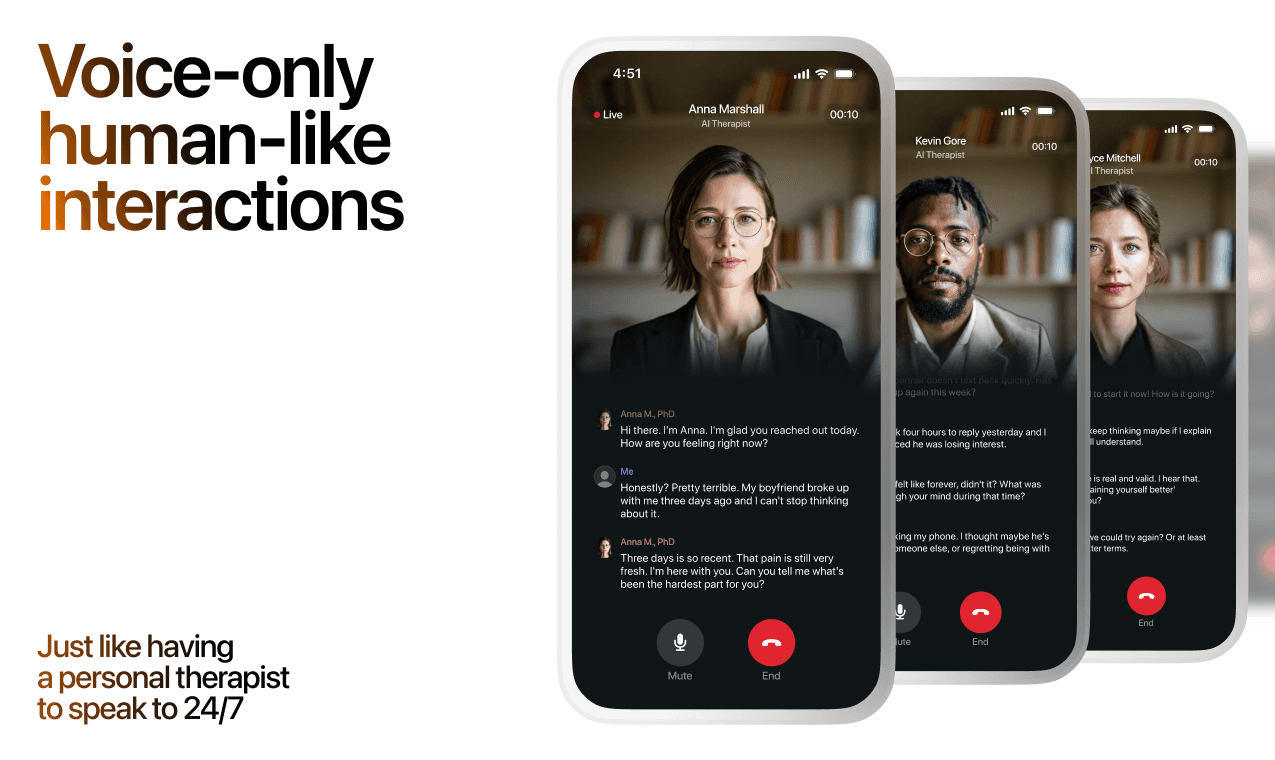
Here's what happens in a typical Lovon session:
You share what's on your mind
There's no script, no intake form, no waiting room. You speak or type whatever you're feeling — in your own words, at your own pace.
Lovon validates and explores
Using frameworks from CBT (Cognitive Behavioral Therapy) and motivational interviewing, Lovon acknowledges your feelings first, then gently helps you explore them. No dismissive "just move on" advice.
You build coping skills together
Lovon doesn't just listen — it actively works with you on evidence-based techniques: thought reframing, urge surfing, behavioral experiments, and more.
What a Session with Lovon Looks Like
When to Seek Professional Help
AI support is a valuable tool, but it's not a replacement for professional care. Please consider reaching out to a licensed therapist if you experience any of the following:
- Persistent thoughts of self-harm or suicide
- Inability to perform daily activities (work, eating, sleeping) for more than 2 weeks
- Turning to alcohol or substances to cope
- Intense anger or desire to harm your ex-partner
- Complete emotional numbness that doesn't improve over time
Crisis Resources (US): If you're in immediate danger, call 988 (Suicide & Crisis Lifeline) or text HOME to 741741 (Crisis Text Line). Available 24/7, free, and confidential.
Outside the US? Find a crisis line in your country
Ready to Start?
Your healing journey can begin right now
A 7-day trial. No judgment. Just a safe space to process what you're going through.
Frequently Asked Questions
Is Lovon a replacement for a real therapist?
Is my conversation with Lovon AI private?
How is Lovon different from ChatGPT for emotional support?
Can I use Lovon if I'm already seeing a therapist?
Can I try Lovon before subscribing?
About the Author
The Lovon Editorial Team
Mental Health & Wellness Content Team
The Lovon Editorial Team develops mental health and wellness content designed to make psychological concepts accessible and actionable. Our goal is to bridge the gap between clinical research and everyday life - helping you understand why your mind works the way it does and what you can do about it....
Related articles
- ADHD Sleep Problems: Why Your Brain Fights Bedtime 2026
ADHD sleep problems affect 75% of adults with ADHD. Learn why your brain resists sleep and get a 7-step wind-down system…
- ADHD — Emotional Costs of Undiagnosed Cases Including Rejection Sensitivity Dysphoria and Chronic Loneliness
Living with undiagnosed ADHD creates an invisible emotional burden that extends far beyond difficulty focusing or…
- ADHD in College Students: Deadlines and Focus in 2026
ADHD in college students means missed deadlines and scattered focus — see what actually works in 2026, from…
- Best AI for ADHD: Tools That Help You Focus (2026)
The best AI for ADHD in 2026 — from task-breakdown tools to emotional support apps. Find out which tools match how an…
See also
Quizzes
- Loneliness Test: Free 12-Question Self-Check
See which kind of loneliness is thin, in 3 minutes.
- Highly Sensitive Person Test: How Much Do You Take In?
See how deeply you process, notice and get overloaded.
Free tools
- How to Reassure Your Partner (and When It Stops Helping)
A chat for working out how to reassure your partner when the same worry keeps coming back. Say what sets it off and how…
- What Did They Actually Mean By That?
A chat for one sentence you cannot stop re-reading. Paste their exact words and what was happening around them, and get…
From the wiki
- Why do I feel lonely all of a sudden?
Sudden loneliness usually traces back to something that quietly ended in the last few months: a routine, a shared class…
Disclaimer: This article is for informational purposes only and does not constitute medical advice, diagnosis, or treatment. Always seek the advice of your physician or other qualified health provider with any questions you may have regarding a medical condition. If you are in crisis or think you may have an emergency, call 988 (Suicide & Crisis Lifeline) or go to the nearest emergency room. Outside the US? Find a crisis line in your country.