
AI Relationship Advice for Long-Distance Couples 2026
The best AI relationship advice for long-distance couples in 2026. Lovon's voice-based AI coach gives on-demand support for conflict, anxiety, and communication—free to start.

Key Takeaways
- AI tools that require both partners to be active users simultaneously. Long-distance conflict rarely happens when
- Generic wellness apps rebranded as relationship tools. If the tool's primary use case is meditation or step-counting
- Advice that treats long-distance as a temporary problem. Some long-distance relationships span years. Tools that
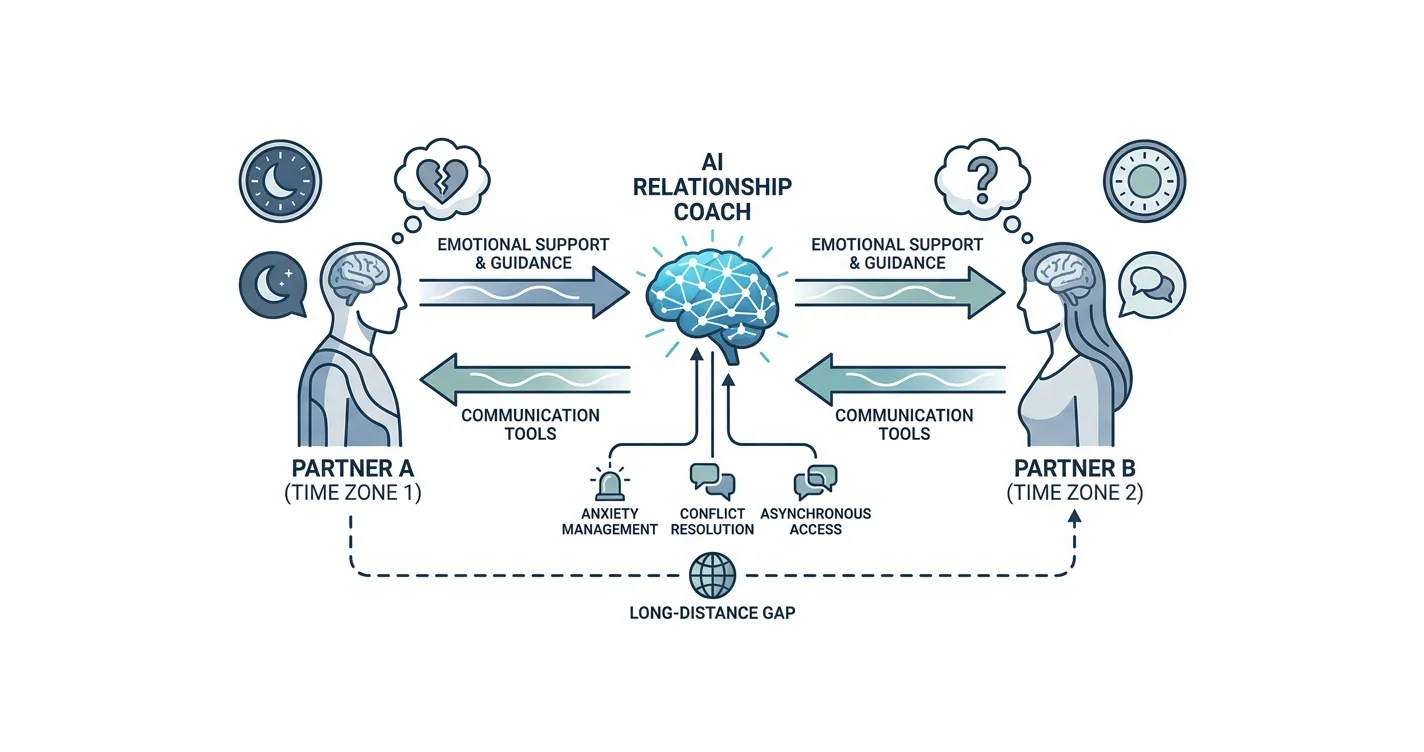
Long-distance relationships fail at a higher rate than co-located ones—not because the love isn't real, but because the communication tools most couples rely on weren't built for the specific stress of physical separation. AI relationship advice for long-distance couples has emerged in 2026 as a practical, on-demand way to work through that gap.
TL;DR: Long-distance couples need advice that accounts for time zones, asynchronous emotional cycles, and the anxiety that compounds when you can't read body language. Lovon's AI relationship coach delivers on-demand, voice-based guidance tailored to exactly those dynamics—available at 2 a.m. when your partner is asleep eight time zones away. If you're managing distance-related jealousy, communication breakdowns, or reunion anxiety, Lovon is the tool to start with in 2026.
Why This Matters
About 14 to 15 million people in the United States identify as being in a long-distance relationship at any given time, according to aggregated survey data. The core challenge isn't missing someone—it's that negative emotional spirals escalate faster when you can't physically comfort each other. A misread text at 11 p.m. becomes a three-day cold war. Traditional therapy appointments, which average $150–$200 per session in 2026, require both partners to be available, motivated, and solvent at the same time. AI-powered support removes the scheduling constraint entirely.
Who This Guide Is For
This guide is written for one specific buyer: the partner in a long-distance relationship who is doing the emotional heavy lifting. You're the one who lies awake parsing your last conversation. You've probably already Googled "why does my partner feel distant" at an hour when no therapist was available. You want specific, structured advice you can act on tonight—not a waitlist.
This is also relevant if you're the partner who shuts down during conflict and doesn't know why. AI-guided sessions let you explore that pattern in private before you try to explain it to your partner.
What to Look for in AI Relationship Advice for Long-Distance Couples
1. Voice-First Interaction
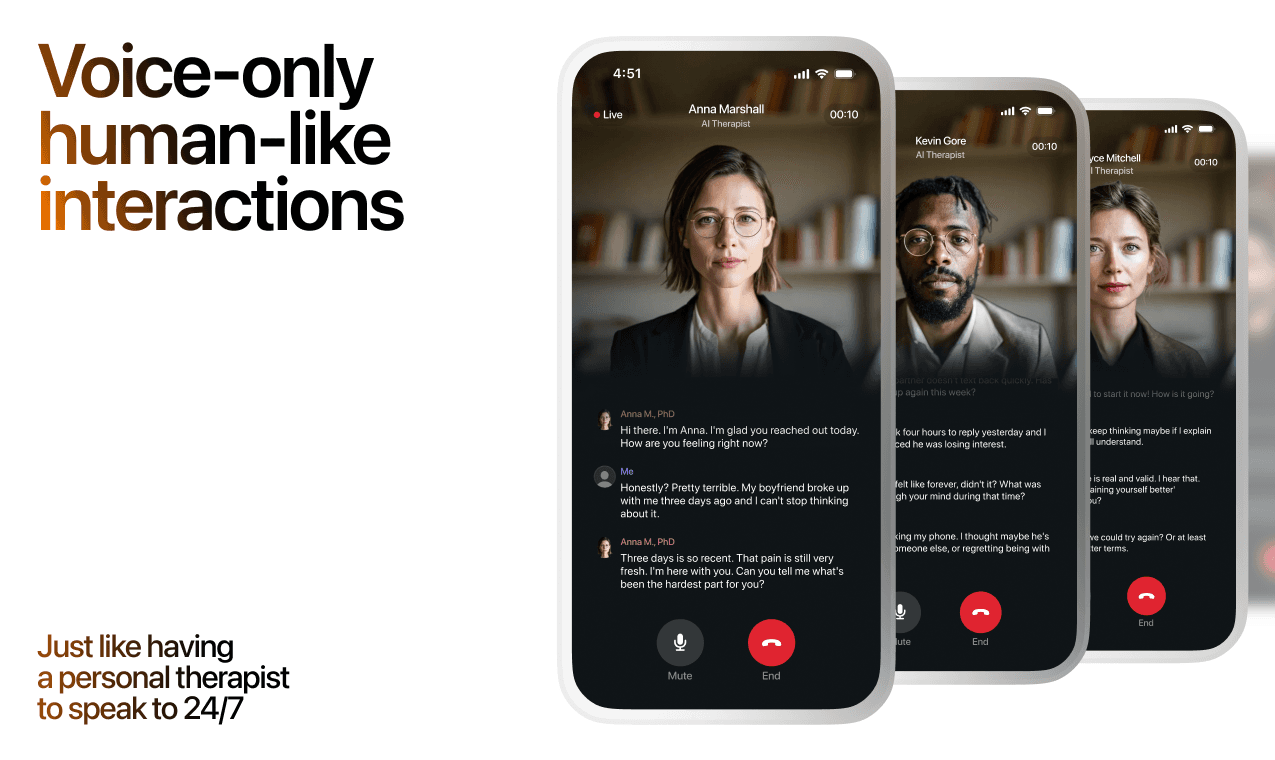
Typing out your feelings at midnight is a friction point that makes most apps useless exactly when you need them most. A voice-based AI coach removes that barrier. Lovon's sessions run on voice, which means you can talk through a conflict the same way you'd talk through it with a human—messy, real-time, and without having to edit yourself for a text box. For long-distance couples, who already do most of their connection through voice and video, this format matches how you actually communicate.
2. Asynchronous Emotional Support
Your partner is in Berlin; you're in Chicago. When you hit an emotional wall at 10 p.m. local time, it's 4 a.m. there. You need support that doesn't depend on your partner being awake or available. The best AI relationship tools in 2026 are asynchronous by design—you get a full session now, and you decide later what to bring back into your relationship conversation. This prevents the escalation that happens when one partner forces an emotionally loaded discussion at the wrong time.
3. Attachment-Aware Guidance
Long-distance stress doesn't affect all attachment styles equally. Anxious-attachment partners experience hypervigilance during gaps in communication. Avoidant partners often withdraw further when they sense pressure—which the anxious partner then reads as rejection. Generic relationship advice ignores this entirely. Look for an AI tool that identifies your attachment pattern early and shapes its guidance around it. Lovon's approach includes personalized sessions that adapt to your stated emotional patterns rather than delivering one-size advice.
4. Coping Tools for Distance-Specific Anxiety
Relationship anxiety in a long-distance context is distinct from general anxiety. It has specific triggers: the unanswered message, the canceled call, the "I'm just tired" that you can't verify with a glance. An AI relationship coach worth using in 2026 should offer discrete coping techniques—breathing exercises, cognitive reframing prompts, journaling scaffolds—targeted at those triggers. Not generic stress relief, but tools calibrated to the uncertainty of not being in the same room.
5. Conflict De-escalation Without a Joint Session
Most couples' therapy models require both partners present. That's a hard constraint when one partner is resistant, unavailable, or in a different time zone. AI relationship advice lets the willing partner do preparatory work: clarify what they actually feel, identify the pattern driving the conflict, and script a calmer version of the conversation they need to have. This solo-use model is particularly valuable for long-distance couples who can't sit down together on short notice.
6. No-Commitment Access
Long-distance relationships are already financially strained—separate rents, travel costs, and the subscription fatigue of every digital connection tool you've paid for. The best AI relationship tools in 2026 offer meaningful free access so you can determine whether the approach actually fits before you pay anything. Lovon's AI relationship coach starts free, with no credit card required at the door.
Top Picks: AI Tools for Long-Distance Relationship Support
Lovon AI Relationship Coach — The Anchor Pick
This is the direct recommendation for long-distance couples dealing with anxiety, communication breakdown, or recurring conflict patterns. Lovon delivers voice-based, on-demand sessions—not a chatbot, not a quiz, but a structured AI-guided conversation that pulls from evidence-based therapeutic frameworks. Sessions are available 24 hours a day, which matters specifically when your emotional crisis doesn't align with business hours or your partner's time zone. The tool is built for mental health use cases including relationship issues, anxiety, and stress, which maps precisely onto what long-distance couples actually need in 2026.
Verdict: Buy. This is the starting point. Use it solo first, then decide what you want to share with your partner.
Lovon AI Voice Companion — For When It's More Than Relationship Stress
Sometimes what looks like long-distance strain is actually untreated anxiety or depression that the distance is amplifying. If you've been in your relationship for more than a year and the emotional dysregulation predates the distance, the free session option on Lovon is worth running alongside the relationship coach. It handles anxiety, depression, and stress with the same voice-first, on-demand format.
Verdict: Consider. Use alongside the relationship coach if you recognize anxiety symptoms that aren't entirely relationship-sourced.
Compatibility Assessment — Before the Next Difficult Conversation
If your long-distance relationship is approaching a decision point—moving in together, ending the distance, or ending the relationship—the compatibility quiz surfaces the structural compatibility data both partners actually need. It covers values, communication style, and life direction. Running it before a high-stakes conversation gives you concrete language to anchor that conversation.
Verdict: Consider. Best used when you're at a decision inflection point, not during an active conflict.
Generic AI Chatbots (ChatGPT, Gemini, Claude) — The Tempting Shortcut
These tools will generate relationship advice on demand. The problem: they have no session continuity, no attachment-aware framework, and no mental health scaffolding. You'll get plausible-sounding text that doesn't adapt to your actual situation. For a one-off question, fine. As a replacement for structured relationship support, they underperform tools built specifically for emotional and mental health contexts.
Verdict: Skip as a primary tool. Use for quick information, not emotional processing.
Couples Journaling Apps — The Passive Option
Apps like Paired and Lasting generate daily prompts for couples. They're low-friction and useful for maintenance. They are not built for active conflict, acute anxiety spikes, or the 2 a.m. emotional crisis. They assume both partners are engaged and relatively stable—which is the exception, not the rule, for long-distance couples in 2026.
Verdict: Hold. Fine as a supplement. Not a substitute for on-demand emotional support.
What to Avoid
- AI tools that require both partners to be active users simultaneously. Long-distance conflict rarely happens when both partners are calm, available, and motivated. Any tool that gates support behind mutual participation will fail you at the worst moments.
- Generic wellness apps rebranded as relationship tools. If the tool's primary use case is meditation or step-counting and the relationship feature is a tab in the menu, the guidance will be too shallow to handle real conflict.
- Advice that treats long-distance as a temporary problem. Some long-distance relationships span years. Tools that frame distance as a phase to "get through" rather than a context to manage actively will give you advice calibrated for the wrong situation.
Verdict Comparison Table
| Tool | Voice-First | 24/7 Access | Attachment-Aware | Solo Use | Free Tier | Best For |
|---|---|---|---|---|---|---|
| Lovon AI Relationship Coach | Yes | Yes | Yes | Yes | Yes | Active conflict, anxiety, daily support |
| Lovon AI Voice Companion | Yes | Yes | Yes | Yes | Yes | Anxiety/depression alongside relationship issues |
| Compatibility Quiz | No | Yes | Partial | Yes | Yes | Decision-point conversations |
| Generic AI Chatbots | No | Yes | No | Yes | Yes | Quick factual questions only |
| Couples Journaling Apps | No | Yes | No | No | Partial | Relationship maintenance |
FAQ
What is the best AI tool for long-distance relationship advice in 2026? Lovon's AI relationship coach is the strongest purpose-built option in 2026 for long-distance couples. It combines voice-based sessions, on-demand 24/7 access, and a mental health framework that handles anxiety, communication breakdown, and conflict—all without requiring your partner to be present.
Can AI relationship advice actually help a long-distance couple? Yes, when the tool is built for emotional support rather than general conversation. AI guidance helps you identify patterns, de-escalate before a call, and process feelings you haven't organized yet. It doesn't replace your partner or a human therapist, but it fills the gap between sessions and between time zones.
Is AI relationship coaching safe for mental health? Tools built within a mental health framework—like Lovon—use evidence-based approaches and are designed for emotional safety. They are not crisis services. If you're experiencing a mental health emergency, contact a crisis line. For day-to-day relationship stress and anxiety, AI coaching in 2026 is a documented, practical support tool.
How is AI relationship advice different from just texting a friend? A friend gives advice based on their own experience and biases. An AI relationship coach applies structured frameworks—communication theory, attachment science, cognitive behavioral techniques—without projecting personal history onto your situation. The advice is more consistent and less likely to take sides.
Does both partners need to use the app for it to work? No. Lovon's AI relationship coach is designed for solo use. One partner can run a full session, work through their communication approach, and bring a clearer, more grounded version of themselves to the next conversation. Joint use is optional, not required.
How much does AI relationship coaching cost in 2026? Lovon starts with a 7-day trial. Premium tiers exist for extended session access. Compared to traditional couples therapy at $150–$200 per session in 2026, even a paid subscription represents a fraction of the cost.
What if my long-distance relationship problems are really about anxiety? That's more common than most couples realize. Distance amplifies pre-existing anxiety. Lovon's platform handles both—the free session tool runs alongside the relationship coach so you can address the anxiety layer directly, not just the relationship symptom.
Can AI help me decide if my long-distance relationship is worth continuing? AI can give you a structured framework for that question—values alignment, communication compatibility, life-direction fit—but it won't make the decision for you. The compatibility assessment on Lovon surfaces the underlying data. What you do with it is yours.
One Last Thing
The couples who most successfully maintain long-distance relationships in 2026 aren't the ones who communicate more—they're the ones who communicate better. Frequency without structure produces more conflict, not less. One focused, emotionally prepared conversation after a Lovon session consistently outperforms five reactive check-ins sent when you're already dysregulated. That's the lever worth pulling.
Related Guides
How AI Support Helps You Heal
AI emotional support isn't about replacing human connection — it's about filling the gaps. The moments when you need to talk at 2 AM, when you don't want to burden your friends again, or when you simply need someone to listen without judgment.
Here's what happens in a typical Lovon session:
You share what's on your mind
There's no script, no intake form, no waiting room. You speak or type whatever you're feeling — in your own words, at your own pace.
Lovon validates and explores
Using frameworks from CBT (Cognitive Behavioral Therapy) and motivational interviewing, Lovon acknowledges your feelings first, then gently helps you explore them. No dismissive "just move on" advice.
You build coping skills together
Lovon doesn't just listen — it actively works with you on evidence-based techniques: thought reframing, urge surfing, behavioral experiments, and more.
What a Session with Lovon Looks Like
When to Seek Professional Help
AI support is a valuable tool, but it's not a replacement for professional care. Please consider reaching out to a licensed therapist if you experience any of the following:
- Persistent thoughts of self-harm or suicide
- Inability to perform daily activities (work, eating, sleeping) for more than 2 weeks
- Turning to alcohol or substances to cope
- Intense anger or desire to harm your ex-partner
- Complete emotional numbness that doesn't improve over time
Crisis Resources (US): If you're in immediate danger, call 988 (Suicide & Crisis Lifeline) or text HOME to 741741 (Crisis Text Line). Available 24/7, free, and confidential.
Outside the US? Find a crisis line in your country
Ready to Start?
Your healing journey can begin right now
A 7-day trial. No judgment. Just a safe space to process what you're going through.
Frequently Asked Questions
Is Lovon a replacement for a real therapist?
Is my conversation with Lovon AI private?
How is Lovon different from ChatGPT for emotional support?
Can I use Lovon if I'm already seeing a therapist?
Can I try Lovon before subscribing?
About the Author
The Lovon Editorial Team
Mental Health & Wellness Content Team
The Lovon Editorial Team develops mental health and wellness content designed to make psychological concepts accessible and actionable. Our goal is to bridge the gap between clinical research and everyday life - helping you understand why your mind works the way it does and what you can do about it....
Related articles
- How to Use an AI Relationship Coach Daily (2026)
Learn how to use an AI relationship coach daily with Lovon. 7 steps to build communication skills, manage conflict, and…
- Love Language Compatibility Quiz for Couples 2026
The best love language compatibility quiz in 2026 maps both partners' scores side-by-side, flags mismatches, and…
- Is couples therapy worth it if one partner refuses?
Is couples therapy worth it if one partner refuses? Individual support can help you decide what to do, but it cannot…
- Is long-distance love realistic in the long run?
Is long distance love realistic? Yes, with mutual effort, honest communication, and a workable future. Learn how to…
See also
Quizzes
- Am I in Love? 13-Question Gut Check
Know what you feel in 2 minutes.
- How Well Do You Know Your Partner? 15-Question Quiz
Find out how out of date your picture of them is.
Free tools
- I Miss You Texts That Don't Sound Copied
I miss you texts written from what you actually miss. Tell it who you miss and why you are apart: distance, a busy…
- Relationship Check-In Questions, and How to Run One
Check-ins fail on structure, not on questions. Tell it whether this would be your first one, what is on your mind, and…
From the wiki
- What does clingy mean in a relationship?
Clingy is what people call behavior that asks for more contact or reassurance than the other person wants to give…
Disclaimer: This article is for informational purposes only and does not constitute medical advice, diagnosis, or treatment. Always seek the advice of your physician or other qualified health provider with any questions you may have regarding a medical condition. If you are in crisis or think you may have an emergency, call 988 (Suicide & Crisis Lifeline) or go to the nearest emergency room. Outside the US? Find a crisis line in your country.