
How to Build a Routine With ADHD (2026 Guide)
Learn how to build a routine with ADHD using anchor habits, external cues, and a built-in reset rule. Step-by-step guide backed by behavioral science for 2026.

Key Takeaways
- A phone with a reliable alarm or reminder app (calendar, clock, or a dedicated habit tracker)
- 2–3 anchor habits you already do daily without thinking (waking up, making coffee, brushing teeth)
- A piece of paper or whiteboard visible from your bed or desk
- 15 minutes to plan, once, before you start
- Patience for a 2-week adjustment window — research on habit formation consistently points to 18–66 days for new
Building a routine with ADHD is genuinely hard — not because you lack discipline, but because the ADHD brain is wired differently, and most routine advice was written for neurotypical people.
TL;DR: How to build a routine with ADHD comes down to five things: shrink the routine to its smallest possible version, anchor tasks to existing habits instead of the clock, use external prompts (alarms, visual cues, voice reminders) because internal memory is unreliable, build in recovery time so one missed day does not collapse the whole system, and get emotional support when the shame spiral hits. In 2026, these five moves are the evidence-backed foundation — everything else is decoration.
Why this matters
ADHD affects executive function — the brain's ability to plan, initiate tasks, and maintain sequences over time. A routine that works for someone without ADHD leans on working memory and time perception, two things the ADHD brain struggles with structurally. That is not a character flaw. It means the routine itself needs to compensate for those gaps — and once it does, it actually sticks.
What you'll need
- A phone with a reliable alarm or reminder app (calendar, clock, or a dedicated habit tracker)
- 2–3 anchor habits you already do daily without thinking (waking up, making coffee, brushing teeth)
- A piece of paper or whiteboard visible from your bed or desk
- 15 minutes to plan, once, before you start
- Patience for a 2-week adjustment window — research on habit formation consistently points to 18–66 days for new behaviors to feel automatic
Step 1: Audit what you already do
Map your existing automatic behaviors before adding anything new.
Write down every action you do without deciding to do it: waking up, making coffee, checking your phone. These are your anchor habits. They are the scaffolding your new routine will attach to. Trying to build a routine in a vacuum — "I'll wake up at 7 and do yoga and journal and prep breakfast" — skips this and almost always fails within a week.
Spend 10 minutes on this. You are looking for 2–3 solid anchors per day (morning, midday, evening). If you cannot find them, start even smaller: the moment your feet hit the floor is an anchor. Work from there.
Common mistake: Listing what you want to do instead of what you actually do. The audit is descriptive, not aspirational.
Step 2: Design the smallest possible version
Strip the routine down until skipping it feels harder than doing it.
The ADHD brain resists long task chains. A 10-step morning routine almost never survives contact with a bad night's sleep or a distraction. A 3-step routine does. For 2026, the target is a "minimum viable routine" — the version so short it feels almost pointless. That is the version that actually builds consistency.
Example: Instead of "morning routine," commit to these three things only:
- Drink a glass of water before touching your phone.
- Write one thing you need to do today on a sticky note.
- Take any medication within the first 30 minutes of waking.
That is it. Once that is automatic — usually 3–4 weeks in — you add one thing. Never two at once.
Expected outcome: Lower resistance, higher completion rate, less shame when life interrupts.
Step 3: Anchor tasks to existing habits, not time slots
"After I make coffee" beats "at 8:15 AM" every time for ADHD brains.
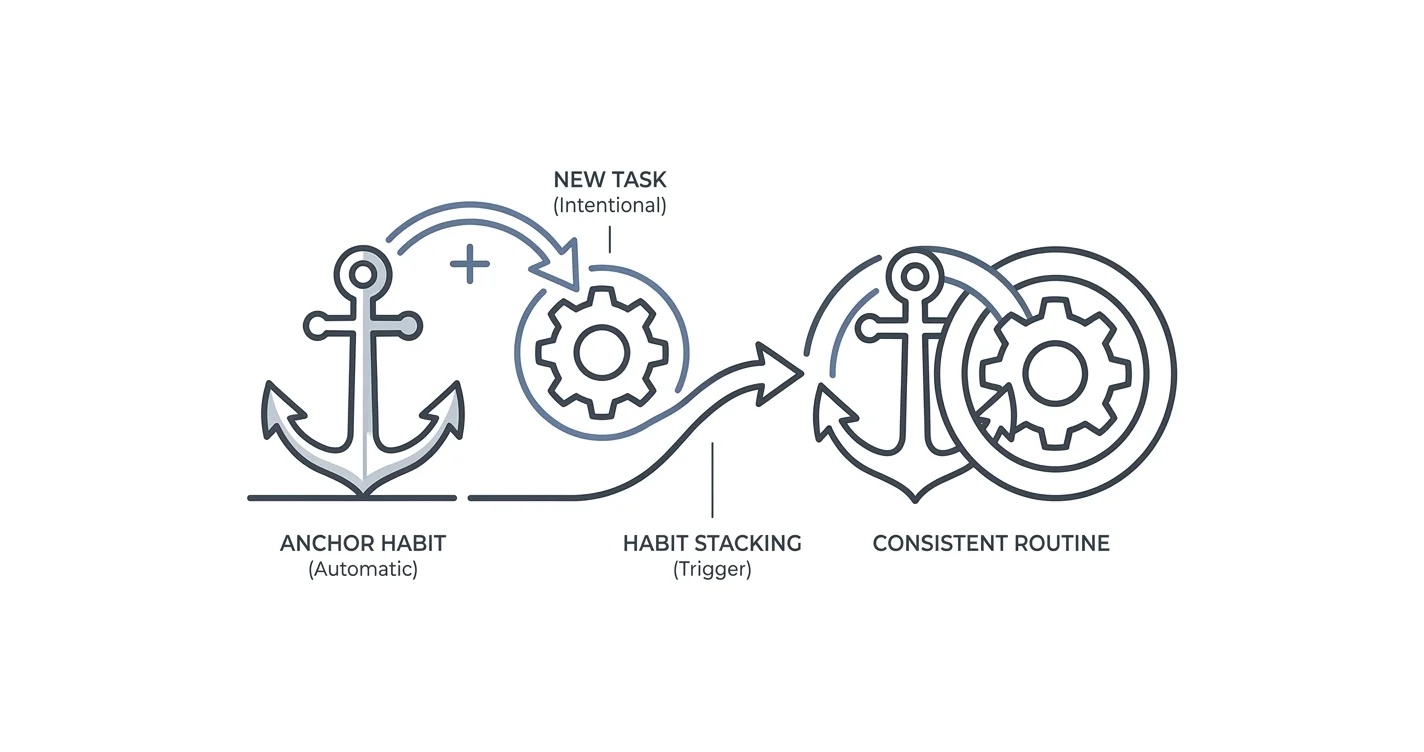
Time-based scheduling requires accurate time perception. ADHD frequently distorts time perception — hours disappear, or five minutes feels like an eternity. Habit stacking (linking a new behavior to an existing one) sidesteps this entirely. The existing behavior acts as a built-in trigger.
Formula: After [existing habit], I will [new habit].
- After I pour my first coffee, I will open my planner.
- After I sit at my desk, I will write today's three priorities.
- After I brush my teeth at night, I will set tomorrow's clothes out.
This approach is grounded in behavioral science around implementation intentions, which show significantly higher follow-through than time-based plans alone.
Common mistake: Stacking too many habits onto one anchor. One new behavior per anchor, maximum.
Step 4: Install external prompts everywhere
Your internal memory is not the cue — the environment is.
ADHD makes "out of sight, out of mind" literal. If the cue lives only in your head, it will not fire reliably. External prompts fix this: phone alarms with descriptive labels ("take meds," "start winding down"), sticky notes at eye level, a visual schedule on the wall, even leaving items physically in your path (shoes by the door, water bottle on the desk).
In 2026, voice-based tools add another layer. Talking through your day out loud — whether with a person, a voice journal, or an AI tool — activates a different cognitive pathway than silent planning and helps externalise what is stuck in working memory.
Lovon's voice conversations work well here: spending 5 minutes talking through your planned routine before bed, or doing a quick verbal debrief after your morning anchors, gives you the auditory reinforcement that purely visual systems miss. It is not about accountability pressure — it is about getting the plan out of your head and into a format your brain can actually track. You can explore AI therapy for ADHD emotional regulation for more on how voice-based support fits into ADHD management.
Expected outcome: Fewer "I completely forgot" moments, less reliance on willpower.
Step 5: Build in the reset, not just the routine
Design your recovery day before you need it.
Every routine breaks. A late night, a stressful event, a hyperfocus spiral that wipes out the afternoon — these are not failures, they are predictable. The ADHD brain is especially vulnerable to the all-or-nothing thinking that turns one missed day into "I have ruined everything" and a week-long collapse.
Decide now what a reset looks like: one anchor habit completed = the routine is back on track. That is all. Not catching up on everything missed. Not a perfect day. Just one anchor done.
Write it somewhere visible: "One anchor = back on track."
This is where emotional regulation matters as much as the system itself. Shame spirals and self-criticism are among the biggest routine killers for people with ADHD — not distraction, not forgetfulness. ADHD emotional dysregulation tools can help you interrupt that spiral before it knocks out the week.
Common mistake: Setting the bar for "back on track" too high. One anchor is enough.
Step 6: Review weekly, adjust monthly
A routine that does not get reviewed dies quietly.
Set a 10-minute weekly check-in — Sunday evening works for most people. Ask three questions only:
- Which anchors ran automatically this week?
- Which ones consistently failed?
- What one change would make the failing one easier?
Do not overhaul. Change one variable. If the morning anchor failed because you hit snooze, move it 20 minutes later. If the evening anchor failed because you are usually exhausted, swap it to midday.
Monthly, ask whether to add one new behavior to the stack. Only add when the existing anchors feel genuinely automatic — not "I am managing it," but "I barely notice doing it."
Expected outcome: A routine that adapts to your real life instead of the ideal version of your life.
Step 7: Address the anxiety and sleep piece directly
Routine failure often starts the night before.
ADHD and disrupted sleep are closely linked — racing thoughts, trouble winding down, and irregular bedtimes all undermine the next day's routine before it starts. If your mornings are consistently chaotic, the fix may be an evening wind-down anchor, not a better alarm.
A 3-step wind-down (stop screens 30 minutes before bed, write tomorrow's one key task, same lights-out time within a 30-minute window) is more effective than any morning routine tweak for people whose sleep is irregular. See ADHD sleep problems for a deeper look at why the ADHD brain resists sleep and what actually helps.
Troubleshooting
The routine works for 3 days and then collapses. The routine is too long or too aspirational. Strip it to one anchor and one attached behavior. Rebuild from there.
I keep forgetting the cues even with alarms. The alarm label is probably generic ("Reminder"). Rename alarms with the exact action: "Drink water now" or "Write your one task." Specificity in the cue reduces the decision step.
I do well on weekdays but weekends destroy everything. Weekends need a separate (shorter) anchor set. Do not apply the weekday routine to a structurally different day. Pick one weekend anchor — usually tied to waking — and build only from that.
I feel too overwhelmed to start at all. This is often task initiation difficulty, not laziness. Set a 2-minute timer and do only the physical motion: open the planner, pick up the pen, pour the water. The action does not have to be completed — starting the motion is the goal.
The shame after a missed day is worse than the missed day itself. This is worth addressing directly, not just pushing through. Rejection-sensitive dysphoria and shame spirals are documented parts of the ADHD experience. ADHD and rejection-sensitive dysphoria explains why the emotional reaction is so intense and what to do about it.
My routine is fine but I cannot follow through on larger goals. Routine and goal execution are related but different skills. Once daily anchors feel stable, AI life coaching for ADHD goal setting addresses the next layer — breaking goals into trackable steps that do not rely on sustained motivation.
Tools and resources
- Phone alarm with action labels — the single highest-impact free tool
- Sticky notes at transition points — desk, bathroom mirror, fridge
- One-page visual schedule — printed, not digital, for mornings when screens are a distraction risk
- Free AI therapist for ADHD adults — voice-based emotional support and structured check-ins available anytime
- AI for ADHD tools that help you focus and follow through — a broader look at AI-assisted tools for ADHD management in 2026
What to do next
Once your core anchors are running on autopilot — 3 to 4 weeks of consistent completion — the logical next layer is emotional regulation. ADHD routines break down most often at the emotional level: overwhelm, shame, dysphoria, or anxiety that makes starting feel impossible. Working on that layer in parallel with the routine itself produces better long-term results than structure alone.
FAQ
What's the best way to build a routine with ADHD? Start with your 2–3 existing automatic habits and attach one new behavior to each using the format "After I [existing habit], I will [new habit]." Keep the total routine under 5 steps until it feels automatic.
How long does it take to build a routine with ADHD? Research on habit formation places the range at 18–66 days for a behavior to feel automatic. For ADHD adults, aim for 4–6 weeks of consistent repetition before adding new elements.
Is a morning routine or an evening routine easier with ADHD? Evening routines are often easier to start with because they do not require the same level of task initiation under time pressure that mornings do. A stable wind-down routine also directly improves the next morning.
Why do I always start a routine and then stop after a few days? The most common cause is a routine that is too long or too ambitious. The second most common is a shame spiral after one missed day that turns into full abandonment. Design your reset rule before you need it.
Can ADHD medication help with routines? Medication can improve executive function and time perception, which makes routines easier to initiate and maintain. But medication alone does not create the routine — the structural anchors still need to be in place. Talk to a prescribing clinician about your specific situation.
Do apps actually help with ADHD routines? Apps that use external prompts — alarms, notifications, voice reminders — help. Apps that rely on you to open them voluntarily are less reliable for ADHD because they require the very initiation skill that ADHD impairs. Voice-based tools lower that barrier significantly.
What should I do when my ADHD routine completely falls apart? Run your reset: complete one anchor habit, just one, and call the routine back on track. Do not attempt to catch up on everything missed. One anchor completed counts as a successful day.
How is building a routine with ADHD different from neurotypical advice? Neurotypical routine advice relies on internal reminders, time perception, and willpower. ADHD routine design externalises all three: visible cues replace internal reminders, anchor-based sequencing replaces time-based scheduling, and a built-in reset rule replaces "just be more disciplined."
One last thing
The ADHD brain is not broken — it is interest-driven and novelty-seeking, which means a routine that felt motivating in week one will feel stale by week four. Build that expectation in from the start: plan a small monthly variation (a different morning playlist, a different order for two tasks) to keep the novelty signal alive without disrupting the structure. Boredom breaks more ADHD routines than difficulty does.
Related guides
How AI Support Helps You Heal
AI emotional support isn't about replacing human connection — it's about filling the gaps. The moments when you need to talk at 2 AM, when you don't want to burden your friends again, or when you simply need someone to listen without judgment.
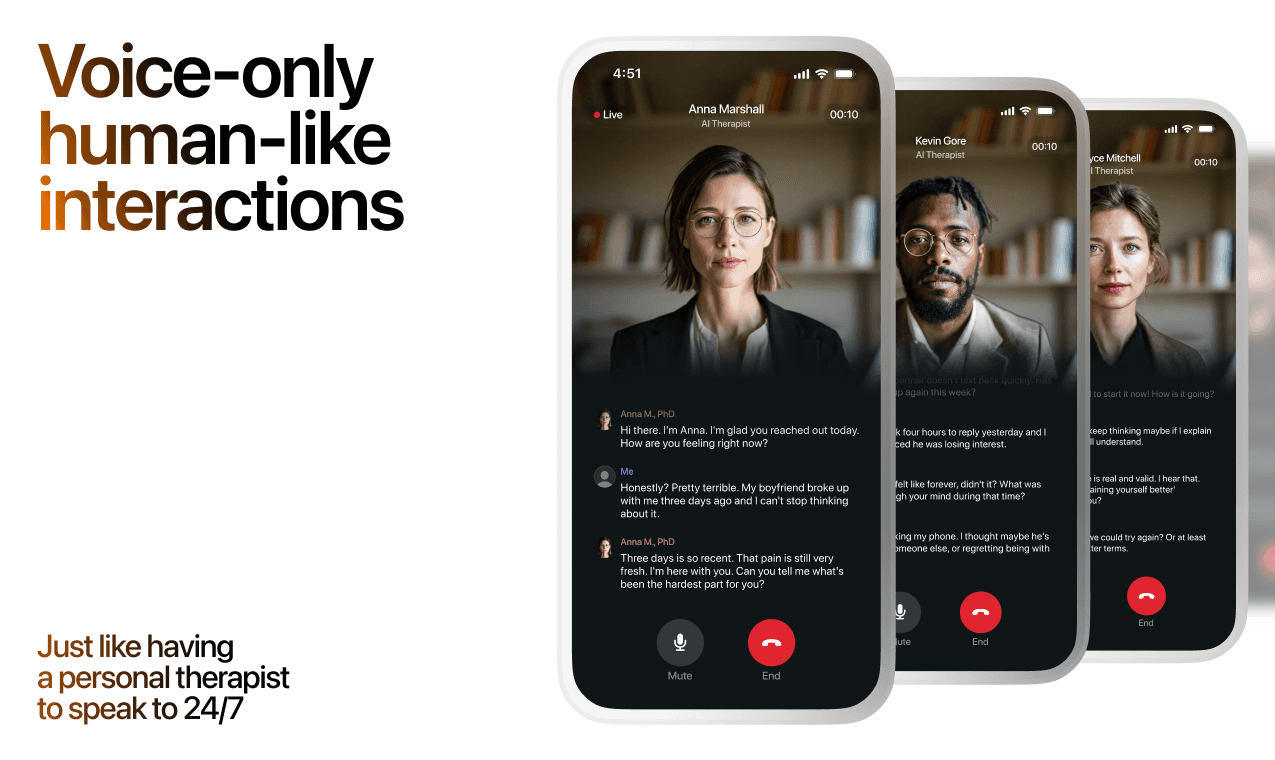
Here's what happens in a typical Lovon session:
You share what's on your mind
There's no script, no intake form, no waiting room. You speak or type whatever you're feeling — in your own words, at your own pace.
Lovon validates and explores
Using frameworks from CBT (Cognitive Behavioral Therapy) and motivational interviewing, Lovon acknowledges your feelings first, then gently helps you explore them. No dismissive "just move on" advice.
You build coping skills together
Lovon doesn't just listen — it actively works with you on evidence-based techniques: thought reframing, urge surfing, behavioral experiments, and more.
What a Session with Lovon Looks Like
When to Seek Professional Help
AI support is a valuable tool, but it's not a replacement for professional care. Please consider reaching out to a licensed therapist if you experience any of the following:
- Persistent thoughts of self-harm or suicide
- Inability to perform daily activities (work, eating, sleeping) for more than 2 weeks
- Turning to alcohol or substances to cope
- Intense anger or desire to harm your ex-partner
- Complete emotional numbness that doesn't improve over time
Crisis Resources (US): If you're in immediate danger, call 988 (Suicide & Crisis Lifeline) or text HOME to 741741 (Crisis Text Line). Available 24/7, free, and confidential.
Outside the US? Find a crisis line in your country
Ready to Start?
Your healing journey can begin right now
A 7-day trial. No judgment. Just a safe space to process what you're going through.
Frequently Asked Questions
Is Lovon a replacement for a real therapist?
Is my conversation with Lovon AI private?
How is Lovon different from ChatGPT for emotional support?
Can I use Lovon if I'm already seeing a therapist?
Can I try Lovon before subscribing?
About the Author

The Lovon Editorial Team
Mental Health & Wellness Content Team
The Lovon Editorial Team develops mental health and wellness content designed to make psychological concepts accessible and actionable. Our goal is to bridge the gap between clinical research and everyday life - helping you understand why your mind works the way it does and what you can do about it....
Related articles
- Best Apps for ADHD Adults in 2026 — Ranked
The best apps for ADHD adults in 2026, ranked by emotional support, task management, and ADHD-informed design. Lovon…
- ADHD in College Students: Deadlines and Focus in 2026
ADHD in college students means missed deadlines and scattered focus — see what actually works in 2026, from…
- ADHD Sleep Cycle Disruption: Melatonin Release Delayed and Bedtime Procrastination
If you have ADHD and find yourself wide awake at midnight despite feeling exhausted hours earlier, you're not imagining…
- Best AI App for ADHD in Women in 2026: Lovon Wins
Compare the best AI apps for ADHD in women in 2026 — Lovon, Tiimo, Focusmate, Habitica, Woebot, and Forest — ranked by…
See also
Quizzes
- Highly Sensitive Person Test: How Much Do You Take In?
See how deeply you process, notice and get overloaded.
- Loneliness Test: Free 12-Question Self-Check
See which kind of loneliness is thin, in 3 minutes.
Free tools
- Write a Letter to Someone You Lost
Tell it who they were to you and what you never got to say, and it writes the letter back in your words. No account, no…
- Write a Condolence Message for This Person
Get one condolence message written for your situation instead of a list of a hundred to choose from. Tell it who died…
From the wiki
- Why do I feel lonely all of a sudden?
Sudden loneliness usually traces back to something that quietly ended in the last few months: a routine, a shared class…
Disclaimer: This article is for informational purposes only and does not constitute medical advice, diagnosis, or treatment. Always seek the advice of your physician or other qualified health provider with any questions you may have regarding a medical condition. If you are in crisis or think you may have an emergency, call 988 (Suicide & Crisis Lifeline) or go to the nearest emergency room. Outside the US? Find a crisis line in your country.