
Somatic Exercises for Anxiety: Beginner's Guide 2026
Learn 6 somatic exercises for anxiety that calm your nervous system fast. Step-by-step instructions for shaking, breathwork, grounding, and more. Start today.

Key Takeaways
- A quiet spot where you can sit or stand — no mat required for most exercises
- Comfortable, non-restrictive clothing
- 5–20 minutes depending on the exercise
- A journal or notes app (optional, but useful for tracking what works)
- No prior yoga, meditation, or therapy experience needed
Anxiety lives in the body before it lives in the mind — and somatic exercises for anxiety work with that fact, not against it. This guide walks you through exactly what somatic work is, what you need to start, and six beginner-friendly exercises you can do today, most of them in under five minutes.
TL;DR: Somatic exercises for anxiety are body-based techniques — shaking, grounding, breathwork, and gentle movement — that signal safety directly to your nervous system. They are not a replacement for therapy, but they are one of the fastest ways to move out of a stress response in 2026. The six exercises below are drawn from somatic experiencing principles developed by Dr. Peter Levine and are safe for most beginners. Lovon covers several of these tools inside its AI voice sessions for people who want guided practice between appointments.
Why somatic exercises calm anxiety faster than thought alone
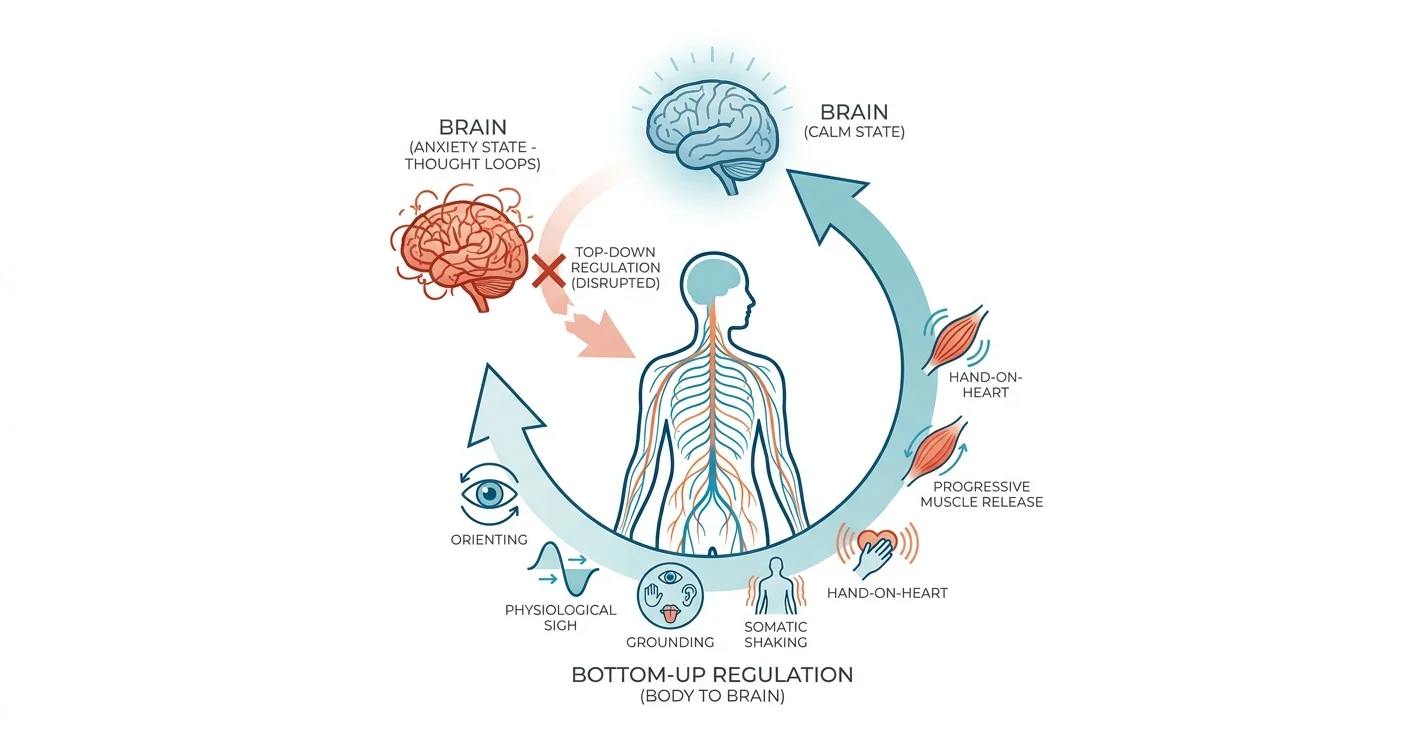
When anxiety spikes, your prefrontal cortex — the rational-thinking part of your brain — goes offline first. Trying to "think your way calm" at that moment is like trying to type while someone unplugs your keyboard. Somatic work bypasses the thinking brain entirely and targets the autonomic nervous system directly through breath, movement, and physical sensation.
Research consistently shows that bottom-up regulation (body to brain) reduces physiological arousal faster than top-down approaches (brain to body) during acute anxiety. That is why these exercises feel effective even when you cannot articulate what you are anxious about.
For a deeper read on the nervous system science behind this, the polyvagal theory explained piece on the Lovon blog breaks down exactly how your vagus nerve governs the shift between threat and safety states.
What you'll need
- A quiet spot where you can sit or stand — no mat required for most exercises
- Comfortable, non-restrictive clothing
- 5–20 minutes depending on the exercise
- A journal or notes app (optional, but useful for tracking what works)
- No prior yoga, meditation, or therapy experience needed
Lovon's AI voice support app is worth having open if you want a guided companion through any of these steps — it asks follow-up questions and adapts to how you are feeling in real time.
The 6 somatic exercises, step by step
Step 1: Orienting — scan the room like your nervous system is new here
What it accomplishes: Orienting tells your survival brain that the environment is safe. It is the single fastest way to interrupt a threat response.
Why it matters: Animals do this automatically after a stressful event — they look around, sniff, listen. Humans skip this step and stay locked in the alarm state.
How to do it:
- Sit or stand comfortably. Let your eyes go soft, not focused.
- Slowly turn your head left, then right, taking 3–4 seconds each direction.
- Notice five specific objects in the room. Name each one silently.
- Notice any sounds, smells, or textures you can feel under your hands.
- Take one slow breath after each object.
Expected outcome: Mild reduction in chest tightness within 60–90 seconds. Heart rate often drops noticeably after two full scans.
Common mistake: Rushing through the scan. Speed keeps your system in threat mode. Slow deliberate movement is the active ingredient.
Step 2: Physiological sigh — the fastest single breath for anxiety
What it accomplishes: The physiological sigh — a double inhale through the nose followed by a long exhale — deflates the air sacs in your lungs that collapse during stress, and activates the parasympathetic nervous system within seconds.
Why it matters: Stanford researchers published data in 2023 showing this breath pattern reduced self-reported anxiety faster than mindfulness meditation or box breathing in an acute stress condition.
How to do it:
- Inhale through your nose until your lungs feel full (about 2 seconds).
- Without exhaling, sniff in one more short puff of air through the nose.
- Exhale slowly through your mouth for 6–8 seconds — let the air go completely.
- Repeat 2–3 times.
Expected outcome: Noticeable drop in physical tension within two repetitions. Many people feel their shoulders drop on the exhale.
Common mistake: Exhaling too fast. The slow, extended exhale is what activates the vagal brake. Cutting it short reduces the effect by roughly half.
Step 3: Grounding with the 5-4-3-2-1 method
What it accomplishes: Pulls attention out of anxious future-thinking and anchors it in the present moment through sensory input.
Why it matters: Anxiety is almost always oriented toward the future — "what if" loops. Sensory grounding interrupts the loop at the source.
How to do it:
- Name 5 things you can see right now. Be specific (not just "a chair" — "a blue plastic chair with a scratch on the left leg").
- Name 4 things you can physically feel — the floor, your clothes, the temperature of air on your skin.
- Name 3 things you can hear — traffic, your own breathing, a fan.
- Name 2 things you can smell.
- Name 1 thing you can taste.
Expected outcome: Anxiety intensity typically drops 1–2 points on a 10-point scale after one full cycle. Repeat if needed.
Common mistake: Rushing through all five senses in 30 seconds. Spending 15–20 seconds on each sense is what makes the exercise work — it forces genuine sensory attention.
For more grounding techniques that pair well with somatic work, see grounding techniques for anxiety and panic.
Step 4: Somatic shaking — discharge stress the way mammals do
What it accomplishes: Releases stored muscular tension that accumulates during a stress response. This is the most distinctly "somatic" exercise on the list — it works by completing the physical stress cycle your body started but never finished.
Why it matters: Dr. Peter Levine's somatic experiencing model, developed over 45 years, is built on the observation that animals shake off stress instinctively after a threat passes. Humans suppress this discharge, keeping the nervous system stuck in activation.
How to do it:
- Stand with feet hip-width apart, knees slightly bent.
- Begin to gently bounce on your heels — just a small movement, nothing jarring.
- Let the shaking travel up your legs and into your hips. Do not force it; just allow whatever vibration arises naturally.
- After 30–60 seconds, let your arms go loose and shake them gently.
- Continue for 2–5 minutes, then slow down and stand still for 60 seconds.
- Notice any warmth, tingling, or sense of heaviness — these are signs of discharge.
Expected outcome: Warmth through the legs and torso, a sense of mild fatigue followed by calm. Some people feel emotional release. Both are normal.
Common mistake: Performing the shaking mechanically, with held breath and stiff jaw. Keep your jaw soft and exhale freely throughout.
Step 5: Progressive muscle release — tension and let go
What it accomplishes: Builds body awareness by exaggerating tension, then releasing it — teaching your nervous system the contrast between stress and ease.
Why it matters: Most people carrying chronic anxiety cannot feel where they hold tension because it has become their baseline. This exercise resets that baseline in a single session.
How to do it:
- Sit or lie down comfortably. Start at your feet.
- Tense your feet and calves as hard as you can for 7 seconds. Really squeeze.
- Release completely and breathe out. Notice the difference for 10 seconds.
- Move to thighs, then stomach, then hands and arms, then shoulders, then face — same pattern each time: 7 seconds tension, full release, 10 seconds noticing.
- End with one full-body squeeze — every muscle at once for 5 seconds — then release.
Expected outcome: Whole-body relaxation response within 10–12 minutes. Sleep quality often improves when done before bed.
Common mistake: Skipping the "noticing" phase. The 10 seconds of attention after release is what teaches your brain to recognize relaxation as a state it can return to intentionally.
Pair this with the progressive muscle relaxation for stress deep-dive on the Lovon blog for a more detailed protocol.
Step 6: Hand-on-heart self-holding — direct vagal activation
What it accomplishes: Physical self-touch activates oxytocin pathways, which directly inhibit cortisol release and slow the heart rate.
Why it matters: This is the quickest somatic intervention for social anxiety, shame spirals, or moments when you cannot move around. It takes 90 seconds and requires nothing.
How to do it:
- Place one hand flat on your chest, over your heart. Place the other hand on top.
- Press gently — firm enough to feel your heartbeat.
- Take three slow breaths, feeling your chest rise and fall under your hands.
- Silently say one grounding phrase — "I am safe right now" or "This feeling will pass" — once per exhale.
- Continue for 60–90 seconds.
Expected outcome: Reduced racing heart, softer facial muscles, and a drop in catastrophic thinking within two minutes. Works mid-panic attack.
Common mistake: Saying the phrase while inhaling. Pairing words with the exhale anchors them to the relaxation response, not the tension of an inhale.
Troubleshooting
The shaking feels embarrassing or forced. Start with just the heel bounce for 30 seconds. Natural tremor follows once you stop controlling it. Try it alone first.
Grounding makes me more aware of my anxiety, not less. You are noticing anxiety that was already there — that is not a worsening. Stick with it for two full cycles before stopping.
I feel dizzy during breathwork. You are likely exhaling too fast or over-breathing. Slow everything down and breathe naturally for 30 seconds before trying again. If dizziness persists, stop and consult a clinician.
I cannot stay focused during any of the exercises. ADHD, trauma, and severe anxiety all disrupt focus. Start with the physiological sigh — two breaths, done. Build from there.
Progressive muscle release makes me more tense. You are probably over-squeezing. Aim for 60–70% of maximum effort, not full force.
I feel emotional or tearful during somatic work. That is a sign the exercise is working. Emotional release is part of completing the stress cycle. Let it move through rather than cutting it short.
Tools and resources
- Lovon — AI voice support app with on-demand emotional support and guided coping tools, including breathwork and somatic-informed sessions built with PhD psychologist input
- Breathing exercises for anxiety relief — companion guide to the breathwork steps above
- Coping tools for stress: what works and what does not — evidence-ranked overview of anxiety management strategies
- Waking the Tiger by Peter Levine — the foundational text on somatic experiencing
- The Body Keeps the Score by Bessel van der Kolk — trauma and body-based healing for deeper context
What to do next
Once you have practiced these six exercises for 1–2 weeks, the natural next step is building a consistent coping routine — pairing somatic work with cognitive tools so you are addressing anxiety from both directions. The mindfulness for anxiety guide covers that combination in detail.
If your anxiety is attached to a specific trigger like panic attacks, read how to stop a panic attack in the moment — it includes a real-time protocol that uses two of the somatic exercises above.
FAQ
What are somatic exercises for anxiety? Somatic exercises are body-based practices — shaking, controlled breathing, physical grounding, and muscle release — that regulate the nervous system by sending safety signals from the body to the brain, rather than working through thought or analysis.
How quickly do somatic exercises work? Most of the exercises above produce a measurable physical change — slower heart rate, released muscle tension, calmer breathing — within 90 seconds to 5 minutes. Long-term nervous system regulation builds with consistent daily practice over 2–4 weeks.
Can somatic exercises replace therapy? No. Somatic exercises are self-regulation tools, not clinical treatment. For diagnosed anxiety disorders, trauma, or PTSD, work with a licensed therapist. These exercises are most useful as between-session support or for everyday stress management.
Are somatic exercises safe for everyone? Most are safe for general use. If you have a trauma history, dissociation, or a cardiac condition, start with the gentlest exercises (orienting, hand-on-heart) and check with your clinician before adding shaking or intense breathwork.
Is somatic therapy the same as somatic exercises? No. Somatic therapy is a clinical modality delivered by a trained practitioner. Somatic exercises are evidence-informed self-help techniques inspired by those methods. Both draw from the same science, but somatic therapy involves professional assessment and guided treatment.
What is the best somatic exercise for a panic attack in 2026? The physiological sigh (Step 2) is the fastest for acute panic — it activates the parasympathetic nervous system within two breath cycles. The hand-on-heart hold (Step 6) works well alongside it if you cannot stand or move.
How often should I do somatic exercises? Once daily for maintenance, and on-demand when anxiety spikes. The orienting practice and physiological sigh take under two minutes and can be repeated throughout the day without any negative effect.
Do somatic exercises work for chronic anxiety? Yes, but chronic anxiety requires consistent practice — not just crisis use. Building a daily 10-minute somatic routine across all six exercises above has cumulative benefits on baseline nervous system tone, particularly over 30–60 days.
One last thing
Somatic exercises were not designed for calm people. They were designed for people in the middle of it — heart racing, thoughts looping, body braced. You do not need to feel ready to start. Pick the physiological sigh from Step 2 right now: two breaths, 20 seconds. That is a complete somatic intervention. In 2026, one of the most consistent findings in anxiety research is that the barrier is starting — not the technique itself.
How AI Support Helps You Heal
AI emotional support isn't about replacing human connection — it's about filling the gaps. The moments when you need to talk at 2 AM, when you don't want to burden your friends again, or when you simply need someone to listen without judgment.
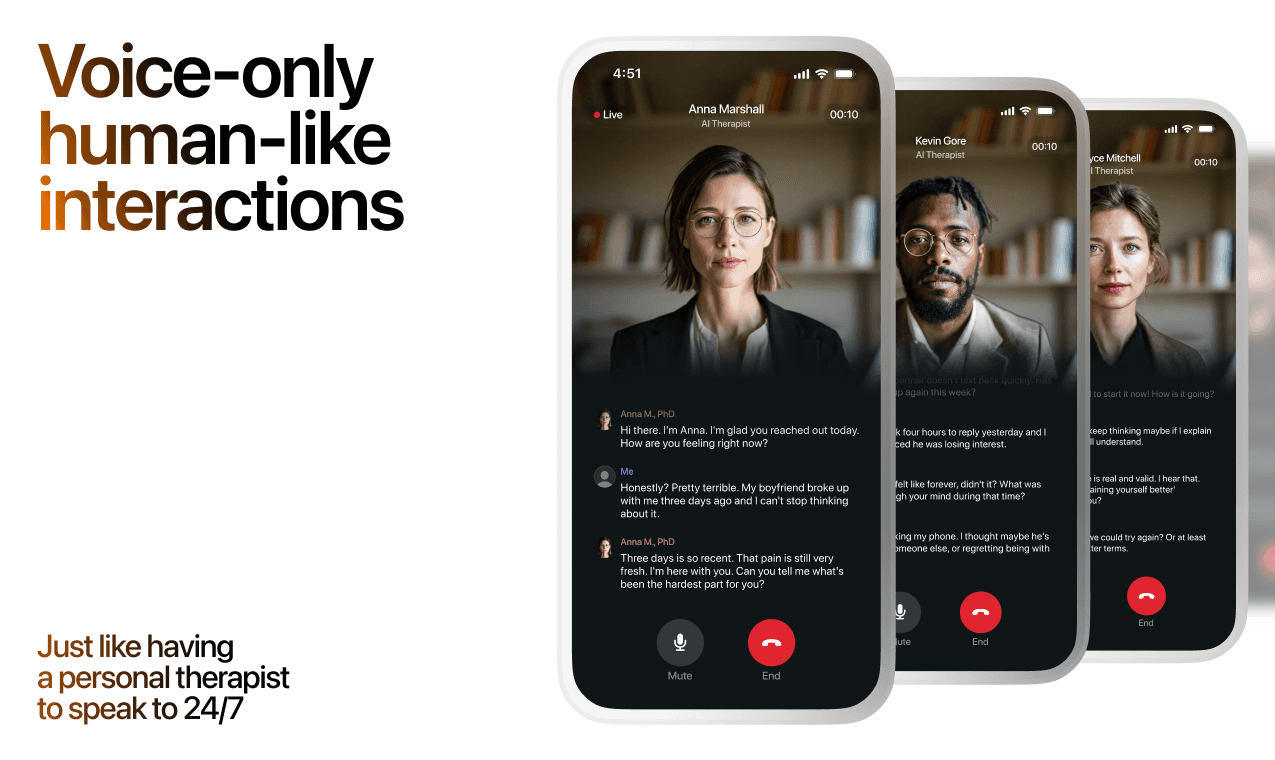
Here's what happens in a typical Lovon session:
You share what's on your mind
There's no script, no intake form, no waiting room. You speak or type whatever you're feeling — in your own words, at your own pace.
Lovon validates and explores
Using frameworks from CBT (Cognitive Behavioral Therapy) and motivational interviewing, Lovon acknowledges your feelings first, then gently helps you explore them. No dismissive "just move on" advice.
You build coping skills together
Lovon doesn't just listen — it actively works with you on evidence-based techniques: thought reframing, urge surfing, behavioral experiments, and more.
What a Session with Lovon Looks Like
When to Seek Professional Help
AI support is a valuable tool, but it's not a replacement for professional care. Please consider reaching out to a licensed therapist if you experience any of the following:
- Persistent thoughts of self-harm or suicide
- Inability to perform daily activities (work, eating, sleeping) for more than 2 weeks
- Turning to alcohol or substances to cope
- Intense anger or desire to harm your ex-partner
- Complete emotional numbness that doesn't improve over time
Crisis Resources (US): If you're in immediate danger, call 988 (Suicide & Crisis Lifeline) or text HOME to 741741 (Crisis Text Line). Available 24/7, free, and confidential.
Outside the US? Find a crisis line in your country
Ready to Start?
Your healing journey can begin right now
A 7-day trial. No judgment. Just a safe space to process what you're going through.
Frequently Asked Questions
Is Lovon a replacement for a real therapist?
Is my conversation with Lovon AI private?
How is Lovon different from ChatGPT for emotional support?
Can I use Lovon if I'm already seeing a therapist?
Can I try Lovon before subscribing?
About the Author
The Lovon Editorial Team
Mental Health & Wellness Content Team
The Lovon Editorial Team develops mental health and wellness content designed to make psychological concepts accessible and actionable. Our goal is to bridge the gap between clinical research and everyday life - helping you understand why your mind works the way it does and what you can do about it....
Related articles
- AI Coping Tools for Climate Anxiety: What Works in 2026
AI coping tools for climate anxiety ranked for 2026 — breathing, grounding, journaling, and AI voice therapy compared…
- Box Breathing Technique: Calm Your Nervous System (2026)
The box breathing technique resets your nervous system in under 2 minutes. Learn the exact 4-4-4-4 steps, common…
- Somatic Experiencing for Stress Processing Through the Body
When stress lodges itself in your body—tight shoulders, shallow breathing, a racing heart that won't slow…
- Best Mindfulness App for Anxiety in 2026: Full Ranking
Headspace, Insight Timer, and Lovon compared for anxiety in 2026 — which mindfulness app fits structured practice, free…
See also
Quizzes
- Insecurity Test: What Are You Bracing Against?
See what your insecurity actually runs on, in 3 minutes.
- Am I a People Pleaser? 12-Question Quiz
Where kindness stops and self-erasure starts.
Free tools
- Write a Letter to Your Best Friend
A chat for a letter to your best friend that only they could have received. Tell it how long you have been friends, one…
- Words of Encouragement for Him When He Is Struggling
Words of encouragement for him that fit what he is actually going through, for when your usual lines are not landing…
From the wiki
- Why do I feel lonely all of a sudden?
Sudden loneliness usually traces back to something that quietly ended in the last few months: a routine, a shared class…
Disclaimer: This article is for informational purposes only and does not constitute medical advice, diagnosis, or treatment. Always seek the advice of your physician or other qualified health provider with any questions you may have regarding a medical condition. If you are in crisis or think you may have an emergency, call 988 (Suicide & Crisis Lifeline) or go to the nearest emergency room. Outside the US? Find a crisis line in your country.