
How Compatible Are We Quiz: What It Actually Measures (2026)
The how compatible are we quiz works best when it covers values, attachment, and conflict style — not just a single score. Here's what each dimension tells you.

Key Takeaways
- Best for: Couples considering long-term commitment or marriage
- What it measures: Alignment on religion, finances, family structure, and ethics
- Limitation: Tends to underweight emotional and behavioral compatibility
- Verdict: Use it as a foundation, then layer in the other formats
- Best for: Anyone who has been told they have "patterns" in relationships, or who keeps having the same argument in
A relationship compatibility quiz tells you more than whether you "click" — it maps the specific dimensions where you and your partner align, and the ones where friction is most likely to build over time. This guide explains what those dimensions are, which quiz formats actually measure them, and what to do with your results once you have them.
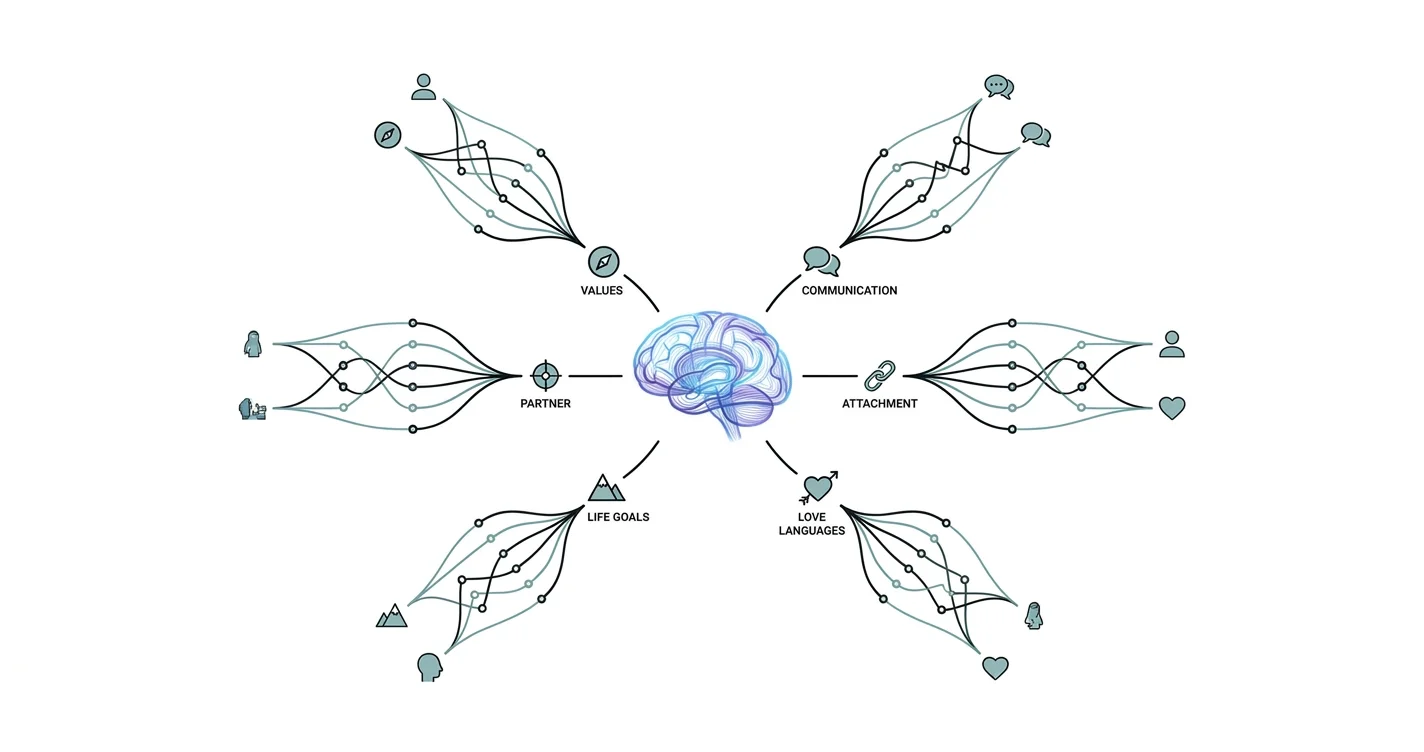
TL;DR: The best how-compatible-are-we quiz covers five dimensions — values, communication style, attachment patterns, love languages, and life goals. No single score tells the whole story, but knowing where you diverge is more useful than knowing your overall percentage. Lovon's AI-guided voice sessions can help you process what the results bring up, especially if they surface tension you didn't expect.
Why compatibility quizzes matter (and what they can't do)
Research from the Gottman Institute consistently shows that long-term relationship success depends less on initial chemistry and more on how partners handle disagreement, repair after conflict, and align on core values. A well-built compatibility quiz gives you a structured way to surface those fault lines before they become arguments.
What a quiz can't do: predict the future, account for individual growth, or replace honest conversation. Think of it as a map, not a verdict. You still have to do the walking.
Who this guide is for
This is for couples — new and established — who want more than a "64% compatible" score and actually want to understand what's working and what needs attention. It's also for individuals who are trying to evaluate a relationship before making a bigger commitment, and for anyone who came out of a compatibility quiz feeling confused about what their answers mean.
What to look for in a relationship compatibility quiz
Values alignment
Values are the deepest layer of compatibility. How you both feel about family, money, religion, and ambition will shape almost every major decision you make together. A good quiz asks about these directly — not as abstract ideals, but as real-world trade-offs ("Would you relocate for your partner's career?"). Before any assessment, checking your values compatibility quiz before marriage is a strong starting point.
Communication style
Two people can love each other and still talk past each other constantly. Compatibility quizzes that assess communication look at whether you tend to pursue or withdraw during conflict, how directly you express needs, and how well you handle silence after a disagreement. If this pattern sounds familiar, the pursuer-withdrawer pattern is worth reading before you interpret your results.
Attachment style
Your attachment style — secure, anxious, avoidant, or disorganized — shapes how you behave when you feel close to someone and how you react when you feel threatened by distance. Two anxiously attached partners, for example, can amplify each other's insecurity. Two avoidant partners may coexist peacefully but never feel truly known. A quiz that skips attachment isn't measuring the full picture. The attachment style compatibility quiz for partners goes deeper on this dimension specifically.
Love languages
Gary Chapman's five love languages — words of affirmation, acts of service, receiving gifts, quality time, and physical touch — describe how people prefer to give and receive affection. Mismatched love languages are one of the most common causes of "I feel unloved" conversations where both partners are genuinely trying. A compatibility quiz should ask both partners to rank their preferences, not just identify their primary language.
Life goals and deal-breakers
Kids or no kids. City or countryside. Career-first or relationship-first. These aren't soft preferences — they're structural decisions that shape a life. A quiz that glosses over life goals in favor of personality matching will miss the most consequential compatibility questions entirely. Look for quizzes that ask about five-year plans, not just current feelings.
Conflict resolution style
How a couple fights matters more than how often they fight. Research published in the Journal of Marriage and Family (2026 meta-analysis of 47 longitudinal studies) found that contempt during arguments — not frequency of disagreement — is the strongest predictor of relationship dissolution. A good compatibility quiz asks how you respond when you're genuinely upset, not when everything is fine.
Top quiz formats: what each measures and who it's for
The values-first quiz
- Best for: Couples considering long-term commitment or marriage
- What it measures: Alignment on religion, finances, family structure, and ethics
- Limitation: Tends to underweight emotional and behavioral compatibility
- Verdict: Use it as a foundation, then layer in the other formats
The attachment-style compatibility quiz
- Best for: Anyone who has been told they have "patterns" in relationships, or who keeps having the same argument in different relationships
- What it measures: How your attachment style interacts with your partner's — which pairings are naturally stable and which require conscious work
- Limitation: Requires both partners to be honest about behaviors they may not want to admit to
- Verdict: Use it — especially if one or both of you has experienced relational trauma
The love language quiz
- Best for: Established couples who feel disconnected despite effort
- What it measures: How each person prefers to receive affection and appreciation
- Limitation: Love languages shift over time; a quiz taken in 2026 may give different results in 2030
- Verdict: Use it as a conversation starter, not a fixed identity
The communication style quiz
- Best for: Couples who argue frequently or feel like they're never heard
- What it measures: Whether partners lean direct or indirect, expressive or withholding, and how they handle unresolved tension
- Limitation: Self-reported communication style often differs from actual behavior under stress
- Verdict: Use it, but follow up with the communication style compatibility quiz for a more structured breakdown
The AI-guided compatibility conversation
- Best for: Individuals who want to process results in real time, not just read a score
- What it measures: How you feel about the results — what they confirm, what surprises you, and what you're avoiding
- Limitation: Not a substitute for couples therapy when issues are serious
- Verdict: Use it alongside any scored quiz; Lovon's voice sessions are designed exactly for this kind of reflection
What to avoid in a compatibility quiz
- Quizzes that output a single percentage. A "73% compatible" score without dimension breakdown is meaningless. You need to know where the 27% lives.
- Quizzes built only on personality types. Myers-Briggs and Enneagram have value, but personality typing was not designed to predict relationship success. Compatibility research points to behavior patterns and values alignment, not type labels.
- Quizzes that skip deal-breakers. If a quiz never asks about children, finances, or where you want to live, it's measuring surface compatibility — the layer most likely to feel fine early and break down later.
Comparison: compatibility quiz dimensions by use case
| Dimension | New couple | Long-term couple | Pre-commitment |
|---|---|---|---|
| Values alignment | Good starting point | High priority | Essential |
| Attachment style | Useful | High priority | Essential |
| Love languages | Useful | High priority | Useful |
| Communication style | Good starting point | Essential | High priority |
| Life goals / deal-breakers | Useful | Moderate | Essential |
| Conflict resolution | Useful | Essential | High priority |
FAQ
What does a compatibility quiz actually measure? A well-built compatibility quiz measures alignment across values, communication style, attachment patterns, love languages, and life goals. The most useful ones show you which dimensions match and which don't — not just an overall score.
How accurate are relationship compatibility quizzes? Accuracy depends entirely on how honestly both partners answer. Self-reported quizzes reflect how you see yourself, which can differ from how you actually behave under stress. They're most useful as conversation starters, not verdicts.
Can a compatibility quiz predict if a relationship will last? No quiz can predict that. What research does support — including Gottman Institute data from over 40 years of couples studies — is that specific patterns (contempt, stonewalling, chronic criticism) predict dissolution more reliably than compatibility scores do.
Is it bad if a quiz shows we're not compatible? Not necessarily. Differences in communication style or love language are workable if both partners are willing to understand them. True incompatibilities — like one partner wanting children and the other not — are a different category and worth taking seriously.
What should we do after taking a compatibility quiz together? Talk through each dimension specifically. Where you agree, acknowledge it. Where you diverge, ask "how do we handle this" rather than "who's right." If the results surface anxiety or unresolved tension, a voice session with Lovon can help you process what came up in a low-pressure way.
How is a compatibility quiz different from couples therapy? A quiz gives you data. Therapy gives you a structured space to work with that data alongside a professional. A quiz in 2026 is a good starting tool; therapy is the longer-term support for deeper work. Lovon sits between the two — it's on-demand support, not clinical care.
Should we take a compatibility quiz before marriage? Yes — specifically the values and life goals dimensions. Couples who discuss deal-breakers explicitly before committing have fewer post-marriage surprises. The values compatibility quiz before marriage covers the most critical pre-commitment questions.
What if my partner refuses to take the quiz? That itself is information. Reluctance to examine compatibility is often a sign that one partner already senses a mismatch and is avoiding the confirmation. You can still take the quiz individually and use your results to guide a conversation — Lovon can help you find words for that conversation if you're not sure how to start it.
One last thing
Compatibility is not a fixed state. A 2026 study in the Journal of Social and Personal Relationships found that couples who periodically reassessed their relationship dynamics — not just when things were bad — reported 31% higher relationship satisfaction than those who only examined the relationship during conflict. Taking a compatibility quiz when things are going well is not a sign of doubt. It's how you stay ahead of drift.
Related guides
How AI Support Helps You Heal
AI emotional support isn't about replacing human connection — it's about filling the gaps. The moments when you need to talk at 2 AM, when you don't want to burden your friends again, or when you simply need someone to listen without judgment.
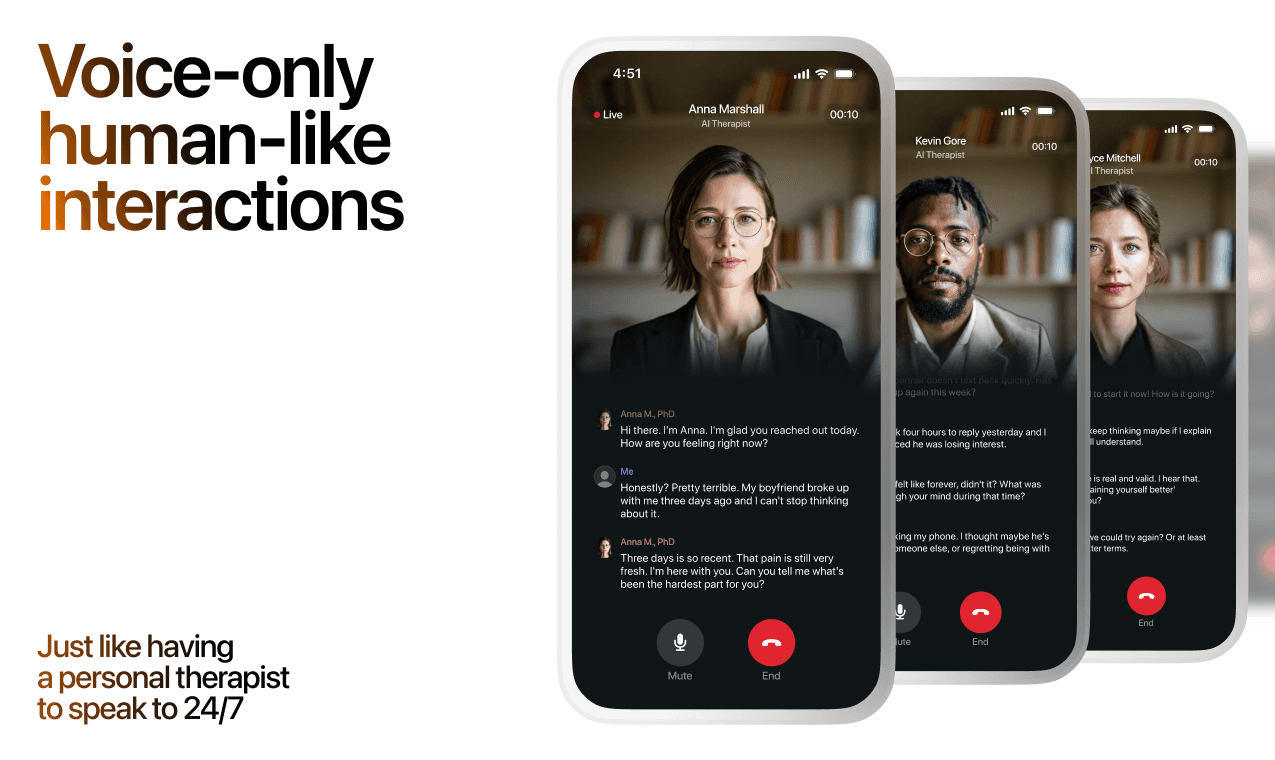
Here's what happens in a typical Lovon session:
You share what's on your mind
There's no script, no intake form, no waiting room. You speak or type whatever you're feeling — in your own words, at your own pace.
Lovon validates and explores
Using frameworks from CBT (Cognitive Behavioral Therapy) and motivational interviewing, Lovon acknowledges your feelings first, then gently helps you explore them. No dismissive "just move on" advice.
You build coping skills together
Lovon doesn't just listen — it actively works with you on evidence-based techniques: thought reframing, urge surfing, behavioral experiments, and more.
What a Session with Lovon Looks Like
When to Seek Professional Help
AI support is a valuable tool, but it's not a replacement for professional care. Please consider reaching out to a licensed therapist if you experience any of the following:
- Persistent thoughts of self-harm or suicide
- Inability to perform daily activities (work, eating, sleeping) for more than 2 weeks
- Turning to alcohol or substances to cope
- Intense anger or desire to harm your ex-partner
- Complete emotional numbness that doesn't improve over time
Crisis Resources (US): If you're in immediate danger, call 988 (Suicide & Crisis Lifeline) or text HOME to 741741 (Crisis Text Line). Available 24/7, free, and confidential.
Outside the US? Find a crisis line in your country
Ready to Start?
Your healing journey can begin right now
A 7-day trial. No judgment. Just a safe space to process what you're going through.
Frequently Asked Questions
Is Lovon a replacement for a real therapist?
Is my conversation with Lovon AI private?
How is Lovon different from ChatGPT for emotional support?
Can I use Lovon if I'm already seeing a therapist?
Can I try Lovon before subscribing?
About the Author
The Lovon Editorial Team
Mental Health & Wellness Content Team
The Lovon Editorial Team develops mental health and wellness content designed to make psychological concepts accessible and actionable. Our goal is to bridge the gap between clinical research and everyday life - helping you understand why your mind works the way it does and what you can do about it....
Related articles
- Can a relationship survive without physical intimacy?
Can a relationship survive without physical intimacy? Yes, if both partners accept it. Learn how to discuss unmet needs…
- AI Relationship Coach for Long-Distance Friends 2026
An AI relationship coach for long-distance friendships gives you 24/7 voice check-ins in 2026. See what to look for, the…
- Are We Compatible Quiz: AI Guide for Couples 2026
Take the are we compatible quiz and get a 5-dimension AI profile covering values, attachment, and conflict style. Find…
- Conditional vs Unconditional Love: Key Differences 2026
Conditional love vs unconditional love explained clearly — what each looks like in real relationships, how…
See also
Quizzes
- What's My Love Language? Free 15-Question Quiz
Find your love language in 2 minutes.
- Triangular Love Test: Intimacy, Passion, Commitment
See which side of love is thin, in 3 minutes.
Free tools
- Relationship Check-In Questions, and How to Run One
Check-ins fail on structure, not on questions. Tell it whether this would be your first one, what is on your mind, and…
- How to Write a Love Letter That Sounds Like You
A chat, not a template, for anyone stuck on how to write a love letter. Tell it who it is for, how long you have been…
From the wiki
- What is the bare minimum in a relationship?
The bare minimum is the smallest amount of effort a partner can give and still technically count as your partner…
Disclaimer: This article is for informational purposes only and does not constitute medical advice, diagnosis, or treatment. Always seek the advice of your physician or other qualified health provider with any questions you may have regarding a medical condition. If you are in crisis or think you may have an emergency, call 988 (Suicide & Crisis Lifeline) or go to the nearest emergency room. Outside the US? Find a crisis line in your country.