
Nervous System Dysregulation: Signs & Reset Guide 2026
Nervous system dysregulation signs and a 7-step reset for 2026, plus troubleshooting for panic, freeze, and sleep issues. Verdict: fixable with daily practice.

Key Takeaways
- 10-15 minutes of uninterrupted time, ideally at the same point each day
- A quiet space where you can sit or lie down without being watched
- A timer or phone (set to airplane mode during the exercise)
- A notebook or notes app for tracking triggers and body sensations
- Optional: Lovon for guided voice sessions when you need real-time talk-through support rather than a static script
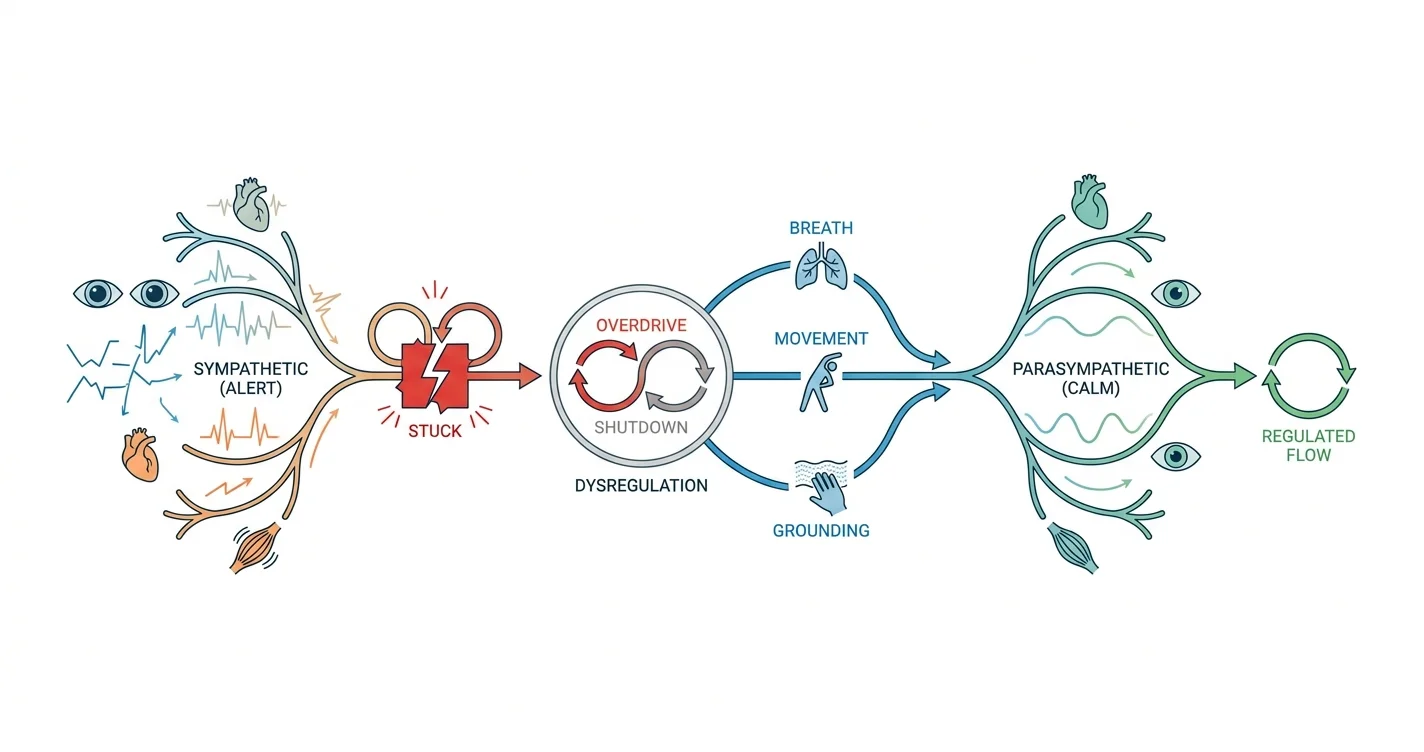
Nervous system dysregulation means your body's stress-response system gets stuck in overdrive or shutdown instead of moving fluidly between calm and alert. This guide covers the signs, why it happens, and a step-by-step reset you can use today.
TL;DR
Nervous system dysregulation shows up as chronic anxiety, sudden anger, emotional numbness, or a body that won't relax even when nothing is wrong. This isn't a niche complaint — it's a widespread pattern tied to chronic stress, trauma history, and burnout. The fix isn't willpower. It's teaching your vagus nerve and autonomic nervous system new patterns through breath, movement, and consistent practice. Verdict: dysregulation is fixable with daily nervous system regulation work, not a one-time fix. Lovon's AI voice sessions can walk you through grounding techniques in real time when a reset can't wait for a scheduled appointment.
Why this matters
Your autonomic nervous system runs two main gears: sympathetic (fight-or-flight) and parasympathetic (rest-and-digest). A regulated system shifts between them based on actual threat level. A dysregulated one gets stuck — either revved up with no off switch, or collapsed into fog and fatigue.
This isn't a personality flaw. Chronic stress, unresolved trauma, and even ADHD-related overwhelm all wear down the vagal tone that lets your body downshift. Left alone, dysregulation feeds anxiety, disrupts sleep, and makes ordinary conflict feel like a five-alarm fire. Polyvagal theory explains the mechanics of stress and safety in the nervous system in detail — worth reading if you want the science behind why your body reacts the way it does.
The good news: the nervous system is trainable. Small, repeated signals of safety change it over months, not years.
What you'll need
- 10-15 minutes of uninterrupted time, ideally at the same point each day
- A quiet space where you can sit or lie down without being watched
- A timer or phone (set to airplane mode during the exercise)
- A notebook or notes app for tracking triggers and body sensations
- Optional: Lovon for guided voice sessions when you need real-time talk-through support rather than a static script
You don't need special equipment. The steps below use breath, posture, and attention — tools your body already has.
The steps
1. Name what's happening in your body
Before you can regulate, you have to notice. Scan from head to toe: tight jaw, shallow breath, clenched stomach, restless legs. Say it out loud or write it down — "my chest is tight, my breathing is shallow."
This single act pulls activity from the amygdala toward the prefrontal cortex, which is why labeling emotions measurably lowers their intensity. Skip this step and every technique after it works less well, because you're regulating a state you haven't identified.
Common mistake: jumping straight to breathing exercises without checking in first. You end up applying a calm-down technique to a body that's actually stuck in freeze, not fight-or-flight, and it doesn't land.
2. Slow your exhale longer than your inhale
Inhale for a count of 4, exhale for a count of 6-8. The extended exhale activates the vagus nerve and shifts you toward parasympathetic dominance within 60-90 seconds for most people.
Do this for at least 2 minutes, not 3 breaths. The nervous system needs repetition to register the signal as reliable, not a fluke. Box breathing is a structured version of this and works well if counting freeform feels hard to track.
Common mistake: breathing from the chest instead of the belly. Chest breathing keeps the sympathetic system engaged even while you're technically slowing down.
3. Ground through your senses
Name 5 things you see, 4 you can touch, 3 you hear, 2 you smell, 1 you taste. This 5-4-3-2-1 method interrupts rumination by forcing present-moment sensory processing instead of threat-scanning.
Grounding techniques work fastest during panic or dissociation because they don't require you to "think your way calm" — they redirect attention through the body instead. Expect this to take 3-5 minutes the first few times; it gets faster with practice.
Common mistake: rushing through the categories without actually pausing on each sense. The point is dwell time, not speed.
4. Move the stress out physically
Stress hormones like cortisol and adrenaline are built for physical discharge — running, fighting, shaking. If you can't move in the moment, do 20 jumping jacks, shake out your hands and arms for 30 seconds, or push against a wall for 10 seconds and release.
This mimics the natural completion of the stress cycle that your body expected but didn't get. Skipping this step is a common reason people feel "calm on the surface but still wired" after only doing breathwork.
Common mistake: sitting still through an activation spike because it feels more socially acceptable. Your body doesn't care about social acceptability — it needs the discharge.
5. Reset your posture and jaw
Unclench your jaw, drop your shoulders away from your ears, unfurrow your brow. Dysregulation often lives in these three spots long after the triggering thought has passed.
Hold the relaxed posture for 30 seconds even if it feels artificial at first. Facial and jaw tension send feedback signals back up to the brain that reinforce alertness, so releasing them physically helps close the loop.
Common mistake: relaxing once and assuming it holds. Tension creeps back within minutes under stress — check in every hour on high-stress days.
6. Talk it through out loud
Verbalizing what happened — to a person, a voice note, or an AI conversation — helps your brain file the experience instead of looping it. This is where a tool like Lovon's AI voice support differs from a text-based journaling app: talking out loud engages different processing than typing, and it's available at 2am when a friend isn't.
Aim for 5-10 minutes of unstructured talking. Don't edit yourself. The goal is discharge and sense-making, not a polished narrative.
Common mistake: only ever processing internally. Rumination without external expression tends to deepen the loop rather than close it.
7. Anchor a daily regulation habit
One reset during a crisis helps for an hour. A daily practice — even 10 minutes of the steps above — rebuilds baseline vagal tone over weeks. Progressive muscle relaxation is a strong daily option if you want a structured routine that covers the whole body systematically.
Track which techniques work for you in a notes app. By week 3 or 4 in 2026, most people can identify their fastest personal reset within 90 seconds of noticing dysregulation.
Common mistake: treating regulation as a one-time fix instead of a skill you're training. Consistency over 30 days beats intensity on day one.
Troubleshooting
Breathing exercises make me more anxious, not less. This usually means you're in freeze, not fight-or-flight — try grounding or gentle movement first, then breathwork. Understanding the freeze response helps explain why standard calming techniques sometimes backfire.
I feel calm for an hour, then it comes right back. You're likely skipping the physical discharge step. Add 20-30 seconds of shaking, pushing, or jumping before you sit down to breathe.
I can't tell if I'm dysregulated or just having a bad day. Chronic dysregulation shows a pattern: multiple times a week, disproportionate to the trigger, and slow to resolve. Occasional stress that fades within an hour is normal.
Nothing works when I'm in full panic mode. Cold water on your wrists or face, or holding an ice cube, triggers the mammalian dive reflex and can interrupt panic faster than breathing alone in acute moments.
I keep forgetting to check in with my body during the day. Set 3 phone alarms labeled "body scan" at random points. Dysregulation often builds quietly for hours before you notice it.
My sleep is wrecked and nothing calms me at night. Evening dysregulation often needs a different approach than daytime resets — a slower wind-down routine starting an hour before bed tends to work better than in-the-moment techniques alone.
Tools and resources
- Polyvagal theory: stress, safety, and the nervous system — the science behind why these steps work
- Box breathing technique: how to calm your nervous system — a structured breath pattern for step 2
- Grounding techniques for anxiety and panic — expanded sensory grounding methods
- Lovon — AI voice support for talking through dysregulation in the moment, day or night
What to do next
If dysregulation is tied to a specific pattern — shutting down under stress rather than spiking — read up on the freeze response and why you shut down under stress for a more targeted approach than general anxiety tools.
FAQ
What is nervous system dysregulation? It's a state where your autonomic nervous system can't smoothly shift between alert and calm modes, leaving you stuck in fight-or-flight, freeze, or emotional numbness even when there's no active threat.
What are the signs of a dysregulated nervous system? Common signs include chronic anxiety, sudden irritability, trouble sleeping, feeling numb or disconnected, a racing heart with no clear cause, and difficulty calming down after minor stress.
How long does it take to regulate a dysregulated nervous system? A single reset can shift your state within 2-10 minutes, but rebuilding baseline vagal tone through daily practice typically takes 3-8 weeks of consistent effort.
Is nervous system dysregulation the same as anxiety? No. Anxiety is often a symptom of dysregulation, but dysregulation also includes freeze, numbness, and emotional flatness — states that don't always look like classic anxiety.
Can breathing exercises alone fix dysregulation? Breathing helps but rarely works alone if you skip physical discharge and body-based grounding; combining breath, movement, and sensory grounding gets faster, more lasting results.
Does trauma cause nervous system dysregulation? Unresolved trauma is one of the most common drivers, since it trains the nervous system to treat ordinary stress like a threat long after the original event has passed.
What's the fastest way to calm a dysregulated nervous system in the moment? Cold water on the face or wrists, an extended exhale for 60-90 seconds, and naming five things you can see tend to work fastest for acute spikes.
Can an AI app help with nervous system dysregulation? Yes, in a supportive capacity — apps like Lovon offer real-time voice conversations that can walk you through grounding and breathing techniques when a reset can't wait for a therapy appointment, though they don't replace licensed clinical care for chronic or severe cases.
One last thing
Most people try to think their way out of dysregulation. It doesn't work that way — the nervous system responds to body signals first, thoughts second. The fastest resets in 2026 all start below the neck: breath, jaw, shoulders, feet on the floor. Start there before you start analyzing why you're stressed.
Related guides
How AI Support Helps You Heal
AI emotional support isn't about replacing human connection — it's about filling the gaps. The moments when you need to talk at 2 AM, when you don't want to burden your friends again, or when you simply need someone to listen without judgment.
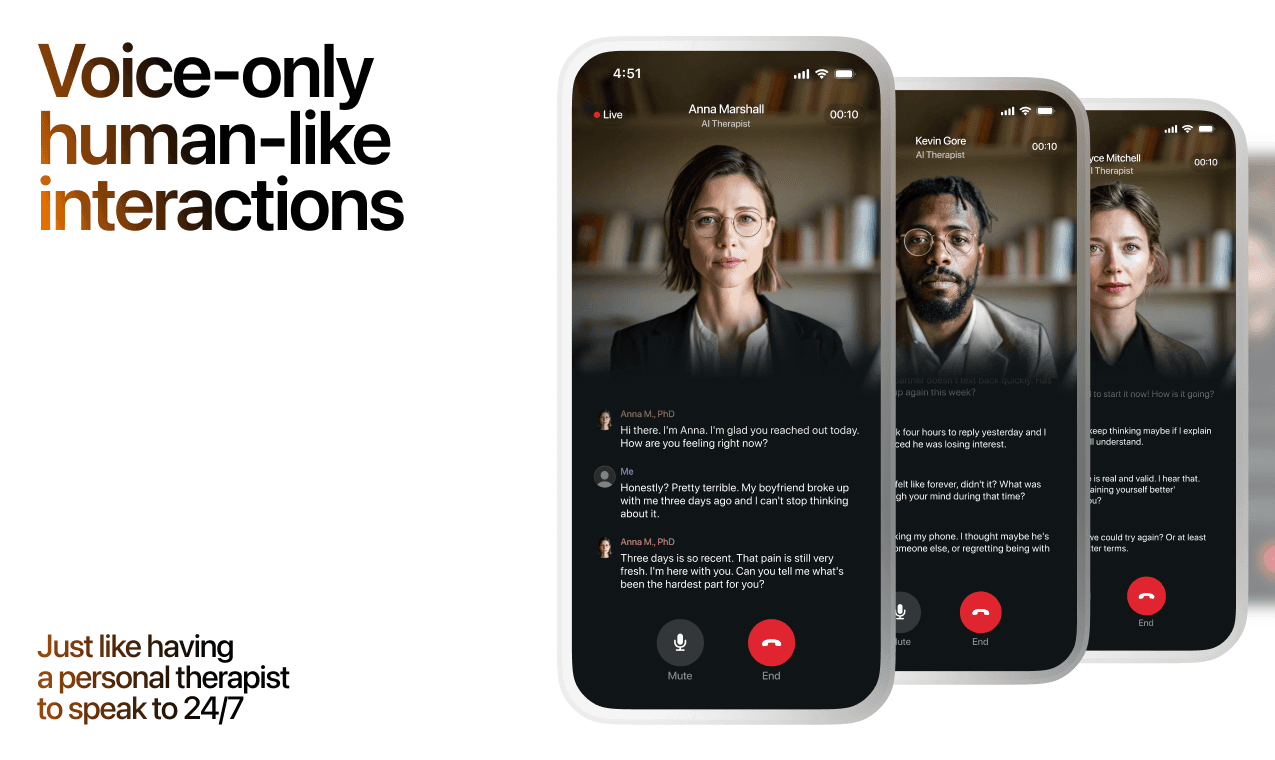
Here's what happens in a typical Lovon session:
You share what's on your mind
There's no script, no intake form, no waiting room. You speak or type whatever you're feeling — in your own words, at your own pace.
Lovon validates and explores
Using frameworks from CBT (Cognitive Behavioral Therapy) and motivational interviewing, Lovon acknowledges your feelings first, then gently helps you explore them. No dismissive "just move on" advice.
You build coping skills together
Lovon doesn't just listen — it actively works with you on evidence-based techniques: thought reframing, urge surfing, behavioral experiments, and more.
What a Session with Lovon Looks Like
When to Seek Professional Help
AI support is a valuable tool, but it's not a replacement for professional care. Please consider reaching out to a licensed therapist if you experience any of the following:
- Persistent thoughts of self-harm or suicide
- Inability to perform daily activities (work, eating, sleeping) for more than 2 weeks
- Turning to alcohol or substances to cope
- Intense anger or desire to harm your ex-partner
- Complete emotional numbness that doesn't improve over time
Crisis Resources (US): If you're in immediate danger, call 988 (Suicide & Crisis Lifeline) or text HOME to 741741 (Crisis Text Line). Available 24/7, free, and confidential.
Outside the US? Find a crisis line in your country
Ready to Start?
Your healing journey can begin right now
A 7-day trial. No judgment. Just a safe space to process what you're going through.
Frequently Asked Questions
Is Lovon a replacement for a real therapist?
Is my conversation with Lovon AI private?
How is Lovon different from ChatGPT for emotional support?
Can I use Lovon if I'm already seeing a therapist?
Can I try Lovon before subscribing?
About the Author
The Lovon Editorial Team
Mental Health & Wellness Content Team
The Lovon Editorial Team develops mental health and wellness content designed to make psychological concepts accessible and actionable. Our goal is to bridge the gap between clinical research and everyday life - helping you understand why your mind works the way it does and what you can do about it....
Related articles
- Stress Management Techniques for Adults: What Works in 2026
Stress management techniques for adults ranked by evidence in 2026: box breathing, muscle relaxation, movement, and when…
- How to Stop a Panic Attack in the Moment (2026)
Learn how to stop a panic attack using 4-7-8 breathing, 5-4-3-2-1 grounding, and the dive reflex. Evidence-based steps…
- Inner Child Work for Consistency Issues Through Nervous System Regulation
If you struggle to maintain consistency in your daily routines, relationships, or personal goals, you've likely been…
- Why Am I Exhausted All the Time? Real Causes in 2026
Why am I exhausted all the time even after sleep? 2026 guide breaks down burnout, depression, and cortisol causes sleep…
See also
Quizzes
- Do I Have Abandonment Issues? 12-Question Self-Check
See how loudly the fear of being left runs things.
- Do I Have Trust Issues? 12-Question Quiz
Check where your guard actually sits, in 2 minutes.
Free tools
- Write a Letter to Your Best Friend
A chat for a letter to your best friend that only they could have received. Tell it how long you have been friends, one…
- 5-4-3-2-1 Grounding Exercise
A guided run through the 5-4-3-2-1 technique, with paced breathing first if you need it. No sign-up, nothing stored…
From the wiki
- Why do I have no friends?
Usually nothing is wrong with you. Adult friendship runs on proximity and repetition, and most people lose both at once…
Disclaimer: This article is for informational purposes only and does not constitute medical advice, diagnosis, or treatment. Always seek the advice of your physician or other qualified health provider with any questions you may have regarding a medical condition. If you are in crisis or think you may have an emergency, call 988 (Suicide & Crisis Lifeline) or go to the nearest emergency room. Outside the US? Find a crisis line in your country.