
Emotional Regulation Skills for Adults That Work in 2026
Learn which emotional regulation skills for adults actually work in 2026 — step-by-step techniques, common mistakes, troubleshooting, and tools that help.

Key Takeaways
- 5-10 minutes of uninterrupted time to practice, ideally daily for the first two weeks
- A quiet space, though a bathroom stall or parked car works in a pinch
- A notebook or notes app for naming emotions and tracking triggers
- A timer (phone default is fine) for paced breathing exercises
- Optional: a voice-based support tool like Lovon for real-time coaching when you're too activated to remember steps
Most advice on emotional regulation skills for adults skips the part where feelings actually happen in your body, not just your head — this guide covers the specific steps that calm a nervous system in real time, plus what to do when they don't work on the first try.
TL;DR
Emotional regulation skills for adults work best when they target the body first and the thoughts second, because a flooded nervous system can't reason its way out of a spike. The strongest combination for 2026 is paced breathing, physical grounding, and naming the emotion out loud or in writing — skip anything that asks you to "just think positive" during a spike, that's a Skip. Techniques like box breathing and progressive muscle relaxation have decades of research behind them and take under five minutes to practice. If you need support between sessions or when a therapist isn't available at 11pm, an AI voice support app like Lovon can walk you through grounding in the moment, which matters more than any framework you read about once and forget.
Why this matters
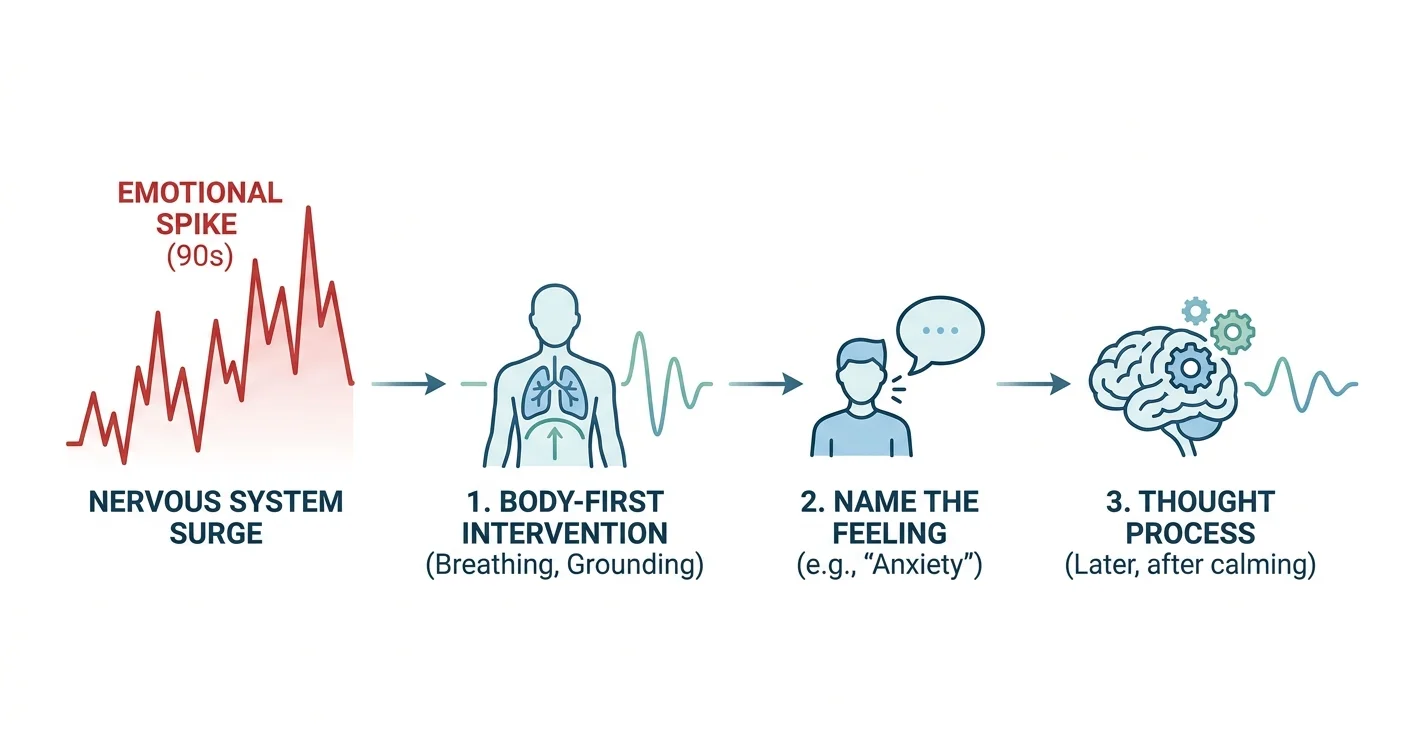
An emotional surge — anger, panic, grief — typically peaks and starts fading within about 90 seconds if you don't feed it with more thinking, a finding neuroscientists have pointed to for years when explaining the biology of emotional waves. The problem is most adults extend that 90 seconds into 90 minutes by ruminating, arguing internally, or scrolling for a distraction that never lands.
The difference between people who recover fast and people who stay dysregulated for hours isn't willpower. It's whether they have a rehearsed, physical response ready before the spike hits. That's what amygdala hijack actually describes: your rational brain goes offline for a window, and no amount of logic reaches you until your body signals safety again.
In 2026, more adults are treating emotional regulation as a trainable skill rather than a personality trait, and the data on nervous-system-based interventions backs that shift up. This guide breaks the process into steps you can practice cold, before you're mid-spike, so the skill is already loaded when you need it.
What you'll need
- 5-10 minutes of uninterrupted time to practice, ideally daily for the first two weeks
- A quiet space, though a bathroom stall or parked car works in a pinch
- A notebook or notes app for naming emotions and tracking triggers
- A timer (phone default is fine) for paced breathing exercises
- Optional: a voice-based support tool like Lovon for real-time coaching when you're too activated to remember steps on your own
The steps
1. Name the emotion before you act on it
Labeling what you feel — "this is anxiety," not "I'm fine" — reduces amygdala activity, a pattern shown repeatedly in affect-labeling research. Use one word, not a paragraph: angry, ashamed, scared, jealous. Naming takes under 10 seconds and interrupts the automatic reaction loop before it fully fires.
Common mistake: people label the situation ("this meeting is stressful") instead of the feeling ("I'm anxious"). Situation labels keep you in your head; emotion labels get you back into your body where regulation actually happens.
2. Slow your breathing to 4-6 breaths per minute
Most adults breathe 12-20 times a minute when stressed. Dropping to 4-6 breaths per minute activates the vagus nerve and shifts you out of fight-or-flight within 60-90 seconds. Box breathing (4 seconds in, 4 hold, 4 out, 4 hold) is the easiest version to remember under pressure.
Expected outcome: your heart rate visibly slows and the urgency to react drops, even if the emotion itself hasn't fully cleared yet. If you want the full technique with pacing cues, the box breathing walkthrough breaks it into a repeatable cadence.
3. Ground through your senses, not your thoughts
When you're spiraling, thinking your way out adds fuel. Instead, name 5 things you see, 4 you hear, 3 you can touch, 2 you smell, 1 you taste. This 5-4-3-2-1 sequence forces your prefrontal cortex back online because it requires present-moment attention.
Common mistake: rushing through the count in under 10 seconds. Slow it down to 60-90 seconds total — the pace matters more than the categories.
4. Release physical tension deliberately
Emotions get stored as muscle tension, especially in the jaw, shoulders, and chest. Progressive muscle relaxation — tensing a muscle group for 5 seconds, then releasing for 10 — teaches your body the felt difference between holding and letting go. A full pass through major muscle groups takes about 8-12 minutes.
Expected outcome: noticeable looseness in the shoulders and jaw, plus a drop in the "buzzing" feeling that comes with unprocessed stress. The progressive muscle relaxation guide has the full sequence if you want to practice it start to finish.
5. Delay the response by 20 minutes
Once your body has calmed, give yourself a 20-minute buffer before responding to whatever triggered the spike — an email, a text, a confrontation. This isn't avoidance; it's letting the nervous system finish its reset so your response comes from the calmer state, not the activated one.
Common mistake: using the 20 minutes to rehearse what you'll say, which re-activates the spike. Use it to do something unrelated instead — a walk, dishes, a different task entirely.
6. Track the pattern afterward
Write down what triggered the emotion, what you felt in your body, and what worked to bring you down. Over 2-3 weeks, patterns emerge — certain people, certain times of day, certain topics — that let you prepare before the spike instead of reacting after it.
Expected outcome: by week three, most people can predict at least one recurring trigger and start pre-loading a coping step before it hits. Understanding the biology behind this — why your body reacts before your mind catches up — is covered in polyvagal theory and the nervous system.
Troubleshooting
Breathing exercises make you more anxious, not less. This happens to some people with a history of panic attacks — the focus on breath can feel like losing control. Switch to grounding through touch instead (holding an ice cube, pressing feet into the floor) before adding breathwork back in slowly.
You forget every technique the second you're actually upset. This is normal and doesn't mean the skills don't work — it means you haven't over-practiced them yet. Rehearse during calm moments, not just crises, until the steps are automatic rather than something you have to recall.
You feel fine in the moment, then crash hours later. This is delayed processing, common with people who suppress rather than regulate. The emotion didn't disappear, it got postponed — schedule 10 minutes in the evening specifically to check in with what you're feeling.
Regulation works for small stuff but not for major triggers. Bigger emotional responses, especially ones tied to past trauma, often need more support than a single technique can provide. If a pattern feels bigger than day-to-day stress, that's a signal to bring in additional support rather than a sign the skill failed.
You regulate fine alone but fall apart during conflict with a partner. Interpersonal triggers activate faster and harder than solo stress. Practicing the same steps but naming the emotion out loud to the other person ("I'm getting flooded, I need two minutes") keeps the conversation from escalating while you reset.
Tools and resources
- Progressive muscle relaxation, step by step for the full-body release sequence
- Box breathing technique walkthrough for pacing cues you can follow live
- Coping tools for stress: what works and what doesn't for a broader comparison of techniques beyond regulation basics
- Lovon, for talking through a spike in real time when no one else is around — the app is built around voice conversation rather than typing, which matters when you're too activated to write clearly
What to do next
Practicing these steps daily for two weeks builds the muscle memory that makes them usable during an actual spike, not just in a calm test run. If regulation attempts consistently feel too big to handle alone, on-demand emotional support between sessions covers what to expect from real-time voice support and when it makes sense to bring in a licensed clinician alongside it.
FAQ
What are the best emotional regulation skills for adults? Naming the emotion, slowing your breath to 4-6 breaths per minute, and grounding through your senses are the three with the strongest research support for adults in 2026. Combine at least two of them, since breath work alone often isn't enough during a strong spike.
How long does it take to get better at emotional regulation? Most adults notice faster recovery from spikes within 2-3 weeks of daily practice, though full pattern change (predicting and pre-empting triggers) tends to take 6-8 weeks. Consistency matters more than intensity — five minutes daily beats an hour once a week.
Is emotional regulation the same as suppressing emotions? No. Suppression pushes the feeling down without processing it, which usually resurfaces later as irritability or a delayed crash. Regulation lets the emotion move through your body fully, just without letting it control your behavior in the moment.
Can breathing exercises alone fix emotional dysregulation? Breathing helps calm the physiological spike but rarely resolves the underlying trigger pattern by itself. Pair it with tracking and naming so you address both the immediate reaction and the recurring cause.
What's the fastest way to calm down during an argument? Name what's happening out loud ("I'm flooded, I need a minute") and step away for 60-90 seconds of slow breathing before continuing. Trying to keep arguing while dysregulated almost always makes things worse, not better.
Does emotional regulation work for anxiety and anger the same way? The body-first approach — breath, grounding, naming — works for both, since both are nervous system activations before they're specific emotions. The difference shows up afterward: anger often needs a delay before response, anxiety often needs reassurance about safety.
Can an app actually help with emotional regulation? A voice-based tool can walk you through grounding and breathing steps in real time, which is useful when you're too activated to remember techniques on your own. Lovon is built for exactly that gap — support between therapy sessions, not a replacement for a licensed clinician.
When should emotional regulation skills not be enough? If spikes are frequent, intense, or tied to trauma responses that don't ease with practice over several weeks, that's a signal to involve a licensed therapist. Self-guided regulation skills are a strong first layer, not a full treatment plan.
One last thing
The 90-second window matters more than any technique on this list — most people who feel like they "can't control their emotions" have simply never let a spike run its course without adding fuel to it. The skill isn't suppressing the wave. It's staying still enough, breath by breath, to let it pass on its own.
Related guides
How AI Support Helps You Heal
AI emotional support isn't about replacing human connection — it's about filling the gaps. The moments when you need to talk at 2 AM, when you don't want to burden your friends again, or when you simply need someone to listen without judgment.
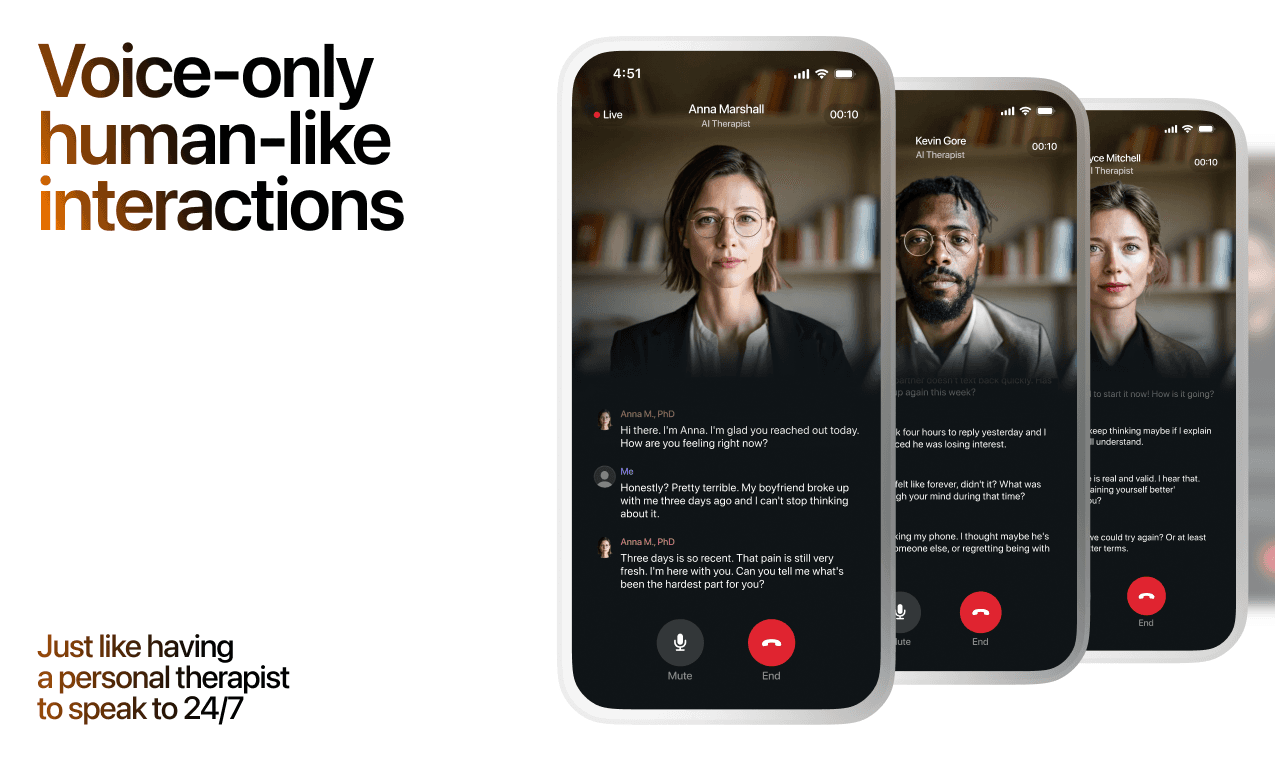
Here's what happens in a typical Lovon session:
You share what's on your mind
There's no script, no intake form, no waiting room. You speak or type whatever you're feeling — in your own words, at your own pace.
Lovon validates and explores
Using frameworks from CBT (Cognitive Behavioral Therapy) and motivational interviewing, Lovon acknowledges your feelings first, then gently helps you explore them. No dismissive "just move on" advice.
You build coping skills together
Lovon doesn't just listen — it actively works with you on evidence-based techniques: thought reframing, urge surfing, behavioral experiments, and more.
What a Session with Lovon Looks Like
When to Seek Professional Help
AI support is a valuable tool, but it's not a replacement for professional care. Please consider reaching out to a licensed therapist if you experience any of the following:
- Persistent thoughts of self-harm or suicide
- Inability to perform daily activities (work, eating, sleeping) for more than 2 weeks
- Turning to alcohol or substances to cope
- Intense anger or desire to harm your ex-partner
- Complete emotional numbness that doesn't improve over time
Crisis Resources (US): If you're in immediate danger, call 988 (Suicide & Crisis Lifeline) or text HOME to 741741 (Crisis Text Line). Available 24/7, free, and confidential.
Outside the US? Find a crisis line in your country
Ready to Start?
Your healing journey can begin right now
A 7-day trial. No judgment. Just a safe space to process what you're going through.
Frequently Asked Questions
Is Lovon a replacement for a real therapist?
Is my conversation with Lovon AI private?
How is Lovon different from ChatGPT for emotional support?
Can I use Lovon if I'm already seeing a therapist?
Can I try Lovon before subscribing?
About the Author

The Lovon Editorial Team
Mental Health & Wellness Content Team
The Lovon Editorial Team develops mental health and wellness content designed to make psychological concepts accessible and actionable. Our goal is to bridge the gap between clinical research and everyday life - helping you understand why your mind works the way it does and what you can do about it....
Related articles
- How to Calm Interview Anxiety Before a Big Interview 2026
Calm interview anxiety fast with box breathing, grounding, and prep steps that work in 2026, plus what to do if panic…
- Nervous System Reset: Daily Practices That Work (2026)
A nervous system reset in 90 seconds: box breathing, cold exposure, and orientation cues that calm fight-or-flight…
- Mindfulness for Anxiety: Techniques That Work in 2026
The best mindfulness techniques for anxiety in 2026 — body scan, 4-6 breathing, and 5-4-3-2-1 grounding — with…
- Progressive Muscle Relaxation for Stress Reduction
A systematic muscle group tension and release technique that calms the nervous system and reduces physical stress.
See also
Quizzes
- Coping Style Test: How Do You Actually Handle Stress?
See how you really cope under stress, in 3 minutes.
- Overthinking Test: Am I an Overthinker? 12-Question Quiz
See which overthinking loop runs you, in 3 minutes.
Free tools
- 5-4-3-2-1 Grounding Exercise
A guided run through the 5-4-3-2-1 technique, with paced breathing first if you need it. No sign-up, nothing stored…
- Words of Encouragement for Him When He Is Struggling
Words of encouragement for him that fit what he is actually going through, for when your usual lines are not landing…
From the wiki
- Why do I keep dreaming about my ex?
Recurring dreams about an ex usually mean your brain is still consolidating a relationship that took up years of memory…
Disclaimer: This article is for informational purposes only and does not constitute medical advice, diagnosis, or treatment. Always seek the advice of your physician or other qualified health provider with any questions you may have regarding a medical condition. If you are in crisis or think you may have an emergency, call 988 (Suicide & Crisis Lifeline) or go to the nearest emergency room. Outside the US? Find a crisis line in your country.