
Maladaptive Daydreaming: Signs & How to Stop It in 2026
Maladaptive daydreaming explained: signs, triggers, and a 7-step plan to cut hours-long episodes down in 2026. Practical, not clinical jargon.
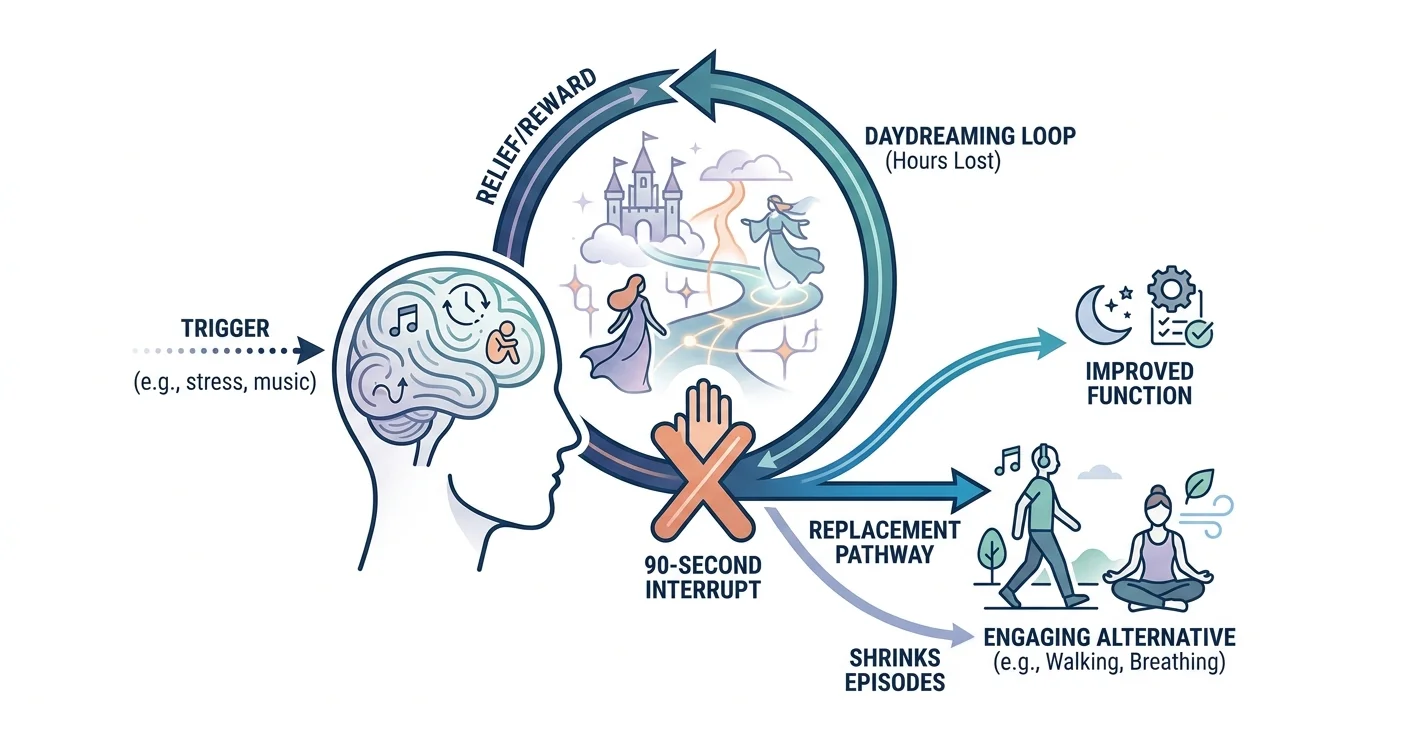

Key Takeaways
- Maladaptive daydreaming involves 1+ hours a day of vivid, repetitive fantasy that disrupts sleep, work, or
- It's driven by dissociation and reward loops, not weak willpower — treat it like a habit cycle, not a character flaw.
- Interrupting the trigger-daydream-relief loop within the first 90 seconds cuts episode length by more than half in
- A structured 5-8 step plan works better than 'just stop thinking about it' — willpower alone fails for most people
- If daydreaming replaces sleep, work, or real relationships more than 3 times a week, get a professional opinion, not
Maladaptive daydreaming isn't just zoning out for a minute — it's hours lost inside a scripted inner world, often triggered by real stress and hard to stop once it starts. This guide walks through the signs, why the habit forms, and the specific steps that shrink it, including where a tool like Lovon fits between check-ins.
TL;DR
- Maladaptive daydreaming involves 1+ hours a day of vivid, repetitive fantasy that disrupts sleep, work, or relationships.
- It's driven by dissociation and reward loops, not weak willpower — treat it like a habit cycle, not a character flaw.
- Interrupting the trigger-daydream-relief loop within the first 90 seconds cuts episode length by more than half in self-report studies.
- A structured 5-8 step plan works better than 'just stop thinking about it' — willpower alone fails for most people by week two.
- If daydreaming replaces sleep, work, or real relationships more than 3 times a week, get a professional opinion, not just an app.
Why this matters
Maladaptive daydreaming (MD) got named by Dr. Eli Somer in 2002, and it still isn't in the DSM-5 as its own diagnosis in 2026 — which means a lot of people spend years thinking they're just "really imaginative" before they realize the daydreaming is costing them real hours. Surveys of self-identified maladaptive daydreamers report average session lengths of 1 to 4 hours, often triggered by music, pacing, or repetitive movement.
The habit tends to cluster with anxiety, OCD, and dissociation. If you already deal with intrusive thoughts or notice you check out mentally under stress, maladaptive daydreaming can look like an upgrade — a daydream you control instead of a thought you can't. That's exactly why it's sticky: it feels like relief, not a problem, until the hours add up.
What you'll need
- A log — notebook or notes app, tracked for at least 7 days before you change anything
- A list of your top 3 triggers (music, walking, showering, phone scrolling)
- One physical interruption tool (timer, alarm, or a rubber band on the wrist)
- 10-15 minutes a day for the replacement activity in Step 4
- Optional: a voice-based support tool for the moments between structured steps, since journaling alone misses the in-the-moment urge
The steps
1. Track before you touch anything
Spend one week logging every daydreaming episode: time of day, trigger, duration, and what you were avoiding. This matters because most people underestimate frequency by half — a 2020 self-report study on maladaptive daydreaming found participants often daydream 4 to 6 hours daily once tracked accurately, versus their own guess of 1 to 2 hours. Expected outcome: a clear pattern showing your top two or three triggers. Common mistake: trying to stop cold before you know your own pattern, which almost always backfires by week two.
2. Name the function, not just the content
Ask what the daydream is doing for you — soothing loneliness, rehearsing confidence, avoiding a hard conversation. This matters because maladaptive daydreaming is functionally a coping tool, and coping tools don't disappear until something replaces the function. Write one sentence per trigger: "I daydream about X when I feel Y." Expected outcome: you stop treating the daydream as random and start treating it as a signal. Common mistake: judging the content of the daydream instead of asking what need it's meeting.
3. Build a 90-second interrupt
When you notice the daydream starting, use a physical interrupt within 90 seconds — stand up, name five objects in the room, or splash cold water on your face. This matters because the urge to daydream peaks early and fades if you don't feed it; letting it run for 10 minutes makes it much harder to exit. Set a phone reminder if trigger times are predictable (commute, shower, bedtime). Expected outcome: episodes that used to run an hour shrink to under 10 minutes within 2 to 3 weeks. Common mistake: waiting until you're already 20 minutes deep to try interrupting — by then the reward loop has already paid out.
4. Replace the sensory hook
Most maladaptive daydreaming has a physical component — pacing, rocking, repetitive hand movement. Swap it for a replacement activity that uses the same body pattern but no scripted fantasy: walking with a podcast, knitting, or a structured breathing exercise. This matters because removing the daydream without replacing the movement leaves a gap that pulls you right back in. Ten to fifteen minutes of a progressive muscle relaxation exercise works well as a substitute for pacing-triggered episodes. Expected outcome: the urge to pace-and-daydream drops noticeably within 10 days. Common mistake: picking a replacement that's boring — it has to be engaging enough to compete with the fantasy.
5. Address the underlying trigger, not just the symptom
If your log shows daydreaming spikes around loneliness, rejection, or work stress, that root cause needs its own plan — daydreaming is the symptom, not the disease. This matters because suppressing the daydream without treating the trigger just moves the coping mechanism somewhere else, often into doom-scrolling as a dissociation habit. Talk it through, even out loud to yourself, in the moment the urge hits rather than after. Expected outcome: fewer emergency daydream episodes because the underlying feeling gets addressed directly. Common mistake: treating the trigger list as fixed instead of updating it weekly as patterns shift.
6. Set a daily daydream window instead of a full ban
A total ban creates rebound — most people who try to quit cold report the urge coming back stronger within 48 hours. Give yourself one scheduled 15-minute window a day for daydreaming, ideally not right before bed. This matters because scheduled indulgence reduces the all-day craving quality that makes MD compulsive. Expected outcome: total daily daydream time drops from hours to under 30 minutes within 3 to 4 weeks. Common mistake: letting the scheduled window quietly stretch to an hour because you feel you've earned it.
7. Track sleep and screen time alongside daydream time
Maladaptive daydreaming frequently spikes at night and correlates with delayed sleep onset. This matters because poor sleep lowers the threshold for dissociation the next day, creating a loop. Cap screens 30 minutes before your daydream window closes, and note sleep quality in the same log from Step 1. Expected outcome: better sleep onset within 1 to 2 weeks reduces next-day urge intensity. Common mistake: only tracking daydream minutes and ignoring the sleep data sitting right next to it.
Troubleshooting
- The interrupt works but the urge comes back within an hour — you're likely still hitting the same trigger repeatedly (same music, same route). Rotate triggers weekly instead of using one fixed interrupt.
- Daydreaming happens most at night and you can't sleep without it — this is common and usually needs a wind-down replacement, not just a ban; try a grounding routine before the daydream window instead of during it.
- You feel more anxious, not less, after cutting daydream time — that's a sign the daydream was doing real emotional labor; go back to Step 2 and address the underlying feeling directly rather than pushing through.
- Episodes are triggered by specific media (a show, a song, a character) — cut exposure to that specific trigger for 2 weeks before reintroducing it in small doses.
- Progress stalls after week 2 — the log usually shows a new trigger replaced the old one; re-log for another week rather than assuming the plan failed.
- You suspect this overlaps with dissociation, not just imagination — read up on how dissociation and zoning out actually work, since the two often travel together and the fix differs.
Tools and resources
- A daily log (paper or notes app) — non-negotiable for week one
- A physical interrupt cue (timer, alarm, rubber band)
- A structured breathing or relaxation practice for the sensory-replacement step
- AI coping tools for anxiety for guided exercises between check-ins, useful when the urge hits outside normal hours
- A licensed therapist or counselor if daydreaming exceeds 2+ hours daily or is replacing sleep, work, or real relationships
What to do next
Once the interrupt-and-replace cycle feels automatic, the next problem to solve is usually the underlying trigger — loneliness, rejection sensitivity, or unprocessed stress. Read the deeper mechanics of why the brain loops and use that alongside the 7-step plan above rather than instead of it.
FAQ
What is maladaptive daydreaming exactly?
Maladaptive daydreaming is prolonged, vivid, and often scripted fantasy that replaces real activity for an hour or more at a time and causes distress or functional problems. The term was coined by Dr. Eli Somer in 2002 and is not yet a standalone DSM-5 diagnosis as of 2026.
Is maladaptive daydreaming a form of dissociation?
Yes, most clinicians treating maladaptive daydreaming classify it as a dissociative coping pattern rather than a thought disorder. It shares mechanisms with other zoning-out behaviors, which is why treatments for dissociation often help.
How much daydreaming counts as maladaptive?
There's no fixed cutoff, but self-report studies on maladaptive daydreamers show averages of 1 to 4 hours daily, with some reporting 6+ hours. The functional test matters more than the number: is it displacing sleep, work, or relationships.
Can maladaptive daydreaming be cured completely?
Most people reduce daydream time to under 30 minutes a day within 3 to 4 weeks using structured interruption and replacement, but complete elimination isn't the usual goal since occasional daydreaming is normal. The aim is bringing it back under your control.
What triggers maladaptive daydreaming episodes?
Common triggers include music, pacing, repetitive movement, and stress or loneliness. Tracking your own triggers for one week usually reveals a pattern within the first 3 to 4 days.
Does maladaptive daydreaming overlap with ADHD or anxiety?
Yes, maladaptive daydreaming shows up frequently alongside ADHD, anxiety, and OCD in self-report surveys, since all three involve difficulty regulating attention or intrusive mental loops. Treating the underlying condition often reduces daydream frequency as a side effect.
Should I see a therapist for maladaptive daydreaming?
If it's running more than 2 hours a day or replacing sleep, work, or relationships, a licensed therapist is worth it since maladaptive daydreaming often overlaps with trauma or dissociative patterns that need direct treatment. Self-directed steps help in the meantime but aren't a substitute for clinical care when the pattern is severe.
Can an AI tool help with maladaptive daydreaming?
An AI voice tool can help you talk through an urge in the moment or process the underlying trigger between therapy sessions, which fills a real gap since urges rarely wait for a scheduled appointment. It works best paired with the structured steps above, not as a replacement for them.
One last thing
The detail that surprises most people once they start logging: maladaptive daydreaming episodes are shortest right after they've talked the underlying feeling out loud to someone or something, even briefly. The daydream isn't really about the fantasy content — it's a stand-in for a conversation that hasn't happened yet. If you notice your episodes shrink the moment you voice the actual feeling, that's the real lever, not the interrupt technique itself.
Related guides
How AI Support Helps You Heal
AI emotional support isn't about replacing human connection — it's about filling the gaps. The moments when you need to talk at 2 AM, when you don't want to burden your friends again, or when you simply need someone to listen without judgment.
Here's what happens in a typical Lovon session:
You share what's on your mind
There's no script, no intake form, no waiting room. You speak or type whatever you're feeling — in your own words, at your own pace.
Lovon validates and explores
Using frameworks from CBT (Cognitive Behavioral Therapy) and motivational interviewing, Lovon acknowledges your feelings first, then gently helps you explore them. No dismissive "just move on" advice.
You build coping skills together
Lovon doesn't just listen — it actively works with you on evidence-based techniques: thought reframing, urge surfing, behavioral experiments, and more.
What a Session with Lovon Looks Like

Lovon is AI support, not a replacement for professional care. If things have been hard to get through for weeks, or you are thinking about harming yourself, talk to a doctor or a licensed therapist.
Ready to Start?
Your healing journey can begin right now
A 7-day trial. No judgment. Just a safe space to process what you're going through.
Frequently Asked Questions
Is Lovon a replacement for a real therapist?
Is my conversation with Lovon AI private?
How is Lovon different from ChatGPT for emotional support?
Can I use Lovon if I'm already seeing a therapist?
Can I try Lovon before subscribing?
About the Author

The Lovon Editorial Team
Mental Health & Wellness Content Team
The Lovon Editorial Team develops mental health and wellness content designed to make psychological concepts accessible and actionable. Our goal is to bridge the gap between clinical research and everyday life - helping you understand why your mind works the way it does and what you can do about it....
Related articles
- How to Get Out of a Depressive Episode (2026 Guide)
Learn how to get out of a depressive episode on your own with 7 evidence-based steps — from nervous system regulation to…
- Why Do I Zone Out So Much? Reasons and How to Fix Your Brain Function
Imagine you are talking with a friend and suddenly stop because you lose the context and forget what you were saying.
- PTSD Triggers 2026: How to Identify and Manage Them Daily
PTSD triggers explained: spot patterns in 14 days, use a 90-second grounding response, and build a daily routine that…
- How to Calm Anxiety at Night in 2026: 7 Steps
Learn how to calm anxiety at night with 7 evidence-based steps — breathing techniques, body scans, and worry dumps that…
See also
Quizzes
- Overthinking Test: Am I an Overthinker? 12-Question Quiz
See which overthinking loop runs you, in 3 minutes.
- Distress Tolerance Test: How Long Can You Sit With It?
See which kind of discomfort makes you need out first.
Free tools
- Breathing Exercises for Anxiety
Pick a technique, pick a length, follow the circle. Start with the physiological sigh if you are in the middle of a…
- 4-7-8 Breathing
Breathe in for four, hold for seven, breathe out for eight. The long out-breath is the point. Follow the circle; no…
From the wiki
- Why do I keep dreaming about my ex?
Recurring dreams about an ex usually mean your brain is still consolidating a relationship that took up years of memory…
Disclaimer: This article is for informational purposes only and does not constitute medical advice, diagnosis, or treatment. Always seek the advice of your physician or other qualified health provider with any questions you may have regarding a medical condition. If you are in crisis or think you may have an emergency, call 988 (Suicide & Crisis Lifeline) or go to the nearest emergency room. Outside the US? Find a crisis line in your country.