
AI Coping Tools for Anxiety 2026: What Actually Works
AI coping tools for anxiety compared for 2026: box breathing, grounding, and PMR ranked with clear verdicts on what to use and what to skip.
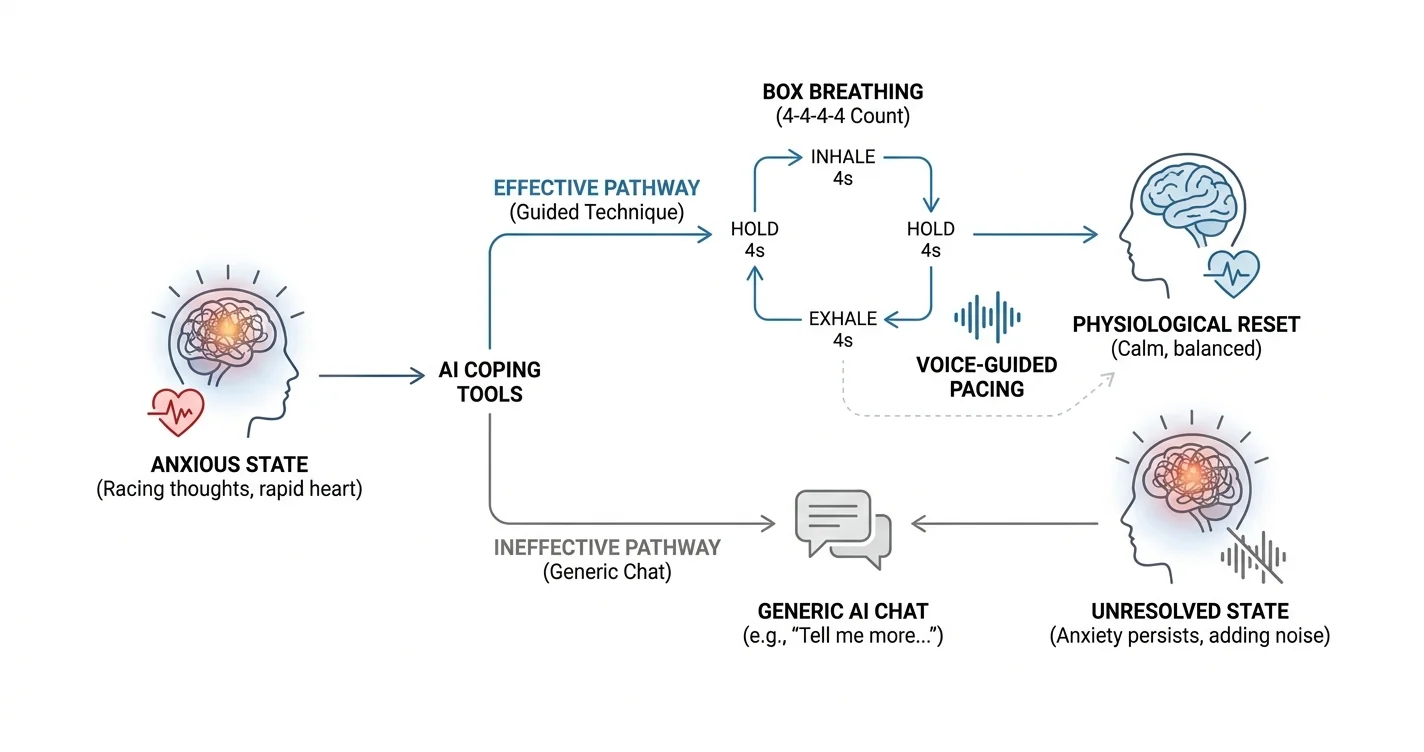

Key Takeaways
- AI coping tools for anxiety work best when they guide a specific technique, not just chat back at you.
- Box breathing and grounding exercises delivered by voice beat text-only prompts for in-the-moment anxiety control.
- Progressive muscle relaxation before bed cuts nighttime anxiety spirals — budget 12 to 15 minutes.
- Skip any tool with no clear technique behind it — vague affirmations are not a coping strategy in 2026.
You want anxiety relief that doesn't require booking an appointment three weeks out — this guide breaks down which AI coping tools for anxiety actually help you calm down in the moment, and which ones just add noise.
TL;DR
- AI coping tools for anxiety work best when they guide a specific technique, not just chat back at you.
- Box breathing and grounding exercises delivered by voice beat text-only prompts for in-the-moment anxiety control.
- Progressive muscle relaxation before bed cuts nighttime anxiety spirals — budget 12 to 15 minutes.
- Skip any tool with no clear technique behind it — vague affirmations are not a coping strategy in 2026.
Why this matters
Anxiety doesn't wait for office hours. A racing heart at 11 p.m. or a spiraling thought loop before a meeting needs a response in minutes, not next Tuesday. That's the gap AI apps for anxiety are built to fill — on-demand, structured, and available at 3 a.m. if that's when your brain decides to spiral.
The catch: not every app that says "AI" and "anxiety" in the same sentence actually does anything useful. Some just generate soothing sentences. Others walk you through a technique with a real physiological basis — slowing your heart rate, interrupting a thought loop, releasing muscle tension. In 2026, that distinction is the whole ballgame.
Lovon runs on voice, not text, because pacing matters when you're trying to slow a nervous system down. Typing out your panic takes longer than talking through it, and a voice that paces your breath with you does something a chat bubble can't.
Who this is for
This guide is for anyone managing everyday anxiety — racing thoughts before bed, a tight chest before a presentation, a spiral that starts at 2 a.m. and won't stop — who wants a coping tool they can use between therapy sessions or when therapy isn't accessible right now. It's not for anyone in crisis needing immediate clinical intervention; that calls for a licensed provider or emergency services, not an app.
What to look for in AI coping tools for anxiety
A specific technique, not just conversation
A tool that says "tell me what's wrong" and responds with generic sympathy doesn't do much for a racing nervous system. Look for tools built around named, testable techniques — box breathing, grounding, progressive muscle relaxation — because those have a mechanism, not just a mood.
Voice-first delivery
Anxiety in the moment often comes with racing thoughts that make typing feel impossible. Voice-guided pacing — counting a breath in real time, walking you through a body scan out loud — keeps you present in a way a text screen doesn't.
Genuine 24/7 availability
Anxiety spikes don't check a calendar. A tool worth using has to be there at 2 a.m. on a Tuesday exactly as reliably as it is at 2 p.m. on a Saturday — no queue, no "next available slot."
Honesty about its limits
Any AI coping tool worth trusting says plainly that it isn't a licensed clinician and isn't a substitute for therapy when you need one. Tools that overclaim — promising to "cure" anxiety or replace a psychologist — are a red flag, not a selling point.
Repeatability without fatigue
A coping exercise you'll actually do again next week beats one that's impressive once and exhausting to repeat. Short, structured sessions (5-15 minutes) build habits; hour-long guided meditations mostly get abandoned by week two.
Top picks
Each of these is a specific exercise you can start using today, matched to a different kind of anxious moment.
Box breathing — the fastest reset. This is the 4-4-4-4 count technique (inhale 4, hold 4, exhale 4, hold 4) used by military and clinical settings to slow a racing heart in under 2 minutes. It's the tool to reach for right before a meeting or a hard conversation, when you need your body to settle fast without stepping away for 20 minutes. The full walkthrough is in Lovon's box breathing guide. Buy.
Grounding — the panic-attack circuit breaker. The 5-4-3-2-1 sensory method (naming things you can see, hear, touch, smell, taste) interrupts a spiraling thought loop by forcing your attention back into your body and your environment. It's built for the moment anxiety tips into a panic attack, not for general daily maintenance. See the grounding techniques for anxiety and panic guide for the step-by-step version. Buy.
Progressive muscle relaxation — the before-bed unwind. This technique tenses and releases muscle groups in sequence, typically taking 12 to 15 minutes start to finish, and it's the pick for anxiety that shows up as physical tension at night rather than racing thoughts. It's slower than box breathing, so it's not the tool for a mid-meeting panic spike. Full sequence at progressive muscle relaxation for stress. Consider.
A general coping-tools sanity check — the works-and-doesn't-work filter. Before you download five apps, it helps to know which coping strategies actually have evidence behind them versus which ones are just popular. The coping tools for stress breakdown sorts the two apart, which matters if you're anxiety-shopping for tools and don't want to waste a week on something with no mechanism. Consider.
What to avoid
- Chat-only "AI therapists" with no named technique. If a tool can't tell you what specific exercise you're doing and why, it's just a sympathetic chatbot — fine for venting, weak for actual anxiety reduction.
- Apps that promise to replace a therapist entirely. Anything overclaiming clinical authority instead of positioning itself as a companion between sessions is overselling what AI can do in 2026.
- Hour-long guided sessions when you need a 90-second reset. Long-form meditation has its place, but it's the wrong tool for a spike that needs to come down in the next five minutes before your meeting starts.
Verdict comparison
| Tool | Best for | Time needed | Verdict |
|---|---|---|---|
| Box breathing | Pre-meeting nerves, fast reset | Under 2 minutes | Buy |
| Grounding (5-4-3-2-1) | Panic attacks, spiraling thoughts | 3-5 minutes | Buy |
| Progressive muscle relaxation | Nighttime tension, trouble sleeping | 12-15 minutes | Consider |
| Generic AI chat with no technique | Venting only | Variable | Skip |
FAQ
What are the best AI coping tools for anxiety in 2026?
The most effective tools guide you through a named technique like box breathing, grounding, or progressive muscle relaxation rather than open-ended chat. Voice-based delivery, available 24/7, tends to outperform text-only apps for in-the-moment anxiety.
Can an AI app actually stop a panic attack?
An AI tool can walk you through grounding or breathing techniques that reduce the physical intensity of a panic attack within minutes, but it cannot diagnose or treat panic disorder. For recurring panic attacks, a licensed provider should be involved.
Is AI coping support as good as therapy?
No. AI coping tools are built for between-session support and everyday anxiety management, not clinical treatment. They work best alongside therapy, not instead of it.
How much does an AI anxiety app cost compared to therapy?
AI coping apps typically cost far less than a single therapy session, though pricing varies by app and plan. Traditional therapy without insurance often runs well over $100 per session in 2026, which is part of why on-demand tools have grown as a between-session option.
What's the fastest way to calm anxiety using an app?
Box breathing is the fastest reset, typically bringing a racing heart rate down within 2 minutes using a 4-4-4-4 count. Grounding techniques work almost as fast for interrupting a spiraling thought pattern.
Do AI coping tools work for nighttime anxiety?
Yes, progressive muscle relaxation and slow breathing exercises are commonly used for anxiety that spikes at bedtime. These take longer than a quick reset, usually 12 to 15 minutes, but target physical tension that keeps you awake.
Is voice-based AI better than text-based apps for anxiety?
Voice-based delivery paces you through a breathing or grounding exercise in real time, which is harder to replicate through typed text during a spike. Text apps still work for reflection and journaling between episodes.
Are free AI coping tools for anxiety worth using?
Free tools can be a reasonable starting point if they're built around a specific technique rather than generic chat. Check whether the tool names its method (box breathing, grounding, etc.) before relying on it regularly.
One last thing
The technique matters more than the app. Box breathing, grounding, and progressive muscle relaxation all predate any AI tool by decades — what changed in 2026 is that you can get walked through them by voice, at 2 a.m., without waiting for anyone's calendar to open up. Pick the technique that matches your specific moment, not the app with the flashiest chat interface.
Lovon is built around exactly this: voice-guided coping exercises available whenever anxiety shows up, developed with input from PhD psychologists, and honest that it's a companion between sessions — not a replacement for a licensed clinician when you need one.
How AI Support Helps You Heal
AI emotional support isn't about replacing human connection — it's about filling the gaps. The moments when you need to talk at 2 AM, when you don't want to burden your friends again, or when you simply need someone to listen without judgment.
Here's what happens in a typical Lovon session:
You share what's on your mind
There's no script, no intake form, no waiting room. You speak or type whatever you're feeling — in your own words, at your own pace.
Lovon validates and explores
Using frameworks from CBT (Cognitive Behavioral Therapy) and motivational interviewing, Lovon acknowledges your feelings first, then gently helps you explore them. No dismissive "just move on" advice.
You build coping skills together
Lovon doesn't just listen — it actively works with you on evidence-based techniques: thought reframing, urge surfing, behavioral experiments, and more.
What a Session with Lovon Looks Like
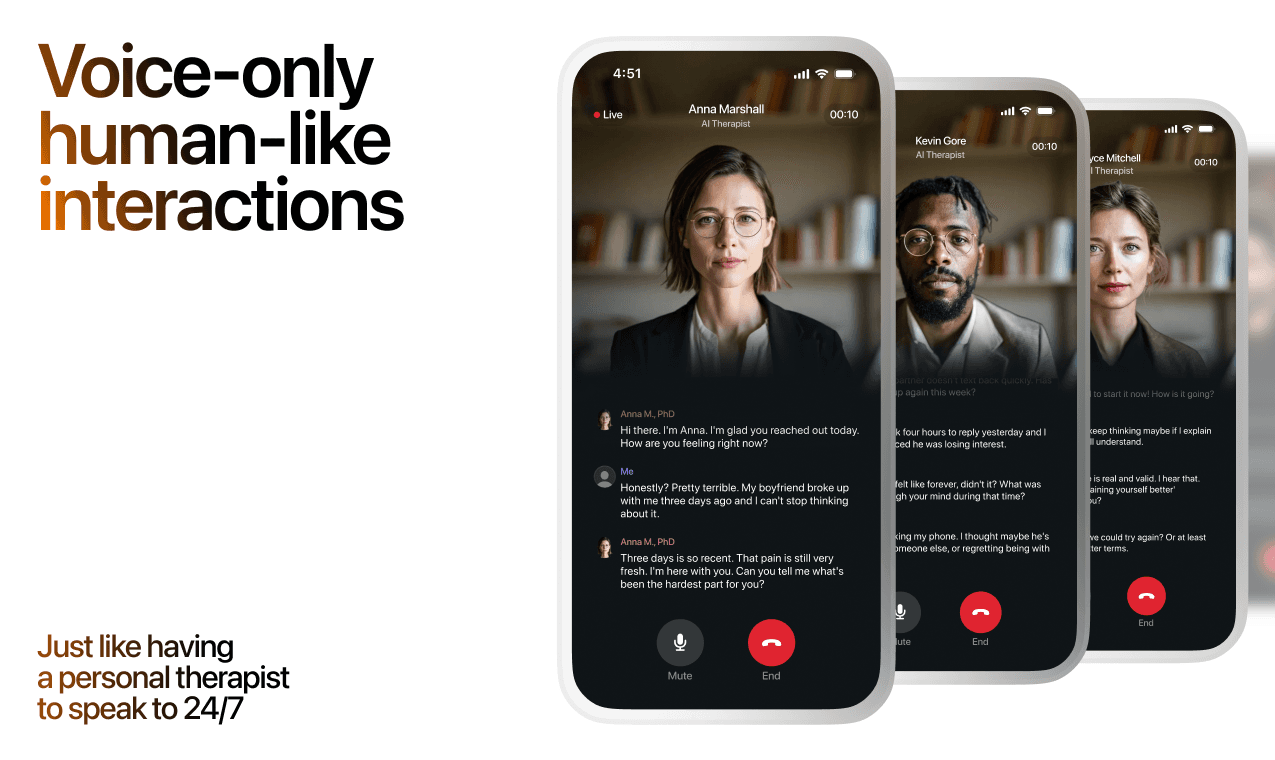
Lovon is AI support, not a replacement for professional care. If things have been hard to get through for weeks, or you are thinking about harming yourself, talk to a doctor or a licensed therapist.
Ready to Start?
Your healing journey can begin right now
A 7-day trial. No judgment. Just a safe space to process what you're going through.
Frequently Asked Questions
Is Lovon a replacement for a real therapist?
Is my conversation with Lovon AI private?
How is Lovon different from ChatGPT for emotional support?
Can I use Lovon if I'm already seeing a therapist?
Can I try Lovon before subscribing?
About the Author
The Lovon Editorial Team
Mental Health & Wellness Content Team
The Lovon Editorial Team develops mental health and wellness content designed to make psychological concepts accessible and actionable. Our goal is to bridge the gap between clinical research and everyday life - helping you understand why your mind works the way it does and what you can do about it....
Related articles
- AI Coping Tools for Panic Attacks While Driving (2026)
The best AI coping tools for panic attacks while driving in 2026 — hands-free grounding, breathing cues, and voice AI…
- AI Therapist for Work Stress: How to Use It in 2026
Learn how to use an ai therapist for work stress the right way in 2026 - specific triggers, grounding steps, and when…
- Stress Management Techniques for Adults: What Works in 2026
Stress management techniques for adults ranked by evidence in 2026: box breathing, muscle relaxation, movement, and when…
- AI Coping Tools for Wedding Planning Stress (2026)
AI coping tools for wedding planning stress in 2026: box breathing, muscle relaxation, and Lovon's on-demand voice…
See also
Quizzes
- Self-Control Test: Where Does Your Willpower Slip?
See where your willpower slips, in 3 minutes.
- Defense Mechanisms Test: Which Ones Do You Use Most?
See what your defenses do with hard feelings, in 3 minutes.
Free tools
- How to Stop Overthinking in a Relationship
Not a list of habits. Tell it the specific thing you are going round on, and it separates what actually happened from…
- Breakup Meditation
For when it's over and it still hurts. Seven minutes of slow breathing, noticing where the breakup sits in your body…
From the wiki
- Why do I feel lonely all of a sudden?
Sudden loneliness usually traces back to something that quietly ended in the last few months: a routine, a shared class…
Disclaimer: This article is for informational purposes only and does not constitute medical advice, diagnosis, or treatment. Always seek the advice of your physician or other qualified health provider with any questions you may have regarding a medical condition. If you are in crisis or think you may have an emergency, call 988 (Suicide & Crisis Lifeline) or go to the nearest emergency room. Outside the US? Find a crisis line in your country.