
Doom Scrolling and Dissociation: How to Break It (2026)
Doom scrolling and dissociation share a shutdown circuit, not a willpower gap. Get the 2026 step-by-step fix, from trigger tracking to a 90-second body reset.

Key Takeaways
- Doom scrolling and dissociation run on the same shutdown circuit — scrolling numbs you, it doesn't calm you. Treat
- The habit spikes at night and right after conflict or overwhelm, when your body is already past its window of tolerance.
- A 90-second body-based interrupt before you unlock your phone breaks the loop for most people faster than app
- Lovon's AI voice therapy sessions give you somewhere to put the urge to zone out instead of scrolling through it in
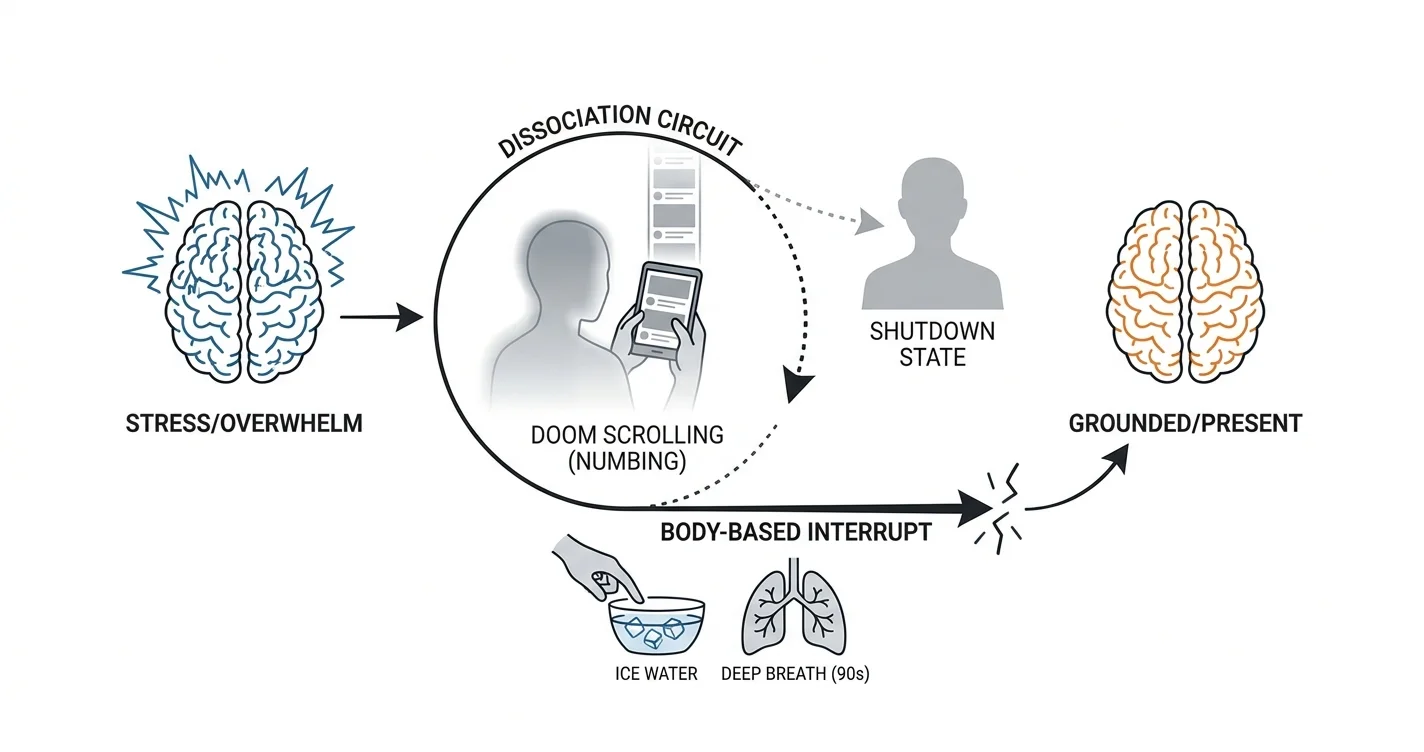
Doom scrolling and dissociation aren't two separate problems — the scroll is usually how the shutdown shows up. If you pick up your phone and forty minutes disappear without a single moment you can recall, that's not boredom. That's your nervous system checking out, and the feed is just where it's checking out to.
TL;DR
- Doom scrolling and dissociation run on the same shutdown circuit — scrolling numbs you, it doesn't calm you. Treat it as a dissociation habit, not a focus problem.
- The habit spikes at night and right after conflict or overwhelm, when your body is already past its window of tolerance.
- A 90-second body-based interrupt before you unlock your phone breaks the loop for most people faster than app blockers alone.
- Lovon's AI voice sessions give you somewhere to put the urge to zone out instead of scrolling through it in silence.
Why this matters
Most advice on doom scrolling treats it like a habit problem: set a timer, grayscale your screen, delete the app. That works for casual overuse. It does almost nothing when the scrolling is a dissociation response, because you're not choosing to scroll — you're already gone by the time your thumb starts moving.
Dissociation is your nervous system's way of pulling you out of a moment that feels like too much, whether that's grief, an argument, or just the low hum of chronic stress that never resolves. The dissociation guide on Lovon breaks down why zoning out happens and what the body is actually doing during it. Scrolling fits the same pattern: it gives your eyes motion and your brain nothing to hold onto, which is exactly what a freeze state wants.
The tell is how you feel when you put the phone down. Distraction leaves you a little relieved. Dissociation leaves you flatter, foggier, and a little unsure of the last twenty minutes. If that's your pattern in 2026, the fix isn't a screen-time limit — it's addressing what your body is trying to avoid.
What you'll need
- A phone with screen-time data (Settings on iOS, Digital Wellbeing on Android) to see your actual pattern, not your guess at it
- A notebook or notes app for a 3-day trigger log
- 90 seconds of uninterrupted space, several times a day, for the body reset
- One low-stakes replacement action you can do with your hands (dishes, a short walk, stretching)
- Fifteen minutes before bed with the phone somewhere other than arm's reach
The steps
1. Name the state before you name the behavior
Before you touch the phone, ask what you're feeling in your body — not your mood, your body. Tight chest, foggy head, heavy limbs, a kind of static behind the eyes. Naming the physical state gives you something to intervene on instead of just white-knuckling the urge to scroll.
This matters because dissociation habits don't respond to logic ("I know I should stop"). They respond to the body registering something different. Skip this step and every other step in this guide becomes another thing you're too checked-out to follow.
Common mistake: trying to reason your way out of it first. If you're already dissociating, reasoning is the last system online.
2. Track your trigger window for three days
Log the time, what happened ten minutes before, and how you felt in your body each time you catch yourself mid-scroll with no memory of opening the app. Most people find the pattern clusters hard around one or two windows — right after a stressful call, or in bed between 11pm and 1am.
That window is where the actual work happens. The nervous system dysregulation guide walks through what dysregulation looks like hour to hour, which makes it easier to spot your own window instead of guessing at it.
Expected outcome: by day three you'll be able to name your trigger window without checking the log. Common mistake: logging only the scroll, not what happened right before it — the trigger is almost never the phone itself.
3. Interrupt with a 90-second body reset
When you catch the urge — or catch yourself already scrolling — stop and do something physical for 90 seconds before deciding anything about the phone. Cold water on your wrists, five slow exhales longer than your inhales, or pressing your feet hard into the floor and naming five things you can see.
The grounding techniques guide has a full set of these you can rotate through so none of them go stale. The point isn't the specific technique — it's giving your body 90 seconds of a different signal than the one that sent you into shutdown.
Common mistake: trying to grind through willpower instead of changing the body's input. Willpower doesn't work on a freeze response; sensory input does.
4. Replace the reflex with something your hands can do
After the 90-second reset, if the urge is still there, do the low-stakes physical task you picked in advance — folding laundry, watering a plant, stacking dishes. It has to require your hands and not your attention, because full attention tasks get abandoned mid-dissociation and low-effort ones don't.
This rebuilds the association between "I feel this way" and "I do this thing," instead of "I feel this way" and "I disappear into a feed." Expected outcome: within a week, the replacement action starts happening automatically before you even reach for the phone.
5. Regulate before bed, not after you're already scrolling
If your trigger window is nighttime, the fix happens 15 minutes before you're normally reaching for the phone, not in the middle of the scroll. Dim the lights, put the phone across the room, and do a slower version of your grounding reset.
The window of tolerance guide explains why nighttime dissociation is so common — your window narrows as the day's stress accumulates, and by 11pm there's almost no buffer left. Widening that window during the day is the actual long-term fix; the nighttime routine is just damage control.
Common mistake: treating the nighttime scroll as a sleep hygiene issue and only addressing it with blue-light filters. The light isn't the problem.
6. Process the underlying feeling instead of numbing it
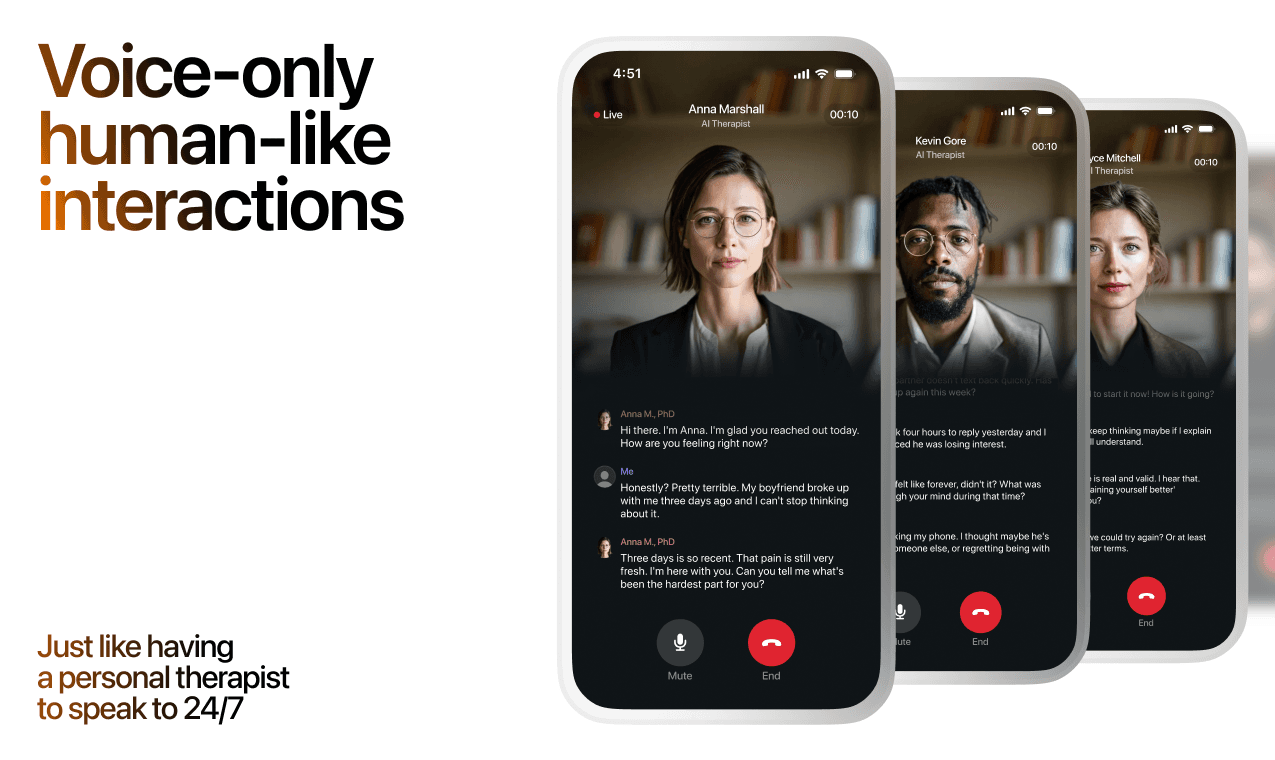
The scroll exists because there's a feeling underneath it that hasn't found anywhere else to go. Talking it through — out loud, not just journaled — tends to close the loop faster than any interrupt technique alone. An AI voice therapy session works well here specifically because it's available in the exact minute the urge shows up, at 11:40pm or mid-workday, not two weeks out.
Lovon is built for that gap: a voice conversation with an AI voice companion when the dissociation urge hits, so the feeling gets somewhere to land instead of getting buried under another hour of scrolling. Verdict: this step is what makes the other five stick.
If scrolling makes you feel less real instead of less anxious, that's dissociation, not distraction.
Troubleshooting
- The urge comes back within an hour of the reset. One 90-second reset rarely holds all day if the trigger window is long. Repeat it every time the fog returns rather than expecting one interrupt to last for hours.
- You can't remember catching yourself mid-scroll. Set a screen-time check-in alert instead of relying on self-awareness in the moment — external cues work better than internal ones during dissociation.
- The replacement task feels pointless and you skip it. Pick something with an immediate physical sensation (cold water, textured fabric) rather than a neutral task like tidying — sensation cuts through fog faster than routine does.
- Nighttime scrolling persists even with the phone across the room. The trigger is likely earlier in the day, not at bedtime. Go back to your trigger log and check what's happening in the two hours before you get into bed.
- You feel worse, not better, after the 90-second reset. That can mean the nervous system is more dysregulated than a quick grounding tool can address alone — that's the point to bring it to a session, not push through solo.
- Screen time drops but the fog doesn't. The scroll was never the disorder — it's the container. If the numbness shows up somewhere else (staring at a wall, rewatching the same show), the underlying work in step 6 still needs to happen.
Tools and resources
- Screen-time tracking built into your phone (free, no install needed)
- A 3-day trigger log — paper or notes app, whichever you'll actually keep
- The grounding techniques list for rotating sensory interrupts
- The nervous system dysregulation guide for understanding your specific trigger window
- An AI voice therapy conversation for the minutes right after the urge hits, when a scheduled session two weeks out doesn't help
FAQ
Is doom scrolling actually a form of dissociation?
For a lot of people, yes — doom scrolling and dissociation overlap when the scrolling happens automatically and leaves you unable to recall the last 20-40 minutes. If you feel flatter or foggier afterward rather than relieved, it's functioning as a dissociation habit, not simple distraction.
How do I know if I'm dissociating or just distracted?
Distraction leaves you mildly relieved and aware of time passing. Dissociation leaves you unsure how much time passed and feeling more numb than before you started scrolling.
What causes doom scrolling to become a dissociation habit?
It usually starts as a coping response to a specific stressor — grief, conflict, chronic overwhelm — and the brain learns that scrolling reliably shuts down uncomfortable feelings. Over time the behavior triggers on its own, without a conscious decision.
Can screen-time limits fix dissociative scrolling?
Limits alone rarely work because the scrolling isn't the actual problem, it's the symptom. Screen-time tools help you see the pattern, but the fix requires addressing the trigger window and the nervous system state underneath it.
How long does it take to break the doom scrolling and dissociation cycle?
Most people notice a shift within one to two weeks of consistently using a body-based interrupt at the trigger window, based on aggregated 2026 mental health app usage patterns. Full change in the habit typically takes longer if there's an underlying trauma response driving it.
Is dissociative scrolling a sign of a bigger mental health issue?
It can be, especially if it's paired with memory gaps, feeling detached from your body, or numbness that extends beyond screen time. It's worth bringing up with a therapist or an AI therapy session if it's happening daily.
Does an AI therapist help with dissociation from doom scrolling?
An AI voice therapy session can help by giving you somewhere to process the urge and the underlying feeling right when it shows up, which is often the missing piece in habit-based fixes. It works alongside grounding techniques rather than replacing them.
What's the fastest way to stop a dissociative scroll in the moment?
A 90-second sensory interrupt — cold water, five slow exhales, naming five things you can see — tends to work faster than trying to reason yourself off the phone, because dissociation isn't a logic problem.
One last thing
The detail that surprises most people: the content of the feed barely matters. Doom scrolling and dissociation happen just as often on a feed of vacation photos as they do on breaking news, because the trigger is the state you're already in, not what's on the screen. Fix the trigger window and the specific app stops mattering.
Related guides
How AI Support Helps You Heal
AI emotional support isn't about replacing human connection — it's about filling the gaps. The moments when you need to talk at 2 AM, when you don't want to burden your friends again, or when you simply need someone to listen without judgment.
Here's what happens in a typical Lovon session:
You share what's on your mind
There's no script, no intake form, no waiting room. You speak or type whatever you're feeling — in your own words, at your own pace.
Lovon validates and explores
Using frameworks from CBT (Cognitive Behavioral Therapy) and motivational interviewing, Lovon acknowledges your feelings first, then gently helps you explore them. No dismissive "just move on" advice.
You build coping skills together
Lovon doesn't just listen — it actively works with you on evidence-based techniques: thought reframing, urge surfing, behavioral experiments, and more.
What a Session with Lovon Looks Like
Lovon is AI support, not a replacement for professional care. If things have been hard to get through for weeks, or you are thinking about harming yourself, talk to a doctor or a licensed therapist.
Ready to Start?
Your healing journey can begin right now
A 7-day trial. No judgment. Just a safe space to process what you're going through.
Frequently Asked Questions
Is Lovon a replacement for a real therapist?
Is my conversation with Lovon AI private?
How is Lovon different from ChatGPT for emotional support?
Can I use Lovon if I'm already seeing a therapist?
Can I try Lovon before subscribing?
About the Author

The Lovon Editorial Team
Mental Health & Wellness Content Team
The Lovon Editorial Team develops mental health and wellness content designed to make psychological concepts accessible and actionable. Our goal is to bridge the gap between clinical research and everyday life - helping you understand why your mind works the way it does and what you can do about it....
Related articles
- Automatically silence notifications when you start a Lovon session
Set up Lovon focus mode notifications so Do Not Disturb turns on the moment you open a session — iPhone Shortcuts and…
- How to Stop Anxiety Spirals: 7 Steps for 2026
How to stop anxiety spirals with 7 grounded steps for 2026: paced breathing, grounding, and catching the thought before…
- Health Anxiety: How to Stop Googling Symptoms (2026)
Health anxiety has you Googling symptoms at 2am. This 2026 guide gives a 15-minute delay rule, grounding steps, and what…
- Best AI Therapy App for Eating Disorder Recovery 2026
Lovon ranks the best AI therapy apps for eating disorder recovery in 2026, comparing voice support, trackers, and…
See also
Quizzes
- Self-Control Test: Where Does Your Willpower Slip?
See where your willpower slips, in 3 minutes.
- Self-Acceptance Test: What Are You Still Arguing With?
See where you are still fighting yourself, in 3 minutes.
Free tools
- Letting Go Meditation
For the person, the message you keep waiting for, or the future you were counting on. Seven minutes to loosen your grip…
- Breathing Exercises for Anxiety
Pick a technique, pick a length, follow the circle. Start with the physiological sigh if you are in the middle of a…
From the wiki
- Why do I keep dreaming about my ex?
Recurring dreams about an ex usually mean your brain is still consolidating a relationship that took up years of memory…
Disclaimer: This article is for informational purposes only and does not constitute medical advice, diagnosis, or treatment. Always seek the advice of your physician or other qualified health provider with any questions you may have regarding a medical condition. If you are in crisis or think you may have an emergency, call 988 (Suicide & Crisis Lifeline) or go to the nearest emergency room. Outside the US? Find a crisis line in your country.