
Intrusive Thoughts: Why They Happen, How to Stop Them 2026
Intrusive thoughts explained: why 94% of people get them, 7 steps to stop the spiral, and when to seek help. Practical, evidence-based guide for 2026.

Key Takeaways
- Intrusive thoughts are normal brain noise, not a character flaw — 94% of people report having them, per research
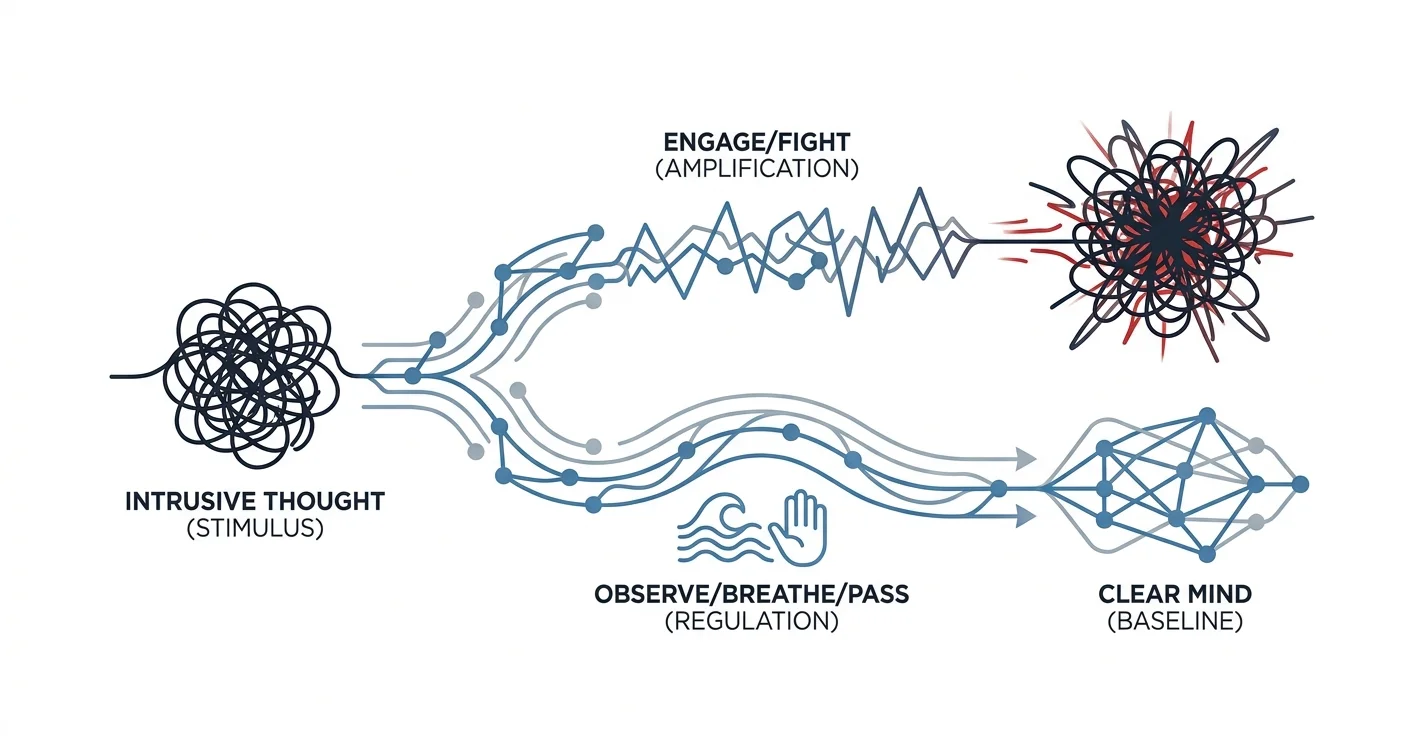
- Fighting or suppressing an intrusive thought makes it louder; naming it and letting it pass without reacting works
- Cognitive distortions like catastrophizing often fuel intrusive thought spirals — spotting the pattern breaks the loop.
- AI voice therapy through Lovon gives you a place to talk through a spike in real time, any hour of the day in 2026.
- If intrusive thoughts involve violence, self-harm, or won't stop despite consistent effort, a licensed clinician
Intrusive thoughts are the sudden, unwanted images or ideas that pop into your head and feel completely out of character — a flash of harm, doubt, or shame that you never asked for and can't seem to shake. This guide breaks down why they happen and gives you a concrete, step-by-step way to loosen their grip in 2026.
TL;DR
- Intrusive thoughts are normal brain noise, not a character flaw — 94% of people report having them, per research cited by the International OCD Foundation.
- Fighting or suppressing an intrusive thought makes it louder; naming it and letting it pass without reacting works better.
- Cognitive distortions like catastrophizing often fuel intrusive thought spirals — spotting the pattern breaks the loop.
- AI voice support through Lovon gives you a place to talk through a spike in real time, any hour of the day in 2026.
- If intrusive thoughts involve violence, self-harm, or won't stop despite consistent effort, a licensed clinician needs to be part of your plan.
Why this matters
An intrusive thought only becomes a problem when you start treating it like a warning label instead of noise. The brain generates thousands of stray thoughts a day, and a small number of them will be strange, violent, sexual, or disturbing simply because the brain doesn't filter for good taste. Research referenced by the International OCD Foundation found that roughly 94% of people experience unwanted intrusive thoughts at some point, which means having them isn't the diagnostic marker — how you respond to them is.
The trap most people fall into is trying to push the thought away or prove to themselves it isn't true. That effort backfires. Suppression research going back decades (the classic "white bear" studies) shows that actively trying not to think about something increases how often it resurfaces. The goal in 2026 isn't to erase intrusive thoughts — it's to change your relationship to them so they stop hijacking your day.
What you'll need
- 10-15 minutes a day for the first two weeks to practice the steps below
- A notes app or small notebook to log thought patterns
- A quiet space for a breathing or grounding exercise when a spike hits
- Optional: a voice-based outlet for talking through a spike in the moment, which is where an AI voice support app like Lovon fits — it's built for exactly this kind of on-demand check-in
- Willingness to sit with discomfort for 60-90 seconds without acting on the thought
The steps
1. Name the thought out loud or in writing
Labeling does more work than most people expect. Saying "I'm having the thought that..." instead of just having the thought creates distance between you and the content of your mind. This single reframe, borrowed from acceptance and commitment therapy, cuts down on the thought's emotional charge within seconds.
Common mistake: people skip this step because it feels silly. It isn't silly — it's the difference between being fused with a thought and observing it.
2. Stop checking for meaning
Intrusive thoughts feel urgent because your brain treats them like they need solving. They don't. Analyzing "why did I think that" or "what does this say about me" is mental checking, and checking reinforces the loop the same way scratching reinforces an itch.
This is where cognitive distortions show up most: thought-action fusion (believing a thought equals an intention) and catastrophizing (assuming the worst-case meaning) both drive the compulsion to keep checking.
Common mistake: treating the thought as evidence. A thought about something doesn't mean you want it or will do it — intent and intrusive content are unrelated in the vast majority of cases.
3. Use a 90-second body reset
When an intrusive thought triggers a spike of anxiety, your nervous system goes into a mild threat response — heart rate up, shoulders tight, breath shallow. Riding that wave physically, rather than mentally arguing with the thought, shortens the spike.
Try box breathing: inhale for 4 counts, hold for 4, exhale for 4, hold for 4, repeat for six rounds. This takes under two minutes and works because slow exhales activate the vagus nerve, which tells your body the threat has passed.
Expected outcome: the physical charge of the thought drops noticeably within 90 seconds to 2 minutes, even if the thought itself lingers a little longer.
4. Delay the response, don't suppress the thought
Instead of trying to make the thought disappear, set a mental timer: "I'll think about this in 20 minutes if it still matters." Most of the time, 20 minutes later the urgency has faded on its own. This works because you're not fighting the thought — you're just not letting it cut the line.
Common mistake: delaying and then spending the entire 20 minutes anxiously waiting to revisit it. The delay only works if you redirect attention somewhere else in the meantime — a task, a conversation, a walk.
5. Track the pattern for two weeks
Write down the time of day, what you were doing, and the theme of the thought each time it hits. Most people find their intrusive thoughts cluster around specific triggers: being overtired, being alone, or a particular type of stress. Patterns you can name are patterns you can plan around.
Expected outcome: by day 10-14, you'll usually see a repeat theme or time window, which turns a scary random event into a predictable one.
6. Talk it through instead of sitting with it alone
Saying an intrusive thought out loud to another person — or to a voice-based AI tool — often deflates it faster than journaling alone, because verbalizing forces you to structure the thought into language instead of letting it loop as a raw feeling. This is the specific use case Lovon is built for: a voice conversation you can start the moment a thought spikes, without waiting for a scheduled appointment. AI voice therapy works through the same principle a friend's ear does — external processing — just available at 2am in 2026 when nobody else is.
Common mistake: waiting until the thought has spiraled for hours before reaching out for any kind of support. Earlier is easier.
7. Rebuild your baseline with regular nervous system care
Intrusive thoughts spike harder when your baseline stress is already high. Sleep debt, caffeine overload, and skipped meals all lower your threshold. This step isn't about the thought itself — it's about shrinking how often your nervous system is primed to overreact to normal mental noise.
Grounding techniques practiced daily, not just during a spike, build the muscle memory you need in the moment it actually counts.
Troubleshooting
- The thought keeps returning within minutes of dismissing it. This is normal in the first week of practicing non-engagement — the brain is used to getting a reaction. Keep the response neutral and consistent; the frequency usually drops over 2-3 weeks, not overnight.
- You feel worse after trying to "just accept" the thought. Acceptance doesn't mean approval — it means not fighting. If forced acceptance feels like giving in, switch back to the naming step (step 1) until the thought feels less personal.
- The thoughts are violent or sexual and you're scared of what that means. This is one of the most common intrusive thought themes precisely because it's the most alarming — the content is disturbing by design, not diagnostic of intent. If this pattern is persistent and paired with heavy checking or reassurance-seeking, it may fit an OCD pattern worth discussing with a licensed clinician.
- You've tried the steps for a month with no change. That's a signal to loop in professional support rather than keep troubleshooting solo — intrusive thoughts that don't respond to standard techniques over several weeks often need a structured approach like exposure and response prevention (ERP).
- Physical symptoms (racing heart, nausea) show up every time. Your nervous system may be running in a chronically activated state. Understanding amygdala hijack helps explain why the body reacts before the thinking brain catches up, and gives you a target for the reset work in step 3.
- You avoid situations that might trigger the thought. Avoidance shrinks your world and reinforces the idea that the thought is dangerous. Small, deliberate exposure — staying in the situation a little longer each time — breaks that reinforcement.
Tools and resources
- A notes app for the two-week pattern log in step 5
- Box breathing or a similar grounding technique for the in-the-moment reset
- Lovon, for a voice conversation with AI-guided support when a thought spikes outside office hours
- A licensed therapist or psychiatrist if the thoughts are violent, sexual, or paired with compulsive checking that doesn't ease with the steps above
- A basic understanding of cognitive distortions, since most intrusive thought spirals are powered by one or two recurring thinking traps
What to do next
If the anxiety around intrusive thoughts feels bigger than the thoughts themselves, the underlying driver is often the anxiety, not the content. Read high-functioning anxiety signs you might be missing for a deeper look at how anxiety hides behind competence and control — a pattern that often travels with intrusive thought spirals.
FAQ
What are intrusive thoughts exactly?
Intrusive thoughts are unwanted, involuntary thoughts, images, or urges that pop into your mind and feel out of character — often violent, sexual, or shameful in content. They're common: research cited by the International OCD Foundation puts the figure at roughly 94% of people experiencing them at some point.
Are intrusive thoughts a sign of a serious mental illness?
Having intrusive thoughts alone is not a diagnosis of anything. They become clinically significant when paired with compulsive checking, avoidance, or distress that doesn't ease over weeks, which can point to OCD or an anxiety disorder worth discussing with a clinician.
How do I stop intrusive thoughts from coming back?
You reduce their frequency by not engaging with them — naming the thought, letting it pass without analyzing it, and using a body-based reset like box breathing. Fighting or suppressing the thought tends to make it return more often, not less.
Is it normal to have violent or disturbing intrusive thoughts?
Yes, and the disturbing content is exactly why the thought grabs your attention — it doesn't reflect what you want or intend to do. These are among the most common intrusive thought themes reported.
Can AI therapy help with intrusive thoughts?
AI voice therapy can give you a place to talk through a spike as it happens, which helps with the external-processing step that deflates most intrusive thoughts. It works best as a between-session or first-response tool, not a replacement for clinical treatment of OCD or an anxiety disorder.
How long does it take for intrusive thoughts to go away?
Most people see a noticeable drop in frequency and intensity within 2-3 weeks of consistently practicing non-engagement and a body reset technique. Thoughts tied to an underlying condition like OCD may need a structured treatment approach like ERP for lasting change.
What triggers intrusive thoughts?
Sleep deprivation, high stress, big life transitions, and hormonal shifts all lower the threshold for intrusive thoughts to surface and feel intense. Tracking your own pattern for two weeks usually reveals a personal trigger you can plan around.
When should I see a professional about intrusive thoughts?
See a licensed clinician if the thoughts are paired with compulsive checking or reassurance-seeking, if they involve a plan to harm yourself or someone else, or if they persist despite a month of consistent effort with the steps above.
One last thing
The fastest way to make an intrusive thought louder is to ask yourself "why did I think that?" — the analyzing is the fuel, not the thought itself. Skip the investigation, name it, breathe through it, and let it pass; that's the entire mechanism behind every evidence-based technique on this page.
Related guides
How AI Support Helps You Heal
AI emotional support isn't about replacing human connection — it's about filling the gaps. The moments when you need to talk at 2 AM, when you don't want to burden your friends again, or when you simply need someone to listen without judgment.
Here's what happens in a typical Lovon session:
You share what's on your mind
There's no script, no intake form, no waiting room. You speak or type whatever you're feeling — in your own words, at your own pace.
Lovon validates and explores
Using frameworks from CBT (Cognitive Behavioral Therapy) and motivational interviewing, Lovon acknowledges your feelings first, then gently helps you explore them. No dismissive "just move on" advice.
You build coping skills together
Lovon doesn't just listen — it actively works with you on evidence-based techniques: thought reframing, urge surfing, behavioral experiments, and more.
What a Session with Lovon Looks Like

Lovon is AI support, not a replacement for professional care. If things have been hard to get through for weeks, or you are thinking about harming yourself, talk to a doctor or a licensed therapist.
Ready to Start?
Your healing journey can begin right now
A 7-day trial. No judgment. Just a safe space to process what you're going through.
Frequently Asked Questions
Is Lovon a replacement for a real therapist?
Is my conversation with Lovon AI private?
How is Lovon different from ChatGPT for emotional support?
Can I use Lovon if I'm already seeing a therapist?
Can I try Lovon before subscribing?
About the Author

The Lovon Editorial Team
Mental Health & Wellness Content Team
The Lovon Editorial Team develops mental health and wellness content designed to make psychological concepts accessible and actionable. Our goal is to bridge the gap between clinical research and everyday life - helping you understand why your mind works the way it does and what you can do about it....
Related articles
- Scarcity Mindset vs Abundance Mindset: Fix It in 2026
Scarcity mindset vs abundance mindset explained with a 7-step shift plan for 2026 — track triggers, reframe beliefs, and…
- AI Coping Tools for Anxiety 2026: What Actually Works
AI coping tools for anxiety compared for 2026: box breathing, grounding, and PMR ranked with clear verdicts on what to…
- How to Calm Anxiety at Night in 2026: 7 Steps
Learn how to calm anxiety at night with 7 evidence-based steps — breathing techniques, body scans, and worry dumps that…
- How to Manage Exam Anxiety Before a Big Test (2026)
How to manage exam anxiety before a big test in 2026: 7 steps, breathing techniques, and what to do when your mind goes…
See also
Quizzes
- Self-Acceptance Test: What Are You Still Arguing With?
See where you are still fighting yourself, in 3 minutes.
- Perfectionism Test: What Are Your Standards Costing?
See what your standards actually cost, in 3 minutes.
Free tools
- Am I Overreacting, or Is This a Big Deal?
A chat for the small thing you cannot stop turning over. Say what happened and what you have already told yourself about…
- Breathing Exercises for Anxiety
Pick a technique, pick a length, follow the circle. Start with the physiological sigh if you are in the middle of a…
From the wiki
- Why do I keep dreaming about my ex?
Recurring dreams about an ex usually mean your brain is still consolidating a relationship that took up years of memory…
Disclaimer: This article is for informational purposes only and does not constitute medical advice, diagnosis, or treatment. Always seek the advice of your physician or other qualified health provider with any questions you may have regarding a medical condition. If you are in crisis or think you may have an emergency, call 988 (Suicide & Crisis Lifeline) or go to the nearest emergency room. Outside the US? Find a crisis line in your country.