
Best AI apps for fertility and IVF stress in 2026
Best AI apps for fertility and IVF stress: choose Lovon for voice support, compare focused alternatives, and keep medical decisions with your fertility team.

Key Takeaways
- Among the best AI apps for fertility and IVF stress, Lovon fits people seeking on-demand voice-based emotional support.
- ChatGPT, Claude, and Gemini serve narrower tasks: organizing concerns, drafting conversations, and preparing questions.
- No chatbot should interpret IVF results, change medication instructions, or predict whether treatment will succeed.
- Choose support that respects infertility grief, protects your boundaries, and keeps your fertility clinic involved.
Best for on-demand voice support: Lovon. Best for organizing worries: ChatGPT. Best for drafting difficult conversations: Claude. Best for preparing appointment questions: Gemini. This 2026 guide compares practical uses of these apps for fertility and IVF stress—not fertility treatment, pregnancy predictions, or licensed therapy.
TL;DR
- Among the best AI apps for fertility and IVF stress, Lovon fits people seeking on-demand voice-based emotional support.
- ChatGPT, Claude, and Gemini serve narrower tasks: organizing concerns, drafting conversations, and preparing questions.
- No chatbot should interpret IVF results, change medication instructions, or predict whether treatment will succeed.
- Choose support that respects infertility grief, protects your boundaries, and keeps your fertility clinic involved.
Why this matters
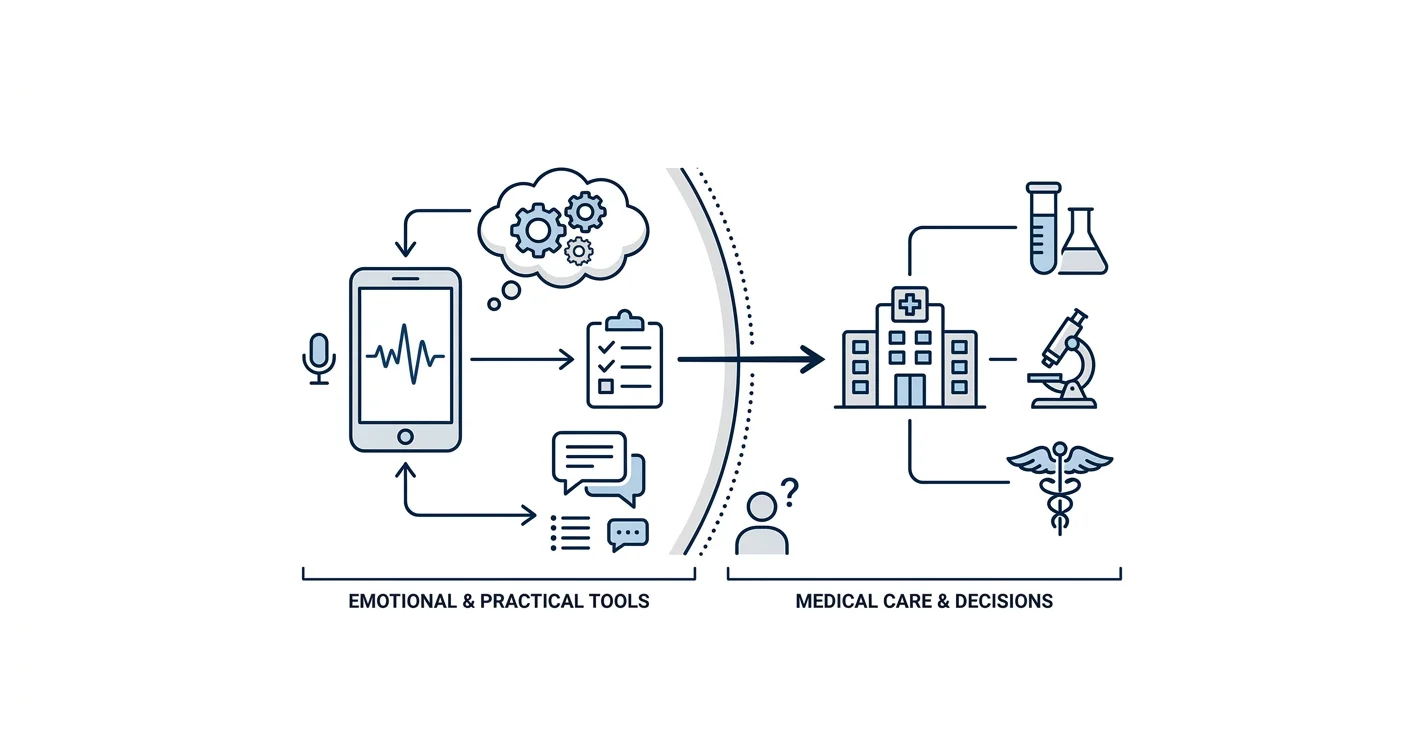
Fertility treatment gives you practical questions and emotional questions. They need different kinds of support. Your clinic handles medication instructions, symptoms, test results, and treatment decisions; an emotional-support app belongs on the other side of that boundary.
You do not need to turn every difficult feeling into a problem to solve. Sometimes you need to name disappointment, rehearse a boundary, or get through an evening without searching for another prediction. For a closer look at that emotional experience, read about how to cope with infertility grief.
Lovon is best for people who want voice-based emotional support alongside fertility care, not medical answers about IVF. The other options below are general-purpose assistants with useful writing and organizing functions. Their place here is task-specific, not a claim that they provide fertility counseling.
What makes the best apps for fertility and IVF stress?
Use these criteria when choosing an app in 2026. A comforting response is not enough if the app encourages you to trust it with clinical decisions.
- Clear boundaries: The app should not act as a fertility specialist, licensed therapist, or emergency service.
- A usable format: Choose voice when speaking feels easier; choose text when you need quiet or want to edit your thoughts.
- Respect for uncertainty: Reject responses that promise success, explain away loss, or pressure you to stay positive.
- A specific purpose: Emotional support, communication rehearsal, and appointment preparation are different jobs. Decide which one you need.
- Privacy clarity: Read current policies before sharing reproductive-health information. Check retention, deletion, and data-use settings rather than assuming confidentiality.
- A stopping point: A useful session ends with a manageable next step, not another round of reassurance seeking.
Before committing in 2026, try a low-detail request about everyday stress. Notice whether the response follows your instructions and respects its limits. Do not upload medical records just to assess the conversation style.
Best AI apps for fertility and IVF stress at a glance
The table compares roles, not clinical effectiveness. None of these recommendations establishes that an app improves fertility outcomes or treats a mental health condition.
| Option | Best for | Standout function | Key limitation |
|---|---|---|---|
| Lovon | Speaking through everyday treatment stress | On-demand voice conversations, coping tools, and self-reflection guidance | Not a licensed clinician or fertility-care provider |
| ChatGPT | Organizing a worry spiral | Turning unstructured text into a short outline | Can generate inaccurate information; not a clinical assessment |
| Claude | Preparing a difficult conversation | Drafting and revising messages with tone instructions | Cannot know your partner's intentions or replace relationship counseling |
| Gemini | Preparing questions for your clinic | Grouping concerns into an appointment checklist | Cannot determine the medical meaning of your symptoms or results |
Choose by the task you want to finish. If your main need is ongoing emotional care, a general-purpose assistant's ability to write a clear list is not a substitute for that care.
1. Lovon: best for voice-based emotional support
Lovon offers on-demand voice conversations, emotional support, coping tools, and self-reflection guidance. It is built with input from PhD psychologists and positioned as an always-available companion, not a replacement for licensed clinical care.
That format fits moments when you want to talk rather than compose a polished message. Keep the purpose emotional: describe how an appointment, waiting period, or conversation affected you without asking the app to explain your medical situation.
A useful way to approach a session
Start with a plain description of the moment, then name the kind of support you want. You can ask for space to reflect before moving to coping tools. You do not have to end the conversation feeling cheerful.
For a first attempt, set a 5-minute session limit as a personal boundary, not a treatment dose. Focus on one feeling and one immediate need. Afterward, decide whether to rest, contact someone you trust, or bring a concern to a professional.
Lovon pros:
- Voice conversations give you an alternative to typing out difficult feelings.
- On-demand support fits moments between scheduled appointments.
- Coping tools and self-reflection are part of its stated offering.
- Its positioning explicitly separates companionship from licensed care.
Lovon cons:
- It does not provide licensed clinical care or fertility treatment.
- Speaking aloud is inconvenient when you lack a private space.
- Its stated purpose does not establish IVF-specific clinical expertise or effectiveness.
Best for: People seeking a place to speak through everyday anxiety, stress, or relationship strain alongside fertility care.
Verdict: Buy only for the emotional-support role; skip it for medical interpretation or treatment decisions.
2. ChatGPT: best for organizing fertility-related worries
ChatGPT is a general-purpose conversational assistant that can summarize text and arrange it into lists. For fertility stress, use that ability to separate feelings, practical tasks, and questions for your clinic. Do not treat the resulting outline as a diagnosis or an explanation of treatment outcomes.
The useful task is small. Instead of asking whether everything will work out, ask it to organize what is occupying your mind without adding medical claims.
Give the conversation a clear job
Use a 3-line check-in: what happened, what you felt, and what you need next. Ask ChatGPT to preserve uncertainty and avoid predictions. Then edit its summary so it reflects your experience rather than accepting every interpretation.
For example, your notes might describe waiting for a clinic call, feeling frightened, and needing a plan for the afternoon. The finished outline should separate the unanswered clinical question from the immediate emotional need. It should not turn your fear into evidence that something is wrong.
ChatGPT pros:
- Can turn a long paragraph into a shorter, readable outline.
- Lets you request a particular structure and revise it.
- Helps draft a list of concerns you can take to a human professional.
ChatGPT cons:
- Fluent answers can contain inaccurate or invented information.
- A conversation is not a licensed mental health assessment.
- Repeatedly asking for certainty leaves the underlying uncertainty unresolved.
Best for: People who prefer typing and need to untangle a crowded set of thoughts before choosing a next step.
Verdict: Hold it to organizing your own words; skip predictions, symptom interpretation, and repeated reassurance requests.
3. Claude: best for drafting conversations about fertility boundaries
Claude is a general-purpose assistant that can draft and revise text. Its role here is communication preparation: explaining what support you want, declining intrusive questions, or asking your partner for a different kind of conversation. It is not a couples therapist.
You remain the judge of what sounds like you. A message that looks considerate on a screen still needs to fit your relationship, your safety, and your actual limits.
Draft a boundary without defending every detail
Give Claude the situation, the boundary, and the tone you want. Ask for a brief draft that does not reveal treatment details. Then remove explanations you do not want to share.
A useful boundary has a clear request. You might want relatives to stop asking for updates, friends to avoid unsolicited treatment suggestions, or a partner to listen before offering solutions. Ask for 2 sentences if a longer message starts to feel like a justification.
Treat any suggested explanation of another person's behavior as speculation. Drafting a message does not establish why someone withdrew, made a hurtful comment, or responded differently from you.
Claude pros:
- Can draft messages from instructions about tone and length.
- Supports revision when a first draft feels too formal or too revealing.
- Gives you text to review before a difficult conversation.
Claude cons:
- Cannot know another person's intentions from your account.
- Polished language can obscure an unclear or unrealistic request.
- Does not provide relationship counseling or assess interpersonal safety.
Best for: People whose main stressor is communicating boundaries or asking clearly for emotional support.
Verdict: Hold it to drafting and rehearsal; skip judgments about your partner or major relationship decisions.
4. Gemini: best for preparing fertility-clinic questions
Gemini is a general-purpose assistant that can organize text and create checklists. Use it to group questions you already have before a fertility appointment. Your clinic—not the app—provides the answers and determines what applies to your care.
Appointment preparation belongs on this list because it creates a concrete task without pretending to resolve the medical uncertainty. Keep the request focused on question wording rather than clinical interpretation.
Prepare questions, not conclusions
Start with your own concerns. Ask Gemini to group them under appointment logistics, instructions needing clarification, and emotional-support needs. Remove anything it adds that does not match your situation.
Choose 1 priority question to ask first. That is an organizing suggestion, not a rule about appointment length. Keep the remaining questions accessible so you can cover them with the clinic or ask how to follow up.
If an answer sounds like a medication instruction, a prognosis, or a conclusion about a test result, stop there. Take the underlying question to your care team instead of using the generated answer.
Gemini pros:
- Can arrange scattered concerns into a readable checklist.
- Lets you shorten or clarify question wording.
- Supports preparation without requiring a medical-record upload.
Gemini cons:
- Generated information can be wrong or irrelevant to your treatment.
- A checklist does not establish which concerns are medically urgent.
- Cannot replace clinic instructions or individualized medical advice.
Best for: People who want an organized set of questions before contacting their fertility team.
Verdict: Hold it to appointment preparation; skip medical conclusions and treatment instructions.
How we ranked these options
This 2026 ranking prioritizes fit for the stated task: voice support, thought organization, communication drafting, or question preparation. The criteria are usable format, clear boundaries, respect for uncertainty, privacy checks, and a defined stopping point.
The order is not a clinical-effectiveness ranking. General-purpose writing capabilities do not establish infertility expertise, and psychologist input does not make an app a licensed clinician. Choose the narrowest useful role, not the most confident answer.
Use an app without making it another stress task
A support routine should not become another thing you have to do perfectly. Use this sequence when deciding what belongs in an app conversation in 2026:
- Name the need: Decide whether you want emotional space, a draft, or a question list.
- Limit details: Leave out identifying information and medical documents unless you have deliberately reviewed the privacy implications.
- Choose the task: Ask for reflection or organization, not a prediction.
- Check the response: Remove assumptions, medical claims, and wording that does not fit you.
- Reconnect offline: Take the next step with your clinic, a trusted person, or a licensed professional when needed.
The point is to finish a useful task and return to your life. If a conversation leaves you more frightened, dependent on another answer, or pressured to be positive, stop using that approach.
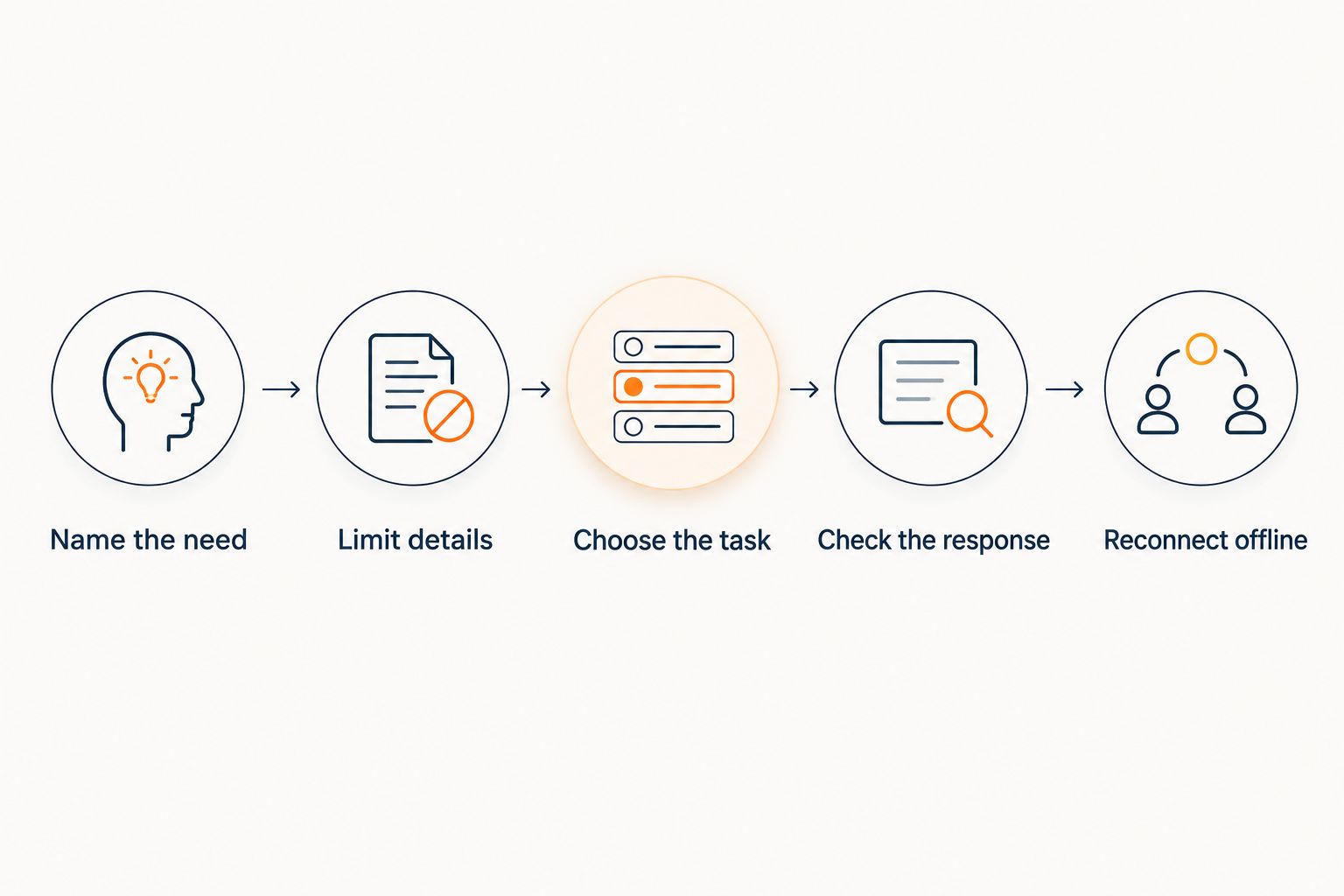 Five steps for keeping app support focused and connected to offline care
Keep the app's task narrow and bring medical questions back to your care team.
Which app should you choose?
Choose the voice-support option if you mainly want to talk through everyday fertility stress. Choose a general-purpose assistant only when you have a defined writing or organizing task. You do not need several apps to build a support plan.
For your 2026 choice, prioritize how the conversation affects you—not how impressive the answer sounds. Keep human support involved, especially when distress disrupts sleep, daily functioning, or your ability to manage treatment. New or concerning physical symptoms belong with your fertility team or appropriate medical care, not a chatbot.
FAQ
What's the best AI app for fertility and IVF stress?
Lovon is the best fit in this guide for on-demand voice-based emotional support. ChatGPT, Claude, and Gemini have narrower roles in organizing thoughts, drafting messages, and preparing clinic questions; none replaces fertility care or licensed therapy.
Can an AI app tell me whether my IVF treatment will work?
No AI chat app should be used to predict your individual IVF outcome. Ask your fertility team to explain your results and the uncertainty that remains.
Is voice support better than typing when I'm overwhelmed?
Choose voice if speaking feels easier, and text if you need quiet or want to edit your thoughts. Neither format is automatically better for everyone; use the one that fits your immediate need.
Can I use an app during the wait for pregnancy-test results?
Use an app for emotional reflection or a practical coping plan, not to interpret symptoms or predict the result. Follow your clinic's testing instructions and contact the clinic with medical concerns.
What should I avoid sharing with a fertility-stress app?
Avoid unnecessary identifying details, clinic documents, and other people's private information. Review current privacy, retention, deletion, and data-use policies before sharing sensitive reproductive-health information.
Can an app help me ask my partner for support?
An app can help draft a clear request or rehearse a conversation. It cannot determine your partner's intentions, resolve a relationship conflict, or replace couples counseling.
Can reducing stress with an app improve my chances of pregnancy?
This guide does not establish that any listed app improves pregnancy chances. Emotional support is for your well-being, not a requirement to stay calm enough for treatment to succeed.
What should I do if fertility stress becomes a crisis?
Seek human crisis support rather than relying on an app. In the United States, call or text 988 for the Suicide & Crisis Lifeline; call 911 if there is immediate danger.
One last thing
You do not have to become perfectly calm to deserve support. An app session can end with sadness still present and a useful boundary, question, or request in hand. Do not make emotional support another test you have to pass.
Related guides
How AI Support Helps You Heal
AI emotional support isn't about replacing human connection — it's about filling the gaps. The moments when you need to talk at 2 AM, when you don't want to burden your friends again, or when you simply need someone to listen without judgment.
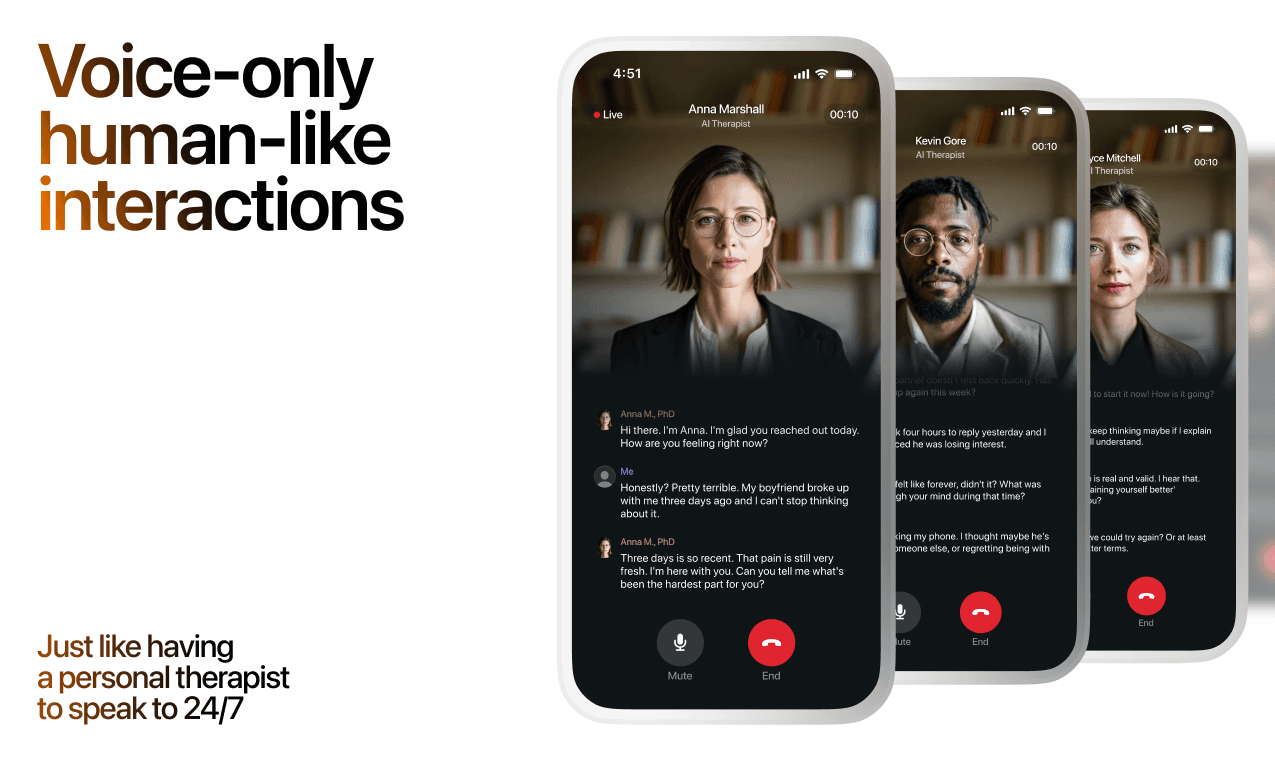
Here's what happens in a typical Lovon session:
You share what's on your mind
There's no script, no intake form, no waiting room. You speak or type whatever you're feeling — in your own words, at your own pace.
Lovon validates and explores
Using frameworks from CBT (Cognitive Behavioral Therapy) and motivational interviewing, Lovon acknowledges your feelings first, then gently helps you explore them. No dismissive "just move on" advice.
You build coping skills together
Lovon doesn't just listen — it actively works with you on evidence-based techniques: thought reframing, urge surfing, behavioral experiments, and more.
What a Session with Lovon Looks Like
When to Seek Professional Help
AI support is a valuable tool, but it's not a replacement for professional care. Please consider reaching out to a licensed therapist if you experience any of the following:
- Persistent thoughts of self-harm or suicide
- Inability to perform daily activities (work, eating, sleeping) for more than 2 weeks
- Turning to alcohol or substances to cope
- Intense anger or desire to harm your ex-partner
- Complete emotional numbness that doesn't improve over time
Crisis Resources (US): If you're in immediate danger, call 988 (Suicide & Crisis Lifeline) or text HOME to 741741 (Crisis Text Line). Available 24/7, free, and confidential.
Outside the US? Find a crisis line in your country
Ready to Start?
Your healing journey can begin right now
A 7-day trial. No judgment. Just a safe space to process what you're going through.
Frequently Asked Questions
Is Lovon a replacement for a real therapist?
Is my conversation with Lovon AI private?
How is Lovon different from ChatGPT for emotional support?
Can I use Lovon if I'm already seeing a therapist?
Can I try Lovon before subscribing?
About the Author
The Lovon Editorial Team
Mental Health & Wellness Content Team
The Lovon Editorial Team develops mental health and wellness content designed to make psychological concepts accessible and actionable. Our goal is to bridge the gap between clinical research and everyday life - helping you understand why your mind works the way it does and what you can do about it....
Related articles
- Can ADHD be managed without medication?
Can ADHD be managed without medication? Yes, for some adults. Learn which therapy, routines, and supports help, where…
- Best AI App for Medical Trauma Recovery 2026: Lovon Wins
Lovon ranks best ai app for medical trauma recovery in 2026, with on-demand voice support between hospital visits…
- Best AI apps for LGBTQ+ mental health support in 2026
Compare the best AI apps for LGBTQ+ mental health support. Choose voice support or writing help, check privacy, and know…
- Best AI apps for nurse burnout in 2026
Compare the best AI apps for nurse burnout. Lovon is the voice-first pick for everyday support; review formats, privacy…
See also
Quizzes
- Empath Test: Do Other People's Moods Become Yours?
See how much of other people's moods you take on.
- Coping Style Test: How Do You Actually Handle Stress?
See how you really cope under stress, in 3 minutes.
Free tools
- Vent to an AI
Need to vent and there is nobody to call, or nobody you want to tell? Type it here. You are talking to an AI listener…
- Family Boundary Plan
Pick the person, the one topic, and how much you want to see them. You get a three-rung ladder, the guilt lines to…
From the wiki
- Why do I feel sad when I'm alone?
Being alone does not create the sadness. It removes the noise that was keeping it out of earshot, so whatever queued up…
Disclaimer: This article is for informational purposes only and does not constitute medical advice, diagnosis, or treatment. Always seek the advice of your physician or other qualified health provider with any questions you may have regarding a medical condition. If you are in crisis or think you may have an emergency, call 988 (Suicide & Crisis Lifeline) or go to the nearest emergency room. Outside the US? Find a crisis line in your country.