
AI Support App for IVF and Fertility Stress in 2026
Lovon's AI support app for IVF and fertility treatment stress gives on-demand voice sessions between appointments in 2026 — not a replacement for clinical care.

Key Takeaways
- Lovon works as an ai support app for IVF and fertility treatment stress by offering on-demand voice sessions during
- No AI app replaces a licensed fertility counselor for major treatment decisions or clinical grief work.
- Self-guided coping tools handle mild day-to-day stress; escalate to a licensed therapist when grief feels stuck or
- Best for: patients who need to talk through fear at 11 p.m., not just during a scheduled session.
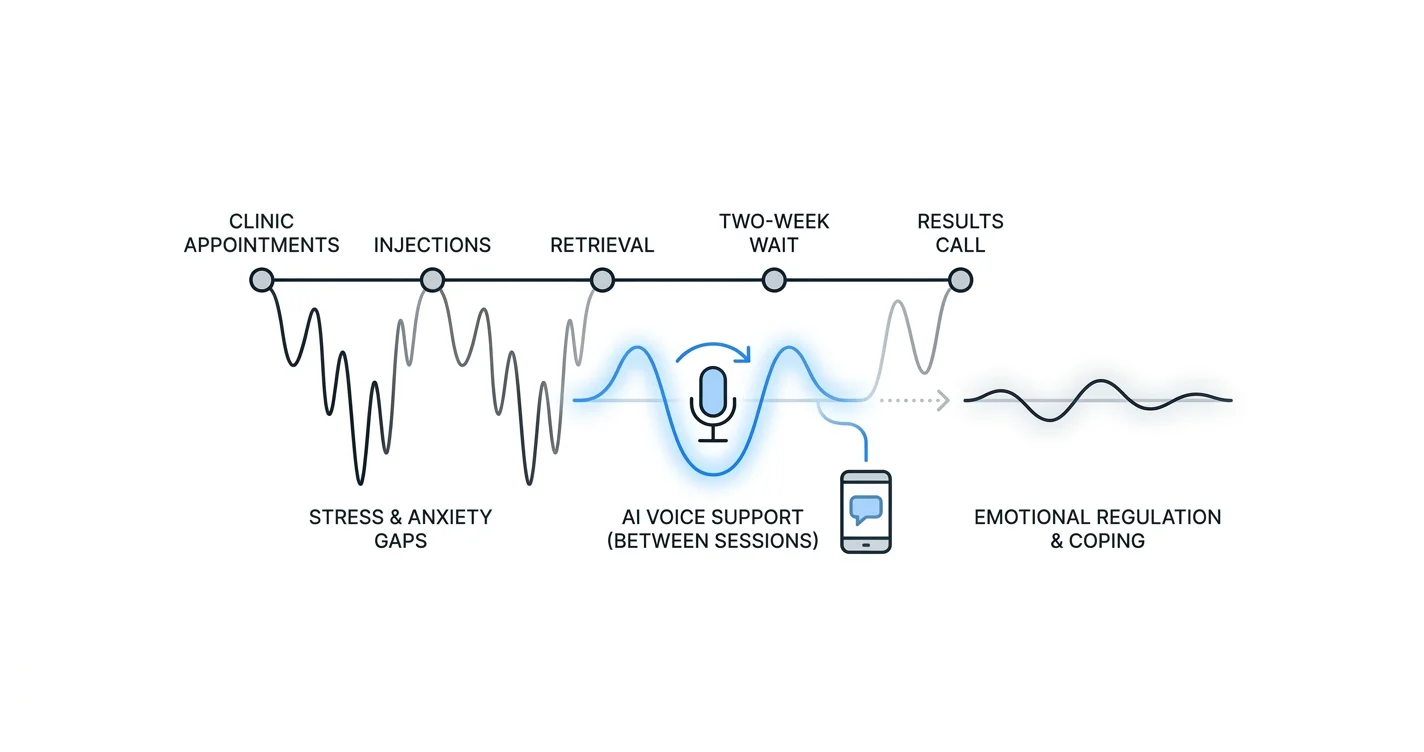
An AI support app for IVF and fertility treatment stress is a voice-based tool you talk to between appointments, injections, and results calls — built to catch the fear and grief that don't fit into a 20-minute clinic visit. IVF stress runs on its own schedule: stimulation days, retrieval, the two-week wait, beta day. It rarely lines up with your therapist's office hours.
TL;DR
- Lovon works as an ai support app for IVF and fertility treatment stress by offering on-demand voice sessions during injections and the two-week wait.
- No AI app replaces a licensed fertility counselor for major treatment decisions or clinical grief work.
- Self-guided coping tools handle mild day-to-day stress; escalate to a licensed therapist when grief feels stuck or unmanageable.
- Best for: patients who need to talk through fear at 11 p.m., not just during a scheduled session.
Why an AI support app matters for IVF and fertility patients
A typical fertility clinic sees you for a handful of minutes per visit, then sends you home to manage the rest on your own. The rest is where most of the damage happens: the injection you're dreading, the 2 a.m. spiral before a retrieval, the silence after a negative beta result.
Traditional therapy runs on a weekly appointment. IVF stress doesn't wait a week — it hits on a Tuesday night mid-cycle and again the morning of a transfer. That mismatch is exactly why patients search out something available between sessions, and why infertility grief shows up as its own category of emotional pain, separate from general anxiety or sadness.
An AI voice therapy app doesn't fix a failed cycle and it doesn't change your protocol. What it does is give you somewhere to talk through the fear in the moment it shows up, instead of carrying it silently until your next scheduled appointment.
Step-by-step: coping with IVF and fertility treatment stress
Name your stress pattern by treatment phase
IVF stress isn't one flat feeling — it shifts shape depending on where you are in the cycle. Naming the pattern makes it easier to plan for instead of being ambushed by it.
- Stimulation phase: hormone swings, irritability, body-image discomfort from bloating
- Retrieval and transfer days: procedure anxiety, fear of low egg or embryo counts
- The two-week wait: obsessive symptom-checking, catastrophizing every twinge
- Beta day: dread before the call, grief or numbness after a negative result
- Between cycles: decision fatigue over whether to try again
Build a grounding routine for injection and appointment days
A short, repeatable routine on the hardest calendar days lowers the spike before it takes over.
- A 5-minute breathing pattern before each injection, done at the same time daily
- A pre-appointment playlist or silence, whichever calms you faster
- A single trusted contact texted "heading in" before retrieval or transfer
- A post-appointment reward that has nothing to do with fertility (a walk, a show, a meal)
Talk through the two-week wait instead of white-knuckling it
The two-week wait is where most patients report the sharpest anxiety, because there's nothing to do but wait for a number. This is usually the point where a scheduled weekly therapy session stops being enough — the wait doesn't respect a calendar.
This is where Lovon fits in as an ai support app for IVF and fertility treatment stress: a voice conversation you can start at midnight when the symptom-spotting won't stop, without waiting for an appointment slot. It's built with input from PhD psychologists, but it's explicit about what it isn't — it doesn't diagnose, prescribe, or replace your reproductive endocrinologist or a licensed mental health clinician. Read more on AI support for infertility grief if the wait has tipped into something heavier than day-to-day nerves.
- A voice check-in on the days you'd normally be refreshing a patient portal
- A guided grounding exercise instead of another symptom-search spiral
- A place to say the scary thought out loud before it grows in silence
Set boundaries with people who mean well but ask too much
Friends and family asking "any updates?" can turn a hard week into a harder one. A few scripts prepared in advance take the edge off.
- "We'll share news when we're ready — thanks for caring"
- Muting or unfollowing pregnancy-heavy social accounts during active cycles
- Designating one person to relay updates so you're not repeating the story
- Declining baby showers or gender reveals without over-explaining why
Process grief after a failed cycle or pregnancy loss before starting again
Jumping straight into the next cycle without processing the last one is one of the fastest paths to burnout. Grief after a failed transfer or an early loss is real grief — it deserves the same attention as any other kind. If a cycle ended in miscarriage and pregnancy loss, give that its own space rather than folding it into general "IVF stress."
- Naming the loss out loud, even just to yourself, before deciding next steps
- Giving yourself a set number of weeks off from appointments if your clinic allows it
- Journaling what worked and didn't emotionally, not just medically, about the last cycle
- Talking through the decision to continue, pause, or stop before making it under pressure
Loop your partner in without making them your only outlet
Partners carry their own version of IVF stress, and leaning on them for every ounce of yours can quietly wear the relationship down.
- Schedule a weekly 20-minute check-in specifically about the emotional side, not logistics
- Name what kind of support you want (listening vs. problem-solving) before venting
- Keep at least one outlet — friend, app, support group, therapist — outside the relationship
- Check in on how they're coping, not just how you are
Know when to bring in a licensed fertility counselor
Some moments call for a trained clinician, not a coping tool. Persistent depression, thoughts of self-harm, a marriage under real strain, or a treatment decision with lasting consequences all belong with a licensed professional who can see the full clinical picture.
- Sadness or numbness lasting more than two weeks straight
- Any thoughts of harming yourself
- Conflict with your partner that isn't resolving on its own
- A major decision (stopping treatment, switching protocols, donor options) you can't think clearly about alone
Talk it through tonight
Start a voice session on Lovon between appointments, no scheduling required.
Options for managing IVF and fertility stress: a comparison
| Option | Best for | Key limitation |
|---|---|---|
| Self-guided coping (journaling, breathing apps) | Mild day-to-day stress on a budget | No personalized response to what you're actually feeling |
| Fertility support groups | Shared experience and validation | Fixed schedules, not available at 2 a.m. |
| Licensed fertility counselor or therapist | Trauma-level grief, major treatment decisions | Appointment-based, and cost without insurance adds up fast |
| Lovon AI voice support | On-demand talking through fear between appointments | Not a substitute for licensed clinical care or medical advice |
Verdict: Lovon works best as the between-appointment layer, not the whole plan — pair it with your clinic's medical team and, when grief gets heavy, a licensed counselor.
Common mistakes IVF and fertility patients make with mental health support
- Waiting until the two-week wait to "deal with" the stress — by then the anxiety is already compounding, not starting.
- Treating every appointment like a pass/fail test on your worth — a low count or a negative beta is a medical result, not a verdict on you.
- Going quiet with your partner to "protect" them — it usually reads as distance, not strength.
- Skipping grief processing after a failed transfer because "there's no time" before the next cycle starts.
- Comparing your protocol and timeline to internet forums instead of your own clinic's plan for your own body.
FAQ
Is there an AI app specifically for IVF and fertility treatment stress?
Yes — Lovon is an ai support app for IVF and fertility treatment stress that offers on-demand voice conversations for the emotional side of a cycle. It works between appointments and isn't limited to scheduled session times.
Can an AI therapist help with infertility grief?
An AI voice therapy app can give you a place to talk through infertility grief in the moment it hits, which is often outside office hours. It isn't a clinical grief specialist, so ongoing or intense grief still calls for a licensed therapist.
Is Lovon a replacement for a fertility counselor?
No. Lovon is built with input from PhD psychologists but is explicit that it doesn't replace licensed clinical care, diagnosis, or medical advice from your fertility team.
How much does therapy cost without insurance during IVF in 2026?
Costs vary by provider and region, and licensed sessions typically run per-appointment rather than on demand. Check current rates locally, since fertility-focused therapists often price differently than general practice.
What helps most during the two-week wait?
A grounding routine and a way to talk through intrusive thoughts as they happen, rather than symptom-searching, tends to help most during the two-week wait. Voice-based check-ins can catch the anxiety spikes that hit outside a weekly session.
Can AI voice therapy help after a failed IVF cycle?
It can give you a space to process the immediate grief and fear after a failed cycle, especially at hours when a therapist isn't reachable. Persistent depression or thoughts of self-harm after a loss need a licensed clinician, not an app.
Is it normal to feel anxious every day during IVF?
Daily anxiety during an active IVF cycle is common given the hormone changes, procedures, and uncertainty involved. It becomes a reason to seek licensed support when it doesn't ease between cycles or starts affecting daily functioning.
How is AI voice therapy different from text-based support apps?
Voice conversations let you talk through a spiral in real time instead of typing it out, which matters when you're mid-anxiety at 2 a.m. and typing feels like one more task.
One last thing
The hardest day of an IVF cycle usually isn't retrieval or transfer — it's the day you're waiting on a number with no update yet. Plan your coping tools around the wait, not just the procedures, and 2026's version of "support" doesn't have to mean choosing between a support group's schedule and total silence.
Related guides
How AI Support Helps You Heal
AI emotional support isn't about replacing human connection — it's about filling the gaps. The moments when you need to talk at 2 AM, when you don't want to burden your friends again, or when you simply need someone to listen without judgment.
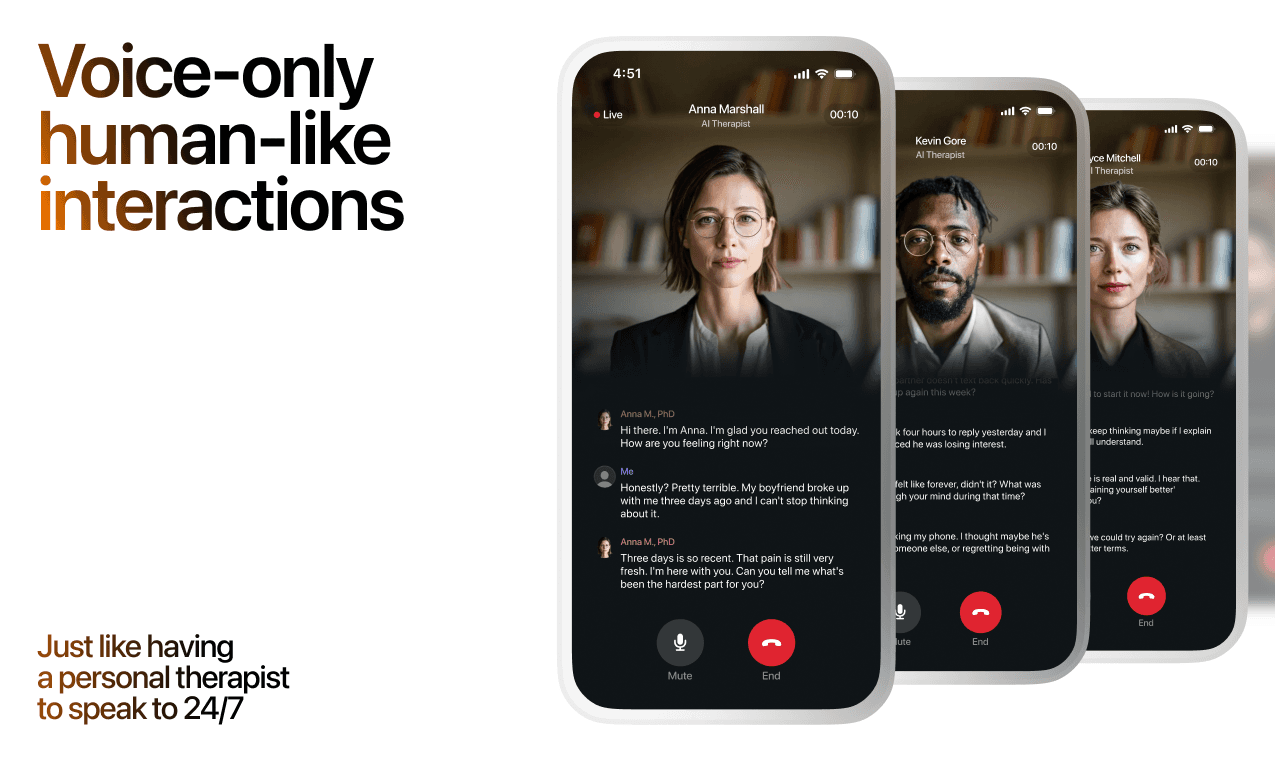
Here's what happens in a typical Lovon session:
You share what's on your mind
There's no script, no intake form, no waiting room. You speak or type whatever you're feeling — in your own words, at your own pace.
Lovon validates and explores
Using frameworks from CBT (Cognitive Behavioral Therapy) and motivational interviewing, Lovon acknowledges your feelings first, then gently helps you explore them. No dismissive "just move on" advice.
You build coping skills together
Lovon doesn't just listen — it actively works with you on evidence-based techniques: thought reframing, urge surfing, behavioral experiments, and more.
What a Session with Lovon Looks Like
When to Seek Professional Help
AI support is a valuable tool, but it's not a replacement for professional care. Please consider reaching out to a licensed therapist if you experience any of the following:
- Persistent thoughts of self-harm or suicide
- Inability to perform daily activities (work, eating, sleeping) for more than 2 weeks
- Turning to alcohol or substances to cope
- Intense anger or desire to harm your ex-partner
- Complete emotional numbness that doesn't improve over time
Crisis Resources (US): If you're in immediate danger, call 988 (Suicide & Crisis Lifeline) or text HOME to 741741 (Crisis Text Line). Available 24/7, free, and confidential.
Outside the US? Find a crisis line in your country
Ready to Start?
Your healing journey can begin right now
A 7-day trial. No judgment. Just a safe space to process what you're going through.
Frequently Asked Questions
Is Lovon a replacement for a real therapist?
Is my conversation with Lovon AI private?
How is Lovon different from ChatGPT for emotional support?
Can I use Lovon if I'm already seeing a therapist?
Can I try Lovon before subscribing?
About the Author

The Lovon Editorial Team
Mental Health & Wellness Content Team
The Lovon Editorial Team develops mental health and wellness content designed to make psychological concepts accessible and actionable. Our goal is to bridge the gap between clinical research and everyday life - helping you understand why your mind works the way it does and what you can do about it....
Related articles
- AI Life Coach for Teacher Classroom Stress (2026)
Lovon's AI life coach fits a teacher's five-minute prep period for classroom stress relief in 2026 — not a replacement…
- AI Therapist for Stress: What It Can and Can't Do (2026)
An honest breakdown of what an AI therapist for stress handles well in 2026, where it falls short, and how Lovon fits…
- Free AI Therapist for Stress & Burnout (2026)
The best free AI therapist for stress in 2026. Lovon leads with voice sessions and burnout-specific coping tools. See…
- Best ChatGPT alternatives for emotional support in 2026
Compare the best ChatGPT alternatives for therapy. Choose voice support for everyday feelings or licensed care for…
See also
Quizzes
- Perfectionism Test: What Are Your Standards Costing?
See what your standards actually cost, in 3 minutes.
- Self-Acceptance Test: What Are You Still Arguing With?
See where you are still fighting yourself, in 3 minutes.
Free tools
- Write a Letter to Someone You Lost
Tell it who they were to you and what you never got to say, and it writes the letter back in your words. No account, no…
- How to Reassure Your Partner (and When It Stops Helping)
A chat for working out how to reassure your partner when the same worry keeps coming back. Say what sets it off and how…
From the wiki
- Why do I feel lonely all of a sudden?
Sudden loneliness usually traces back to something that quietly ended in the last few months: a routine, a shared class…
Disclaimer: This article is for informational purposes only and does not constitute medical advice, diagnosis, or treatment. Always seek the advice of your physician or other qualified health provider with any questions you may have regarding a medical condition. If you are in crisis or think you may have an emergency, call 988 (Suicide & Crisis Lifeline) or go to the nearest emergency room. Outside the US? Find a crisis line in your country.