
How to Cope With Infertility Grief: 7 Steps (2026)
Infertility grief comes in waves, not a line. Get 7 concrete steps to cope, what to avoid, and when to see a grief counselor in 2026.

Key Takeaways
- Coping with infertility grief starts with naming the loss, not pushing through it silently.
- Grief moves in waves through 2026, not a straight line — expect setbacks after good months.
- Talking the loss out loud, even to an AI voice like Lovon, reduces the isolation that makes grief heavier.
- If grief blocks daily function for months, see a licensed grief counselor — Lovon supports, it doesn't replace one.
Infertility grief hits different than most losses: there's no funeral, no body, and often no one around who understands why a negative test wrecks an entire week. This guide walks through what actually helps, step by step, so the grief has somewhere to go instead of getting stuck.
TL;DR
- Coping with infertility grief starts with naming the loss, not pushing through it silently.
- Grief moves in waves through 2026, not a straight line — expect setbacks after good months.
- Talking the loss out loud, even to an AI voice like Lovon, reduces the isolation that makes grief heavier.
- If grief blocks daily function for months, see a licensed grief counselor — Lovon supports, it doesn't replace one.
Why This Matters
Roughly 1 in 6 people worldwide experience infertility at some point, according to World Health Organization data, and most of them never talk about the grief attached to it. Infertility grief is disenfranchised grief — no casket, no obituary, no sanctioned time off work for it. That silence is part of what makes it so heavy in 2026, when pregnancy announcements show up on every feed and every family group chat.
Left unprocessed, this grief doesn't fade on its own. It resurfaces at ovulation, at baby showers, during the two-week wait, at every "any news?" from a well-meaning relative. Working through infertility grief starts with naming what's actually being lost — not just a pregnancy, but a version of a future.
What You'll Need
- A private space where you don't have to perform being okay
- A witness — a partner, a friend, a therapist, or an AI voice like Lovon for the hours no one else is awake
- A journal, notes app, or voice memo app for tracking the waves
- 15 to 20 minutes a day set aside on purpose, not squeezed into a lunch break
- Permission to grieve something that never had a name, a birth certificate, or a photo
The Steps
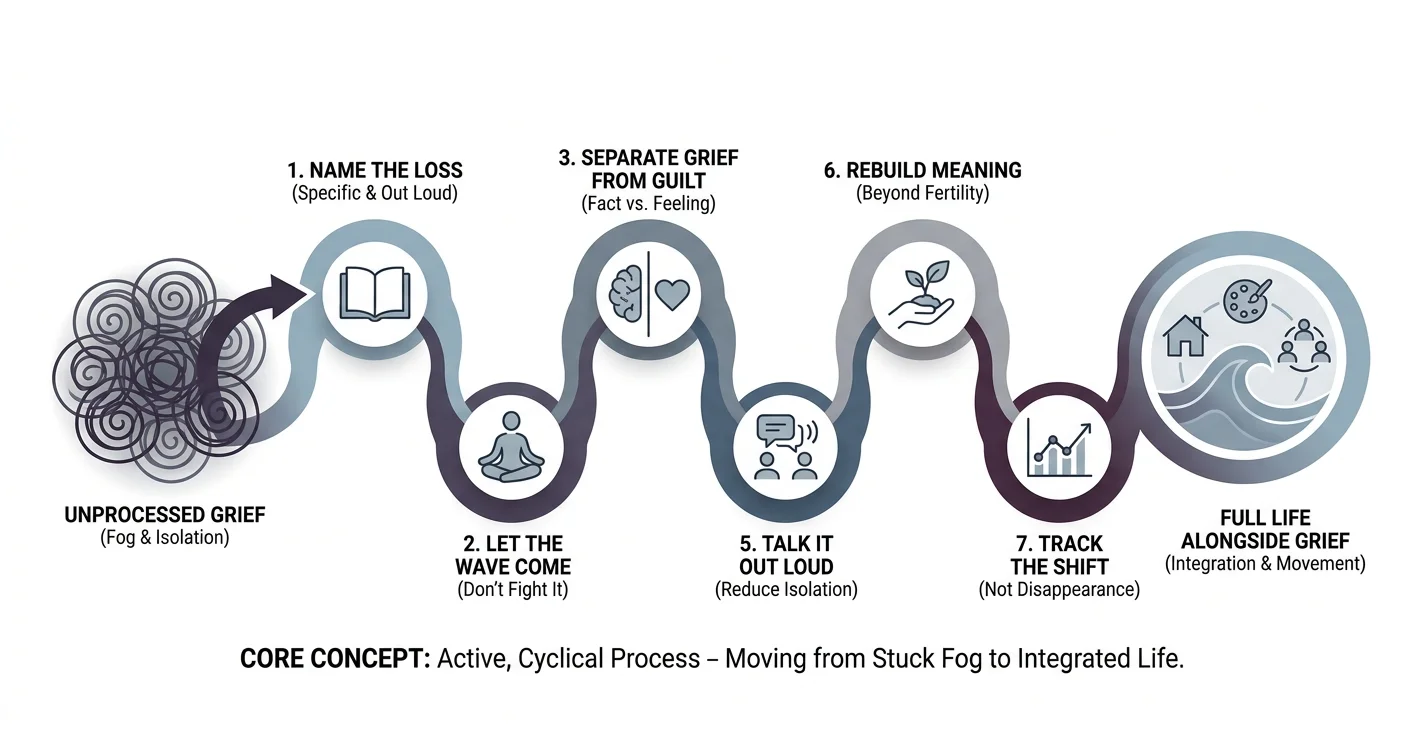
These are the steps that actually move infertility grief in 2026, one at a time, instead of leaving it stuck in place.
1. Name the loss specifically
Vague grief stays stuck; specific grief moves. Write down exactly what's being mourned — the due date that never arrived, the embryo that didn't implant, the version of parenthood pictured five years ago. Naming it in one sentence turns a fog into something you can actually process. Common mistake: calling it "just disappointment," which minimizes it and delays the real work.
2. Let the wave come instead of fighting it
Infertility grief moves in waves, not a straight line, through 2026 and every year after a loss like this. When a wave hits — a baby shower invite, a friend's pregnancy post, a failed cycle — give it 10 to 15 minutes of full attention: cry, sit with it, breathe through it. Fighting the wave with distraction or forced smiling just delays it to a worse moment later. Common mistake: scheduling something demanding right after a hard appointment, leaving no room for the wave to pass.
3. Separate grief from guilt
Grief says "this hurts." Guilt says "I shouldn't feel this way" or "I did this to myself." The two get tangled fast in infertility loss, especially with self-blame around age, diagnosis, or timing. Write the guilty thought down, then write the fact next to it — most causes of infertility are physiological, not the result of a decision made years ago. Common mistake: letting guilt run the show while calling it grief, which keeps the loop going indefinitely.
4. Set a real boundary for triggering spaces
Understanding the stages of grief explains why a shower invite can knock someone flat even on a good week — grief isn't linear, and one step forward doesn't mean immunity from the next trigger. Mute the accounts that hurt. Skip the shower and send a gift instead. Tell one person a specific ask: "Let me hear pregnancy news from someone else first." Common mistake: attending every event out of obligation and getting blindsided by the crash afterward.
5. Talk it through out loud
Grief that stays in your head compounds. Say it out loud — to a partner, a friend, a support group, or a voice conversation with an AI like Lovon at 2 a.m. when no one else is awake. Hearing yourself say "I'm grieving a child I haven't met" makes the loss concrete instead of a vague weight in your chest. Common mistake: journaling privately only and never speaking the loss to another presence, which keeps it isolated.
6. Rebuild one source of meaning that isn't tied to fertility
Infertility can swallow identity — every hobby, friendship, and plan gets filtered through "trying." Pick one thing that has nothing to do with conceiving and give it real time each week: a class, a hobby, a friendship that isn't about fertility updates. This isn't "moving on" — it's proof a full life exists alongside the grief. Common mistake: putting every other part of life on hold until the outcome is settled.
7. Track the shift, not the disappearance
Infertility grief doesn't disappear on a schedule — it changes shape. Log the waves weekly: how intense, how long, what triggered it. By month three or four, most people notice the waves are still there but shorter and less disorienting. Common mistake: expecting the grief to be "done" by a certain date and treating any relapse as failure.
Troubleshooting
- Can't cry, even when the sadness is obvious — the body may be stuck in survival mode. Try physical release first, like a walk or cold water on the face, before expecting tears on command.
- Partner grieves on a completely different timeline — one wants to talk constantly, the other shuts down. Agree on one weekly check-in instead of expecting matched grief in real time.
- Every pregnancy announcement feels like an attack — that's a normal response to disenfranchised grief, not an overreaction. Mute first, apologize never.
- Grief feels endless with no improvement — track it for eight weeks before judging progress; short-term snapshots are misleading.
- Guilt about wanting a break from treatment — needing a pause is a boundary, not quitting. A treatment break doesn't erase grief work already done.
Tools and Resources
- A journal or voice memo app for tracking wave frequency and intensity
- One person designated as the "no filter" contact for hard days
- A support app built for grief and loss for the hours between appointments and therapy sessions, especially now in 2026 when digital support options keep expanding
- A licensed grief counselor or reproductive psychologist for grief that isn't shifting after several months
Talk Through It When It Hits
Lovon offers voice conversations for the moments grief shows up without warning.
What to Do Next
Infertility grief rarely runs on a fixed clock, and having on-demand emotional support for the 11 p.m. spiral matters as much as a weekly session. Lovon isn't a licensed clinician and isn't a replacement for one — it's a voice to talk to when the wave hits at a time no therapist's office is open.
FAQ
What is infertility grief?
Infertility grief is mourning a loss that has no body, funeral, or fixed date — the loss of an expected pregnancy, a due date, or a version of parenthood. It's a real grief response, even without a physical loss to point to.
How long does infertility grief last?
There's no fixed timeline for infertility grief; it typically softens over months rather than weeks. Waves can return years later around anniversaries, fertility milestones, or someone else's pregnancy announcement.
Is it normal to grieve without a miscarriage or loss?
Yes, grieving the inability to conceive is normal even without a diagnosed loss. The grief attaches to an imagined future, not just a physical event.
How do I cope with infertility grief during the holidays?
Set boundaries ahead of time about what you will and won't discuss, and have an exit plan for gatherings that get heavy. Naming the plan out loud to one trusted person beforehand makes it easier to actually use.
Can an AI therapist help with infertility grief?
An AI voice companion like Lovon can give you somewhere to talk through the grief between appointments or at 2 a.m. when no one else is awake. It's not a replacement for licensed grief counseling, especially if the grief is affecting daily function.
What's the difference between infertility grief and depression?
Infertility grief usually comes in waves tied to triggers like ovulation or pregnancy news, while depression tends to be a flatter, more constant state. If low mood, appetite, or sleep changes persist for weeks regardless of triggers, that points toward depression and warrants a professional evaluation.
How do I support a partner going through infertility grief?
Ask what kind of support they want before offering solutions — most people want to be heard, not fixed. Grieve on your own timeline too, since partners often process infertility loss differently and at different speeds.
One Last Thing
The hardest wave usually isn't the diagnosis — it's the two-week wait after a failed cycle, when hope and grief run at the same time. Naming that overlap out loud, instead of picking one feeling to perform, is usually what breaks the loop, and it's still true heading into 2026 no matter how many new treatments or apps show up.
Related Guides
How AI Support Helps You Heal
AI emotional support isn't about replacing human connection — it's about filling the gaps. The moments when you need to talk at 2 AM, when you don't want to burden your friends again, or when you simply need someone to listen without judgment.
Here's what happens in a typical Lovon session:
You share what's on your mind
There's no script, no intake form, no waiting room. You speak or type whatever you're feeling — in your own words, at your own pace.
Lovon validates and explores
Using frameworks from CBT (Cognitive Behavioral Therapy) and motivational interviewing, Lovon acknowledges your feelings first, then gently helps you explore them. No dismissive "just move on" advice.
You build coping skills together
Lovon doesn't just listen — it actively works with you on evidence-based techniques: thought reframing, urge surfing, behavioral experiments, and more.
What a Session with Lovon Looks Like

When to Seek Professional Help
AI support is a valuable tool, but it's not a replacement for professional care. Please consider reaching out to a licensed therapist if you experience any of the following:
- Persistent thoughts of self-harm or suicide
- Inability to perform daily activities (work, eating, sleeping) for more than 2 weeks
- Turning to alcohol or substances to cope
- Intense anger or desire to harm your ex-partner
- Complete emotional numbness that doesn't improve over time
Crisis Resources (US): If you're in immediate danger, call 988 (Suicide & Crisis Lifeline) or text HOME to 741741 (Crisis Text Line). Available 24/7, free, and confidential.
Outside the US? Find a crisis line in your country
Ready to Start?
Your healing journey can begin right now
A 7-day trial. No judgment. Just a safe space to process what you're going through.
Frequently Asked Questions
Is Lovon a replacement for a real therapist?
Is my conversation with Lovon AI private?
How is Lovon different from ChatGPT for emotional support?
Can I use Lovon if I'm already seeing a therapist?
Can I try Lovon before subscribing?
About the Author

The Lovon Editorial Team
Mental Health & Wellness Content Team
The Lovon Editorial Team develops mental health and wellness content designed to make psychological concepts accessible and actionable. Our goal is to bridge the gap between clinical research and everyday life - helping you understand why your mind works the way it does and what you can do about it....
Related articles
- Disenfranchised grief: loss nobody acknowledges
Grief that other people do not treat as real: an ex, a coworker, a pet, a miscarriage, a friend you never met in person…
- Grief brain, grief fog, and waves of grief
Why grief wrecks memory and attention, what a wave of grief feels like, how it shows up in the body, and what helps on a…
- AI Support for Grief After Losing a Pet: 2026 Verdict
AI support for grief after losing a pet, reviewed: voice therapy wins over text chatbots for guilt and 2am moments. Full…
- AI Coping Tools for Grief During the Holidays (2026)
AI coping tools for grief during the holidays: what to look for, top picks, and what to avoid. Lovon's on-demand voice…
See also
Quizzes
- Pet Loss Check: Free 12-Question Pet Grief Self-Check
See what losing them is actually doing, in 3 minutes.
- What Stage of Grief Am I In? Free 12-Question Quiz
See what your grief is actually doing, in 3 minutes.
Free tools
- What to Say to Someone Who Is Grieving
Get sentences that fit this person and this week, not a list of things people say at funerals. Describe who they lost…
- What to Say When a Pet Dies
Get a message you can actually send to someone whose dog or cat just died: one that uses the animal's name, treats the…
From the wiki
- What is a rebound relationship?
A rebound is a relationship that starts while someone is still attached to the last one, and is doing a job the old…
Disclaimer: This article is for informational purposes only and does not constitute medical advice, diagnosis, or treatment. Always seek the advice of your physician or other qualified health provider with any questions you may have regarding a medical condition. If you are in crisis or think you may have an emergency, call 988 (Suicide & Crisis Lifeline) or go to the nearest emergency room. Outside the US? Find a crisis line in your country.