
Best AI apps for LGBTQ+ mental health support in 2026
Compare the best AI apps for LGBTQ+ mental health support. Choose voice support or writing help, check privacy, and know when to seek affirming human care.
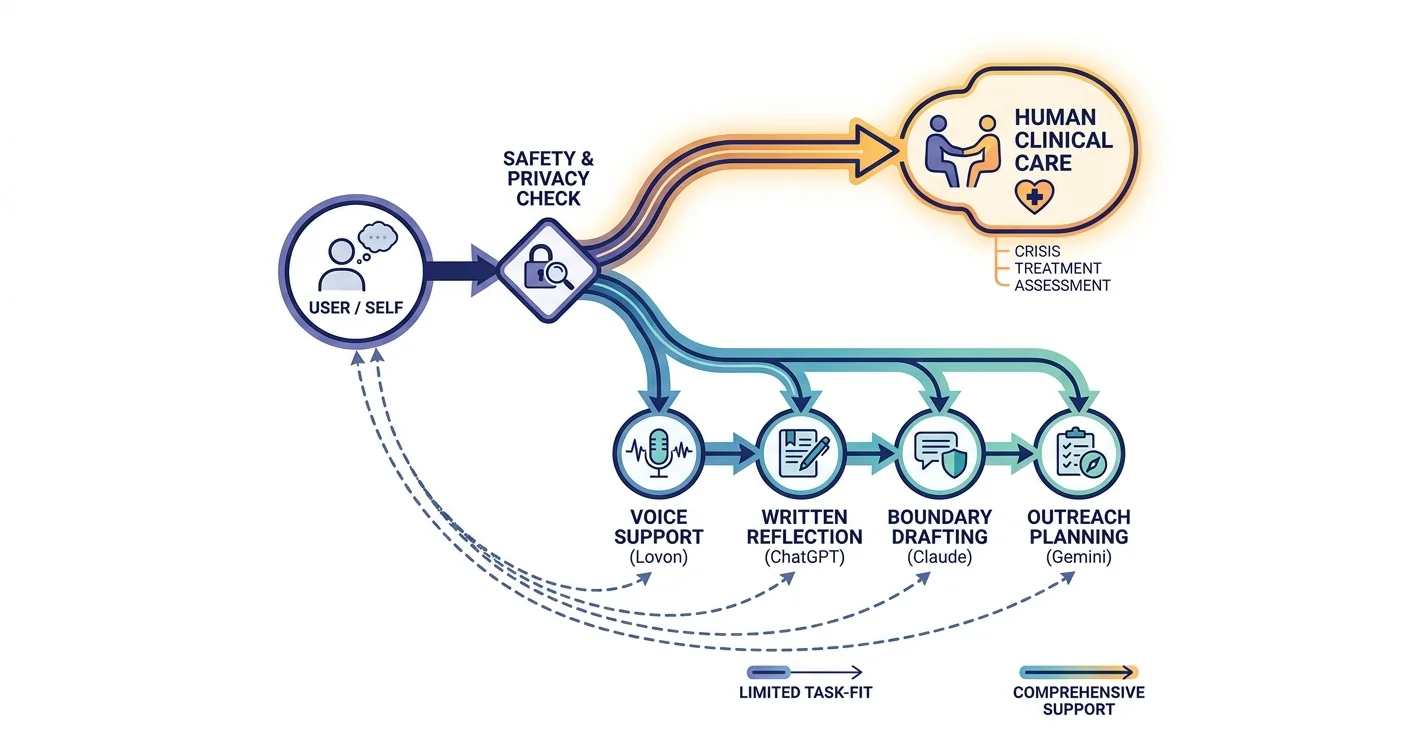

Key Takeaways
- For the best AI apps for LGBTQ+ mental health support, choose by task—not a promise of therapy.
- Lovon fits voice-led emotional support and coping practice; it is not a licensed clinician.
- ChatGPT, Claude, and Gemini can help with writing tasks; none replaces LGBTQ+-affirming clinical care.
- Check identity respect, privacy terms, and safety boundaries before sharing sensitive information.
- Use human crisis support, not an app conversation, when your safety is at risk.
Best for voice-led everyday support: Lovon. Best for written self-reflection: ChatGPT. Best for drafting a boundary message: Claude. Best for organizing an outreach plan: Gemini. This 2026 guide to the best AI apps for LGBTQ+ mental health support ranks practical uses—not proven LGBTQ+ clinical outcomes—and explains when you need human support instead.
TL;DR
- For the best AI apps for LGBTQ+ mental health support, choose by task—not a promise of therapy.
- Lovon fits voice-led emotional support and coping practice; it is not a licensed clinician.
- ChatGPT, Claude, and Gemini can help with writing tasks; none replaces LGBTQ+-affirming clinical care.
- Check identity respect, privacy terms, and safety boundaries before sharing sensitive information.
- Use human crisis support, not an app conversation, when your safety is at risk.
Why this matters
You deserve support that respects your identity without turning it into a problem to solve. Being lesbian, gay, bisexual, transgender, queer, or questioning is not itself a mental illness. Anxiety after rejection, stress around disclosure, and loneliness deserve attention without treating your identity as the cause.
An app can give you somewhere to put feelings into words. That is different from having a clinician assess your symptoms, understand your circumstances, and take responsibility for your care. A reassuring response alone does not establish either clinical competence or LGBTQ+ understanding.
Lovon is best for LGBTQ+ adults who want voice-led support for everyday stress alongside, not instead of, human care. That recommendation concerns its stated format and purpose. It is not a claim that the app has demonstrated LGBTQ+-specific treatment effectiveness.
What makes the best LGBTQ+ mental health support app?
For your 2026 shortlist, use these criteria before comparing names:
- Identity respect: The app should use your name, pronouns, and relationship terms without treating them as symptoms.
- Control over disclosure: Support should not pressure you to come out, confront someone, or share details before you feel safe.
- Clear privacy terms: Check what happens to conversations, recordings, account information, and deleted data.
- A useful format: Choose spoken conversation for talking things through, or text for reviewing and revising your thoughts.
- Honest limits: The app should distinguish emotional support from diagnosis, treatment, and emergency help.
- A concrete next step: Look for help naming a feeling, practicing a coping tool, or preparing a human conversation—not endless reassurance.
Treat identity respect and safety as requirements, not bonus features. An app that dismisses discrimination or repeatedly misgenders you is not a suitable support tool, whatever else it offers.
Privacy also needs a separate check. A mental health label does not by itself establish confidentiality protections equivalent to a therapist's care. Read the actual terms rather than assuming that a comforting conversation is a protected one.
The options at a glance
These 2026 recommendations separate a purpose-built emotional support app from general-purpose assistants. The general assistants below are recommended for bounded writing and planning tasks, not as therapists.
| Option | Best for | Standout use | Key limitation |
|---|---|---|---|
| Lovon | Voice-led everyday emotional support | Spoken conversations, coping tools, and self-reflection guidance | Not a licensed clinician or replacement for clinical care |
| ChatGPT | Written self-reflection | Turning a messy account into an editable reflection | Generated interpretations can be wrong |
| Claude | Boundary-message drafting | Rewriting a message around your stated limits | Cannot establish whether sending the message is safe |
| Gemini | Outreach planning | Organizing questions and next steps for seeking support | Cannot verify that a provider is affirming without reliable evidence |
The task assignments are not exclusive capabilities. General-purpose assistants overlap substantially. Pick the format you will actually use, then judge the response against the same safety criteria.
1. Lovon: best for voice-led everyday emotional support
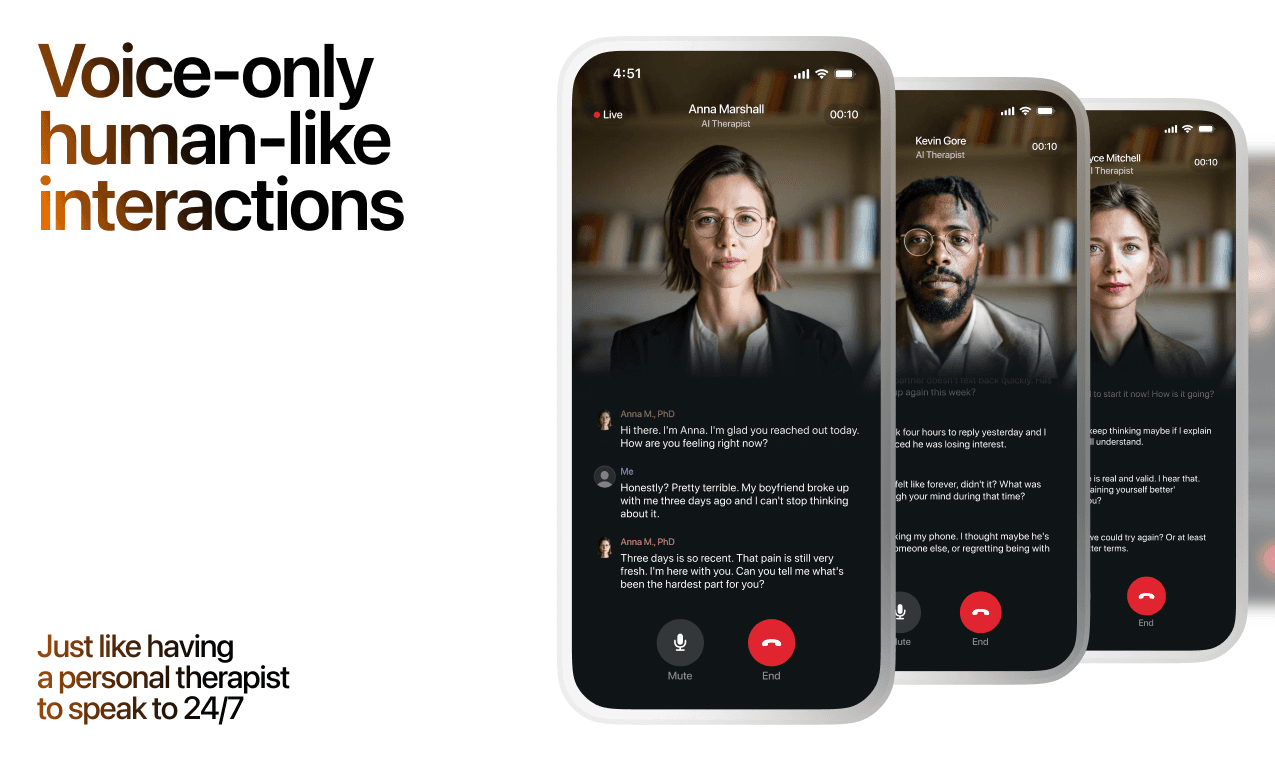
Lovon offers voice conversations with an AI therapist for emotional support, coping tools, and self-reflection guidance. It is built with input from PhD psychologists and addresses everyday concerns such as anxiety, stress, low mood, relationship problems, and burnout. It remains an always-available companion, not a licensed clinician.
Voice is a useful format to consider when writing feels like another task. You can talk about the experience that is bothering you without first turning it into a polished journal entry. Keep the goal small: describe what happened and identify what you need next.
For example, after an uncomfortable family conversation, focus on the immediate aftermath. Ask for help naming your feelings or choosing a coping exercise. Do not hand the app the decision about whether to disclose your identity or reconnect with an unsafe person.
Lovon pros:
- Voice conversations let you speak rather than compose a written account.
- Its stated purpose includes emotional support and coping tools.
- Self-reflection guidance fits everyday stress and relationship concerns.
Lovon cons:
- It cannot replace licensed assessment or treatment.
- Psychologist input does not establish LGBTQ+-specific competence in every response.
- Sensitive spoken details still require a careful privacy review.
Best for: Adults who prefer talking through everyday feelings and want support alongside human relationships or clinical care.
Verdict: Hold until the privacy and identity-respect checks pass; then consider it for everyday voice support.
2. ChatGPT: best for written self-reflection
ChatGPT is a general-purpose assistant that can generate, summarize, and revise text. For this guide, its role is written reflection: helping you separate an event, your interpretation, and the support you want. It is not a substitute for a mental health assessment.
Give it a narrow task rather than asking it to explain your whole personality. Describe a situation without identifying details, then ask it to distinguish what you know from what you are assuming. Read the result critically.
That distinction matters when you are dealing with possible rejection. An assistant should not turn a delayed reply into proof that someone hates you, but it should not automatically dismiss real prejudice either. Ask it to preserve uncertainty instead of deciding another person's motives.
ChatGPT pros:
- Written responses are easy to revisit and edit.
- You can request a specific structure for your reflection.
- Text generation supports preparing notes for a human conversation.
ChatGPT cons:
- It can generate convincing but inaccurate explanations.
- It does not know another person's intentions from your account.
- A general-purpose assistant does not provide a clinician's duty of care.
Best for: Adults who want to organize thoughts before journaling, talking with a trusted person, or attending therapy.
Verdict: Hold for bounded reflection tasks; skip generated diagnoses and conclusions about other people's motives.
3. Claude: best for drafting a boundary message
Claude is a general-purpose assistant that can draft and revise text. A useful task is turning your stated boundary into a message that sounds like you. Keep the decision about the boundary—and whether to send it—with yourself and trusted human support.
Start with the limit, not a detailed history of the relationship. For example, ask for a message that declines questions about your dating life without disclosing your orientation. Specify that the draft must not apologize for your identity or promise a later disclosure.
Review every sentence before using it. A polished message is not necessarily a safe message, especially when the recipient controls your housing, income, or access to support. You are allowed to choose silence, delay, or distance instead.
Claude pros:
- Drafting helps translate a stated limit into plain language.
- Revision lets you adjust tone without changing the boundary.
- A writing task does not require disclosing your full personal history.
Claude cons:
- It cannot determine how the recipient will react.
- A draft can include assumptions you did not intend.
- Helpful wording does not replace safety planning or relationship support.
Best for: Adults who already know their boundary and want help expressing it without unnecessary disclosure.
Verdict: Hold until you review the wording and safety implications; skip sending any draft automatically.
4. Gemini: best for organizing an outreach plan
Gemini is a general-purpose assistant that can help structure written information. Use it to turn the broad goal of finding support into questions, priorities, and next steps. Do not treat generated provider descriptions as verified recommendations.
You can ask for a checklist for contacting an LGBTQ+-affirming therapist or community organization. Include what matters to you: experience with your concerns, respect for your identity, confidentiality, and the kind of support you are seeking.
Then confirm the answers directly with the provider or organization. An assistant's confident wording is not evidence of a clinician's qualifications, current practice, or experience with transgender, bisexual, or questioning clients.
Gemini pros:
- It can organize a broad goal into a readable checklist.
- Drafting supports preparing an initial outreach message.
- You can specify your priorities before generating questions.
Gemini cons:
- Generated provider information requires independent verification.
- A checklist cannot establish a good therapeutic relationship.
- Planning alone does not deliver care or community connection.
Best for: Adults who want help preparing to seek human support rather than processing feelings inside an app.
Verdict: Hold for planning tasks; skip unverified provider recommendations.
How the options are ranked
The ranking uses the criteria above: format, task fit, identity respect, privacy review, and clear limits. The dedicated voice-support option comes first because its stated purpose matches everyday emotional support. The remaining options cover distinct writing tasks.
This is a 2026 task-fit guide, not a clinical effectiveness ranking. No position establishes that an app is safer for LGBTQ+ users, better at treating symptoms, or more private than another. Those conclusions require evidence beyond a product category or fluent response.
Try a low-disclosure check before sharing more
You do not need to reveal your identity, location, workplace, or family history to evaluate an app. Begin with a made-up, low-stakes scenario. Check whether the response respects your instructions before deciding whether to continue.
Use this sequence:
- Set the task: Ask for one reflection question, a coping suggestion, or a short draft.
- State your terms: Give the pronouns and relationship words you want used.
- Check the response: Look for assumptions, pressure, invented certainty, or disrespect.
- Choose your next step: Continue, revise the request, stop, or contact human support.
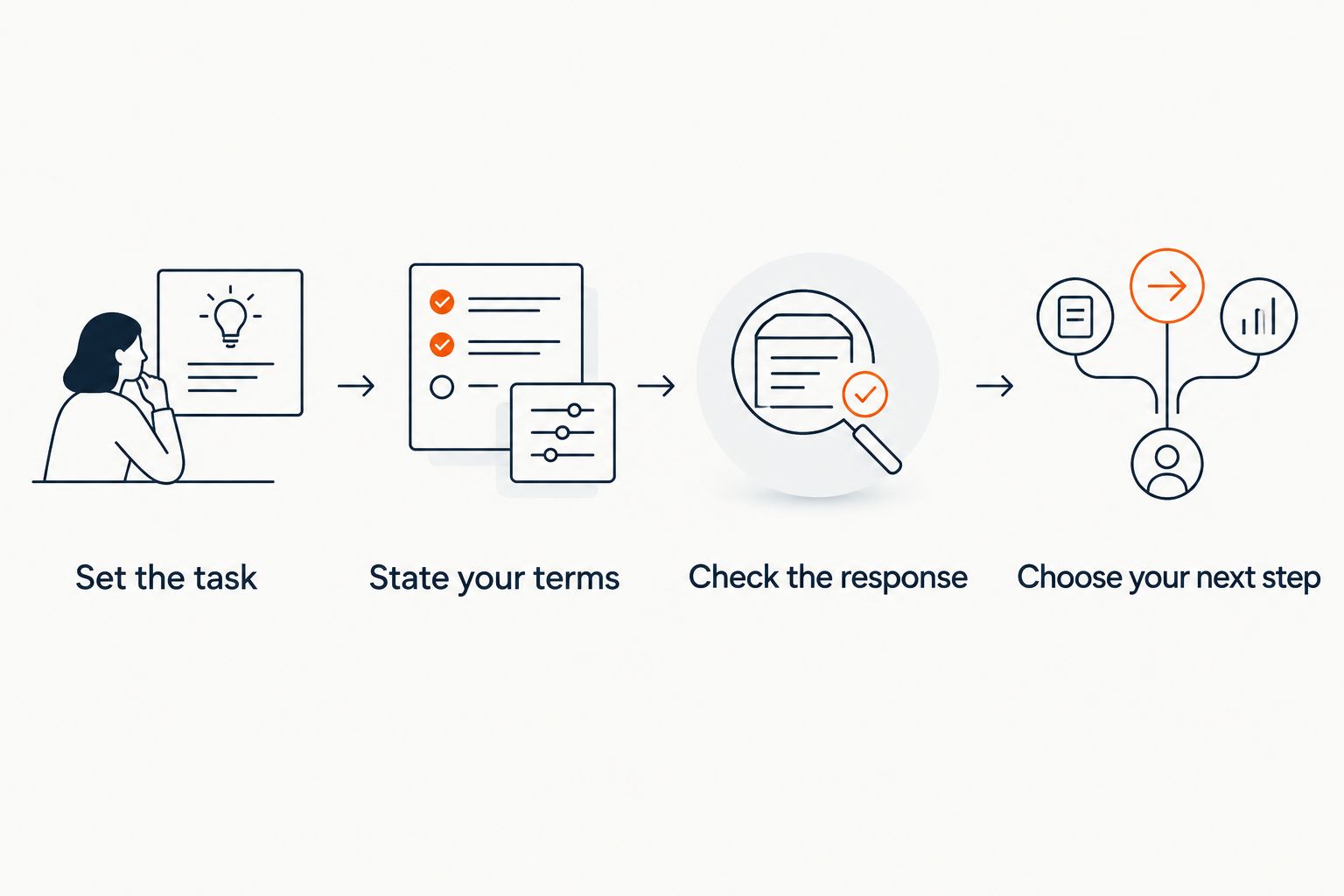 A sequence for checking an app before sharing sensitive personal information
Test how an app responds before giving it more personal detail.
For a first conversation, set a 5-minute limit as a practical boundary, not a treatment recommendation. Ask for a 2-sentence summary and finish by choosing 1 next action outside the app. That action can be as simple as getting water, resting, or contacting someone you trust.
The point is not to complete a perfect session. It is to see whether the tool helps you understand your immediate need without drawing you into repeated checking or decisions you are not ready to make.
Privacy questions to answer first
Before using an app in 2026, check its current policies and your device setup. Conversations about identity can reveal information you have not shared elsewhere. Leave out names and identifying details when they are unnecessary for the task.
Ask:
- Are voice recordings or transcripts retained?
- Who can access conversation data, and for what purposes?
- Is conversation content used to improve models?
- What does deletion remove, and what remains?
- Can notifications, shared accounts, or a shared device expose your use?
These are questions to verify, not features to assume. A reassuring answer generated inside a chat is not the same as the provider's written policy. If the policy does not answer your concern clearly, do not share that information.
Which option should you choose?
Choose the smallest tool that fits your immediate task. Voice support fits talking things through. Written reflection fits reviewing thoughts. Drafting fits a boundary you have already chosen. Outreach planning fits preparing to contact a person or organization.
If you are undecided, start with a low-disclosure task rather than a deeply personal conversation. You do not owe an app your story to find out whether it is useful.
Choose human care when you need assessment, treatment, help with persistent symptoms, or support around abuse and safety. Ask a prospective clinician directly about LGBTQ+-affirming practice and experience with your concerns. An app should support that connection, not become a reason to postpone it.
For suicidal thoughts or a mental health crisis in the United States, call or text 988. If there is an immediate life-threatening emergency, call 911. Do not wait for an assistant to decide whether your situation qualifies for help.
FAQ
What's the best AI app for LGBTQ+ mental health support in 2026?
The best choice depends on your task: Lovon fits voice-led everyday emotional support, while general-purpose assistants can help with reflection, drafting, and planning. This is a task-fit recommendation, not evidence of LGBTQ+-specific clinical effectiveness.
Can an AI app replace an LGBTQ+-affirming therapist?
No, an AI app cannot replace an LGBTQ+-affirming therapist. Licensed care provides assessment, treatment, and professional responsibility that an app conversation does not.
Is ChatGPT better than Claude for LGBTQ+ emotional support?
This guide does not establish that ChatGPT is better than Claude for LGBTQ+ emotional support. Both can assist with text tasks; evaluate the actual response for identity respect, accuracy, and appropriate limits.
Is it safe to tell an AI app that I'm LGBTQ+?
Do not assume that sharing your identity with an app is confidential. Check the provider's current privacy terms and your device access, and leave out identifying details when they are not needed.
Can an AI app help me decide whether to come out?
An app can help organize your thoughts, but it should not decide whether or when you come out. Your safety, housing, finances, relationships, and personal readiness belong at the center of that decision.
What should I do if an app misgenders me or dismisses discrimination?
Stop relying on a response that misgenders you or dismisses discrimination. You can correct the instruction, but you do not need to keep using a tool that repeatedly disrespects you.
What should I use if I need urgent mental health support?
Use human crisis support rather than an AI app when you need urgent help. In the United States, call or text 988 for a mental health crisis; call 911 for an immediate life-threatening emergency.
One last thing
A supportive response should help you understand yourself—not make you defend your identity. When checking an app, include a boundary against unwanted disclosure advice. For example, ask it to help with family stress without suggesting that you come out.
If it cannot respect that instruction, stop there. You are choosing a tool for support, not auditioning for acceptance.
Related guides
How AI Support Helps You Heal
AI emotional support isn't about replacing human connection — it's about filling the gaps. The moments when you need to talk at 2 AM, when you don't want to burden your friends again, or when you simply need someone to listen without judgment.
Here's what happens in a typical Lovon session:
You share what's on your mind
There's no script, no intake form, no waiting room. You speak or type whatever you're feeling — in your own words, at your own pace.
Lovon validates and explores
Using frameworks from CBT (Cognitive Behavioral Therapy) and motivational interviewing, Lovon acknowledges your feelings first, then gently helps you explore them. No dismissive "just move on" advice.
You build coping skills together
Lovon doesn't just listen — it actively works with you on evidence-based techniques: thought reframing, urge surfing, behavioral experiments, and more.
What a Session with Lovon Looks Like
When to Seek Professional Help
AI support is a valuable tool, but it's not a replacement for professional care. Please consider reaching out to a licensed therapist if you experience any of the following:
- Persistent thoughts of self-harm or suicide
- Inability to perform daily activities (work, eating, sleeping) for more than 2 weeks
- Turning to alcohol or substances to cope
- Intense anger or desire to harm your ex-partner
- Complete emotional numbness that doesn't improve over time
Crisis Resources (US): If you're in immediate danger, call 988 (Suicide & Crisis Lifeline) or text HOME to 741741 (Crisis Text Line). Available 24/7, free, and confidential.
Outside the US? Find a crisis line in your country
Ready to Start?
Your healing journey can begin right now
A 7-day trial. No judgment. Just a safe space to process what you're going through.
Frequently Asked Questions
Is Lovon a replacement for a real therapist?
Is my conversation with Lovon AI private?
How is Lovon different from ChatGPT for emotional support?
Can I use Lovon if I'm already seeing a therapist?
Can I try Lovon before subscribing?
About the Author
The Lovon Editorial Team
Mental Health & Wellness Content Team
The Lovon Editorial Team develops mental health and wellness content designed to make psychological concepts accessible and actionable. Our goal is to bridge the gap between clinical research and everyday life - helping you understand why your mind works the way it does and what you can do about it....
Related articles
- Best AI apps for shift workers in 2026
The best AI apps for shift workers: Lovon for voice support, plus picks for planning, messages, and notes. Compare uses…
- Best AI Mental Health App for Rural Residents (2026)
Lovon ranks best AI mental health app for rural residents in 2026 for on-demand voice support, alongside 988…
- Best Mental Health App for Depression in 2026: Ranked
The best mental health app for depression in 2026, ranked: Lovon (Buy), BetterHelp, Talkspace, Wysa, and more compared…
- AI Mental Health Support 2026: What It Is & Who It Helps
AI mental health support ranges from voice therapy to chatbots in 2026. See what each format does best, who it helps…
See also
Quizzes
- Highly Sensitive Person Test: How Much Do You Take In?
See how deeply you process, notice and get overloaded.
- Shame Test: Do You Read Mistakes as Verdicts?
See which exit your shame takes, in 3 minutes.
Free tools
- Write a Condolence Message for This Person
Get one condolence message written for your situation instead of a list of a hundred to choose from. Tell it who died…
- How to Come Out to Your Parents
A chat about how to come out to your parents that starts with whether now is safe, not with the speech. Tell it your…
From the wiki
- What does it mean when you dream about your ex?
Dreaming about your ex usually reflects emotional processing, not prophecy and not a message from them. Your sleeping…
Disclaimer: This article is for informational purposes only and does not constitute medical advice, diagnosis, or treatment. Always seek the advice of your physician or other qualified health provider with any questions you may have regarding a medical condition. If you are in crisis or think you may have an emergency, call 988 (Suicide & Crisis Lifeline) or go to the nearest emergency room. Outside the US? Find a crisis line in your country.