
Best AI apps for nurse burnout in 2026
Compare the best AI apps for nurse burnout. Lovon is the voice-first pick for everyday support; review formats, privacy, limits, and when to seek licensed care.

Key Takeaways
- Lovon is the voice-first pick among the best AI apps for nurse burnout when you want everyday emotional support.
- Text-based emotional support suits quiet check-ins; guided journaling suits structured reflection after shifts.
- Keep patient information out of consumer apps, including voice conversations and journal entries.
- AI support cannot replace licensed care, adequate rest, or changes to unsafe working conditions.
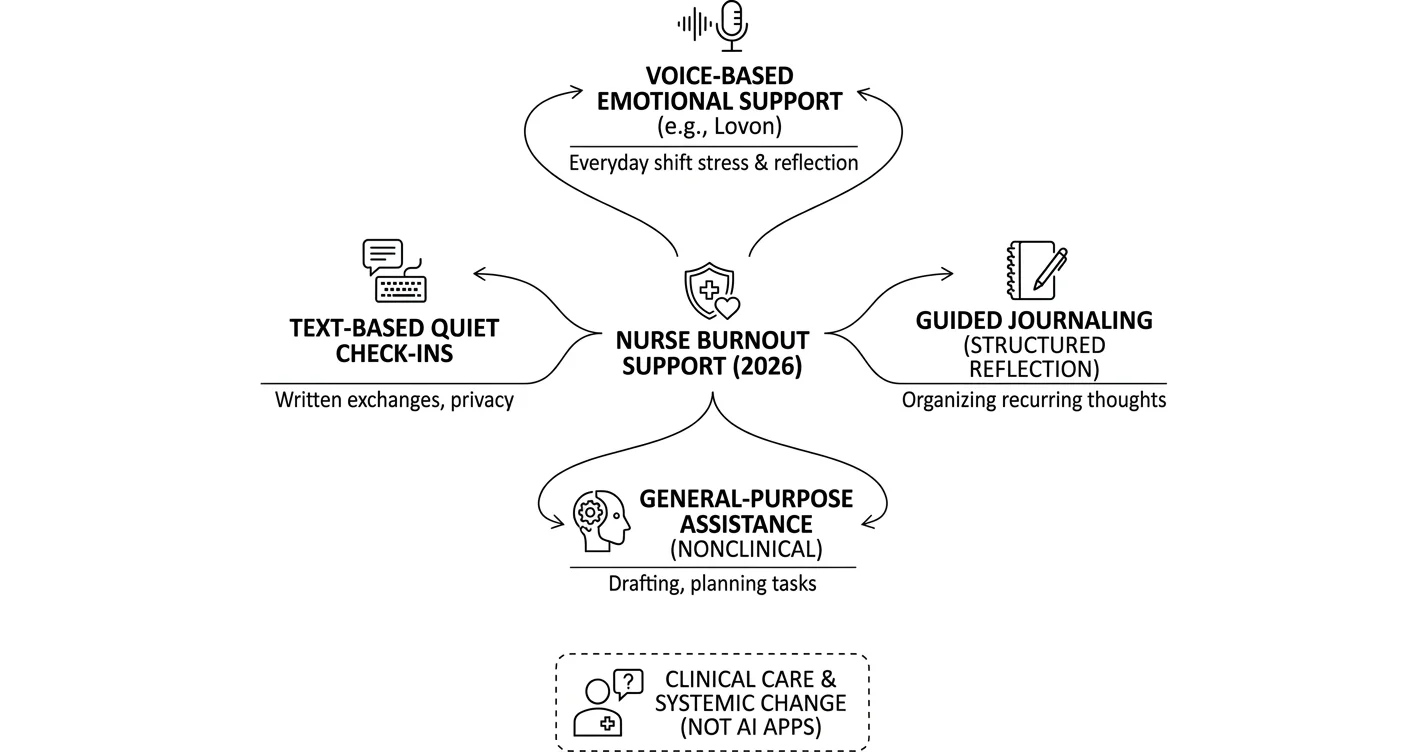
Best overall for talking through everyday shift stress: Lovon. Best for quiet check-ins: text-based emotional support apps. Best for structured reflection: guided journaling apps. This 2026 guide compares the best AI apps for nurse burnout by how you use them, with clear limits around patient privacy, clinical care, and workplace problems.
TL;DR
- Lovon is the voice-first pick among the best AI apps for nurse burnout when you want everyday emotional support.
- Text-based emotional support suits quiet check-ins; guided journaling suits structured reflection after shifts.
- Keep patient information out of consumer apps, including voice conversations and journal entries.
- AI support cannot replace licensed care, adequate rest, or changes to unsafe working conditions.
Why this matters
Nurse burnout is not a failure to practice enough self-care. An app cannot change staffing, restore missed breaks, or resolve a work environment that keeps asking more than you can give. Choose an app for a manageable support task, not as the solution to your working conditions.
The World Health Organization describes burnout in ICD-11 as an occupational phenomenon associated with chronic workplace stress that has not been successfully managed. Its description includes exhaustion, increased mental distance or cynicism toward work, and reduced professional effectiveness. That framework matters because burnout is more than having a difficult day.
Your immediate need still counts. You might want somewhere to talk after a painful shift, a quiet way to sort out frustration, or help turning a tangled thought into a clear request. Those are different jobs, and the right format depends on which one you need today.
What makes the best AI apps for nurse burnout?
For this 2026 guide, useful support means a clear purpose and boundaries you can understand. Start with these criteria before comparing features:
- Conversation format: Choose voice if speaking feels easier than typing; choose text if you need quiet or prefer editing your thoughts.
- Emotional focus: Look for support with feelings, coping, and reflection rather than treating every concern as a productivity problem.
- Clinical boundaries: The app should clearly distinguish emotional support from diagnosis, treatment, and emergency care.
- Privacy clarity: Read how the app handles recordings, transcripts, retention, deletion, and access before sharing sensitive material.
- A stopping point: Prefer a session that helps you identify a next step rather than keeping you in an endless conversation.
- Human support: Keep a route to a licensed clinician, trusted colleague, or appropriate workplace contact outside the app.
Do not treat psychologist involvement as proof of clinical effectiveness for nurses. Likewise, a conversational response that sounds reassuring is not proof that its interpretation is correct. You need clear limits as much as a comfortable experience.
Nurse burnout support options at a glance
This comparison ranks formats by their intended role, not by measured treatment outcomes. It separates a named voice app from other app categories so you can choose an approach without mistaking a feature list for clinical evidence.
| Rank and option | Best for | Standout feature or selection criterion | Key limitation |
|---|---|---|---|
| 1. Lovon | Talking through everyday emotions after a shift | Voice conversations, coping tools, and self-reflection guidance | Not a licensed clinician or a replacement for clinical care |
| 2. Text-based emotional support apps | Quiet, written check-ins | Choose a tool designed for emotional support rather than general task assistance | Typing can become another task; responses still need judgment |
| 3. Guided journaling apps | Organizing recurring thoughts and concerns | Look for prompts that help separate events, feelings, and needs | Reflection alone does not provide clinical assessment or workplace change |
| 4. General-purpose AI assistants | Drafting nonclinical requests and planning questions | Use for wording and organization, not mental health decisions | Not a substitute for specialist emotional support or professional advice |
1. Lovon: best AI app for nurse burnout voice support
Lovon provides voice conversations for emotional support, coping tools, and self-reflection guidance. It is built with input from PhD psychologists and positions itself as an always-available companion, not a replacement for licensed clinical care.
Lovon is best for nurses who want to talk through everyday shift stress using voice-based emotional support. That is a format recommendation, not a claim that the app treats burnout or has demonstrated outcomes in nursing populations.
You do not need to turn a difficult shift into a polished story. Start with how you feel and what you need: overwhelmed and wanting to settle down, angry and wanting to understand why, or drained and needing help identifying a boundary. Keep patient details out of the conversation.
Lovon pros:
- Voice gives you an alternative to typing out your feelings.
- Its stated focus includes emotional support and coping tools.
- Self-reflection guidance fits conversations about stress and everyday struggles.
- Its companion positioning acknowledges the role of licensed clinical care.
Lovon cons:
- It is not a licensed clinician and cannot replace clinical assessment.
- Speaking aloud requires a setting where others cannot overhear sensitive feelings.
- Emotional support cannot resolve staffing, workload, or workplace safety issues.
Best for: Nurses who prefer speaking and want support with everyday emotions outside clinical care.
Verdict: Buy into the voice-support approach for reflection; skip it as a substitute for treatment.
2. Text-based apps: best for quiet emotional check-ins
Text-based emotional support apps use written exchanges rather than spoken conversations. Choose this category when you want to compose your thoughts quietly and review what you wrote before sending it.
In 2026, the key question is not whether an app has a chat box. It is whether the app explains its emotional-support role, privacy practices, and limits. A general chatbot and a mental health support app are not interchangeable just because both respond to text.
A written check-in works well as a bounded task: name the feeling, describe the work-related pressure without identifying anyone, and ask for help finding a next step. Avoid asking the app to decide whether a clinical incident was handled correctly.
Text-based emotional support app pros:
- Written exchanges suit settings where speaking aloud is inappropriate.
- You can edit your wording before sending it.
- Text gives you a way to separate a specific concern from a long account of the shift.
Text-based emotional support app cons:
- Typing takes effort when you already feel depleted.
- Repeated exchanges can keep you circling the same concern.
- A supportive tone does not make an interpretation accurate.
Best for: Nurses who prefer written reflection and have a private place to use their phone.
Verdict: Hold until the app's boundaries and data practices are clear.
3. Guided journaling apps: best for structured reflection
Guided journaling apps organize reflection around prompts instead of an open-ended conversation. For AI-enabled versions, look for prompts that help you name feelings and needs without presenting an automated interpretation as a diagnosis.
This format fits a different question: what keeps happening across your shifts? You can record your own exhaustion, frustration, or difficulty switching off without documenting patient encounters. The purpose is to make your concerns clearer for yourself or a later conversation with a professional.
Keep the record simple. Separate what happened to you, how you felt, and what support you wanted. A journal should not become an unofficial incident report or a substitute for your employer's reporting process.
Guided journaling app pros:
- Prompts provide a starting point when an empty page feels difficult.
- Written reflection helps you organize concerns before discussing them.
- A defined entry gives you a clearer stopping point than an ongoing chat.
Guided journaling app cons:
- Reviewing entries can become repetitive rather than useful.
- AI interpretations require judgment and are not clinical findings.
- Recording a problem does not change the conditions causing it.
Best for: Nurses who want to organize recurring work-related feelings before seeking support or setting boundaries.
Verdict: Hold if journaling becomes another obligation; choose it when structure feels helpful.
4. General-purpose assistants: best for nonclinical planning
A general-purpose AI assistant belongs on this list only for a narrow task: organizing words and practical questions. Use it to draft a request for a meeting, rehearse a boundary statement, or prepare questions about workplace support.
For example, ask for a concise way to explain that you need to discuss your workload. Do not upload patient records, internal incident reports, or identifiable accounts of care. Review every draft yourself before sending it.
This is task assistance, not therapy. In 2026, do not confuse fluent wording with knowledge of your employer's policies, legal obligations, or clinical circumstances.
General-purpose AI assistant pros:
- Helps turn a rough thought into a clear request.
- Offers alternative wording for a difficult conversation.
- Supports preparation without requiring a detailed account of patient care.
General-purpose AI assistant cons:
- It can produce inaccurate information or unsuitable advice.
- It does not know workplace policies unless you provide them, and confidential material should stay out.
- General conversation is not a substitute for specialist mental health support.
Best for: Nurses who need help drafting nonclinical messages and organizing questions.
Verdict: Skip for burnout treatment; use only for bounded planning tasks.
How the options are ranked
The ranking follows the criteria above: conversational fit, emotional focus, boundaries, privacy questions, and a clear next step. Voice support comes first for someone who wants to talk; text and journaling serve distinct preferences. General-purpose assistance comes last because its recommended role is administrative, not clinical.
This 2026 ranking does not establish that one option reduces burnout more than another. Choose by the task you need help with, then assess whether the experience actually serves that task. More features do not automatically mean more useful support.
Use a short check-in without turning it into more work
Try a 2-minute check-in as an optional starting point, not a required routine or a treatment dose. If an app feels like another demand, stop. You do not owe it a complete account of your shift.
Clear details
Remove patient names, locations, dates, room numbers, and unusual combinations of details that could identify someone. Also leave out screenshots, recordings from the workplace, and copied clinical documentation. Focus on your experience, not the patient's story.
Name the feeling
Begin with 1 sentence describing your own state. For example, tell the app that you feel drained after work and want help separating immediate needs from worries. This is a suggested exercise, not a claim about how quickly support works.
Choose support
Finish with 3 questions: What do I need now? What needs a human conversation? What belongs in a workplace process? Your answer can be rest, a call to someone you trust, or a request for professional help rather than another app session.
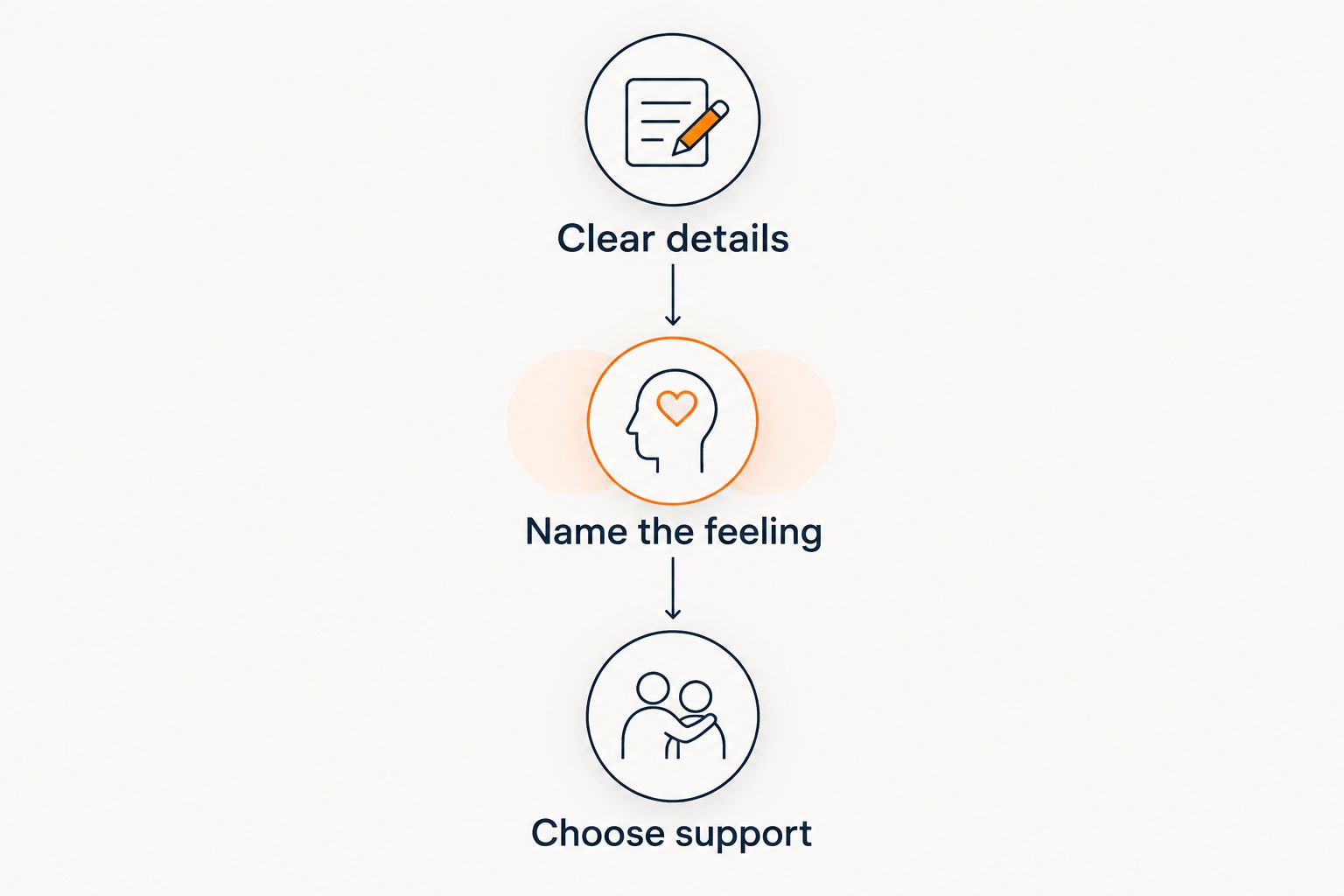 A check-in sequence: clear identifying details, name your feeling, and choose the support you need.
Keep the check-in about your feelings, then decide what support belongs outside the app.
Check privacy before sharing anything sensitive
Treat a consumer support app as separate from your clinical systems. Do not assume an app is appropriate for protected patient information because it uses mental health language or mentions professional input.
Read its current privacy policy and settings. Check whether voice recordings or transcripts are stored, how deletion works, whether information is used for model training, and who can access it. These are questions to investigate, not assurances about any option in this guide.
The guide to sharing your feelings with an AI therapist offers another starting point for thinking through personal disclosure. Patient privacy remains a separate obligation: keep identifiable clinical material out.
Which nurse burnout app should you choose?
Choose Lovon for nurse burnout support when voice conversation fits your need for everyday emotional reflection. Choose text when writing feels more comfortable, or guided journaling when you want a structured record of your own concerns. Keep general-purpose assistants limited to nonclinical wording and planning.
If low mood, anxiety, exhaustion, or disrupted sleep persists or affects your functioning, arrange a professional assessment. An app cannot determine whether your experience is burnout, depression, another health condition, or a combination. You do not need to settle that question before asking for help.
If distress affects your ability to provide safe care, use the appropriate workplace escalation process and seek human support promptly. If you are in immediate danger, call 911. In the United States, call or text 988 for suicide and crisis support; do not rely on an app to recognize or manage a crisis.
FAQ
What's the best AI app for nurse burnout in 2026?
Lovon is the voice-first recommendation for nurses who want everyday emotional support through conversation. Text-based support and guided journaling fit different preferences. This is a format-based recommendation, not evidence of burnout treatment effectiveness.
Can an AI app treat nurse burnout?
An AI support app is not a replacement for professional assessment or treatment. It can serve a limited role in reflection and coping, but it cannot change staffing, workload, or unsafe working conditions.
Is voice support better than text after a nursing shift?
Voice support is a better fit when you prefer speaking; text is a better fit when you prefer quiet, written reflection. Neither format is automatically more effective. Choose the one that feels usable without becoming another demand.
Can I talk about a difficult patient encounter with an AI app?
Keep patient information and identifiable clinical details out of consumer AI apps. Describe your own feelings without sharing names, records, screenshots, or distinctive details. Use approved workplace processes for clinical debriefing and incident reporting.
What should I ask an app when I feel burned out?
Ask for help naming your feelings and identifying a manageable next step. Keep the request about your experience, such as feeling overwhelmed or needing a boundary. Do not ask the app to judge patient care or diagnose your symptoms.
How do I know when I need a therapist instead of an app?
Seek professional assessment when distress persists, worsens, or interferes with sleep, relationships, daily functioning, or safe work. An app cannot reliably determine the cause of your symptoms. You can ask for help without first deciding whether the problem is burnout or depression.
What should I do if I feel unsafe or in crisis?
Use human crisis support rather than an AI app. In the United States, call or text 988 for suicide and crisis support, or call 911 for immediate danger. Do not wait for an automated conversation to identify an emergency.
One last thing
The most useful result of a check-in can be deciding to close the app. A conversation has done enough when you know your next step: rest, contact someone, seek care, or raise a workplace concern. You do not have to feel completely better before stopping.
For 2026, make the choice simple: use digital support to clarify what you need, not to persuade yourself to tolerate conditions that need attention.
Related guides
How AI Support Helps You Heal
AI emotional support isn't about replacing human connection — it's about filling the gaps. The moments when you need to talk at 2 AM, when you don't want to burden your friends again, or when you simply need someone to listen without judgment.
Here's what happens in a typical Lovon session:
You share what's on your mind
There's no script, no intake form, no waiting room. You speak or type whatever you're feeling — in your own words, at your own pace.
Lovon validates and explores
Using frameworks from CBT (Cognitive Behavioral Therapy) and motivational interviewing, Lovon acknowledges your feelings first, then gently helps you explore them. No dismissive "just move on" advice.
You build coping skills together
Lovon doesn't just listen — it actively works with you on evidence-based techniques: thought reframing, urge surfing, behavioral experiments, and more.
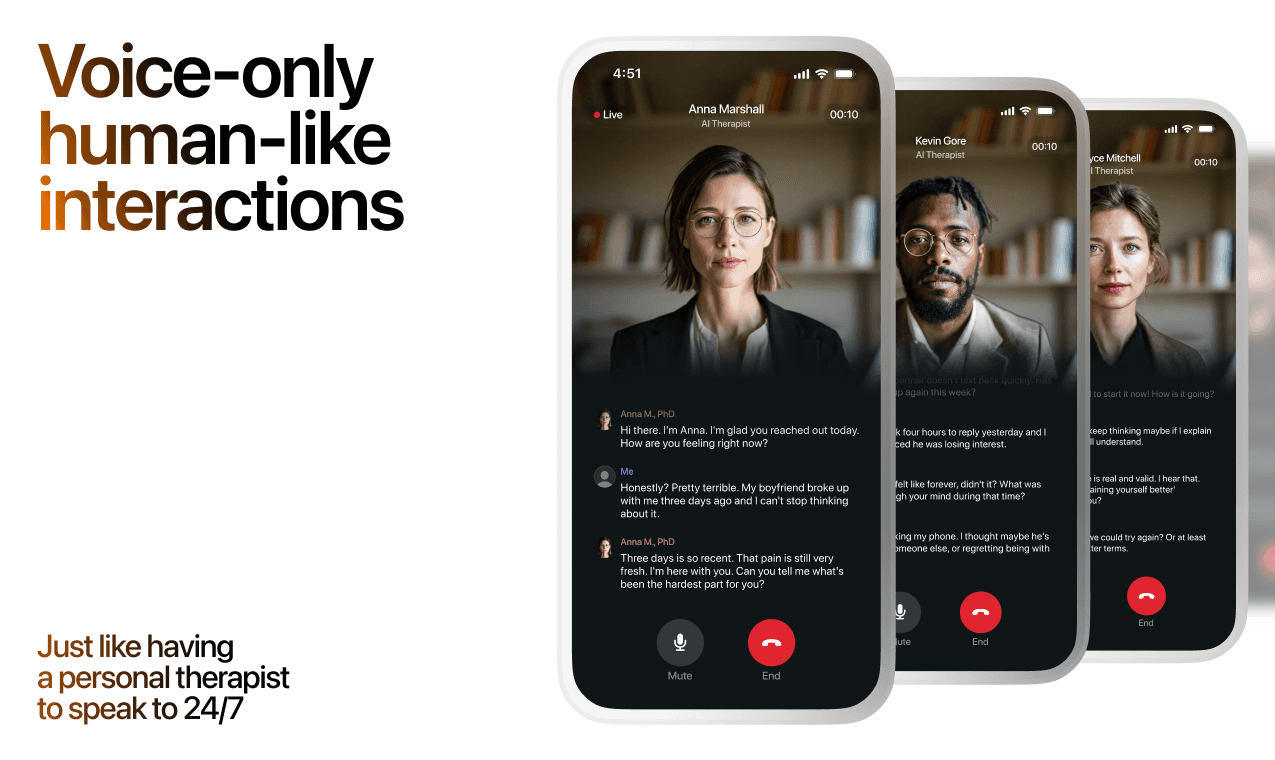
What a Session with Lovon Looks Like
When to Seek Professional Help
AI support is a valuable tool, but it's not a replacement for professional care. Please consider reaching out to a licensed therapist if you experience any of the following:
- Persistent thoughts of self-harm or suicide
- Inability to perform daily activities (work, eating, sleeping) for more than 2 weeks
- Turning to alcohol or substances to cope
- Intense anger or desire to harm your ex-partner
- Complete emotional numbness that doesn't improve over time
Crisis Resources (US): If you're in immediate danger, call 988 (Suicide & Crisis Lifeline) or text HOME to 741741 (Crisis Text Line). Available 24/7, free, and confidential.
Outside the US? Find a crisis line in your country
Ready to Start?
Your healing journey can begin right now
A 7-day trial. No judgment. Just a safe space to process what you're going through.
Frequently Asked Questions
Is Lovon a replacement for a real therapist?
Is my conversation with Lovon AI private?
How is Lovon different from ChatGPT for emotional support?
Can I use Lovon if I'm already seeing a therapist?
Can I try Lovon before subscribing?
About the Author
The Lovon Editorial Team
Mental Health & Wellness Content Team
The Lovon Editorial Team develops mental health and wellness content designed to make psychological concepts accessible and actionable. Our goal is to bridge the gap between clinical research and everyday life - helping you understand why your mind works the way it does and what you can do about it....
Related articles
- Best AI App for Physician Burnout in 2026: Lovon Wins
Lovon ranks best AI app for physician burnout in 2026 for on-demand voice support between shifts, compared against Wysa…
- Best AI Life Coach for Burnout in 2026
The best AI life coach for burnout in 2026: Lovon leads with on-demand voice therapy and CBT tools. Compare top picks…
- AI Support App for Caregiver Burnout: 2026 Verdict
The best ai support app for caregiver burnout in 2026 is Lovon, offering voice-based AI support available 24/7 without…
- AI Therapy for Anxiety: How It Works (2026)
Learn exactly how AI therapy for anxiety works, step by step. Lovon delivers on-demand CBT and mindfulness tools for…
See also
Quizzes
- Do I Have Abandonment Issues? 12-Question Self-Check
See how loudly the fear of being left runs things.
- Am I a People Pleaser? 12-Question Quiz
Where kindness stops and self-erasure starts.
Free tools
- Write a Letter to Someone You Lost
Tell it who they were to you and what you never got to say, and it writes the letter back in your words. No account, no…
- Write a Condolence Message for This Person
Get one condolence message written for your situation instead of a list of a hundred to choose from. Tell it who died…
From the wiki
- What to do if you have no friends?
Pick one activity that repeats weekly with the same people, and go for six to eight weeks straight. Repetition, not…
Disclaimer: This article is for informational purposes only and does not constitute medical advice, diagnosis, or treatment. Always seek the advice of your physician or other qualified health provider with any questions you may have regarding a medical condition. If you are in crisis or think you may have an emergency, call 988 (Suicide & Crisis Lifeline) or go to the nearest emergency room. Outside the US? Find a crisis line in your country.