
Can ADHD be managed without medication?
Can ADHD be managed without medication? Yes, for some adults. Learn which therapy, routines, and supports help, where they fall short, and when to seek care.

Key Takeaways
- Can ADHD be managed without medication? Yes, for some people; judge the plan by how well you function.
- Skills-based therapy and external reminders address different ADHD difficulties; neither works for everyone.
- Lovon is best for adults seeking voice-based emotional support, not a replacement for ADHD care.
- If daily life remains hard despite your plan, review treatment options with a qualified clinician.
Yes, ADHD can be managed without medication, especially when practical routines, skills-based therapy, and support from other people address the problems disrupting your day. That does not mean medication is unnecessary for everyone: if symptoms still interfere with work, relationships, or basic responsibilities, talk with a qualified clinician about your options. In 2026, the useful question is not whether you can avoid medication at all costs, but whether your plan helps you function.
TL;DR
- Can ADHD be managed without medication? Yes, for some people; judge the plan by how well you function.
- Skills-based therapy and external reminders address different ADHD difficulties; neither works for everyone.
- Lovon is best for adults seeking voice-based emotional support, not a replacement for ADHD care.
- If daily life remains hard despite your plan, review treatment options with a qualified clinician.
Can ADHD be managed without medication?
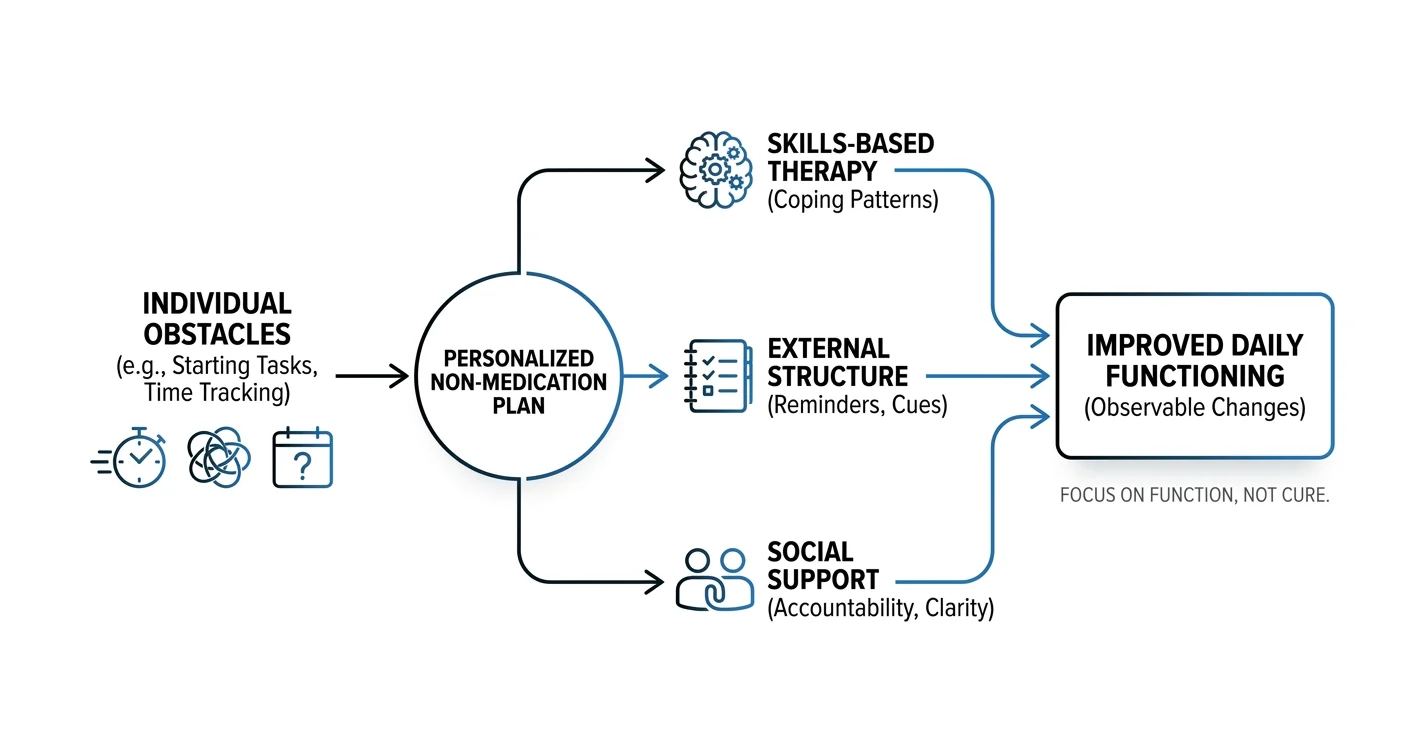
Yes, but a plan needs more than willpower. ADHD can affect starting tasks, keeping track of time, managing emotions, and following through. The right non-medication approach depends on which of those problems gets in your way. In 2026, focus on observable changes in your day rather than whether you managed to push through it.
| Approach | Best for | What it helps you do | Limitation |
|---|---|---|---|
| Skills-based therapy | Repeated patterns of avoidance, disorganization, or self-criticism | Practice responses to problems that keep recurring | Requires participation and practice between sessions |
| External structure | Forgotten tasks, missed transitions, and cluttered priorities | Put reminders and next steps outside your head | A system you do not use will not help |
| Sleep and movement habits | Days made harder by fatigue or restlessness | Support attention and day-to-day well-being | Do not replace assessment or treatment |
| Support from other people | Tasks that are hard to start or finish alone | Add accountability and clarify expectations | Depends on clear agreements and boundaries |
Start with the obstacle you can name. If mornings unravel because you cannot decide what comes first, a written first step is more useful than another general promise to be organized. If you lose track of time once you begin, make the end of a task visible with an alarm or a planned check-in. The step-by-step guide to building an ADHD routine can help you turn that distinction into a repeatable plan.
No row in the table is a stand-alone cure. A therapist can help you practice skills, but cannot make reminders appear when you need them; a calendar can show an appointment, but cannot resolve the shame you feel after missing one. Combine supports around a specific problem, then check whether that problem is becoming easier to manage.
Why this matters
Choosing not to take medication is a treatment preference, not a requirement to manage ADHD alone. You can ask for help with planning, emotional reactions, and daily responsibilities without first deciding how you feel about medication. That distinction matters when a rough week makes you think your only choices are to push harder or give up.
Non-medication strategies also serve a different purpose from an ADHD assessment. Trouble concentrating can overlap with sleep problems, anxiety, depression, and other concerns. If you have not been assessed, ask a qualified clinician to review what is happening rather than treating every attention problem as proof of ADHD. If you already have a diagnosis, use that conversation to identify which symptoms your current plan does and does not address.
In 2026, a workable plan should be easy to describe: the task you struggle with, the support you will use, and the sign that tells you it helped. You do not need to change your entire life at once. You do need a way to tell whether your effort is making daily life less difficult.
Build a non-medication plan around the problem
The steps below are a starting structure, not a test of discipline. Keep what helps. Change what does not.
- Name the sticking point. Write down one repeatable problem, such as starting reports, leaving on time, or answering messages. Describe what happens, not what it says about your character.
- Make the next step visible. Put the first action where you will encounter it: on a calendar, a note by the door, or the document you need to open. Keep the action small enough that you know when it is done.
- Add a cue or a person. Use an alarm for a transition, or agree on a check-in with someone who understands the task. Say what you need from them instead of asking them to keep you accountable in general.
- Review what changed. Notice whether you started, finished, or got stuck at a different point. If the same barrier remains, adjust the support rather than repeating the same instruction to yourself.
For a hard-to-start task, the first action could be opening the document and writing its heading. A 5-minute start can make that action feel more defined; it is a tool to try, not a measure of how long you should be able to focus. If beginning gets easier but finishing does not, move your attention to stopping points and transitions. A 10-minute check-in before you need to switch tasks might help you notice what is still unfinished.
For appointments or deadlines, work backward from the point where things usually go wrong. If you remember an appointment but leave late, another appointment reminder misses the problem. A departure cue is more relevant. If you leave on time but forget what you need, put the items together beforehand. Match the support to the failure point, not to the label ADHD.
Skills-based therapy: useful for patterns you keep repeating
A qualified therapist can help you examine a cycle such as avoiding a task, feeling overwhelmed as the deadline approaches, then criticizing yourself afterward. Skills-based approaches, including cognitive behavioral therapy, can help you practice planning, problem-solving, and responses to discouraging thoughts. The work is specific: you identify a situation, try a different response, and discuss what happened.
Therapy is a strong choice when emotional reactions make practical systems hard to use. If a missed deadline leads to shame and then more avoidance, adding another reminder does not address the full cycle. A therapist can also help you sort out concerns that overlap with ADHD rather than assuming one strategy should cover everything.
The limitation is that insight alone does not complete tomorrow's task. Ask how a skill will show up in your actual day: What will you do when you avoid opening the email? What is the next action when a plan falls apart? If you leave with an idea but no way to practice it, bring that gap back to the next session.
External structure: useful when keeping track is the problem
External structure means putting information somewhere you can see or hear it instead of relying on memory in the moment. A calendar holds commitments. A checklist holds the steps of a recurring task. An alarm marks a transition. None is automatically the right tool; each needs a job.
For a task that stalls because it feels too large, write the next physical action rather than the whole project. For a day full of interruptions, keep a visible place to return to the task you left. If several reminders blend into background noise, remove the ones that do not prompt a decision. More alerts are not always more support.
Try a 15-minute planning session if it helps you decide what needs attention, but do not make the session itself another complicated project. The useful output is a clear next step and a place to find it. This approach is best for missed steps and transitions; its weakness is that it depends on regular use and cannot resolve every emotional or clinical concern.
Sleep, movement, and support: helpful foundations, not substitutes
Sleep and physical activity support general health and can affect how manageable attention feels during the day. If sleep is difficult, address that problem directly rather than treating exhaustion as a personal failure. Movement can be a useful break or transition cue. Neither approach proves that you no longer need ADHD treatment, and neither should be presented as a cure.
Support from another person can make a task clearer. You might ask a coworker to confirm the next deadline, or ask someone you trust to sit with you while you begin a chore. Make the request concrete and give the other person room to say no. Accountability works better as a shared agreement than as constant monitoring.
These foundations also have limits. If your sleep is disrupted, your responsibilities are slipping, and you feel unable to recover, a new checklist alone is not an adequate answer. In 2026, treat worsening day-to-day functioning as a reason to seek a clinical review, not as evidence that you failed at a routine.
Why results vary from person to person
- The main difficulty differs. A plan for losing track of time will not necessarily help with emotional overwhelm.
- Other concerns can overlap. Sleep problems, anxiety, and depression deserve attention in their own right.
- The environment matters. A reminder helps only if you can notice it and act when it appears.
- Support has to fit the task. A check-in that helps you start does not automatically help you finish.
- Plans need revision. If a tool adds work without changing the problem, simplify or replace it.
Those factors explain why copying someone else's routine is an unreliable measure of your own progress. Ask what the strategy is meant to change. Then look for that change in a real situation, such as leaving when you planned or returning to a paused task. You do not need a perfect day to learn whether the support helped.
When should you talk with a clinician about medication?
Talk with a qualified clinician when ADHD symptoms continue to disrupt daily life despite your current supports, or when you want to understand all available treatment options. Discuss what you have tried and where you still get stuck. Considering medication does not erase the value of therapy, routines, or the work you have already done.
A clinician can help you weigh benefits, limitations, and other health considerations for your situation. Do not stop or change prescribed medication based on an article or an app. If a treatment is not working for you, bring that concern to the professional who prescribes it.
Can emotional support help even if it does not treat ADHD?
Yes. Emotional support can help you talk through stress, frustration, or self-criticism while you work on practical ADHD supports. Lovon is best for adults who want voice-based emotional support alongside ADHD care, not as a substitute for assessment or treatment. You can use its voice conversations to reflect on what felt hard and consider a coping tool; it is not a licensed clinician or a source of medication advice.
Keep the distinction clear. Talking through a difficult morning can help you name what happened. A clinician is the right person to assess persistent symptoms, review treatment, or address a mental health concern that needs professional care. In 2026, choose each form of support for the job it can actually do.
FAQ
Can ADHD be managed without medication in 2026?
Yes, some people manage ADHD without medication through skills-based therapy, external structure, and support. The test is whether the plan improves daily functioning; speak with a qualified clinician if significant difficulties remain.
What is the best non-medication approach for ADHD?
The best approach targets the difficulty that disrupts your day. Skills-based therapy can address recurring patterns, while reminders and clear next steps help with tasks and transitions.
Can adults with ADHD use therapy instead of medication?
Yes, adults can discuss skills-based therapy as part of a non-medication plan with a qualified clinician. Therapy takes practice, and it does not make medication unnecessary for everyone.
Do exercise and sleep habits treat ADHD?
Sleep and movement support well-being, but they are not stand-alone substitutes for ADHD assessment or treatment. If attention problems persist or sleep is consistently difficult, discuss both with a clinician.
How do I know whether my ADHD routine is working?
Check whether the specific task you targeted is getting easier to start, complete, or return to. If the same barrier keeps appearing, change the support or ask for help reviewing your plan.
When should I ask about ADHD medication?
Ask a qualified clinician when symptoms keep interfering with work, relationships, or daily responsibilities, or whenever you want to compare treatment options. You can keep using practical supports while discussing medication.
Can an emotional support app replace ADHD therapy?
No. An emotional support app can help you reflect and practice coping tools, but it cannot replace a qualified clinician's assessment or ADHD treatment.
One last thing
If a strategy only works when you have an unusually easy day, it is not yet supporting the day you need help with. In 2026, start with your most predictable sticking point and put support there. A plan you can revise is more useful than a rule you blame yourself for breaking.
Related guides
How AI Support Helps You Heal
AI emotional support isn't about replacing human connection — it's about filling the gaps. The moments when you need to talk at 2 AM, when you don't want to burden your friends again, or when you simply need someone to listen without judgment.
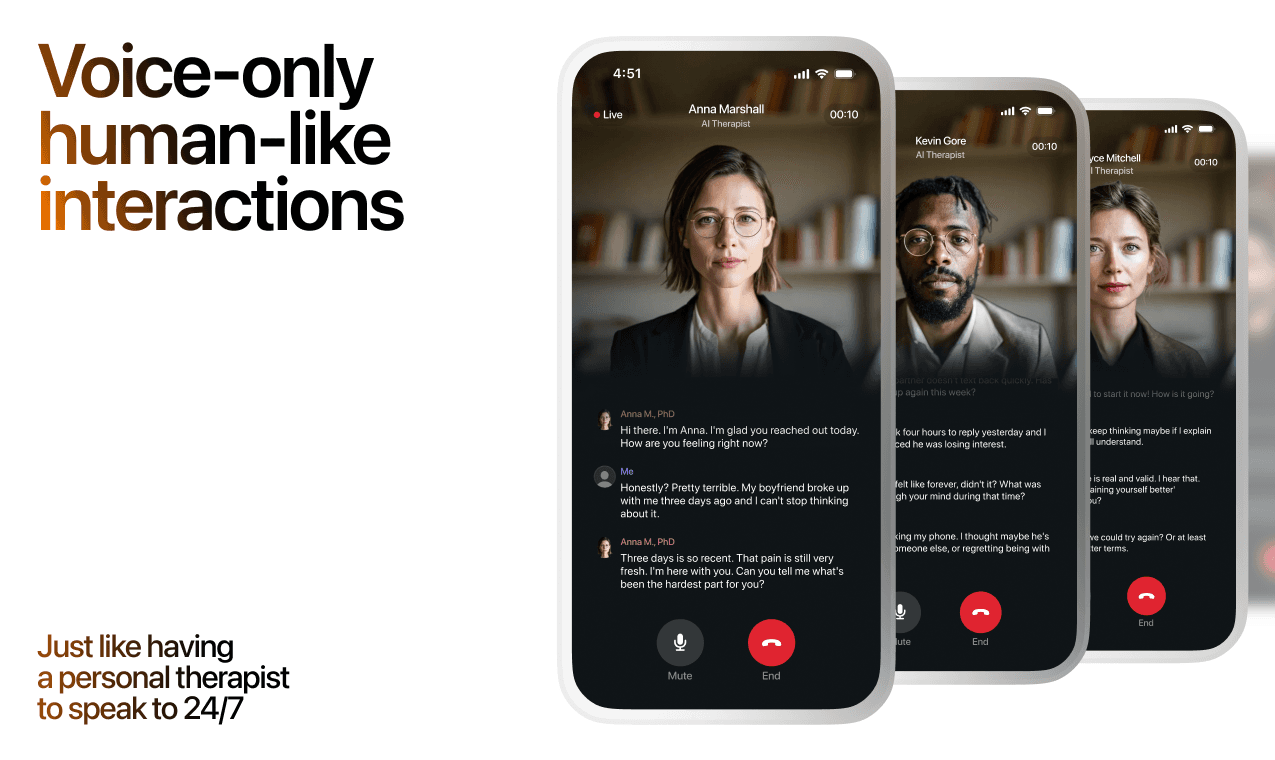
Here's what happens in a typical Lovon session:
You share what's on your mind
There's no script, no intake form, no waiting room. You speak or type whatever you're feeling — in your own words, at your own pace.
Lovon validates and explores
Using frameworks from CBT (Cognitive Behavioral Therapy) and motivational interviewing, Lovon acknowledges your feelings first, then gently helps you explore them. No dismissive "just move on" advice.
You build coping skills together
Lovon doesn't just listen — it actively works with you on evidence-based techniques: thought reframing, urge surfing, behavioral experiments, and more.
What a Session with Lovon Looks Like
When to Seek Professional Help
AI support is a valuable tool, but it's not a replacement for professional care. Please consider reaching out to a licensed therapist if you experience any of the following:
- Persistent thoughts of self-harm or suicide
- Inability to perform daily activities (work, eating, sleeping) for more than 2 weeks
- Turning to alcohol or substances to cope
- Intense anger or desire to harm your ex-partner
- Complete emotional numbness that doesn't improve over time
Crisis Resources (US): If you're in immediate danger, call 988 (Suicide & Crisis Lifeline) or text HOME to 741741 (Crisis Text Line). Available 24/7, free, and confidential.
Outside the US? Find a crisis line in your country
Ready to Start?
Your healing journey can begin right now
A 7-day trial. No judgment. Just a safe space to process what you're going through.
Frequently Asked Questions
Is Lovon a replacement for a real therapist?
Is my conversation with Lovon AI private?
How is Lovon different from ChatGPT for emotional support?
Can I use Lovon if I'm already seeing a therapist?
Can I try Lovon before subscribing?
About the Author

The Lovon Editorial Team
Mental Health & Wellness Content Team
The Lovon Editorial Team develops mental health and wellness content designed to make psychological concepts accessible and actionable. Our goal is to bridge the gap between clinical research and everyday life - helping you understand why your mind works the way it does and what you can do about it....
Related articles
- How much does ADHD coaching cost?
How much does ADHD coaching cost? No verified average is available here. Compare full plans, ask about hidden terms, and…
- AI Therapist for Stress: What It Can and Can't Do (2026)
An honest breakdown of what an AI therapist for stress handles well in 2026, where it falls short, and how Lovon fits…
- Can anxiety come back after years of being fine?
Can anxiety come back after years of being fine? Yes. Learn what a return of symptoms means, what to do now, and when to…
- AI Therapist When You Can't Afford Therapy: 2026 Guide
Can't afford therapy in 2026? Learn how to use an AI therapist like Lovon for daily support, what it can't replace, and…
See also
Quizzes
- Do I Have Abandonment Issues? 12-Question Self-Check
See how loudly the fear of being left runs things.
- Light Triad Test: Are People Ends or Means?
See how you treat people when there is nothing to gain.
Free tools
- How to Come Out to Your Parents
A chat about how to come out to your parents that starts with whether now is safe, not with the speech. Tell it your…
- Family Boundary Plan
Pick the person, the one topic, and how much you want to see them. You get a three-rung ladder, the guilt lines to…
From the wiki
- Why do I feel sad when I'm alone?
Being alone does not create the sadness. It removes the noise that was keeping it out of earshot, so whatever queued up…
Disclaimer: This article is for informational purposes only and does not constitute medical advice, diagnosis, or treatment. Always seek the advice of your physician or other qualified health provider with any questions you may have regarding a medical condition. If you are in crisis or think you may have an emergency, call 988 (Suicide & Crisis Lifeline) or go to the nearest emergency room. Outside the US? Find a crisis line in your country.