
AI Support for Infertility Grief: What Helps in 2026
AI support for infertility grief compared for 2026: which tools help between clinic visits, which overstep, and where Lovon's voice therapy fits in.

Key Takeaways
- Lovon's voice-based sessions give you AI support for infertility grief at 2am, when clinics and therapists are
- Grief-specific content beats generic chatbot scripts written for breakups or bereavement, not reproductive loss.
- Voice journaling helps when typing out a miscarriage or a failed IVF cycle feels impossible — Consider it for
- No AI tool should diagnose infertility causes or replace a fertility counselor — treat that as a hard Skip.
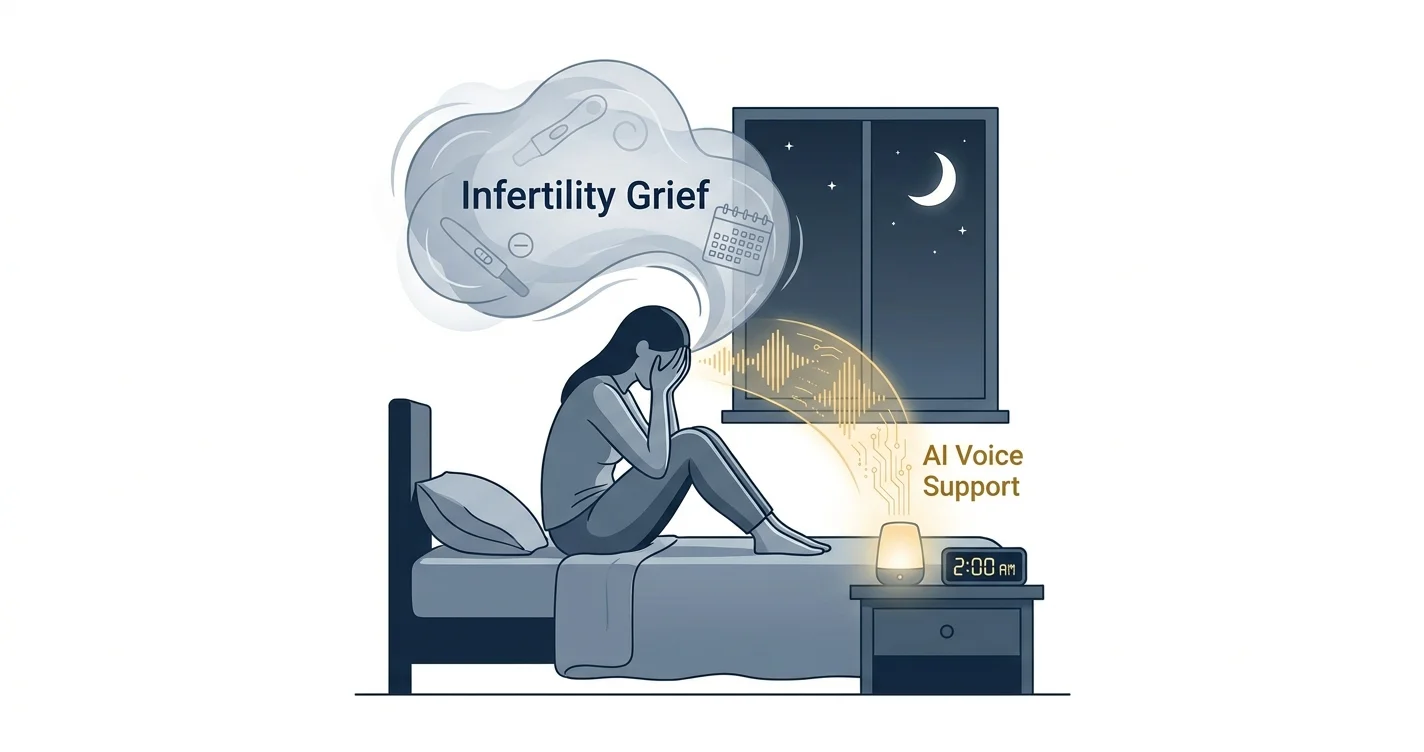
Infertility grief does not wait for office hours. It shows up after a negative test at 11pm, during a friend's baby shower, or in the silence after a failed transfer when your partner is asleep and you are not. This guide walks through what AI support for infertility grief actually offers, who it is built for, and where a tool like Lovon fits next to your fertility clinic and your therapist, not instead of them.
TL;DR
- Lovon's voice-based sessions give you AI support for infertility grief at 2am, when clinics and therapists are closed — Buy for between-appointment moments.
- Grief-specific content beats generic chatbot scripts written for breakups or bereavement, not reproductive loss.
- Voice journaling helps when typing out a miscarriage or a failed IVF cycle feels impossible — Consider it for processing alone.
- No AI tool should diagnose infertility causes or replace a fertility counselor — treat that as a hard Skip.
Why this matters
Infertility grief is a specific kind of loss. It is grief without a body, without a funeral, and often without anyone outside your household knowing it happened. Standard grief resources are written for death and breakups. They rarely address the two-week wait, the cycle that didn't work, or the baby shower you had to skip in 2026.
AI support fills a real gap: it is there at 2am, it does not get tired of hearing about the same failed transfer twice, and it costs nothing extra if you already pay for an app. It is not a replacement for a reproductive endocrinologist, an OB, or a licensed grief counselor — and any tool that implies otherwise is overselling itself.
Who this is for
This is for anyone mid-treatment or post-loss: someone tracking a cycle that didn't work, a couple sitting with a canceled embryo transfer, a person grieving a miscarriage while still fielding baby announcements from friends. Lovon was built with input from PhD psychologists for exactly this kind of everyday-but-heavy moment — talking it through by voice instead of typing it out, at whatever hour it hits.
It is not for anyone in crisis needing immediate clinical intervention, and it is not a substitute for a fertility specialist managing your medical care.
What to look for in AI support for infertility grief
Available when the grief actually hits
Most infertility grief spikes happen outside a 9-to-5 window — after a call from the clinic, after a period arrives, after scrolling past a pregnancy announcement at midnight. A tool that only works during business hours misses the moments that matter most.
Voice, not just another text box
Typing out "I just found out this cycle failed" takes energy you may not have. Voice-based support lets you talk the way you would to a friend, without staring at a blinking cursor. AI voice therapy differs from text-based apps in exactly this way — it lowers the barrier to actually opening up.
Language built for reproductive loss, not generic grief
A script written for losing a parent does not fit losing a pregnancy, a cycle, or the version of parenthood you pictured. Support that names the two-week wait, the injections, the transfer, and the specific ambiguity of infertility grief will land differently than a one-size-fits-all grief template.
No cost barrier tied to insurance approval
Infertility treatment already runs expensive in 2026, and mental health support layered on top of it should not require another insurance fight. Therapy without insurance can run well past what many people can absorb on top of fertility bills, which is why on-demand tools matter for the gaps between paid sessions.
A clear line about what it cannot do
Any honest AI support tool says plainly that it is not a licensed clinician and cannot diagnose infertility causes, adjust medication, or manage medical risk. If a tool skips that disclosure, that is a warning sign, not a feature.
Top picks for AI support for infertility grief
The always-there pick: Lovon One spec that matters: available for a voice conversation at any hour, including 2am after a bad appointment. Built with input from PhD psychologists specifically for everyday emotional struggles like grief and burnout, not just as a chatbot wrapper. Verdict: Buy for anyone who needs somewhere to talk between clinic visits.
The specific-to-you pick: AI support app for grief and loss AI support for grief and loss breaks down how AI tools are actually built to hold different kinds of loss, including the ambiguous kind infertility creates. The value here is specificity — it does not treat a failed cycle like a generic bad day. Verdict: Buy if you want to understand how the support is structured before you use it.
The process-alone pick: AI voice journaling When you cannot face another conversation but need to get the grief out of your head, voice journaling works as a lower-pressure entry point. It takes a few minutes, requires no typing, and gives you a record of how the grief shifts week to week through 2026. Verdict: Consider for the days you want to process solo before talking to anyone.
The orientation pick: Grief stages guide If you are confused about why you feel fine one day and flattened the next, the grief stages breakdown explains why grief is not linear and how long each stage tends to run. It will not replace support, but it gives you language for what is happening. Verdict: Consider as a companion read, not a standalone fix.
Talk through it tonight
Start a voice conversation with Lovon whenever the grief hits, no appointment needed.
What to avoid
- Generic grief chatbots that never mention infertility. If the responses read like they were written for losing a pet or a job, the tool wasn't built for reproductive loss and it will show in every reply.
- Anything that implies it can explain why you're infertile. Diagnosing causes or predicting outcomes is a medical function, not a support function — a tool that crosses that line is overstepping.
- Closed communities that turn grief into comparison. Some forums quietly become a place to measure your loss against someone else's "worse" story, which tends to deepen isolation instead of easing it.
Verdict comparison
| Option | Available 2am | Voice-based | Grief-specific | Safety line stated | Verdict |
|---|---|---|---|---|---|
| Lovon (AI voice support) | Yes | Yes | Yes | Yes | Buy |
| AI support app for grief and loss (guide) | N/A | N/A | Yes | Yes | Buy |
| AI voice journaling | Yes | Yes | Partial | Yes | Consider |
| Grief stages guide | N/A | N/A | Yes | N/A | Consider |
| Generic grief chatbot | Varies | Rarely | No | Rarely | Skip |
FAQ
What is AI support for infertility grief?
It's on-demand emotional support delivered through an app, usually by voice or chat, built to help you process feelings around infertility, miscarriage, or failed treatment cycles. Lovon offers this as voice conversations available any hour, built with input from PhD psychologists, not as a replacement for a fertility counselor.
Can an AI therapist replace a fertility counselor?
No. AI support tools like Lovon are explicit that they are not licensed clinicians and cannot manage medical decisions, diagnose causes of infertility, or replace in-person counseling. They fill the gap between appointments, not the appointment itself.
Is AI support available at night when grief hits hardest?
Yes, that's the main advantage over scheduled therapy. Voice-based AI support is available at 2am or any other hour in 2026, when clinics and most therapists are closed.
How much does therapy cost without insurance in 2026?
Costs vary widely by location and provider, and infertility treatment already adds significant out-of-pocket expense for many people. That's part of why on-demand, lower-barrier support matters between paid sessions.
Is voice-based AI support better than text-based apps for grief?
Voice lowers the barrier for people who struggle to type out painful details, like a failed transfer or a miscarriage. Text apps work for some people, but voice conversations tend to feel closer to talking to a person.
What should I avoid in an AI grief support tool?
Avoid any tool that implies it can diagnose why you're infertile or predict treatment outcomes — that's a medical claim, not a support claim. Also avoid generic grief scripts that never mention reproductive loss specifically.
Can AI support help with grief between IVF cycles?
Yes, that's one of its most practical uses. The wait between cycles is often when grief and anxiety peak, and having somewhere to talk it through at any hour helps close that gap.
One last thing
The hardest part of infertility grief is usually not the loss itself, it's how invisible it stays. Most people carry it silently through 2026 while still showing up to work, family dinners, and other people's pregnancy announcements. A tool that lets you say the hard thing out loud at 2am, even to an AI, is doing something a support group that meets once a month cannot: it's there on the actual bad night.
Related guides
How AI Support Helps You Heal
AI emotional support isn't about replacing human connection — it's about filling the gaps. The moments when you need to talk at 2 AM, when you don't want to burden your friends again, or when you simply need someone to listen without judgment.
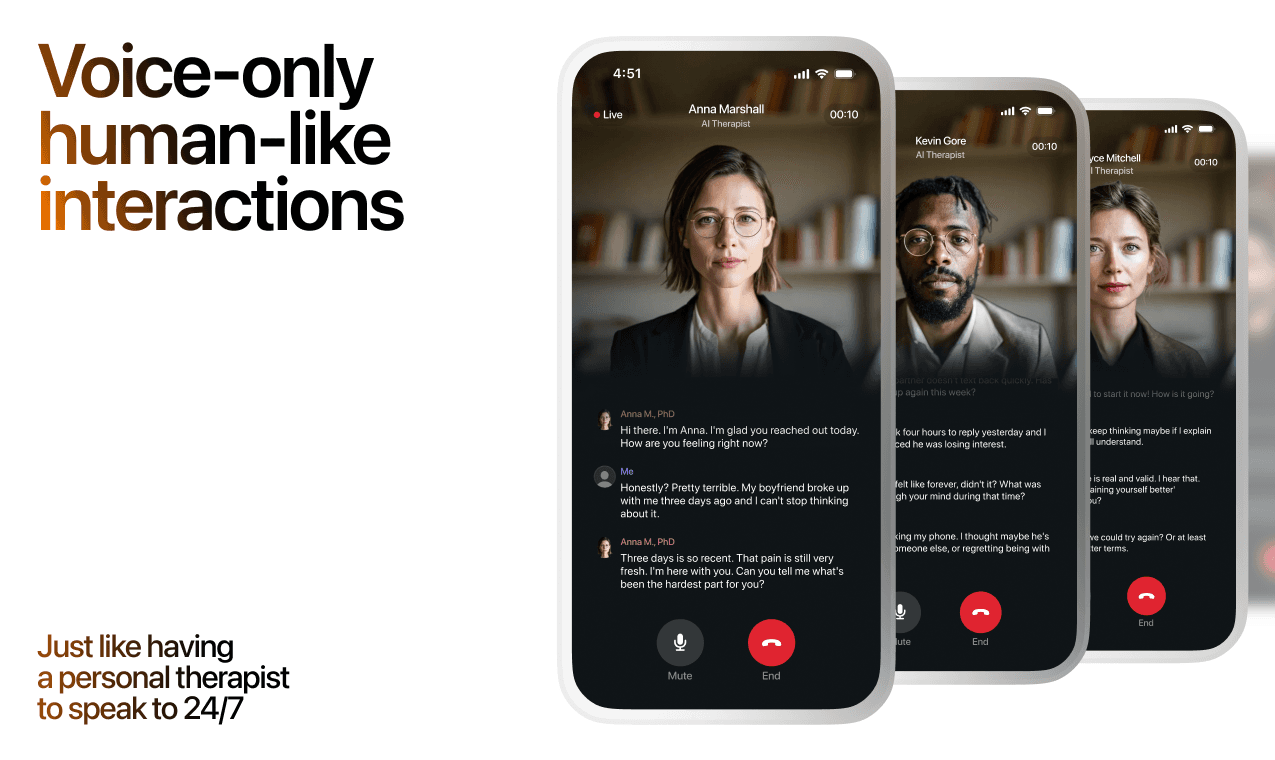
Here's what happens in a typical Lovon session:
You share what's on your mind
There's no script, no intake form, no waiting room. You speak or type whatever you're feeling — in your own words, at your own pace.
Lovon validates and explores
Using frameworks from CBT (Cognitive Behavioral Therapy) and motivational interviewing, Lovon acknowledges your feelings first, then gently helps you explore them. No dismissive "just move on" advice.
You build coping skills together
Lovon doesn't just listen — it actively works with you on evidence-based techniques: thought reframing, urge surfing, behavioral experiments, and more.
What a Session with Lovon Looks Like
When to Seek Professional Help
AI support is a valuable tool, but it's not a replacement for professional care. Please consider reaching out to a licensed therapist if you experience any of the following:
- Persistent thoughts of self-harm or suicide
- Inability to perform daily activities (work, eating, sleeping) for more than 2 weeks
- Turning to alcohol or substances to cope
- Intense anger or desire to harm your ex-partner
- Complete emotional numbness that doesn't improve over time
Crisis Resources (US): If you're in immediate danger, call 988 (Suicide & Crisis Lifeline) or text HOME to 741741 (Crisis Text Line). Available 24/7, free, and confidential.
Outside the US? Find a crisis line in your country
Ready to Start?
Your healing journey can begin right now
A 7-day trial. No judgment. Just a safe space to process what you're going through.
Frequently Asked Questions
Is Lovon a replacement for a real therapist?
Is my conversation with Lovon AI private?
How is Lovon different from ChatGPT for emotional support?
Can I use Lovon if I'm already seeing a therapist?
Can I try Lovon before subscribing?
About the Author

The Lovon Editorial Team
Mental Health & Wellness Content Team
The Lovon Editorial Team develops mental health and wellness content designed to make psychological concepts accessible and actionable. Our goal is to bridge the gap between clinical research and everyday life - helping you understand why your mind works the way it does and what you can do about it....
Related articles
- AI Therapy App for Content Creator Burnout Guide 2026
Content creator burnout isn't office burnout. This guide covers what an ai therapy app for content creator burnout…
- AI Therapy App for Miscarriage and Pregnancy Loss 2026
AI therapy app for miscarriage and pregnancy loss: what to look for, when it helps, and where a licensed therapist is…
- Disenfranchised grief: loss nobody acknowledges
Grief that other people do not treat as real: an ex, a coworker, a pet, a miscarriage, a friend you never met in person…
- AI Support App for IVF and Fertility Stress in 2026
Lovon's AI support app for IVF and fertility treatment stress gives on-demand voice sessions between appointments in…
See also
Quizzes
- What Stage of Grief Am I In? Free 12-Question Quiz
See what your grief is actually doing, in 3 minutes.
- Pet Loss Check: Free 12-Question Pet Grief Self-Check
See what losing them is actually doing, in 3 minutes.
Free tools
- What to Say When a Pet Dies
Get a message you can actually send to someone whose dog or cat just died: one that uses the animal's name, treats the…
- Write a Condolence Message for This Person
Get one condolence message written for your situation instead of a list of a hundred to choose from. Tell it who died…
From the wiki
- How to break up with someone you still love?
Loving someone does not mean the relationship works. If you have circled the same decision for months and the reasons…
Disclaimer: This article is for informational purposes only and does not constitute medical advice, diagnosis, or treatment. Always seek the advice of your physician or other qualified health provider with any questions you may have regarding a medical condition. If you are in crisis or think you may have an emergency, call 988 (Suicide & Crisis Lifeline) or go to the nearest emergency room. Outside the US? Find a crisis line in your country.