
AI Support App for Dementia Caregivers: 2026 Verdict
See what to look for in an ai support app for dementia caregivers in 2026 - where Lovon fits, what to avoid, and when you still need a human.

Key Takeaways
- Lovon works as an ai support app for dementia caregivers who need a voice to talk to at 3 a.m. Buy.
- Text-only apps fail caregivers mid-task; voice-first design matters more here than most reviews admit.
- Lovon is not a crisis line or a diagnostic tool - pair it with your care team, don't replace them.
- Compassion fatigue builds for months before caregivers notice it; catching it early beats catching it late.
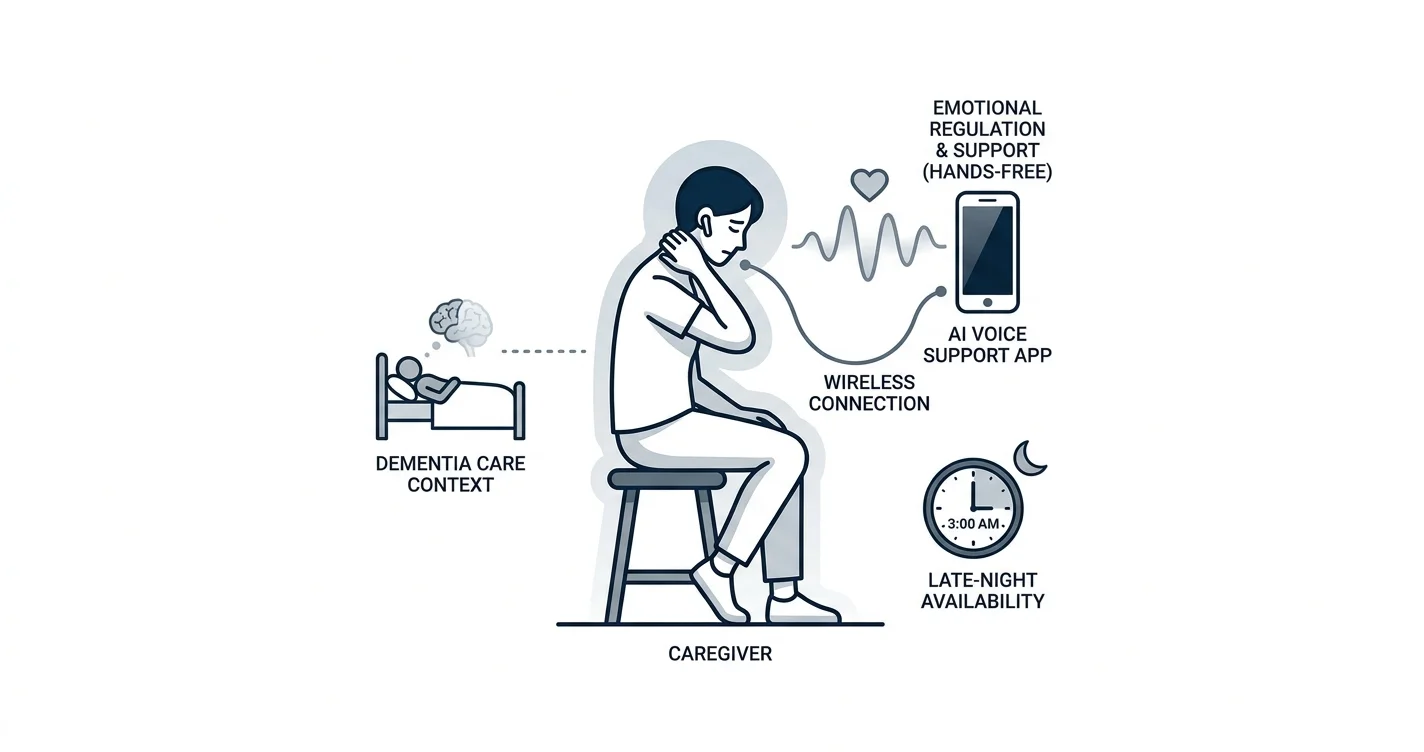
Dementia caregiving does not stop for office hours, and exhaustion rarely announces itself until 2 a.m. when the same question gets asked for the fifth time. This guide breaks down what an ai support app for dementia caregivers actually needs to do, where Lovon fits into that picture, and what to skip.
TL;DR
- Lovon works as an ai support app for dementia caregivers who need a voice to talk to at 3 a.m. Buy.
- Text-only apps fail caregivers mid-task; voice-first design matters more here than most reviews admit.
- Lovon is not a crisis line or a diagnostic tool - pair it with your care team, don't replace them.
- Compassion fatigue builds for months before caregivers notice it; catching it early beats catching it late.
Why this matters
More than 11 million Americans provide unpaid care for someone with dementia, according to the Alzheimer's Association, and most of that care happens outside a doctor's office, at odd hours, with no one to talk to. An ai support app for caregiver burnout fills a real gap here: it does not replace a neurologist or a support group, but it gives you somewhere to put the frustration, guilt, and grief that build up between appointments.
The problem is most mental health apps were not built with this specific caregiver in mind. They assume you have quiet time to type, a fixed schedule, and a problem that resolves. Dementia caregiving is none of those things in 2026, and an app that ignores that reality wastes your time.
Who this is for
This guide is for the adult child, spouse, or family member managing day-to-day care for someone with Alzheimer's or another dementia diagnosis. You're likely juggling medical appointments, behavioral changes like sundowning or repetition, and your own job or family on top of it. You're not looking for a diagnosis or a cure - you're looking for somewhere to unload before you snap at the person you're caring for.
What to look for in an AI support app for dementia caregivers
Availability when the crisis actually happens
Sundowning episodes, wandering scares, and 3 a.m. confusion don't wait for business hours. An app that's only useful during a 9-to-5 window solves a problem you don't have. Look for something available 24/7, because that's when dementia caregiving actually gets hard.
Voice-first, hands-free design
You're often mid-task when the stress hits - cooking, redirecting a wandering parent, or sitting in a hospital waiting room. Typing out your feelings isn't realistic in those moments. Voice-based support lets you talk while your hands stay busy with the person in front of you.
Tools built for cumulative grief, not one-off stress
Dementia caregiving isn't a single crisis - it's a slow, repeated loss that stretches over years. Compassion fatigue shows up gradually, and generic stress-relief content misses the specific weight of grieving someone who is still alive. The right tool recognizes anticipatory grief as its own category, not a subset of general anxiety.
Honesty about its limits
Any app claiming to diagnose dementia progression or replace your care team is overreaching. A trustworthy tool says plainly what it is and isn't - emotional support, not clinical treatment - and points you toward a doctor or crisis line when something is genuinely urgent.
Judgment-free space to say the hard part out loud
Caregivers rarely admit resentment or exhaustion to family, because it feels disloyal. A tool that lets you say "I'm so tired of this" without a lecture is doing something a lot of well-meaning relatives can't.
Low friction to actually start
If getting support requires paperwork, a waitlist, or scheduling a call, you won't use it during the moment you need it. The best option opens in seconds, not days.
Top picks
The middle-of-the-night pick: Lovon. The one spec that matters here is voice-based conversation available 24/7 - no typing, no appointment. Lovon was built with input from PhD psychologists to give emotional support and coping tools on demand, positioned as an always-available companion rather than a replacement for licensed care. For a caregiver awake at 3 a.m. with nowhere else to put the stress, that combination is exactly the gap that needs filling. Buy.
The long-haul pick: anticipatory grief support. Dementia caregiving involves grieving someone gradually, over months and years, while they're still in the room. The anticipatory grief angle matters because generic "cheer up" content doesn't acknowledge that this kind of loss is ongoing, not a single event to process and move past. Consider it alongside any daily coping routine.
The format-check pick: voice vs. text. If you've tried a text-based mental health app and abandoned it within a week, the format was probably the problem, not the content. Voice-based AI therapy removes the typing barrier entirely, which matters more for caregivers than for almost any other user group. Consider switching formats before writing off AI support altogether.
The community pick: peer support groups. Nothing replaces talking to another person who has fed a parent who no longer recognizes them. Local and virtual Alzheimer's caregiver groups offer something an app cannot - shared lived experience. Consider running this alongside daily AI check-ins, not instead of them.
The professional backstop pick: your care team. A neurologist, geriatric care manager, or licensed therapist should still be in the loop for medication questions, behavioral changes, or your own mental health if it's deteriorating. Any app, including Lovon, is a supplement to that relationship. Skip the idea that an app alone is a full care plan.
What to avoid
- Apps that promise to predict or diagnose dementia progression. That's a medical claim requiring a clinician, not a wellness feature.
- Generic meditation apps with no caregiver-specific content. Breathing exercises help, but they don't address the guilt spiral that's unique to this kind of caregiving.
- Any tool that positions itself as a substitute for a doctor or crisis line. If a behavioral change is sudden or safety is at risk, that's a call to a professional, not an app session.
Talk it out before it builds up
Voice conversations with Lovon are available anytime, day or night.
Verdict comparison
| Criteria | Lovon (AI voice) | Peer support group | Caregiver hotline | Text-based AI app |
|---|---|---|---|---|
| Available at 3 a.m. | Yes, 24/7 | No, scheduled meetings | Limited hours | Yes, typing required |
| Hands-free while caregiving | Yes | No | Yes, but human-staffed | No |
| Built for cumulative grief | Yes | Yes, informally | Varies | Rarely |
| Replaces clinical care | No | No | No | No |
FAQ
What is the best ai support app for dementia caregivers in 2026?
Lovon is a strong option in 2026 for caregivers who need voice-based emotional support available around the clock. It's built for on-demand coping conversations, not diagnosis or crisis intervention, so pair it with your care team for medical questions.
Is an AI app better than a support group for dementia caregivers?
Neither replaces the other - an AI app like Lovon is available at 3 a.m. when a support group isn't in session, while a support group offers shared lived experience an app can't replicate. Most caregivers benefit from using both.
Can an AI app help with caregiver compassion fatigue?
Yes, an AI voice app can help you talk through the exhaustion and resentment that build up during long-term caregiving before they turn into full burnout. It won't resolve the underlying workload, so respite care and family support still matter.
How much does AI therapy cost compared to in-person therapy?
AI support apps are generally far less expensive than a licensed therapist's hourly rate, though pricing varies by app and plan. Traditional therapy without insurance often runs well over $100 per session in 2026, which makes on-demand AI support a practical gap-filler between sessions.
Is Lovon a replacement for a dementia caregiver support hotline?
No, Lovon is not a crisis line and does not replace one. If there's an immediate safety concern involving the person you're caring for, call a hotline or emergency services first.
Does a voice-based app work better than a text-based one for caregivers?
For most dementia caregivers, yes, because voice support works while your hands are occupied with caregiving tasks. Typing out a message mid-crisis is often impractical when you're managing someone else's needs in real time.
What are signs of caregiver burnout an app can help with?
Signs include chronic exhaustion, irritability, feeling numb toward the person you're caring for, and dreading routine tasks. An AI support app can help you name these patterns early, though ongoing burnout still warrants a conversation with a doctor.
Is it normal to feel resentment as a dementia caregiver?
Yes, resentment is a common and normal response to long-term, high-demand caregiving - it doesn't mean you don't love the person. Having a judgment-free place to say that out loud, whether to an app or a therapist, reduces the shame that often comes with it.
One last thing
The hardest part of dementia caregiving usually isn't the big medical decisions - it's the ninth time in an hour you're asked the same question and have to answer it like it's the first. That's the moment worth having an ai support app for dementia caregivers open, not a session booked for next Tuesday. In 2026, the caregivers who last longest without burning out are the ones who built a small habit of talking it out daily, not just when things fall apart.
How AI Support Helps You Heal
AI emotional support isn't about replacing human connection — it's about filling the gaps. The moments when you need to talk at 2 AM, when you don't want to burden your friends again, or when you simply need someone to listen without judgment.
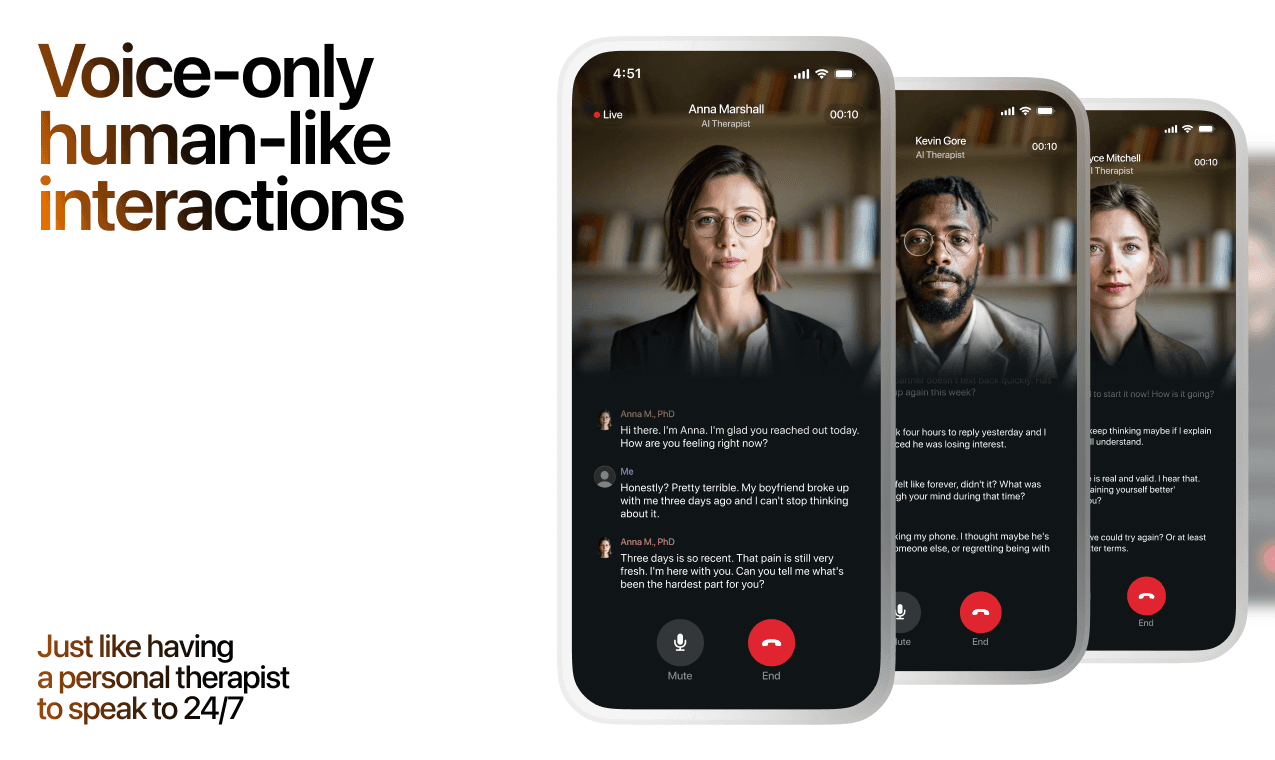
Here's what happens in a typical Lovon session:
You share what's on your mind
There's no script, no intake form, no waiting room. You speak or type whatever you're feeling — in your own words, at your own pace.
Lovon validates and explores
Using frameworks from CBT (Cognitive Behavioral Therapy) and motivational interviewing, Lovon acknowledges your feelings first, then gently helps you explore them. No dismissive "just move on" advice.
You build coping skills together
Lovon doesn't just listen — it actively works with you on evidence-based techniques: thought reframing, urge surfing, behavioral experiments, and more.
What a Session with Lovon Looks Like
When to Seek Professional Help
AI support is a valuable tool, but it's not a replacement for professional care. Please consider reaching out to a licensed therapist if you experience any of the following:
- Persistent thoughts of self-harm or suicide
- Inability to perform daily activities (work, eating, sleeping) for more than 2 weeks
- Turning to alcohol or substances to cope
- Intense anger or desire to harm your ex-partner
- Complete emotional numbness that doesn't improve over time
Crisis Resources (US): If you're in immediate danger, call 988 (Suicide & Crisis Lifeline) or text HOME to 741741 (Crisis Text Line). Available 24/7, free, and confidential.
Outside the US? Find a crisis line in your country
Ready to Start?
Your healing journey can begin right now
A 7-day trial. No judgment. Just a safe space to process what you're going through.
Frequently Asked Questions
Is Lovon a replacement for a real therapist?
Is my conversation with Lovon AI private?
How is Lovon different from ChatGPT for emotional support?
Can I use Lovon if I'm already seeing a therapist?
Can I try Lovon before subscribing?
About the Author
The Lovon Editorial Team
Mental Health & Wellness Content Team
The Lovon Editorial Team develops mental health and wellness content designed to make psychological concepts accessible and actionable. Our goal is to bridge the gap between clinical research and everyday life - helping you understand why your mind works the way it does and what you can do about it....
Related articles
- AI Coping Tools for Medical Trauma & PTSD (2026)
AI coping tools for medical trauma PTSD compared: what to look for, which options to buy or skip, and how voice-based AI…
- How much time a day should you spend on self-care?
How much time a day should you spend on self care? There is no fixed daily target. Learn how to choose care that fits…
- AI Coping Tools for Chronic Fatigue & Burnout 2026
AI coping tools for chronic fatigue and burnout in 2026: what to track first, which tools fit low energy days, and where…
- AI Therapy for Social Anxiety 2026: Verdict + Top Picks
AI therapy for social anxiety in 2026: which voice-based tools help, what to avoid, and when to see a licensed therapist…
See also
Quizzes
- Experiential Avoidance Test: Do You Avoid Your Feelings?
See which way you keep feelings out, in 3 minutes.
- Highly Sensitive Person Test: How Much Do You Take In?
See how deeply you process, notice and get overloaded.
Free tools
- What to Say When a Pet Dies
Get a message you can actually send to someone whose dog or cat just died: one that uses the animal's name, treats the…
- What to Say When They Are Struggling
A chat, not a list. Tell the coach who this person is to you, what they are going through, and what you already said…
From the wiki
- Why do I have no friends?
Usually nothing is wrong with you. Adult friendship runs on proximity and repetition, and most people lose both at once…
Disclaimer: This article is for informational purposes only and does not constitute medical advice, diagnosis, or treatment. Always seek the advice of your physician or other qualified health provider with any questions you may have regarding a medical condition. If you are in crisis or think you may have an emergency, call 988 (Suicide & Crisis Lifeline) or go to the nearest emergency room. Outside the US? Find a crisis line in your country.