
How much time a day should you spend on self-care?
How much time a day should you spend on self care? There is no fixed daily target. Learn how to choose care that fits your needs and when to seek support.

Key Takeaways
- How much time a day should you spend on self care? There is no fixed daily minute target in 2026.
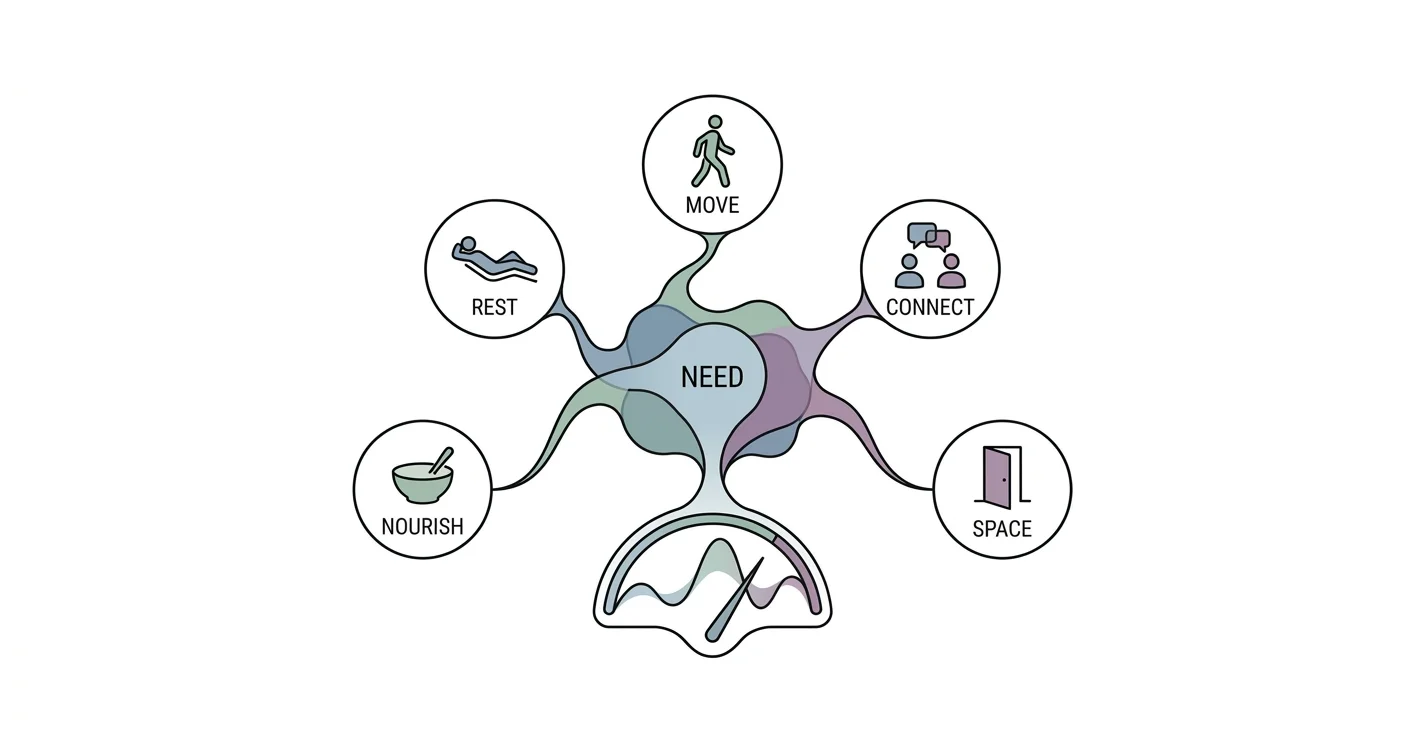
- Choose self-care based on what you need: rest, food, movement, connection, or space to process a feeling.
- Lovon is best for talking through everyday stress; its voice support does not replace a licensed clinician.
- If a routine leaves you more drained, change the routine instead of trying to meet a time goal.
There is no fixed number of minutes you should spend on self-care each day in 2026. Give yourself enough time to meet the need in front of you, whether that means resting, eating, moving, setting a boundary, or asking for support. A daily timer can help you make space for yourself, but it cannot tell you whether that care is enough.
TL;DR
- How much time a day should you spend on self care? There is no fixed daily minute target in 2026.
- Choose self-care based on what you need: rest, food, movement, connection, or space to process a feeling.
- Lovon is best for talking through everyday stress; its voice support does not replace a licensed clinician.
- If a routine leaves you more drained, change the routine instead of trying to meet a time goal.
Why this matters
Self-care can start to feel like another task you have failed to finish. That misses the point. If you need a meal or sleep, spending more time on an elaborate routine will not meet that need.
In 2026, the useful question is not whether you have reached a daily quota. It is whether what you are doing helps you care for yourself in your actual circumstances. If stress is the immediate problem, coping tools for stress can give you a more specific place to start than a timer.
How much time a day should you spend on self-care?
Spend the time needed to respond to a real need, not to satisfy a preset number. Self-care includes everyday basics as well as intentional breaks. It also changes from day to day: a quiet moment can help when you feel overwhelmed, while a longer conversation can make more sense when something has been weighing on you.
Start by asking what is missing. Then choose an action that addresses it directly. You can use this table to separate a need from the activity you might choose:
| What you notice | A self-care response | What it cannot do alone |
|---|---|---|
| Your body feels tense | Settle your body with a pause or gentle movement | Resolve the situation causing the stress |
| You cannot name what is bothering you | Name a feeling by writing or talking it through | Diagnose a mental health condition |
| Other people keep taking your time | Protect your time by declining a request | Remove every demand on your schedule |
| You feel isolated or unable to cope | Ask for help from someone you trust or a professional | Guarantee an immediate solution |
There is no winning row. Choose the response that fits, and reassess afterward. If a break helps you return to what matters, it served a purpose. If you still need food, rest, safety, or human support, give that need attention instead of repeating the same exercise.
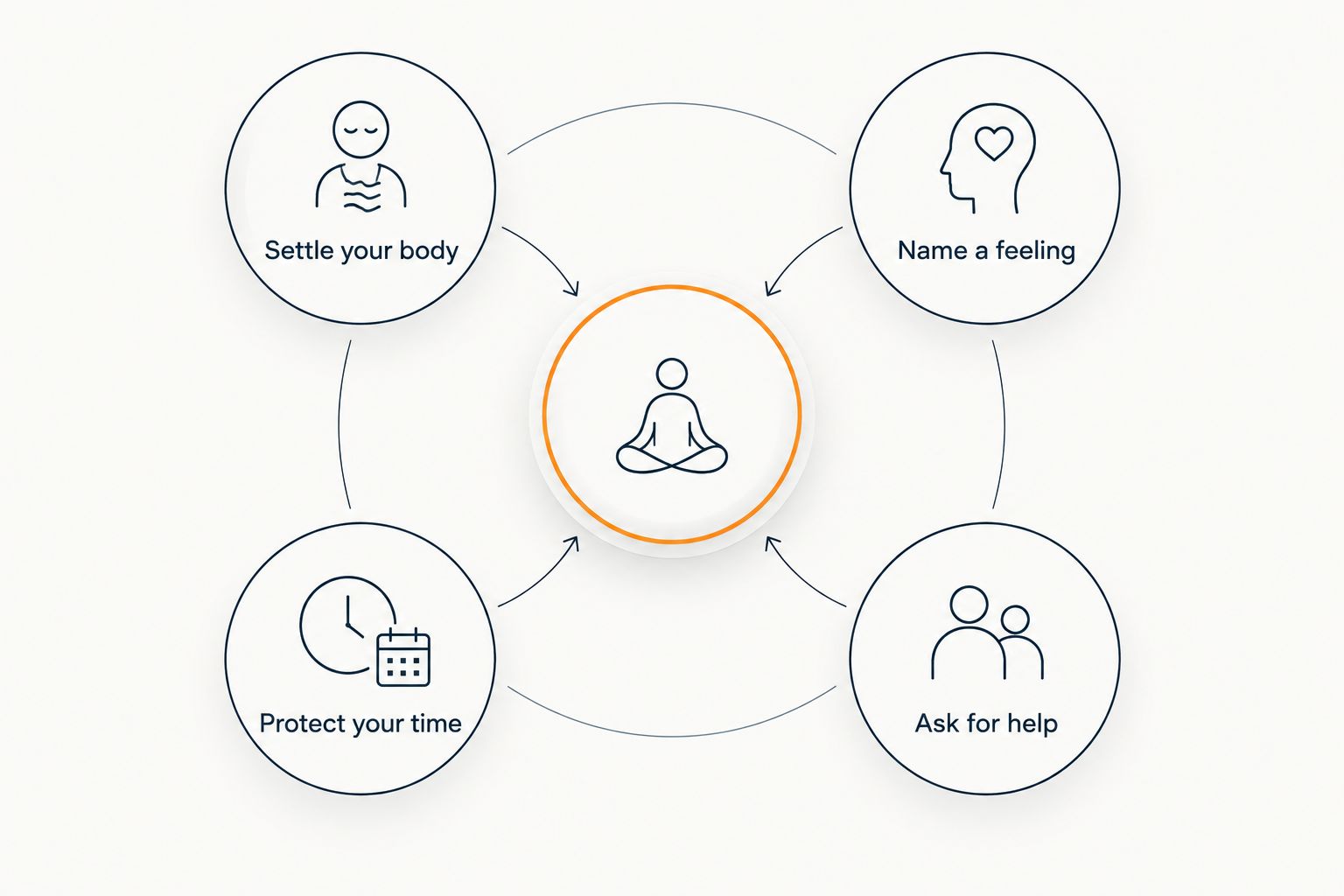 Four self-care responses: settle your body, name a feeling, protect your time, and ask for help
Pick the response that meets the need you notice, rather than following a fixed routine.
Try a need-first check instead of a timer
Pause and describe what is happening without judging it. Are you hungry, tired, overstimulated, lonely, or worried about a conversation? A specific answer gives you something to act on. Feeling bad is real, but it does not always point to the same kind of care.
Next, choose the smallest useful action that fits your situation. You might step away from a noisy room, eat something, tell a friend that you need to talk, or put off a non-urgent request. The action does not need to look impressive. It needs to address what you identified.
Afterward, check whether anything changed. You might feel calmer, more able to focus, or simply clearer about what you need next. You might also feel no better. That is information, not proof that you did self-care incorrectly; try a different response or get support from another person.
Make room for care without turning it into a rule
A reminder on your calendar can protect time that otherwise disappears. Use it as an invitation to check in, not as a demand to complete the same activity every day. Some days you will want quiet. Other days you will need practical help or a conversation.
If scheduling itself adds pressure, attach a check-in to something you already do. Ask how you feel when you finish work, get home, or prepare for bed. The moment matters less than the question: what would help right now? You do not owe the same answer each time.
This approach also keeps self-care from becoming avoidance. If a difficult email is causing stress, a pause can help you approach it; endless pauses will not send it. Give yourself permission to rest, then decide whether the next kind step is to handle the task, ask for help, or set a limit.
Does a longer self-care routine help more?
No. More time does not automatically mean better care. An activity is useful when it meets the need you have identified and fits alongside your other responsibilities. Extending it just to reach a target can leave you with less time for sleep, relationships, or the problem you meant to address.
Think about the difference between a pause and a repair. A pause gives you space when emotions feel intense. A repair might mean having a hard conversation, changing a commitment, or getting professional help. Both can be self-care, but one cannot always stand in for the other.
It is also fine to enjoy an activity without making it therapeutic. A hobby can be pleasant simply because you like it. You do not have to measure its effect on your mood or justify the time you spend on it. When self-care becomes another performance to track, step back and ask whether the tracking is helping.
Why self-care time varies
A fixed daily recommendation overlooks the reasons you need care in the first place. These factors change what makes sense on a given day:
- Your immediate need. Hunger calls for food; an unresolved worry might call for a conversation. They do not require the same response or the same amount of time.
- Your available energy. When you are worn out, a complicated routine can create more work. A simpler choice can be easier to follow through on.
- Your responsibilities. Work, caregiving, and other commitments affect when you can pause. Needing to work around them does not mean your care matters less.
- The source of your stress. A brief break can help you settle. Ongoing demands may also require a boundary, practical change, or outside support.
- The kind of support you need. Time alone can give you space to think, while time with someone else can help you feel heard. Neither is the right choice for every situation.
In 2026, treat these as questions to revisit, not boxes to complete. Your needs can change even when your schedule does not. If you keep choosing an activity that leaves you depleted, change the activity before adding more time to it.
What if you only have a small window for self-care?
Use the window for one thing you actually need. Drink water if you are thirsty, take a break from a stressful exchange, or name the feeling you have been pushing aside. A short pause is not a failure because it is short.
At the same time, do not expect a small window to solve a larger problem. If you are regularly missing sleep, struggling with daily tasks, or carrying stress you cannot manage alone, the answer is not simply to become more efficient at self-care. Look for a way to change the demand or bring in support.
If talking helps you sort out a feeling, Lovon is best for people who want to talk through everyday stress in their own words, not for emergencies or licensed clinical care. The Lovon voice support app offers on-demand conversations and coping tools. Lovon is not a licensed clinician and does not replace one.
What if self-care starts to feel like another obligation?
Drop the checklist and return to the need. If you planned to journal but would rather sleep, rest is a valid choice. If you keep taking quiet time but feel lonely, reaching out may fit better than another session alone.
Pay attention to language that makes care feel conditional: you must earn a break, complete a routine perfectly, or feel calm afterward. You do not have to prove that a choice worked to deserve care. Ask whether the routine gives you room to respond to yourself, or whether it makes you feel watched and graded.
You can also separate maintenance from pleasure. Eating, resting, and asking for help are not rewards for finishing your work. Enjoyment matters too, but you do not have to turn every enjoyable activity into a treatment plan. Leave room for both without insisting that either follow a clock.
When should you seek support beyond a self-care routine?
Reach out for professional help if distress keeps interfering with daily life, feels hard to manage, or persists despite the steps you can take on your own. A self-care habit can sit alongside care from a licensed clinician; it does not have to replace it. You do not need to find the perfect routine before asking for help.
If you are in immediate danger or thinking about harming yourself, seek urgent help rather than relying on an app or a self-care exercise. In the United States, you can call or text 988 for the Suicide & Crisis Lifeline. If there is an immediate emergency, contact emergency services.
FAQ
How much time a day should you spend on self care in 2026?
There is no fixed daily minute target for self-care in 2026. Choose an action that addresses what you need, then check whether you need a different kind of support.
Is a short self-care break enough?
A short break can be enough for an immediate need, such as stepping away from an overwhelming moment. It will not necessarily resolve ongoing stress or replace sleep, practical changes, or professional care.
Do I need to practice self-care at the same time every day?
No. A regular reminder can help you make space to check in, but your needs can change from day to day. Change the activity when the usual one no longer fits.
Does resting count as self-care?
Yes, resting counts when you need rest. You do not have to pair it with a productivity goal or another activity to make it worthwhile.
What should I do when I do not know what self-care I need?
Start by checking your basic needs and naming what feels hardest right now. If you still cannot tell, talking it through with someone you trust can help you choose a next step.
Can a self-care app replace therapy?
No. An app can offer a place to reflect or practice coping tools, but it does not replace care from a licensed clinician. Seek professional support when distress persists or interferes with daily life.
Should I spend more time on self-care when I feel stressed?
Spend enough time to respond to the stress, but do not assume a longer routine is the answer. If the source of stress continues, you may also need a boundary, practical help, or professional support.
One last thing
The most useful self-care choice might be the one that ends a routine early. In 2026, if you are exhausted, you do not need to finish a planned exercise before you can rest. If you are lonely, you do not need to sit alone until a timer runs out before contacting someone.
Measure self-care by whether it responds to your need, not by the minutes you can report. Check in, make one useful choice, and stay open to changing it. That is a more helpful daily practice than trying to reach a number that does not fit everyone.
Related guides
How AI Support Helps You Heal
AI emotional support isn't about replacing human connection — it's about filling the gaps. The moments when you need to talk at 2 AM, when you don't want to burden your friends again, or when you simply need someone to listen without judgment.
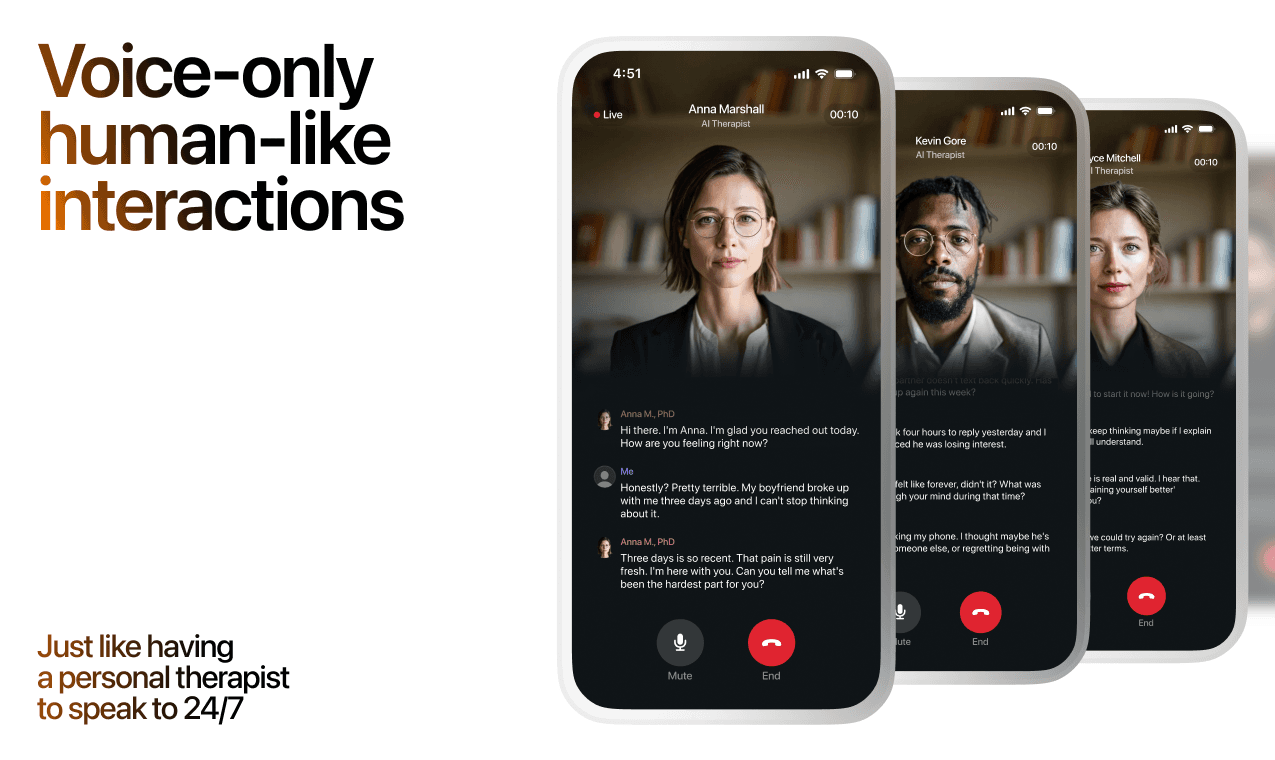
Here's what happens in a typical Lovon session:
You share what's on your mind
There's no script, no intake form, no waiting room. You speak or type whatever you're feeling — in your own words, at your own pace.
Lovon validates and explores
Using frameworks from CBT (Cognitive Behavioral Therapy) and motivational interviewing, Lovon acknowledges your feelings first, then gently helps you explore them. No dismissive "just move on" advice.
You build coping skills together
Lovon doesn't just listen — it actively works with you on evidence-based techniques: thought reframing, urge surfing, behavioral experiments, and more.
What a Session with Lovon Looks Like
When to Seek Professional Help
AI support is a valuable tool, but it's not a replacement for professional care. Please consider reaching out to a licensed therapist if you experience any of the following:
- Persistent thoughts of self-harm or suicide
- Inability to perform daily activities (work, eating, sleeping) for more than 2 weeks
- Turning to alcohol or substances to cope
- Intense anger or desire to harm your ex-partner
- Complete emotional numbness that doesn't improve over time
Crisis Resources (US): If you're in immediate danger, call 988 (Suicide & Crisis Lifeline) or text HOME to 741741 (Crisis Text Line). Available 24/7, free, and confidential.
Outside the US? Find a crisis line in your country
Ready to Start?
Your healing journey can begin right now
A 7-day trial. No judgment. Just a safe space to process what you're going through.
Frequently Asked Questions
Is Lovon a replacement for a real therapist?
Is my conversation with Lovon AI private?
How is Lovon different from ChatGPT for emotional support?
Can I use Lovon if I'm already seeing a therapist?
Can I try Lovon before subscribing?
About the Author
The Lovon Editorial Team
Mental Health & Wellness Content Team
The Lovon Editorial Team develops mental health and wellness content designed to make psychological concepts accessible and actionable. Our goal is to bridge the gap between clinical research and everyday life - helping you understand why your mind works the way it does and what you can do about it....
Related articles
- Lovon vs BetterHelp 2026: Which Fits Your Needs
Lovon vs BetterHelp in 2026: Lovon wins on instant AI voice support, BetterHelp wins on licensed clinical care. Compare…
- Best AI Therapy App for Eating Disorder Recovery 2026
Lovon ranks the best AI therapy apps for eating disorder recovery in 2026, comparing voice support, trackers, and…
- How long does an anxiety attack usually last?
How long does an anxiety attack last? There is no set time. Learn why the 5 to 20 minutes cited for most panic attacks…
- Loneliness vs Being Alone: Tell the Difference (2026)
Loneliness vs being alone explained with a step-by-step self-check for 2026. Learn the real difference, spot chronic…
See also
Quizzes
- Self Esteem Test: What Is Your Worth Resting On?
See what your sense of worth is resting on.
- Am I Codependent? 12-Question Self-Check
See how much of you is left over, in 2 minutes.
Free tools
- Write a Condolence Message for This Person
Get one condolence message written for your situation instead of a list of a hundred to choose from. Tell it who died…
- What to Say When a Pet Dies
Get a message you can actually send to someone whose dog or cat just died: one that uses the animal's name, treats the…
From the wiki
- Why do I keep dreaming about my ex?
Recurring dreams about an ex usually mean your brain is still consolidating a relationship that took up years of memory…
Disclaimer: This article is for informational purposes only and does not constitute medical advice, diagnosis, or treatment. Always seek the advice of your physician or other qualified health provider with any questions you may have regarding a medical condition. If you are in crisis or think you may have an emergency, call 988 (Suicide & Crisis Lifeline) or go to the nearest emergency room. Outside the US? Find a crisis line in your country.