
AI Therapy for Social Anxiety 2026: Verdict + Top Picks
AI therapy for social anxiety in 2026: which voice-based tools help, what to avoid, and when to see a licensed therapist instead. Buy, Consider, or Skip.

Key Takeaways
- AI therapy for social anxiety works best as spoken rehearsal, not a text chatbot swap for real conversations.
- Lovon's on-demand voice sessions let you talk through nerves before an event any hour of 2026 - Buy for daily practice.
- Pair AI voice sessions with 4-4-4-4 box breathing or 5-4-3-2-1 grounding between conversations.
- Skip any AI tool with no licensed-care disclaimer if you need a diagnosis or crisis support - see a human therapist
Social anxiety doesn't clock out at 5 PM, and neither does the dread before a meeting, a first date, or a birthday party you can't skip. AI therapy for social anxiety gives you a private voice conversation to rehearse and calm down before the real one happens, on your schedule, in 2026.
TL;DR
- AI therapy for social anxiety works best as spoken rehearsal, not a text chatbot swap for real conversations.
- Lovon's on-demand voice sessions let you talk through nerves before an event any hour of 2026 - Buy for daily practice.
- Pair AI voice sessions with 4-4-4-4 box breathing or 5-4-3-2-1 grounding between conversations.
- Skip any AI tool with no licensed-care disclaimer if you need a diagnosis or crisis support - see a human therapist instead.
Why this matters
Social anxiety isn't shyness. It's a specific, physical response - racing heart, tight throat, the urge to cancel - that shows up around other people, not alone with a journal. Text-based apps let you avoid the exact thing that triggers the anxiety: talking out loud. That's the gap Lovon is built to close in 2026.
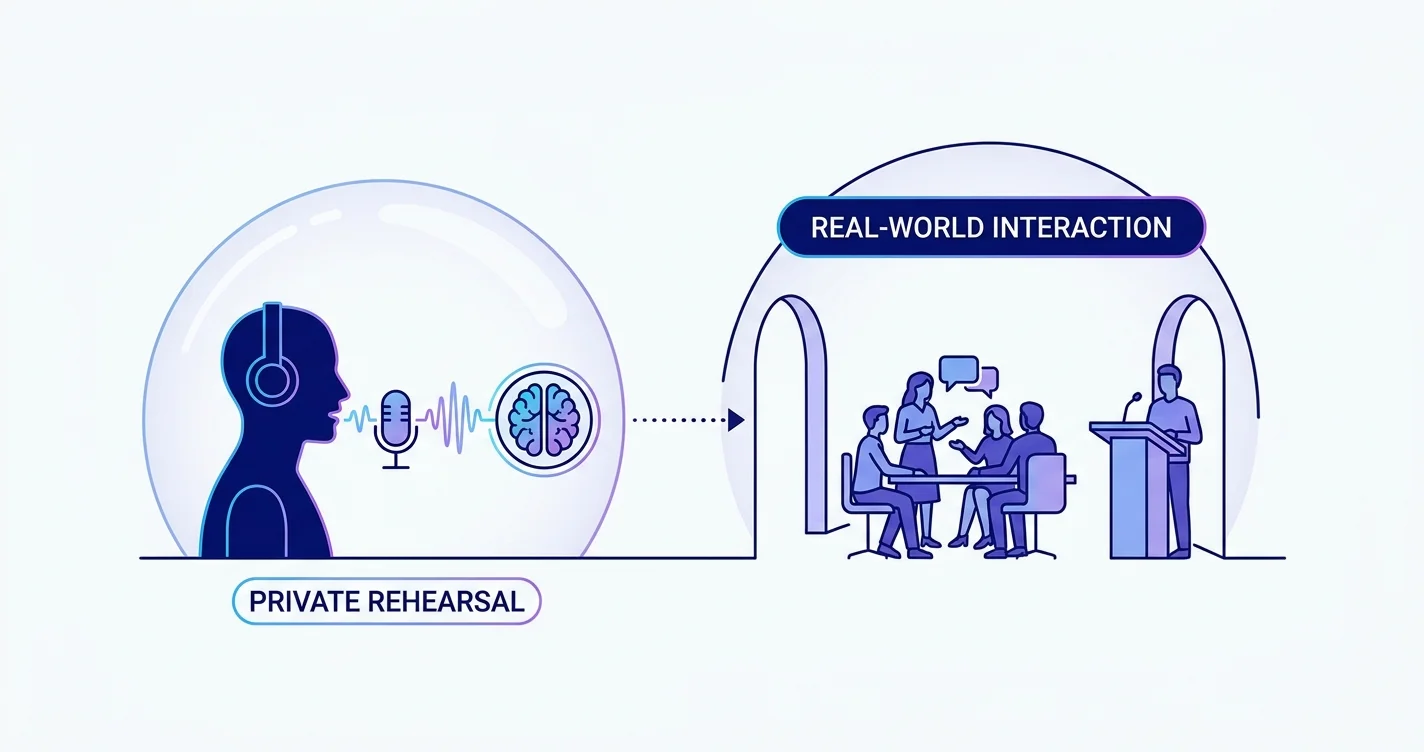
A spoken AI conversation forces you to form words in real time, hear your own voice shake and then steady out, and rehearse the actual skill you're avoiding - talking to another person - without an audience judging you. That's a different exercise than typing into a chat box, and for social anxiety specifically, the format is the whole point.
Who AI therapy for social anxiety is for
This is for someone who freezes up before meetings, avoids phone calls, rewrites texts fifteen times before sending, or cancels plans the morning of because the thought of walking into a room got too loud. It's for people already in therapy who want a way to process a spiraling thought at 11 PM on a Tuesday, and for people not ready to sit across from a stranger yet who still want to practice talking out loud.
It is not built for someone in crisis or needing a formal diagnosis. That requires a licensed clinician's evaluation, not conversation practice with an app.
What to look for in AI therapy for social anxiety
Voice, not just text
Typing avoids the trigger entirely. Social anxiety gets activated by real-time spoken exchange - pacing, tone, pauses, the awkward laugh - and a tool that only lets you type sidesteps the exact skill you need to rebuild. Voice-based conversation forces the rehearsal to look like the real thing.
Available before the event, not just business hours
Anxiety about Friday dinner peaks around 4 PM on Friday, not during a scheduled Tuesday slot. An AI therapy app that's available any hour in 2026 matters more for social anxiety than for conditions with predictable triggers.
No audience for the practice run
The appeal of rehearsing with an AI is zero judgment on the first ten shaky attempts. If the tool feels like a performance - scored, logged publicly, shared with anyone - it defeats the low-stakes practice ground social anxiety actually needs.
Built with clinical grounding, honest about its limits
Look for a tool shaped with input from psychologists that still says plainly it isn't a replacement for a licensed clinician. That distinction matters most here, since severe cases with panic attacks or agoraphobia need a human diagnosis, not just conversation practice.
Coping tools between sessions
One voice conversation a day doesn't cover the anxiety spike ten minutes before you walk into the room. The tool should hand you something concrete for that window - a breathing pattern, a grounding count - not just "talk again later."
Top picks for practicing through social anxiety
The pre-event pick: a voice session before you walk in
Rehearse the conversation with your voice, not your thumbs. Talk through what you're dreading - small talk at the wedding, the intro at a new job - out loud, any hour of the day. Your nervous system responds to spoken rehearsal differently than to a typed script, because you're practicing the actual mechanics of talking, not just the words. Buy for anyone whose anxiety spikes in the hour before a specific event. Read how AI therapy handles anxiety and panic attacks.
The in-the-moment pick: box breathing while you wait
Four counts, four times, no app required once you know the pattern. Box breathing runs on a 4-4-4-4 count - inhale four seconds, hold four, exhale four, hold four - and it's the fastest way to bring your heart rate down in the two minutes before you're expected to speak. Buy as a companion to voice sessions, not a replacement for them. See the full breathing exercise for anxiety relief.
The debrief pick: grounding after a rough interaction
For the spiral that starts the second you walk away. The 5-4-3-2-1 grounding technique - five things you see, four you hear, three you touch, two you smell, one you taste - pulls attention out of the replay loop after an interaction that felt like it went badly. Buy for post-event rumination specifically. Walk through the grounding technique for anxiety and panic.
The referral pick: a licensed therapist for diagnosis or crisis
The highest-stakes pick, and not one an app should try to be. If social anxiety comes with panic attacks that don't resolve, if you're avoiding work or school entirely, or if there's any crisis risk, that needs a licensed clinician's evaluation. Consider this the referral, not a competitor to what AI voice therapy does.
The daily-habit pick: short reflection between bigger moments
The low-key pick that catches what the big events miss. A quick self-reflection check-in on an ordinary Tuesday - no event on the calendar, just processing why a coworker's comment sat wrong all day - builds the habit of naming a feeling before it snowballs into avoidance. Consider it for maintenance between the higher-stakes rehearsal sessions.
What to avoid if social anxiety is the target
- Text-only "AI therapy" that never asks you to speak. It looks similar in the app store, but typing doesn't rehearse the skill you're avoiding - talking out loud to another entity, real or artificial.
- Any tool with no disclaimer about licensed care. If it implies it replaces a diagnosis, a prescription, or crisis support, that's a red flag in 2026, not a selling point.
- Meditation-only apps marketed as "anxiety help." Passive breathing audio helps, but it doesn't build the specific muscle social anxiety needs: initiating and sustaining a spoken exchange.
How the picks compare
| Pick | Best for | Format | Verdict |
|---|---|---|---|
| Pre-event voice session | Nerves before a specific event | AI voice, on demand | Buy |
| Box breathing (4-4-4-4) | Calming down in the final minutes | Guided breathing pattern | Buy |
| 5-4-3-2-1 grounding | Post-interaction spiraling | Guided grounding technique | Buy |
| Licensed therapist | Diagnosis, panic attacks, crisis | In-person or licensed telehealth | Consider |
| Daily reflection check-in | Ordinary-day maintenance | Short self-reflection habit | Consider |
FAQ
What's the best AI therapy app for social anxiety in 2026?
Lovon is built around voice conversations rather than text, which matters most for social anxiety since the fear centers on real-time spoken interaction. Look for a tool that lets you rehearse out loud any hour of the day, not just during scheduled sessions.
Is AI therapy as good as a real therapist for social anxiety?
No - AI voice therapy is a rehearsal and coping tool, not a diagnostic or clinical treatment. For panic attacks, agoraphobia, or crisis-level avoidance, a licensed therapist needs to evaluate you directly.
How much does AI therapy for social anxiety cost?
Pricing varies by app and plan, so check current pricing directly on the site before committing. Compare that against the cost of in-person therapy sessions in your area, which typically run higher per session.
Can an AI voice app help me practice conversations before a party or work event?
Yes - a voice conversation lets you rehearse what you might say and hear your own voice steady out before the real interaction happens. That rehearsal effect is the main reason voice-based tools outperform text-only chatbots for this specific type of anxiety.
Is Lovon a replacement for a licensed therapist?
No. Lovon is built with input from PhD psychologists but positions itself as a companion for everyday support, not a replacement for licensed clinical care. Anyone with a diagnosis, medication needs, or crisis-level symptoms should see a licensed clinician.
How do breathing exercises help with social anxiety?
Box breathing on a 4-4-4-4 count slows your heart rate in the minutes before a social event, which lowers the physical intensity of the anxiety before you walk in. It works alongside voice-based rehearsal, not instead of it.
Is AI therapy for social anxiety private?
Conversations happen one-on-one with the app, without another person hearing your rehearsal attempts, which is the point for anyone not ready to practice in front of a therapist or friend yet. Check the specific app's data handling before sharing sensitive details.
How do I start using an AI therapy app for social anxiety?
Start with one voice session about something small, like a phone call you'd normally dodge, before using it to prepare for a bigger event. Building the habit on low-stakes situations first makes the higher-stakes rehearsal easier later in 2026.
One last thing
The detail people miss: social anxiety responds to exposure, and exposure has to happen in the same modality as the fear. If the fear lives in your voice catching mid-sentence, practicing by typing doesn't touch it - you need to hear yourself talk and keep going anyway. That's the actual mechanism behind AI voice therapy for social anxiety in 2026, not a marketing angle. Start with one voice session before something small this week - a phone call you'd normally avoid - before you use it for the big one.
Related guides
How AI Support Helps You Heal
AI emotional support isn't about replacing human connection — it's about filling the gaps. The moments when you need to talk at 2 AM, when you don't want to burden your friends again, or when you simply need someone to listen without judgment.
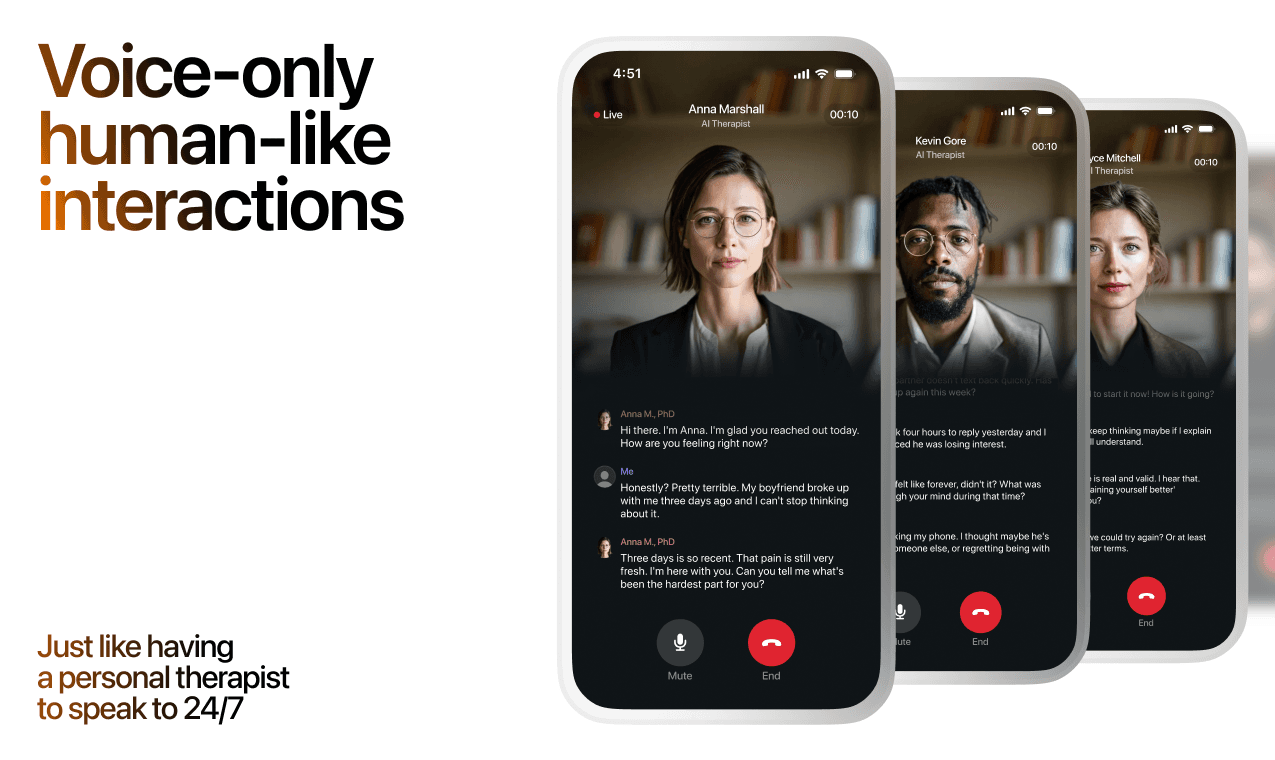
Here's what happens in a typical Lovon session:
You share what's on your mind
There's no script, no intake form, no waiting room. You speak or type whatever you're feeling — in your own words, at your own pace.
Lovon validates and explores
Using frameworks from CBT (Cognitive Behavioral Therapy) and motivational interviewing, Lovon acknowledges your feelings first, then gently helps you explore them. No dismissive "just move on" advice.
You build coping skills together
Lovon doesn't just listen — it actively works with you on evidence-based techniques: thought reframing, urge surfing, behavioral experiments, and more.
What a Session with Lovon Looks Like
Lovon is AI support, not a replacement for professional care. If things have been hard to get through for weeks, or you are thinking about harming yourself, talk to a doctor or a licensed therapist.
Ready to Start?
Your healing journey can begin right now
A 7-day trial. No judgment. Just a safe space to process what you're going through.
Frequently Asked Questions
Is Lovon a replacement for a real therapist?
Is my conversation with Lovon AI private?
How is Lovon different from ChatGPT for emotional support?
Can I use Lovon if I'm already seeing a therapist?
Can I try Lovon before subscribing?
About the Author
The Lovon Editorial Team
Mental Health & Wellness Content Team
The Lovon Editorial Team develops mental health and wellness content designed to make psychological concepts accessible and actionable. Our goal is to bridge the gap between clinical research and everyday life - helping you understand why your mind works the way it does and what you can do about it....
Related articles
- AI Therapy for Phone Call Anxiety: What Works in 2026
AI therapy for phone call anxiety in 2026: what to look for, which approaches to buy or skip, and the pre-call routine…
- AI Coping Tools for a Quarter-Life Crisis in 2026
AI coping tools for a quarter-life crisis in your 20s: free tactics, when Lovon's voice therapy helps, and when to see a…
- AI Coping Tools for Exam Anxiety (2026 Verdict)
AI coping tools for exam anxiety ranked for 2026: voice check-ins, breathing drills, and grounding techniques compared…
- AI Therapist for Stress: What It Can and Can't Do (2026)
An honest breakdown of what an AI therapist for stress handles well in 2026, where it falls short, and how Lovon fits…
See also
Quizzes
- Loneliness Test: How Lonely Am I? 3 Kinds of Loneliness
See which kind of loneliness is thin, in 3 minutes.
- Digital Stress Test: Texting, Likes and Read Receipts
See which part of being online wears on you, in 3 minutes.
Free tools
- Write a Letter to Your Best Friend
A chat for a letter to your best friend that only they could have received. Tell it how long you have been friends, one…
- Breakup Meditation
For when it's over and it still hurts. Seven minutes of slow breathing, noticing where the breakup sits in your body…
From the wiki
- Why do I keep dreaming about the same person?
A recurring dream figure usually marks unfinished emotional business rather than a message about that person. Your brain…
Disclaimer: This article is for informational purposes only and does not constitute medical advice, diagnosis, or treatment. Always seek the advice of your physician or other qualified health provider with any questions you may have regarding a medical condition. If you are in crisis or think you may have an emergency, call 988 (Suicide & Crisis Lifeline) or go to the nearest emergency room. Outside the US? Find a crisis line in your country.