
AI Coping Tools for Chronic Fatigue & Burnout 2026
AI coping tools for chronic fatigue and burnout in 2026: what to track first, which tools fit low energy days, and where Lovon's AI voice therapy fits.

Key Takeaways
- AI coping tools for chronic fatigue and burnout work best as short daily check-ins, not one big fix.
- Lovon's AI voice therapy gives exhausted people an on-demand space to talk without booking anything.
- Burnout and chronic fatigue overlap but are not identical, and treating them the same slows recovery in 2026.
- Free pacing and energy tracking come first; AI voice tools speed up the noticing and naming part.
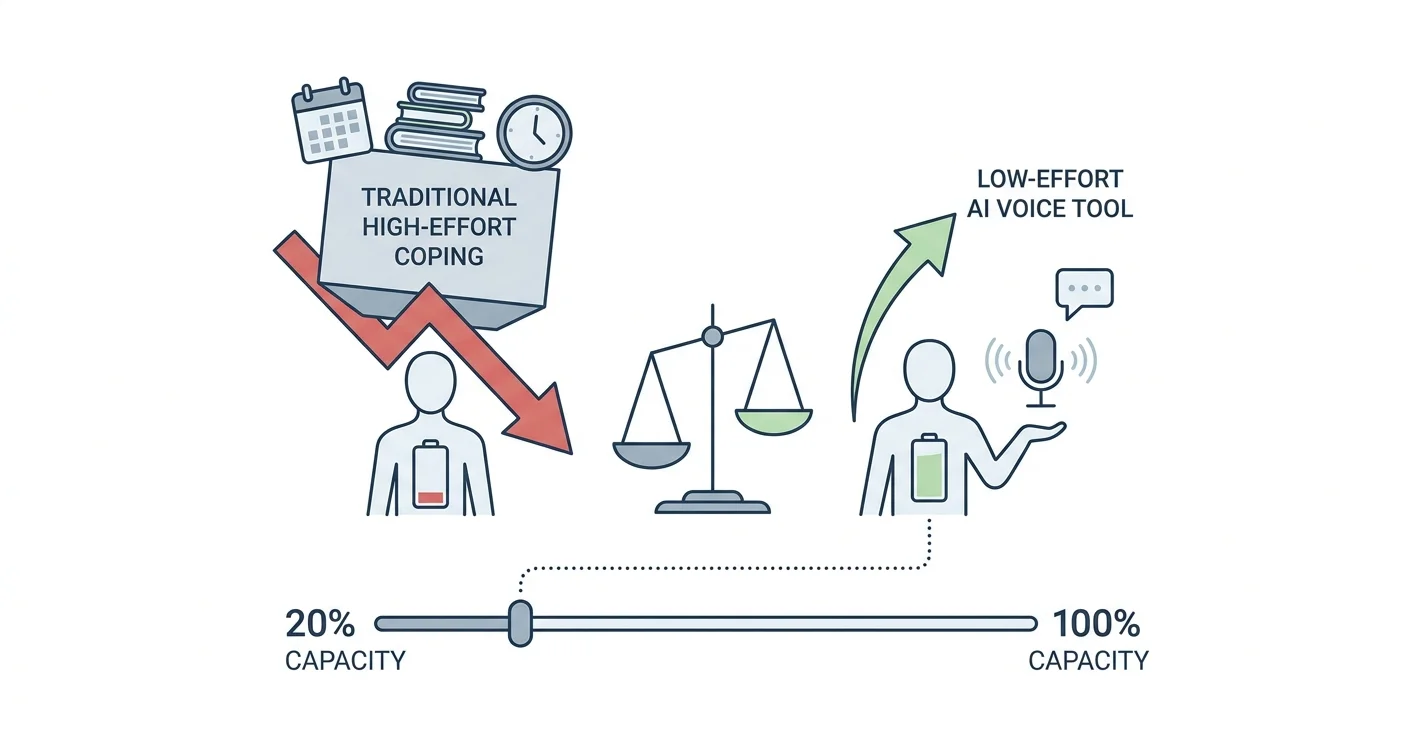
Chronic fatigue and burnout need a different first move than most advice gives you: rest before strategy, and coping tools that do not ask for more energy than you have. AI coping tools for chronic fatigue and burnout work when they meet you at 20% capacity, not when they demand a 45-minute self-improvement routine. This guide is built for people running on empty, where fatigue has become the baseline rather than a bad week.
TL;DR
- AI coping tools for chronic fatigue and burnout work best as short daily check-ins, not one big fix.
- Lovon's AI voice support gives exhausted people an on-demand space to talk without booking anything.
- Burnout and chronic fatigue overlap but are not identical, and treating them the same slows recovery in 2026.
- Free pacing and energy tracking come first; AI voice tools speed up the noticing and naming part.
Why AI coping tools matter for chronic fatigue and burnout
People dealing with chronic fatigue do not lack willpower. They lack a system that fits low-energy days. Burnout adds numbness and cynicism on top of the exhaustion, which makes it easy to misread as depression or laziness. If you cannot tell which one you are in, the burnout vs. depression guide breaks down the difference in plain terms before you pick a coping strategy.
The reason AI voice tools fit this segment specifically: talking out loud takes less effort than typing a journal entry, and a voice conversation can happen from bed, from a parked car, or during a five-minute break. Those are exactly the windows chronic fatigue leaves you. Lovon's AI voice support exists for that gap, the moments when you are too tired to schedule support but still need to say something out loud.
In 2026 the practical question is not whether AI coping tools help, but where they sit. They sit in the daily maintenance layer. Diagnosis, medication, and severe-symptom care stay with licensed professionals.
Name what is actually driving your exhaustion
Before any coping tool works, you need to know whether you are dealing with burnout, a chronic fatigue condition, poor sleep, or depression wearing a fatigue mask. Guessing wrong wastes the little energy you have.
- Check whether rest actually restores you, because if a full weekend off does not touch it, this is not simple tiredness
- Notice if cynicism or detachment from work and people showed up alongside the fatigue, which is the burnout signature
- Rule out sleep first: why sleep does not fix your exhaustion covers the mental health causes extra sleep alone will not solve
- Track whether the fatigue is physical (heavy limbs, brain fog) or emotional (flatness, dread), because they call for different tools
Track your energy pattern before you try to fix it
One week of honest tracking beats a month of guessing. This step is free and takes under two minutes a day.
- Rate energy on a 1-10 scale at three fixed times daily: morning, midday, evening
- Note what drained you fastest, whether meetings, caregiving, commuting, or decision-making
- Flag the one task each day that felt disproportionately heavy
- Mark days you skipped movement or meals entirely
- Keep entries to one line, because a tracking system with friction gets abandoned by day 3
Use a coping tool that fits burnout, not perfectionism
Most burnout advice assumes you have energy to build a new habit. You do not, which is why this step is about tools with near-zero setup cost.
- Try box breathing for 60 seconds before you stand up from your desk
- Use a two-minute voice check-in instead of a journal page when typing feels like too much
- This is where an AI voice companion earns its place: Lovon lets you talk through the day out loud, without writing, scheduling, or waiting for a callback
- Set a reminder for one micro-break every 90 minutes instead of pushing through until collapse
Rebuild boundaries around your energy budget
Burnout recovery stalls when the same demands stay in place. Boundaries are not a personality overhaul. They are arithmetic.
- List your three biggest energy drains and cut, delegate, or shorten one this week
- Say no to one optional commitment without an apology attached
- Protect one block of unscheduled time daily, even 15 minutes
- Tell one person what you are not available for right now, because vagueness invites more requests
Talk it through when the day is heaviest, not after you collapse
Most people wait until they are fully depleted to process anything, which means the processing never happens. A small daily habit changes that.
- Use a five-minute voice session at the point in your day when fatigue peaks, not at midnight
- Say the sentence you are avoiding out loud, which is often some version of not being able to keep this pace
- Lovon's AI voice support is available at 2pm on a Tuesday, not only after hours, which matters because burnout does not wait for evenings
- Look at patterns across a week of sessions instead of judging any single day
Loop in real-world support when tools are not enough
AI coping tools handle daily maintenance. They do not replace a doctor ruling out thyroid issues, anemia, or sleep apnea, and they do not replace a licensed clinician when burnout has tipped into depression.
- Book a physical if fatigue has lasted more than a few weeks with no clear cause
- Bring your energy-tracking notes to that appointment, because concrete patterns speed up the conversation
- Escalate to a licensed therapist if numbness, hopelessness, or detachment from people you love shows up
- Treat AI voice therapy as the between-sessions layer when symptoms are severe, not the whole plan
Comparing coping options for chronic fatigue and burnout
| Option | Best for | Key limitation |
|---|---|---|
| Self-guided pacing and energy tracking | A free first step with no tools required | Needs self-discipline when you have almost no energy to spare |
| Friends, family, or peer support groups | Connection and feeling less alone in it | Rarely available at 2am or mid-workday |
| Licensed therapy or a doctor visit | Diagnosis and treatment of underlying causes | Waitlists and scheduling do not match how burnout hits |
| Lovon AI voice support | Daily on-demand talk-based coping between bigger decisions | Not a licensed clinician, so not built for diagnosis or crisis care |
The straight verdict: Lovon is best for people with chronic fatigue and burnout who need a daily place to talk it out on demand, and it is not a substitute for a doctor or licensed therapist when symptoms are severe.
Common mistakes people with chronic fatigue and burnout make
- Treating rest as a reward instead of a requirement, waiting for collapse instead of pacing daily
- Confusing numbness with calm, because burnout detachment can feel peaceful when it is actually a warning sign
- Adding more self-improvement tasks, a new routine or protocol, none of which lower the actual load
- Skipping the medical check, assuming it is just stress without ruling out sleep, thyroid, or nutrient causes
- Going silent instead of talking it through, since isolating during burnout removes the one thing that actually processes it
Talk through today's exhaustion
Start a voice session with Lovon whenever fatigue peaks, no appointment needed.
FAQ
What are the best AI coping tools for chronic fatigue and burnout in 2026?
The most effective setup in 2026 pairs free daily habits, meaning energy tracking, pacing, and boundary-setting, with an AI voice support app like Lovon for talking through the day when energy is too low to journal or wait for a session.
Is burnout the same as chronic fatigue?
No. Burnout is tied to sustained work or caregiving stress and includes cynicism and detachment, while chronic fatigue conditions involve persistent physical exhaustion that rest does not resolve. Persistent fatigue warrants a medical check.
Can an AI voice therapist help with burnout recovery?
Yes, as a daily coping layer. Lovon gives you a place to process stress and exhaustion between bigger decisions, but it does not replace a licensed clinician for diagnosis or treatment.
How do I know if I have burnout or depression?
Burnout usually eases somewhat with distance from the stressor, while depression persists regardless of rest or environment change. Comparing symptoms side by side helps you pick the right coping strategy before you spend energy on the wrong one.
Does more sleep fix chronic fatigue?
Not always. Chronic fatigue often has causes beyond sleep debt, including stress load, medical conditions, and unprocessed emotional strain, so extra sleep alone frequently does not resolve it.
What is a low-effort coping tool when you are too tired to journal?
A short voice check-in. Talking for two to five minutes into an app like Lovon takes less effort than typing and still gives you the processing benefit that written journaling provides.
When should burnout or chronic fatigue go to a doctor instead of an app?
See a doctor when fatigue lasts more than a few weeks, comes with unexplained physical symptoms, or when detachment turns into hopelessness. AI coping tools support daily maintenance, not diagnosis.
How long does it take for AI coping tools to help with burnout?
Most people notice value from the naming-and-noticing effect within the first week of daily check-ins. Structural relief takes longer because it depends on lowering the actual demands, not only processing them.
One last thing
The fastest sign burnout is easing is not feeling energized. It is noticing you said no to something and felt no guilt afterward. That is the marker worth tracking through 2026, more than energy scores or sleep hours.
Related guides
How AI Support Helps You Heal
AI emotional support isn't about replacing human connection — it's about filling the gaps. The moments when you need to talk at 2 AM, when you don't want to burden your friends again, or when you simply need someone to listen without judgment.
Here's what happens in a typical Lovon session:
You share what's on your mind
There's no script, no intake form, no waiting room. You speak or type whatever you're feeling — in your own words, at your own pace.
Lovon validates and explores
Using frameworks from CBT (Cognitive Behavioral Therapy) and motivational interviewing, Lovon acknowledges your feelings first, then gently helps you explore them. No dismissive "just move on" advice.
You build coping skills together
Lovon doesn't just listen — it actively works with you on evidence-based techniques: thought reframing, urge surfing, behavioral experiments, and more.
What a Session with Lovon Looks Like
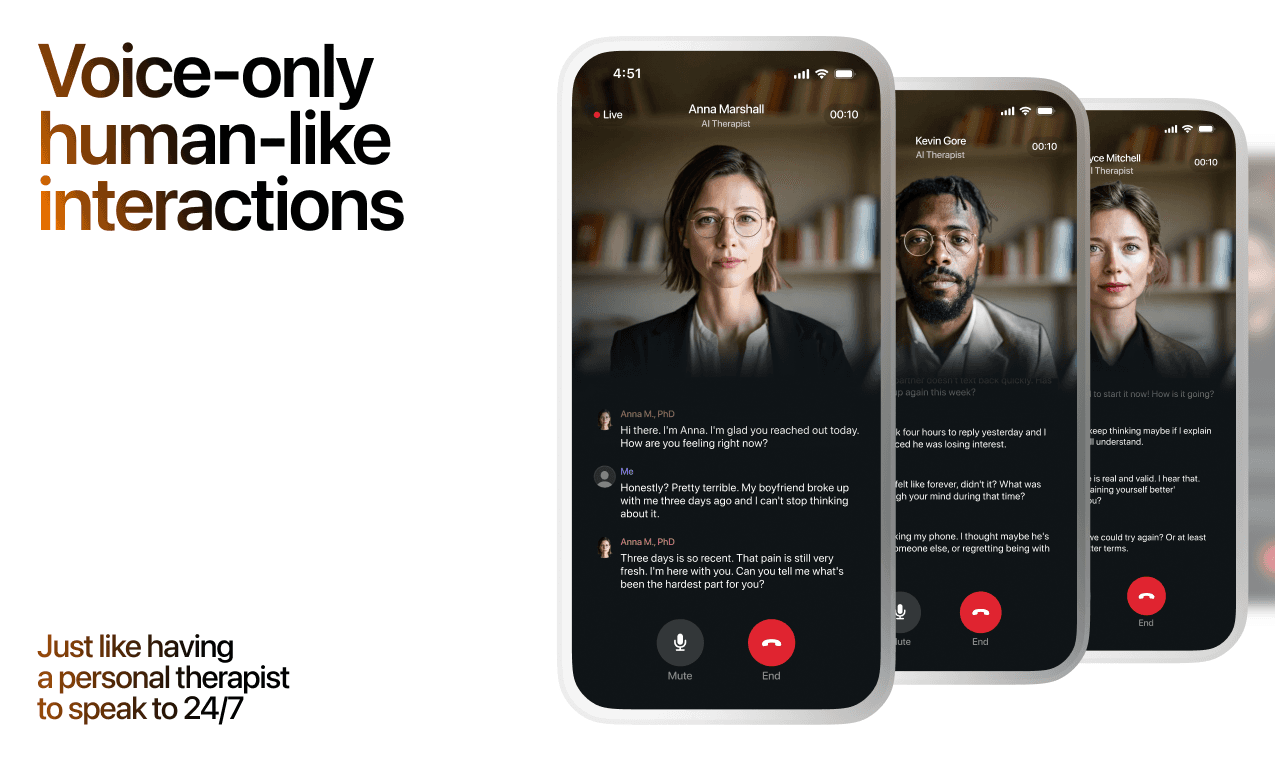
Lovon is AI support, not a replacement for professional care. If things have been hard to get through for weeks, or you are thinking about harming yourself, talk to a doctor or a licensed therapist.
Ready to Start?
Your healing journey can begin right now
A 7-day trial. No judgment. Just a safe space to process what you're going through.
Frequently Asked Questions
Is Lovon a replacement for a real therapist?
Is my conversation with Lovon AI private?
How is Lovon different from ChatGPT for emotional support?
Can I use Lovon if I'm already seeing a therapist?
Can I try Lovon before subscribing?
About the Author

The Lovon Editorial Team
Mental Health & Wellness Content Team
The Lovon Editorial Team develops mental health and wellness content designed to make psychological concepts accessible and actionable. Our goal is to bridge the gap between clinical research and everyday life - helping you understand why your mind works the way it does and what you can do about it....
Related articles
- Best AI App for Anxiety: On-Demand Support in 2026
Looking for an AI app for anxiety? See how Lovon and top alternatives deliver 24/7 coping tools and voice support…
- Best AI Therapy for Depression (2026 Guide)
AI therapy for depression in 2026: Lovon's voice app delivers CBT-based sessions, 24/7 on-demand access, and…
- AI Coping Tools for Seasonal Affective Disorder (2026)
AI coping tools for seasonal affective disorder ranked for 2026: what to use daily, what to skip, and where AI voice…
- How much time a day should you spend on self-care?
How much time a day should you spend on self care? There is no fixed daily target. Learn how to choose care that fits…
See also
Quizzes
- Shame Test: Do You Read Mistakes as Verdicts?
See which exit your shame takes, in 3 minutes.
- Empath Test: Do Other People's Moods Become Yours?
See how much of other people's moods you take on.
Free tools
- Write a Condolence Message for This Person
Get one condolence message written for your situation instead of a list of a hundred to choose from. Tell it who died…
- What to Say When a Pet Dies
Get a message you can actually send to someone whose dog or cat just died: one that uses the animal's name, treats the…
From the wiki
- What to do if you have no friends?
Pick one activity that repeats weekly with the same people, and go for six to eight weeks straight. Repetition, not…
Disclaimer: This article is for informational purposes only and does not constitute medical advice, diagnosis, or treatment. Always seek the advice of your physician or other qualified health provider with any questions you may have regarding a medical condition. If you are in crisis or think you may have an emergency, call 988 (Suicide & Crisis Lifeline) or go to the nearest emergency room. Outside the US? Find a crisis line in your country.