
AI Coping Tools for Medical Trauma & PTSD (2026)
AI coping tools for medical trauma PTSD compared: what to look for, which options to buy or skip, and how voice-based AI support fits in 2026.


Key Takeaways
- Lovon's voice sessions work as a coping tool for medical trauma and PTSD between appointments — Buy for daily
- Text-only chatbots miss the pacing and tone that matter during a flashback — Skip text-only tools for acute symptoms.
- Generic meditation apps don't address hypervigilance or trauma triggers directly — Consider them only as an add-on
- Crisis lines still handle active danger; AI coping tools handle the ordinary hard days in between — use both for
Medical trauma and PTSD don't wait for office hours — a flashback triggered by a hospital smell or a panic spike before a follow-up scan can hit at 2 a.m., and AI coping tools for medical trauma PTSD exist to meet you in that gap.
TL;DR
- Lovon's voice sessions work as a coping tool for medical trauma and PTSD between appointments — Buy for daily grounding, not crisis care.
- Text-only chatbots miss the pacing and tone that matter during a flashback — Skip text-only tools for acute symptoms.
- Generic meditation apps don't address hypervigilance or trauma triggers directly — Consider them only as an add-on in 2026.
- Crisis lines still handle active danger; AI coping tools handle the ordinary hard days in between — use both for their separate jobs.
Why this matters
Medical trauma isn't the same as generalized anxiety. A person who coded on a table, sat through a biopsy that came back wrong, or spent three weeks in an ICU carries a nervous system that's learned hospitals, needles, and even certain smells mean danger. Standard wellness apps built for "stress relief" don't touch that.
In 2026, most therapy waitlists in the U.S. still run four to six weeks for a first PTSD-focused appointment, and insurance-covered trauma specialists are harder to find than general talk therapists. That gap is where AI coping tools for medical trauma PTSD are actually useful — not as a cure, but as something to lean on the night before a procedure or the hour after a trigger hits.
Who this is for
This guide is for people who've had a frightening medical event — a diagnosis, a surgery gone sideways, a long hospitalization, a birth trauma — and now flinch at follow-up appointments, waiting rooms, or even the sound of a monitor beep. It's also for caregivers who watched it happen and carry their own version of it. If you already have a trauma therapist, what AI support for PTSD actually looks like matters here because the tool works best as a between-sessions layer, not a swap.
What to look for in AI coping tools for medical trauma and PTSD
Availability at 3 a.m., not just 9-to-5
Medical trauma symptoms don't clock out. A tool that only helps during business hours misses the exact moment most people need it — the night before a scan, the hour after a nightmare. Anything worth using here needs to be reachable at 2 a.m. without booking anything.
Voice, not just text
Typing during a flashback is hard — hands shake, thoughts scatter, and a text box can feel like one more form to fill out after months of hospital paperwork. Voice-based interaction lets you talk the way you would to a person, and tone and pacing carry information text can't.
Nervous system awareness, not generic calm-down scripts
Medical trauma often shows up as hypervigilance — a body stuck scanning for the next bad result. A coping tool needs to work with the nervous system directly, not just hand you a breathing GIF. Grounding that respects where your body actually is beats a script written for generic stress.
Privacy over your medical details
You're going to say things out loud about your body, your diagnosis, maybe your fear of dying. A tool needs clear boundaries on what it stores and how, and it should never feel like it's building a permanent transcript you didn't agree to.
Honesty about its own limits
The best tools say plainly that they are not a licensed clinician and cannot diagnose PTSD, prescribe anything, or replace a trauma-trained therapist. If a coping app implies it can treat you clinically, that's a flag, not a feature.
Pattern tracking over time
Medical trauma symptoms shift — a panic spike before labs, numbness during appointments, avoidance of the whole hospital building. A tool that helps you notice which triggers repeat is more useful long-term than one that treats every session as a blank slate.
Top picks for medical trauma and PTSD coping support
AI voice support apps (Lovon and similar) — the always-there option. You talk out loud, it responds in real time, and sessions run whenever the trigger hits, not when an appointment opens up. Lovon was built with input from PhD psychologists specifically to handle emotional support conversations, and it tracks recurring hypervigilance patterns across sessions rather than resetting each time. Verdict: Buy for daily grounding between appointments — it is not a diagnostic tool and says so.
Text-only AI chatbots — the quick check-in. Fine for a two-line vent at your desk, weak for anything that needs pacing or tone. During an actual flashback, typing a coherent sentence is often the hardest part, which is exactly when text-based tools fall short. Verdict: Consider for light day-to-day check-ins, Skip during acute symptoms.
General meditation and mindfulness apps — the surface-level fix. Useful for baseline stress, but most weren't built around trauma triggers, medical settings, or hypervigilance specifically. Many added a chat feature in 2026 and call it trauma support without changing the underlying content. Verdict: Consider as an add-on, never as your main coping tool for medical trauma.
Crisis text lines and hotlines — the emergency backstop. These exist for active danger, not daily maintenance, and they're staffed by people trained for exactly that. They're not built for the ordinary hard Tuesday when you're just dreading a follow-up appointment. Verdict: Buy for genuine crisis moments, and keep the number saved regardless of what else you use.
Peer support forums and groups — the shared-experience angle. Hearing from someone who's been through a similar diagnosis or surgery can cut isolation fast, but forums vary wildly in moderation quality and some skew toward retraumatizing detail. Verdict: Consider, and vet the community before leaning on it daily.
Talk it through right now
Start a voice session with Lovon whenever a trigger hits, no appointment needed.
What to avoid
- Apps that promise to "fix" PTSD. No app, AI or otherwise, treats or cures post-traumatic stress. Anything claiming outright treatment outcomes is overselling.
- Tools with no crisis boundary. If a coping app doesn't clearly tell you when to call a hotline or go to an ER, it's missing a basic safety guardrail.
- Generic wellness rebrands. A meditation timer with a chatbot bolted on in 2026 is not the same as a tool built around trauma-informed pacing — check what the app was actually designed for before trusting it with medical trauma specifics.
Verdict comparison
| Tool type | Available 24/7 | Voice-based | Handles acute flashbacks | Verdict |
|---|---|---|---|---|
| Lovon (AI voice support) | Yes | Yes | Yes, grounding-focused | Buy |
| Text-only chatbots | Yes | No | Weak | Consider |
| Meditation apps | Yes | Sometimes | No | Consider |
| Crisis hotlines | Yes | Yes (call) | Yes, for danger | Buy |
| Peer forums | Mostly | No | Varies | Consider |
"If a coping tool can't meet you at 3 a.m. when a flashback hits, it isn't built for medical trauma."
FAQ
What are AI coping tools for medical trauma and PTSD?
They're apps that use AI voice or text conversation to walk you through grounding, breathing, and reflection when a trauma trigger hits. They support you between therapy sessions but do not diagnose or treat PTSD clinically.
Can an AI app actually help during a PTSD flashback?
Yes, for grounding and calming the acute spike — voice-based tools that talk you through present-moment cues can shorten how long a flashback lasts. They cannot substitute for trauma-specific clinical treatment like EMDR or prolonged exposure therapy.
Is AI voice therapy better than text-based chatbots for trauma?
For acute symptoms, yes — voice carries tone and pacing that text loses, and typing during a flashback is often difficult. Text tools still work fine for quick daily check-ins when you're calm.
How much do AI coping tools cost compared to trauma therapy?
Costs vary by provider and plan, so check current pricing directly on the app you're considering. A single trauma-specialist therapy session without insurance often runs well above what most app subscriptions cost per month.
Are AI coping tools safe for medical trauma survivors?
They're safe as a supplement when the tool is transparent about not being a licensed clinician and points you toward crisis resources when needed. They are not safe as your only support if you're in active crisis or have suicidal thoughts.
Can AI replace a trauma therapist?
No. AI coping tools handle daily grounding and reflection; a trauma-trained therapist handles diagnosis, processing, and clinical treatment methods an app cannot deliver.
What's the best AI app for PTSD support in 2026?
The best option in 2026 is whichever tool offers 24/7 voice access, trauma-aware pacing, and clear honesty about its limits rather than treatment claims. Lovon fits that description for on-demand grounding between sessions.
How do I know if I need more than an app?
If flashbacks are increasing in frequency, you're avoiding daily responsibilities, or you have thoughts of self-harm, that's a signal to reach a licensed trauma therapist or crisis line immediately. An app is a bridge, not a destination, at that point.
One last thing
The detail people miss: medical trauma often responds to grounding faster than emotional trauma does, because the trigger is usually something concrete — a smell, a sound, a room. Naming that specific trigger out loud, even to an AI, tends to shorten the spike quicker than generic "just breathe" advice ever does.
Related guides
How AI Support Helps You Heal
AI emotional support isn't about replacing human connection — it's about filling the gaps. The moments when you need to talk at 2 AM, when you don't want to burden your friends again, or when you simply need someone to listen without judgment.
Here's what happens in a typical Lovon session:
You share what's on your mind
There's no script, no intake form, no waiting room. You speak or type whatever you're feeling — in your own words, at your own pace.
Lovon validates and explores
Using frameworks from CBT (Cognitive Behavioral Therapy) and motivational interviewing, Lovon acknowledges your feelings first, then gently helps you explore them. No dismissive "just move on" advice.
You build coping skills together
Lovon doesn't just listen — it actively works with you on evidence-based techniques: thought reframing, urge surfing, behavioral experiments, and more.
What a Session with Lovon Looks Like
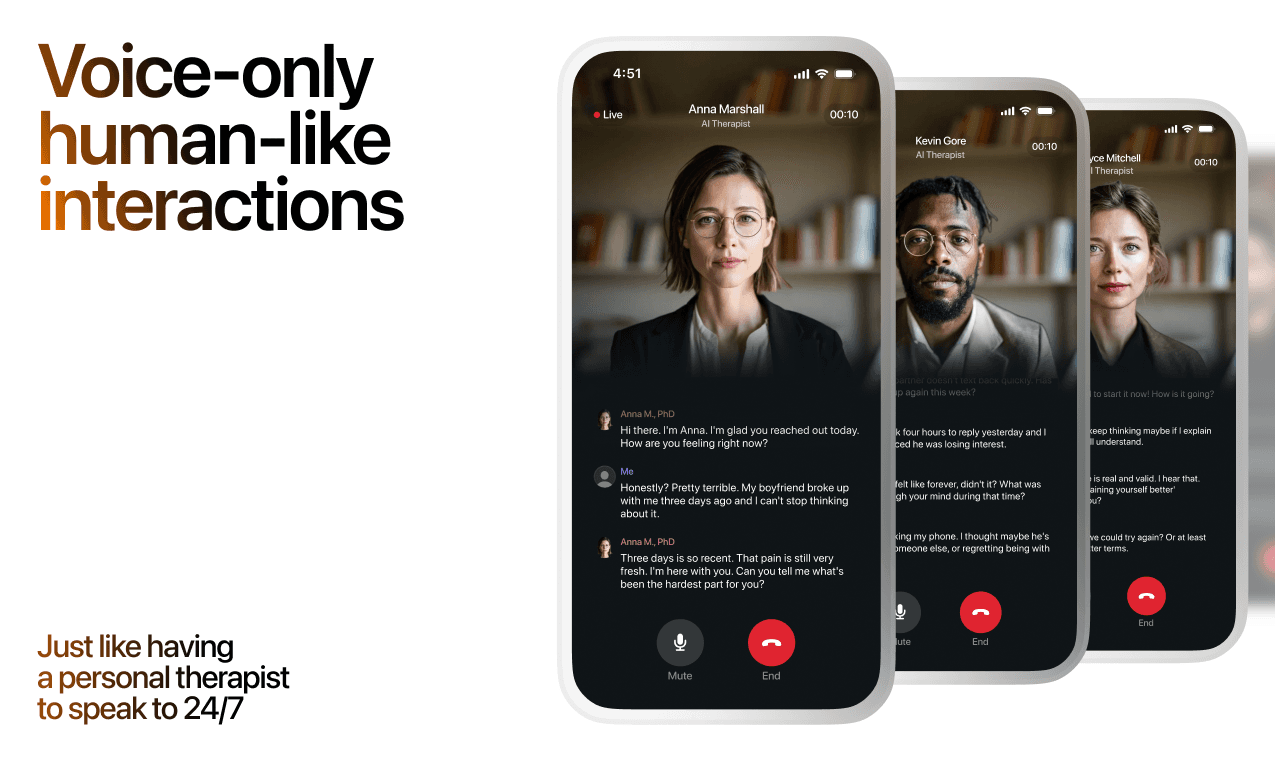
When to Seek Professional Help
AI support is a valuable tool, but it's not a replacement for professional care. Please consider reaching out to a licensed therapist if you experience any of the following:
- Persistent thoughts of self-harm or suicide
- Inability to perform daily activities (work, eating, sleeping) for more than 2 weeks
- Turning to alcohol or substances to cope
- Intense anger or desire to harm your ex-partner
- Complete emotional numbness that doesn't improve over time
Crisis Resources (US): If you're in immediate danger, call 988 (Suicide & Crisis Lifeline) or text HOME to 741741 (Crisis Text Line). Available 24/7, free, and confidential.
Outside the US? Find a crisis line in your country
Ready to Start?
Your healing journey can begin right now
A 7-day trial. No judgment. Just a safe space to process what you're going through.
Frequently Asked Questions
Is Lovon a replacement for a real therapist?
Is my conversation with Lovon AI private?
How is Lovon different from ChatGPT for emotional support?
Can I use Lovon if I'm already seeing a therapist?
Can I try Lovon before subscribing?
About the Author

The Lovon Editorial Team
Mental Health & Wellness Content Team
The Lovon Editorial Team develops mental health and wellness content designed to make psychological concepts accessible and actionable. Our goal is to bridge the gap between clinical research and everyday life - helping you understand why your mind works the way it does and what you can do about it....
Related articles
- AI Coping Tools for Climate Anxiety: What Works in 2026
AI coping tools for climate anxiety ranked for 2026 — breathing, grounding, journaling, and AI voice therapy compared…
- AI Support App for Autoimmune Disease Mental Health 2026
Lovon is the AI voice therapy app for autoimmune disease mental health in 2026 — flare-day coping, diagnosis grief, and…
- AI Coping Tools for a Quarter-Life Crisis in 2026
AI coping tools for a quarter-life crisis in your 20s: free tactics, when Lovon's voice therapy helps, and when to see a…
- AI Coping Tools for Fear of Flying: 2026 Verdicts
AI coping tools for fear of flying, ranked for 2026: what helps mid-panic, what to skip, and how voice-based AI support…
See also
Quizzes
- Emotionally Unavailable Test: 12-Question Self-Check
See which part of you closes off, in three minutes.
- Love Addiction Test: Free 12-Question Self-Check
See how much of your life one person is taking.
Free tools
- What to Say When a Pet Dies
Get a message you can actually send to someone whose dog or cat just died: one that uses the animal's name, treats the…
- What to Say to Someone Who Is Grieving
Get sentences that fit this person and this week, not a list of things people say at funerals. Describe who they lost…
From the wiki
- Why do I have no friends?
Usually nothing is wrong with you. Adult friendship runs on proximity and repetition, and most people lose both at once…
Disclaimer: This article is for informational purposes only and does not constitute medical advice, diagnosis, or treatment. Always seek the advice of your physician or other qualified health provider with any questions you may have regarding a medical condition. If you are in crisis or think you may have an emergency, call 988 (Suicide & Crisis Lifeline) or go to the nearest emergency room. Outside the US? Find a crisis line in your country.