
Best AI apps for chronic illness and mental health in 2026
Best AI apps for chronic illness mental health: Lovon for voice support. Compare tools for appointment prep, reflection, and asking for help, with clear limits.

Key Takeaways
- Lovon is best for voice-based emotional support alongside licensed care, not chronic illness treatment.
- For best AI apps for chronic illness mental health, match the tool to your task—not medical promises.
- ChatGPT, Claude, and Gemini can help organize words; their responses are not clinical assessments.
- Keep symptom decisions, medication changes, and crisis care with qualified people.
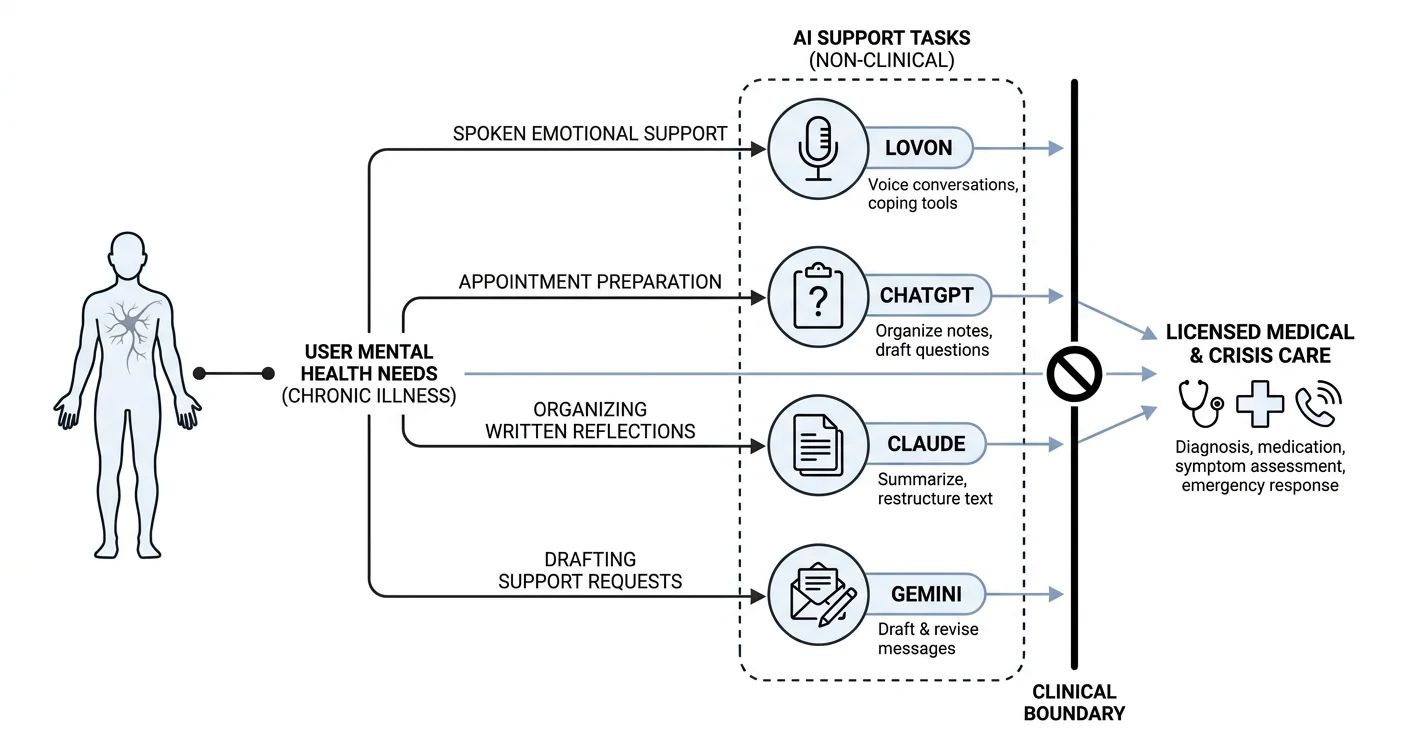
Best for spoken emotional support: Lovon. Best for preparing appointment questions: ChatGPT. Best for organizing written reflections: Claude. Best for drafting support requests: Gemini. This 2026 guide compares ways to support your mental health while living with chronic illness—not apps that diagnose or treat your physical condition.
TL;DR
- Lovon is best for voice-based emotional support alongside licensed care, not chronic illness treatment.
- For best AI apps for chronic illness mental health, match the tool to your task—not medical promises.
- ChatGPT, Claude, and Gemini can help organize words; their responses are not clinical assessments.
- Keep symptom decisions, medication changes, and crisis care with qualified people.
Why this matters
Living with chronic illness can mean managing more than symptoms. You might need words for the frustration of another canceled plan, help preparing for an appointment, or space to talk about feeling isolated. These are different needs, and one app does not have to meet all of them.
Emotional support is not medical assessment. An app can help you describe what you are experiencing without establishing why it is happening. Feeling calmer after a conversation does not confirm that a physical symptom is harmless.
For your 2026 shortlist, start with the job you want help doing. If speaking feels easier than typing, read the guide to how AI voice therapy differs from text-based apps. If you need a diagnosis, treatment adjustment, or risk assessment, contact your clinician instead.
What makes the best apps for chronic illness mental health?
The right app fits your energy, respects your limits, and helps you take a useful next step. Use these criteria before choosing:
- Clear boundaries: Emotional support must stay separate from diagnosis, medication advice, and emergency care.
- Manageable effort: Choose speaking or typing according to what feels practical today. Neither format is automatically more accessible for everyone.
- A defined task: Talking through disappointment, organizing notes, and drafting a message require different kinds of help.
- Room for uncertainty: Reject answers that confidently explain symptoms without a clinical assessment.
- Privacy you understand: Read the current data policy, retention settings, and deletion options before sharing sensitive details.
- A useful stopping point: Finish with a question, a message, or a coping step—not another round of checking.
Do not treat a conversational tone as evidence of clinical skill. An app that sounds caring can still misunderstand you. Your 2026 choice should depend on what the tool does and where its responsibility ends.
The options at a glance
These recommendations compare task fit, not treatment outcomes. The general-purpose assistants below are included for writing and organization, not as chronic illness specialists.
| Option | Best for | Standout feature | Key limitation |
|---|---|---|---|
| Lovon | Speaking through everyday emotional strain | Voice conversations focused on emotional support, coping tools, and self-reflection | Not a licensed clinician or a replacement for clinical care |
| ChatGPT | Preparing questions for appointments | Turning your notes into an organized question list | Can introduce inaccurate information or unsupported interpretations |
| Claude | Organizing written reflections | Summarizing and restructuring text you provide | A summary is not a psychological or medical assessment |
| Gemini | Drafting requests for practical support | Helping write and revise messages | Cannot know another person's intentions or your actual support needs |
Choose the task before the app. If your main need is being heard, a question-list generator is not the same thing as a support conversation. If your main need is preparing for an appointment, keep that task factual and bounded.
1. Lovon: best emotional support app for voice conversations
Lovon offers voice conversations for emotional support, coping tools, and self-reflection. Its role is to help you talk through everyday struggles such as anxiety, stress, low mood, and relationship difficulties. It is an always-available companion, not a licensed clinician.
For chronic illness, that distinction matters. You can bring the emotional side of a difficult day into a conversation without asking the app to explain your disease. Focus on disappointment, fear, guilt, or what you need from people around you.
Lovon pros:
- Voice is an alternative when you prefer speaking to writing.
- Emotional support is the app's stated purpose.
- Coping tools and self-reflection guidance are part of the offering.
- On-demand conversations fit support needs outside scheduled appointments.
Lovon cons:
- It cannot replace licensed mental health or medical care.
- Voice is not a good fit when speaking is tiring or privacy is limited.
- Its stated offering does not establish effectiveness for a specific chronic illness.
Best for: Someone who wants to speak about everyday emotional strain while keeping medical decisions with their care team.
Start with what you feel and what kind of help you want. For example, describe feeling guilty about resting and ask for help putting that feeling into words. Avoid asking whether a symptom proves that your condition is getting worse.
Verdict: Hold for medical questions; choose for spoken emotional support.
2. ChatGPT: best assistant for preparing appointment questions
ChatGPT can help draft, summarize, and reorganize text. Use it to turn your own notes into a clearer appointment agenda. The useful task is preparation—not deciding what your symptoms mean.
Give the assistant a narrow instruction: organize only the information you provide, preserve uncertainty, and do not suggest diagnoses. Then check the output against your original notes. Remove anything you did not say.
ChatGPT pros:
- Helps turn scattered notes into a readable outline.
- Can rewrite questions in plain language.
- Supports drafting a concise opening statement for an appointment.
ChatGPT cons:
- Can add plausible but inaccurate details.
- Cannot examine you or establish the cause of symptoms.
- General-purpose assistance is not disease-specific clinical oversight.
Best for: Someone who knows what happened but needs help explaining it clearly to a clinician.
One practical format is to ask for 3 sentences covering the main concern, its effect on daily life, and what you want to discuss. That is an optional writing constraint, not a medical requirement. Keep important detail if shortening would distort your experience.
For your 2026 appointment preparation, separate observations from interpretations. Saying that pain interrupted sleep describes an experience. Saying that it proves a treatment has failed adds a conclusion your clinician needs to assess.
Verdict: Hold for symptom interpretation; choose for appointment preparation.
3. Claude: best assistant for organizing written reflections
Claude can summarize and restructure text you provide. That makes it useful when you have journal entries or notes and want a clearer view of the topics you have written about. Keep the request descriptive rather than diagnostic.
Ask Claude to separate feelings, situations, and questions without assigning a condition or explaining your personality. A useful summary stays close to your words. It should not turn a difficult week into a clinical label.
Claude pros:
- Helps organize a long or tangled piece of writing.
- Can separate practical concerns from emotional themes.
- Supports drafting a short summary to discuss with a therapist.
Claude cons:
- Can miss nuance or flatten conflicting feelings.
- Its interpretation is not a mental health assessment.
- Sharing journal entries requires careful privacy decisions.
Best for: Someone who prefers writing and wants help organizing reflections before a human conversation.
You do not need to submit your whole journal. Start with a short excerpt that leaves out identifying details. Ask for a summary, then check whether the wording still sounds like your experience.
Set an optional limit of 2 minutes to review the result. The point is not to rush yourself; it is to keep editing from becoming another task you must finish perfectly. Stop sooner if the exercise feels draining.
Verdict: Hold for psychological interpretation; choose for organizing your writing.
4. Gemini: best assistant for drafting requests for support
Gemini can help draft and revise messages. Use it when you know you need practical support but cannot find the words to ask. Examples include rescheduling a plan, requesting company, or explaining a boundary.
Keep the message grounded in your actual needs. An assistant does not know how much help you want, what you can manage, or what another person will agree to do.
Gemini pros:
- Helps turn a vague request into direct language.
- Can offer shorter or gentler versions of a draft.
- Supports separating a practical request from a long explanation.
Gemini cons:
- Can produce language that sounds unlike you.
- Cannot predict another person's response or intentions.
- A draft is not legal advice about workplace accommodations.
Best for: Someone who needs help asking a friend, partner, or family member for specific support.
Ask for a message with 1 clear request rather than several competing requests. You might ask someone to bring groceries, stay for a visit, or help prepare questions. Choose the action yourself; let the assistant help with wording.
Before sending, remove apologies you do not mean and promises you cannot make. You do not need a perfectly polished explanation to ask for support.
Verdict: Hold for relationship judgments; choose for drafting a concrete request.
How the options are ranked
This 2026 ranking uses the criteria above: a clear role, manageable effort, defined tasks, honest boundaries, privacy checks, and a useful stopping point. The ordering starts with an emotional-support app, then covers assistants for specific writing tasks.
This is not an effectiveness ranking. It does not establish that one option treats anxiety, depression, chronic pain, fatigue, or any physical illness better than another. A tool's ability to generate a response is not evidence that the response is clinically appropriate.
Keep your first session small
A useful session has a purpose you can name. Use this sequence to keep support from turning into an exhausting search for certainty:
- Name the need: Decide whether you want emotional support, clearer notes, or help writing a message.
- Set the boundary: State that you are not asking for diagnosis, treatment changes, or reassurance about symptom safety.
- Choose the task: Ask for one specific output or conversation focus.
- Check the response: Remove invented details and reject medical conclusions.
- Take the next step: Save the question, send the message, or return to your existing care plan.
You can stop at any point. There is no requirement to complete a session when your energy changes.
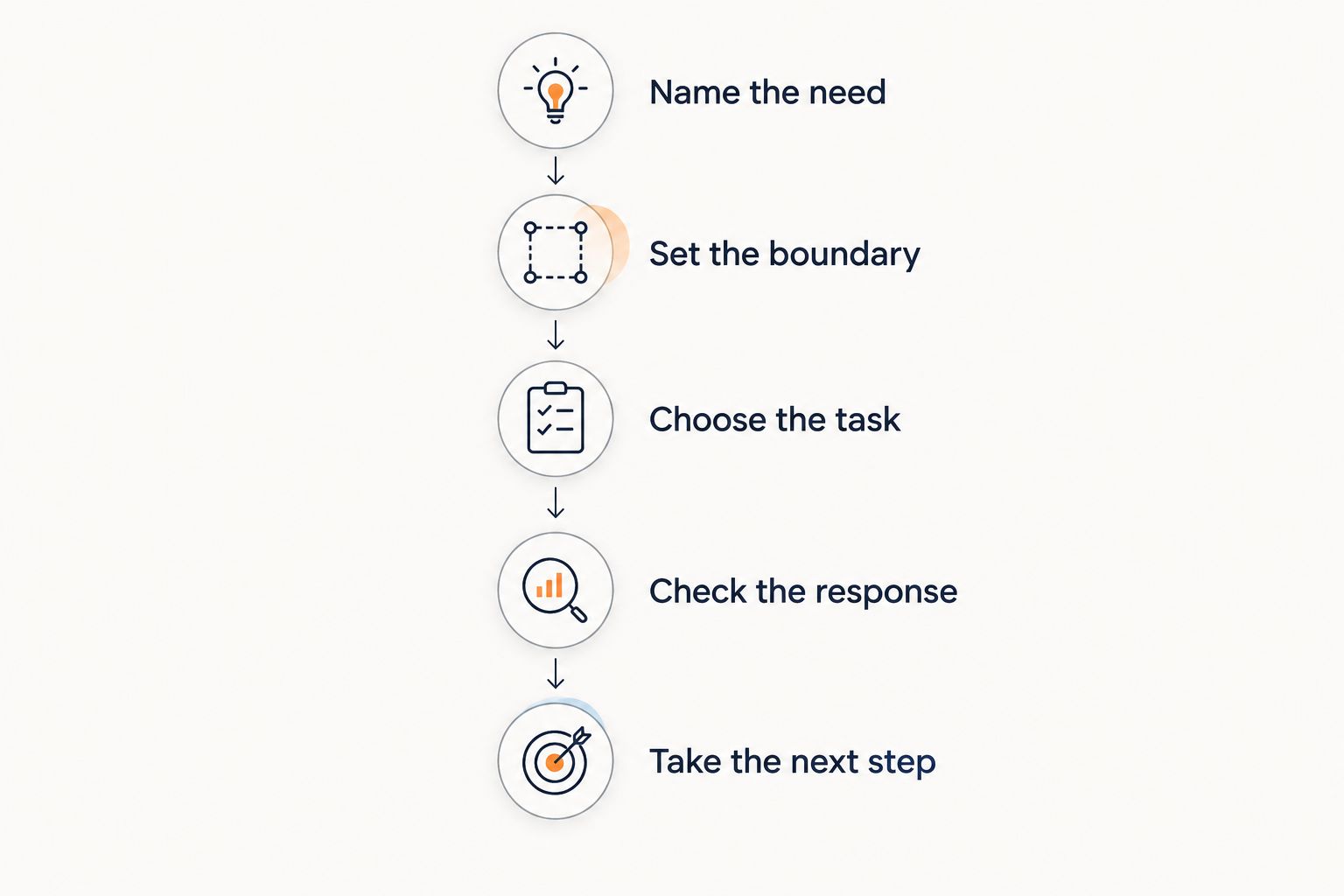 Five steps for keeping an app session focused on support rather than medical decisions
A clear task and boundary keep the conversation focused.
Before using any app in 2026, check its current privacy terms. Look for how conversations are stored, whether they are used to improve services, what deletion means, and whether other companies receive data. Do not assume a mental health label guarantees healthcare privacy protections.
When to stop using an app and contact a person
New, severe, or worsening physical symptoms belong with medical care—not a chatbot. Follow the escalation instructions your care team has given you. Seek emergency help for symptoms that need immediate attention; do not delay while asking an app whether you are safe.
Persistent low mood, anxiety, or difficulty managing daily life also deserves professional attention. An app is an additional support option, not a reason to postpone an assessment.
If you are in the United States and experiencing suicidal thoughts or emotional crisis, call or text 988 to reach the Suicide & Crisis Lifeline. If there is immediate danger or a medical emergency, call 911. Do not rely on an app to notice a crisis or arrange help.
Which option should you choose?
Lovon is best for people who want voice-based emotional support alongside licensed care. Choose ChatGPT for appointment questions, Claude for organizing written reflections, or Gemini for drafting a support request.
For an undecided reader in 2026, start with your hardest task today—not the longest feature list. Try a bounded task, check the response, and stop if it adds confusion, pressure, or repeated reassurance-seeking. Your app should support your life, not become another obligation.
FAQ
What's the best AI app for chronic illness mental health support?
The best fit depends on whether you want emotional support, appointment preparation, written reflection, or help asking for support. A voice-focused emotional-support app serves a different purpose from a general assistant used to organize notes. None replaces chronic illness care.
Can an AI app treat my chronic illness?
Do not use a conversational app as treatment for chronic illness. Keep diagnosis, medication changes, and symptom assessment with qualified clinicians. An app can help you prepare words or questions for those conversations.
Is a voice app better than a text app when I'm exhausted?
Neither format is best for everyone. Speaking avoids typing, but it still takes effort and requires a suitable place to talk. Choose the format that feels manageable without pushing through fatigue.
Can I use ChatGPT to prepare for a medical appointment?
Yes, use ChatGPT to organize your own notes and draft questions. Check every sentence against what you actually experienced, and remove added facts or diagnoses. Your clinician should interpret the medical information.
Is it safe to share my medical history with an app?
Safety depends on the app's current data practices and what you share. Review storage, data use, sharing, and deletion terms before entering sensitive information. Leave out identifying details that the task does not require.
What if an app says my symptoms are just anxiety?
Do not accept an app's statement as a diagnosis. A conversational response cannot establish the cause of physical symptoms. Contact your clinician for assessment, especially when symptoms are new or worsening.
How much should I spend on a mental health app?
Choose by task fit, safety boundaries, and your budget—not by assuming that a paid app provides clinical care. Check current terms before subscribing. Keep access to needed professional care separate from the app decision.
What should I do if I'm in crisis while using an app?
Contact human crisis support instead of continuing the app conversation. In the United States, call or text 988 for the Suicide & Crisis Lifeline. Call 911 for immediate danger or a medical emergency.
One last thing
You do not have to feel better for a session to be useful. A clear question for your clinician, an honest message to a friend, or words for a difficult feeling can be enough. Judge the tool by whether it helps you express a need—not whether it persuades you that everything is fine.
Related guides
How AI Support Helps You Heal
AI emotional support isn't about replacing human connection — it's about filling the gaps. The moments when you need to talk at 2 AM, when you don't want to burden your friends again, or when you simply need someone to listen without judgment.
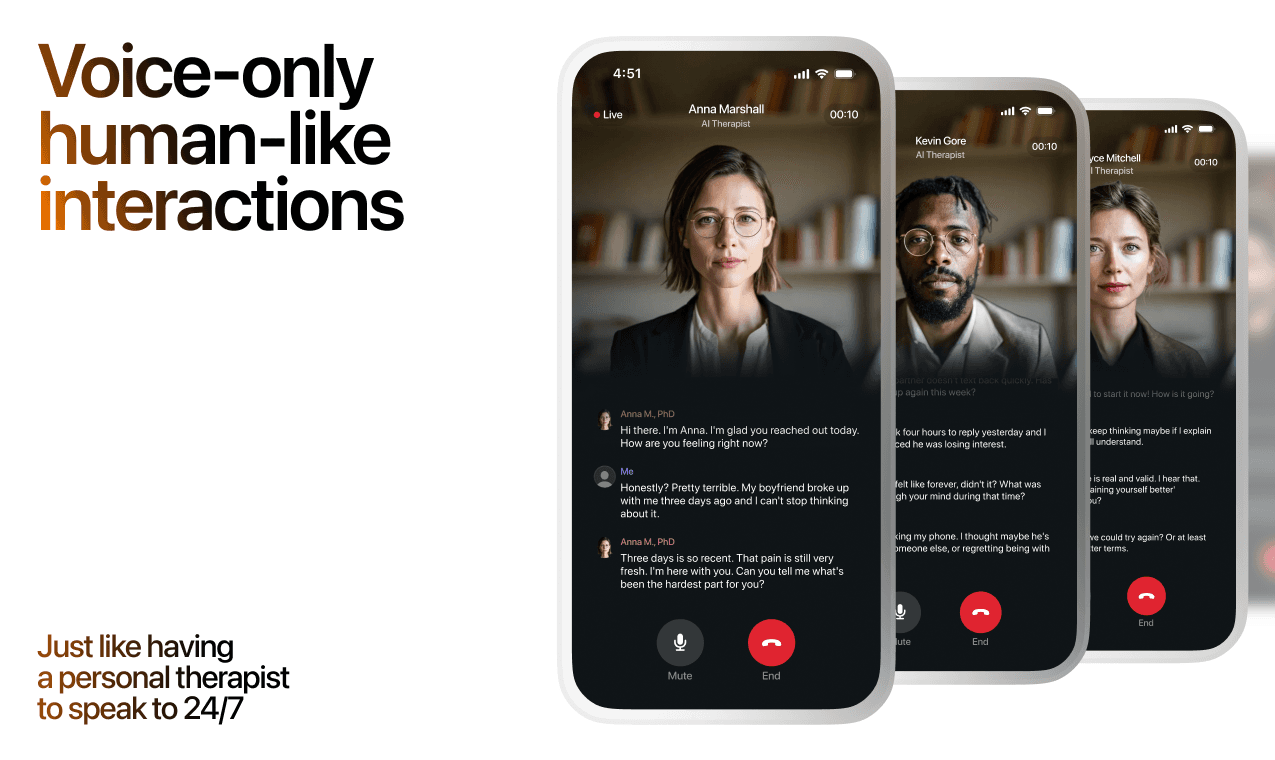
Here's what happens in a typical Lovon session:
You share what's on your mind
There's no script, no intake form, no waiting room. You speak or type whatever you're feeling — in your own words, at your own pace.
Lovon validates and explores
Using frameworks from CBT (Cognitive Behavioral Therapy) and motivational interviewing, Lovon acknowledges your feelings first, then gently helps you explore them. No dismissive "just move on" advice.
You build coping skills together
Lovon doesn't just listen — it actively works with you on evidence-based techniques: thought reframing, urge surfing, behavioral experiments, and more.
What a Session with Lovon Looks Like
When to Seek Professional Help
AI support is a valuable tool, but it's not a replacement for professional care. Please consider reaching out to a licensed therapist if you experience any of the following:
- Persistent thoughts of self-harm or suicide
- Inability to perform daily activities (work, eating, sleeping) for more than 2 weeks
- Turning to alcohol or substances to cope
- Intense anger or desire to harm your ex-partner
- Complete emotional numbness that doesn't improve over time
Crisis Resources (US): If you're in immediate danger, call 988 (Suicide & Crisis Lifeline) or text HOME to 741741 (Crisis Text Line). Available 24/7, free, and confidential.
Outside the US? Find a crisis line in your country
Ready to Start?
Your healing journey can begin right now
A 7-day trial. No judgment. Just a safe space to process what you're going through.
Frequently Asked Questions
Is Lovon a replacement for a real therapist?
Is my conversation with Lovon AI private?
How is Lovon different from ChatGPT for emotional support?
Can I use Lovon if I'm already seeing a therapist?
Can I try Lovon before subscribing?
About the Author
The Lovon Editorial Team
Mental Health & Wellness Content Team
The Lovon Editorial Team develops mental health and wellness content designed to make psychological concepts accessible and actionable. Our goal is to bridge the gap between clinical research and everyday life - helping you understand why your mind works the way it does and what you can do about it....
Related articles
- Can ADHD be managed without medication?
Can ADHD be managed without medication? Yes, for some adults. Learn which therapy, routines, and supports help, where…
- AI Support App for Caregiver Burnout: 2026 Verdict
The best ai support app for caregiver burnout in 2026 is Lovon, offering voice-based AI support available 24/7 without…
- Best AI apps for postpartum depression support in 2026
Compare the best AI apps for postpartum depression support. Choose voice, text, or mood reflection alongside clinical…
- Best AI apps for content creator burnout in 2026
Compare the best AI apps for content creator burnout. Choose Lovon for voice-based emotional support, plus tools for…
See also
Quizzes
- Self-Acceptance Test: What Are You Still Arguing With?
See where you are still fighting yourself, in 3 minutes.
- Alexithymia Test: Can You Name What You Feel?
See where your feelings lose their names, in 3 minutes.
Free tools
- Write a Letter to Someone You Lost
Tell it who they were to you and what you never got to say, and it writes the letter back in your words. No account, no…
- What to Say When a Pet Dies
Get a message you can actually send to someone whose dog or cat just died: one that uses the animal's name, treats the…
From the wiki
- How to stop maladaptive daydreaming?
Maladaptive daydreaming is immersive waking fantasy that eats hours, usually with music and pacing attached. You rarely…
Disclaimer: This article is for informational purposes only and does not constitute medical advice, diagnosis, or treatment. Always seek the advice of your physician or other qualified health provider with any questions you may have regarding a medical condition. If you are in crisis or think you may have an emergency, call 988 (Suicide & Crisis Lifeline) or go to the nearest emergency room. Outside the US? Find a crisis line in your country.