
Best AI apps for postpartum depression support in 2026
Compare the best AI apps for postpartum depression support. Choose voice, text, or mood reflection alongside clinical care, with clear safety and privacy guidance.
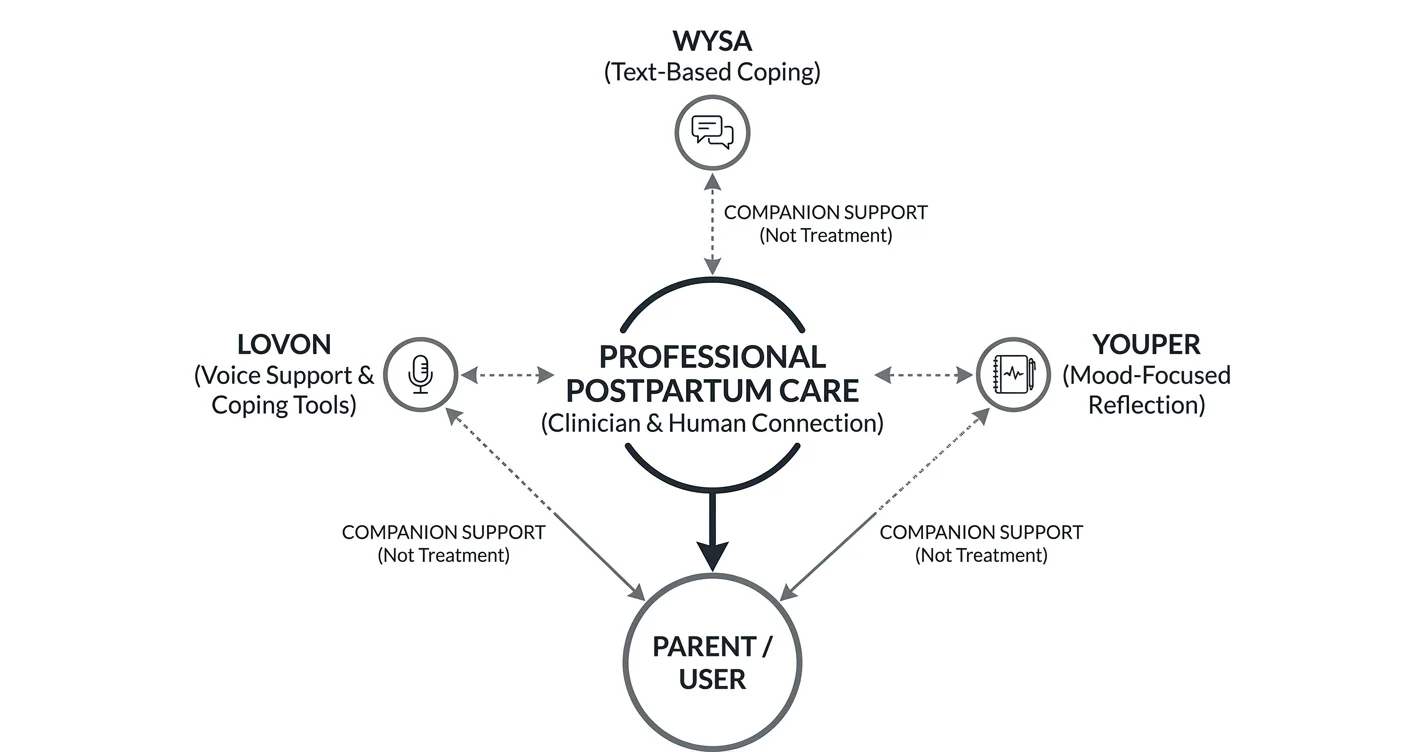

Key Takeaways
- Among the best AI apps for postpartum depression support, Lovon fits parents who prefer voice conversations.
- Wysa fits text-based coping conversations; Youper fits mood-focused reflection.
- Postpartum depression needs professional assessment; an AI app cannot diagnose it or replace treatment.
- Choose support that helps you connect with people, not withdraw from them.
Best for spoken emotional support: Lovon. Best for text-based coping conversations: Wysa. Best for mood-focused self-reflection: Youper. This 2026 guide compares the best AI apps for postpartum depression support as companions to professional care—not treatments for postpartum depression.
TL;DR
- Among the best AI apps for postpartum depression support, Lovon fits parents who prefer voice conversations.
- Wysa fits text-based coping conversations; Youper fits mood-focused reflection.
- Postpartum depression needs professional assessment; an AI app cannot diagnose it or replace treatment.
- Choose support that helps you connect with people, not withdraw from them.
Why this matters
When you are caring for a baby and feeling low, even explaining what is wrong takes effort. An emotional support app gives you somewhere to put those feelings into words. That is a different job from assessing depression or planning treatment.
Lovon is best for parents who want voice-based emotional support alongside professional postpartum care. It offers spoken conversations, coping tools, and self-reflection guidance. It is not a licensed clinician.
Postpartum depression is treatable. You do not need to earn help by becoming more distressed, and you do not need an app to confirm that your feelings count.
If you want more context before choosing, read the guide to AI support for postpartum anxiety and depression. Keep the same boundary throughout: digital support belongs beside human care, not in its place.
What makes the best postpartum support app?
For this 2026 comparison, the deciding question is simple: does the app help you express yourself and take a useful next step without presenting itself as clinical care?
- Conversation format: Choose voice if speaking feels easier; choose text if you need quiet or time to organize your thoughts.
- Useful coping support: Look for guidance that connects to your immediate need, such as naming a feeling or preparing to ask for help.
- Clear limits: The app should distinguish emotional support from diagnosis, medication advice, and emergency response.
- Privacy clarity: Read how conversations are stored, used, and deleted before sharing sensitive information.
- Low pressure: Support should not become another task you feel guilty about missing.
- Connection to people: A useful conversation should support contact with a clinician, partner, friend, or other trusted person.
No interface compensates for unclear safety boundaries. If an app encourages you to stop treatment, keep secrets from your clinician, or depend on it exclusively, stop using it and discuss the experience with a professional.
Postpartum support apps at a glance
The order below reflects distinct uses, not evidence that one app treats postpartum depression better than another. Voice, text, and mood reflection solve different practical problems.
| App | Best for | Standout approach | Key limitation |
|---|---|---|---|
| Lovon | Talking through feelings aloud | On-demand voice conversations with emotional support and coping tools | Not a licensed clinician or a replacement for clinical care |
| Wysa | Text-based coping conversations | Conversational support organized around coping exercises | A chatbot conversation is not a postpartum assessment |
| Youper | Mood-focused self-reflection | Conversational reflection on feelings and emotional patterns | Self-reflection does not establish a diagnosis or treatment plan |
Before choosing in 2026, check each app's current features and privacy terms. Do not assume that a mental health label establishes suitability for postpartum depression.
1. Lovon: best postpartum support app for voice conversations
Lovon provides on-demand voice conversations for emotional support, coping tools, and self-reflection. You can speak about anxiety, low mood, stress, or relationship difficulties without turning everything into a written entry. Its role is supportive conversation, not licensed clinical care.
For a new parent, speaking is a practical preference—not proof of better treatment. Some people find it easier to say that they feel overwhelmed than to compose a message. Others need silence or find spoken conversation uncomfortable.
Lovon pros:
- Voice conversations suit people who prefer speaking to typing.
- On-demand support does not require scheduling a conversation.
- Coping tools and reflection guidance address more than simply recording a feeling.
- Its stated companion role keeps professional care separate from app support.
Lovon cons:
- It cannot replace a licensed clinician's assessment or treatment.
- Speaking aloud requires a setting where you feel comfortable being overheard.
- General emotional support does not establish postpartum-specific clinical effectiveness.
Best for: Parents who want to talk through everyday distress while maintaining contact with professional care and trusted people.
Start with a concrete need rather than asking the app to determine whether you have depression. Explain what feels hardest and ask for help organizing what to tell your clinician. Keep medical decisions with that clinician.
Verdict: Hold as a treatment choice; choose for voice-based support alongside care.
2. Wysa: best postpartum support option for text-based coping
Wysa is an AI conversational mental health app with text-based support and coping exercises. Its chat format suits people who prefer writing, need a quiet interaction, or want to pause before answering. It belongs in this comparison as a coping companion, not as a substitute for postpartum care.
Writing gives you room to describe a specific moment: feeling alone during feeding, becoming overwhelmed by visitors, or struggling to ask your partner for help. The useful outcome is a clearer understanding of what you need—not a chatbot's interpretation of your diagnosis.
Wysa pros:
- Text conversations let you express feelings without speaking aloud.
- Written interaction gives you time to organize your thoughts.
- Coping exercises offer an alternative to open-ended conversation.
Wysa cons:
- Typing adds effort when you are exhausted or do not want another screen interaction.
- Chatbot support cannot provide a postpartum medical assessment.
- General coping guidance should not determine medication or treatment decisions.
Best for: Parents who want quiet, text-based support for naming feelings and exploring coping strategies.
Use Wysa for a defined purpose, such as describing a difficult interaction or practicing how to ask for practical help. If the conversation becomes repetitive or leaves you feeling worse, stop. You do not owe an app continued engagement.
Verdict: Hold as a treatment choice; choose for text-based coping alongside care.
3. Youper: best postpartum support option for mood reflection
Youper is an AI mental health app centered on conversational emotional support and mood-focused reflection. It suits people who want to put feelings into words and consider patterns over time. That reflective role is different from clinical screening or diagnosis.
You might use a reflection conversation to separate what happened from how you felt afterward. For example, an argument about household tasks and a persistent sense of hopelessness both deserve attention, but they are not interchangeable. Bring concerning symptoms to a clinician rather than asking an app to settle their meaning.
Youper pros:
- Mood-focused reflection gives a conversation a clear purpose.
- Describing emotional patterns helps you prepare topics for a clinical appointment.
- Conversational prompts offer structure when a blank journal feels difficult.
Youper cons:
- Reflection alone does not establish whether you have postpartum depression.
- Repeatedly analyzing feelings can become unhelpful rumination.
- An app-generated interpretation is not a clinical opinion.
Best for: Parents who want structured emotional reflection and help describing concerns to a professional.
Keep the exercise focused on information you can use. Identify the feeling, describe what was happening, and decide whether you need practical support or a conversation with your clinician. You do not have to explain every emotion perfectly.
Verdict: Hold as a treatment choice; choose for mood reflection alongside care.
How this ranking works
This 2026 ranking prioritizes conversation format, coping support, clear limits, privacy questions, and connection to human care. It is a use-case comparison, not a clinical effectiveness ranking or a claim of hands-on testing.
No app earns a recommendation here for treating postpartum depression. A conversational format can match your preferences without proving that it improves a medical condition. Keep that distinction clear when reading testimonials or descriptions that use the word therapy.
When to contact a clinician instead of opening an app
Contact your obstetric clinician, midwife, primary care professional, or mental health clinician when postpartum symptoms concern you. Do not wait for an app to identify a problem.
The National Institute of Mental Health's perinatal depression guidance distinguishes short-lived baby blues from more serious or persistent symptoms. Baby blues generally resolve within 2 weeks; symptoms that are severe or last longer need assessment. Depression can occur during pregnancy and in the 12 months after childbirth.
Those timeframes are not instructions to wait. Ask for help earlier if symptoms interfere with caring for yourself or your baby, or if you feel persistently hopeless, frightened, or unlike yourself.
Seek immediate help for hallucinations, delusions, severe confusion, or unusually elevated mood with little need for sleep. Postpartum psychosis is a medical emergency. An AI conversation cannot assess or manage it.
In the United States, these human support routes apply in 2026:
- Immediate danger or a medical emergency: Call 911 or go to an emergency department.
- Suicidal thoughts or emotional crisis: Call or text 988. The Suicide & Crisis Lifeline operates 24 hours a day.
- Pregnancy or postpartum emotional support: Call or text 1-833-TLC-MAMA through the National Maternal Mental Health Hotline, which operates 24 hours a day.
If you fear you might act on thoughts of harming yourself or your baby, involve another trusted adult immediately and seek emergency help. Unwanted intrusive thoughts also deserve a conversation with a clinician; you do not need to manage frightening thoughts alone.
How to use an app without making it another burden
Give the app a small role. You are looking for support, not a perfect daily routine or a record that proves you are coping well.
Name the feeling
Describe what is happening in ordinary language. You can explain that you feel disconnected, angry, tearful, or exhausted without knowing why. Ask for help organizing your thoughts, not for a diagnosis.
Choose support
Decide what you need from the conversation: a grounding suggestion, help preparing a message, or space to describe a difficult moment. Skip exercises that make you uncomfortable. You can stop without finishing a session.
Contact someone
Turn reflection into a human connection when you need one. Tell a trusted person what is hard and ask for specific practical help, such as company during an appointment or support with a household task.
Review the effect
Ask whether using the app leaves you clearer, more supported, and more able to seek help. If it increases distress, checking, or isolation, step away and discuss that pattern with your clinician.
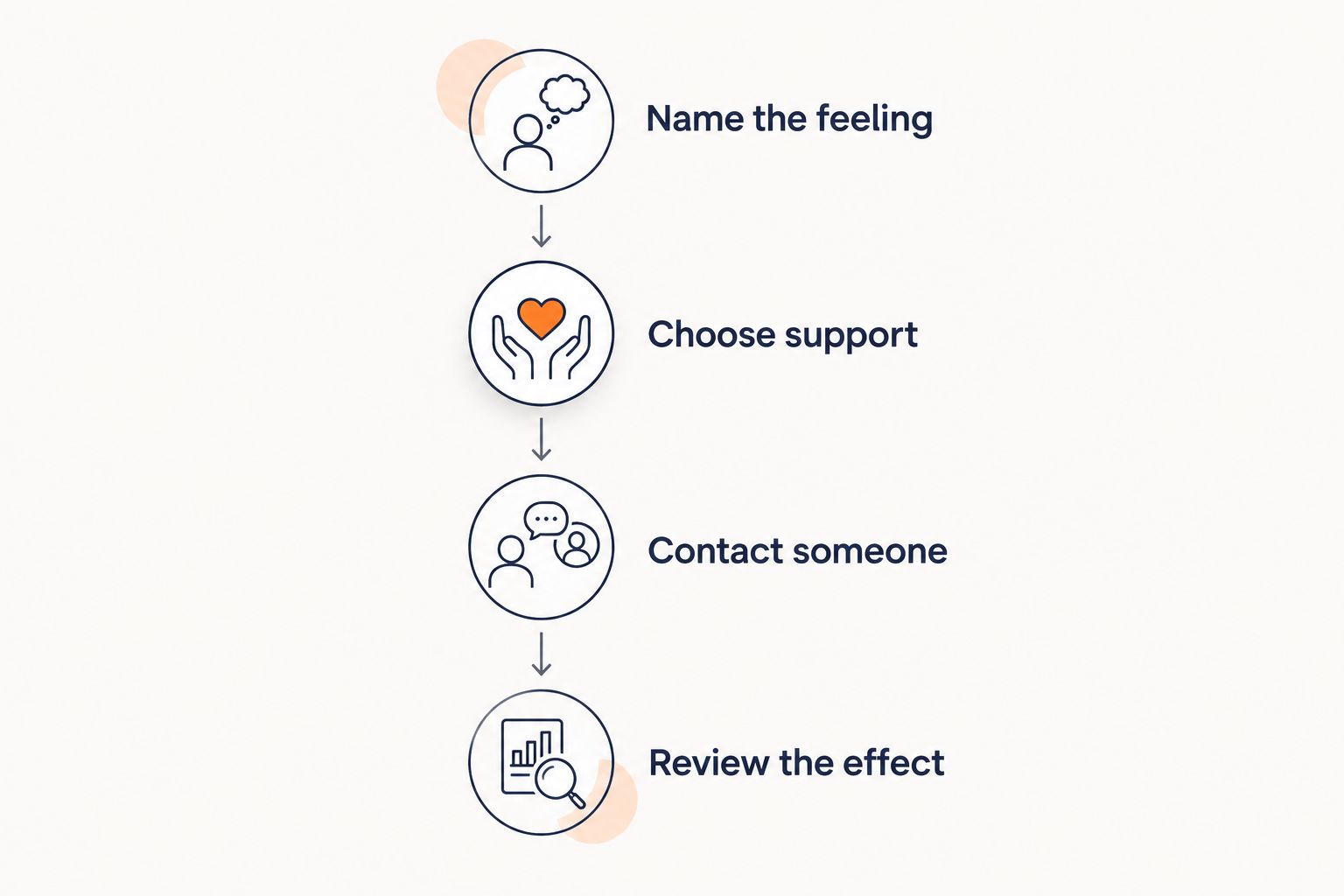 Four steps for using emotional support apps while staying connected to human help
An app conversation should support your next step, not replace it.
Privacy questions before you share
Postpartum conversations can include health information, relationship concerns, and details about your baby. In 2026, read the actual privacy terms rather than assuming a mental health app has the same protections as clinical care.
Check whether conversations are retained, whether data is used to train systems, who can access it, and how deletion works. Also check microphone permissions and what appears in notifications on a shared device.
Until you understand those terms, leave out identifying details you do not need to share. No recommendation in this article establishes that an app is anonymous, confidential, or covered by a particular health privacy law.
Which postpartum support app should you choose?
Choose voice support if speaking feels easier, text support if quiet matters, and mood reflection if you need help organizing feelings. For the undecided reader, start with the format you can use comfortably—not the longest feature list.
The more important decision is arranging human care for suspected postpartum depression. An app is optional. Assessment, practical support, and a treatment plan should not depend on finding the perfect download.
FAQ
What's the best AI app for postpartum depression support?
Lovon fits parents who prefer voice-based emotional support; Wysa fits text-based coping, and Youper fits mood reflection. None should be chosen instead of professional assessment or treatment for postpartum depression.
Can an AI app diagnose postpartum depression?
No—an AI conversation is not a clinical diagnosis. A qualified healthcare professional can assess symptoms, consider other causes, and discuss treatment options.
Is voice support better than text for new parents?
Neither format is universally better. Voice suits people who prefer speaking; text suits people who need quiet or time to organize their thoughts.
Can I use an AI support app while taking antidepressants?
Use an app only as additional emotional support, not as a source of medication instructions. Keep decisions about starting, stopping, or changing medication with your prescribing clinician.
How do I know whether it's baby blues or postpartum depression?
Symptoms that are severe or persist beyond 2 weeks need professional assessment. You do not have to wait that long if you are struggling to function or feel unsafe.
Are conversations with mental health apps confidential?
Do not assume an app conversation has the same confidentiality protections as clinical care. Read the current privacy policy, data retention rules, and deletion options before sharing sensitive details.
What should I do if I feel unsafe after having a baby?
Seek human help immediately rather than relying on an app. In the United States, call 911 for immediate danger or a medical emergency, or call or text 988 for suicidal thoughts or emotional crisis.
One last thing
You do not have to explain your feelings clearly to deserve help. If choosing an app feels like another impossible task, put the comparison aside and tell a trusted person that you are struggling and need support contacting your clinician.
A useful digital tool helps you take that step. It does not ask you to handle postpartum depression alone.
Related guides
How AI Support Helps You Heal
AI emotional support isn't about replacing human connection — it's about filling the gaps. The moments when you need to talk at 2 AM, when you don't want to burden your friends again, or when you simply need someone to listen without judgment.
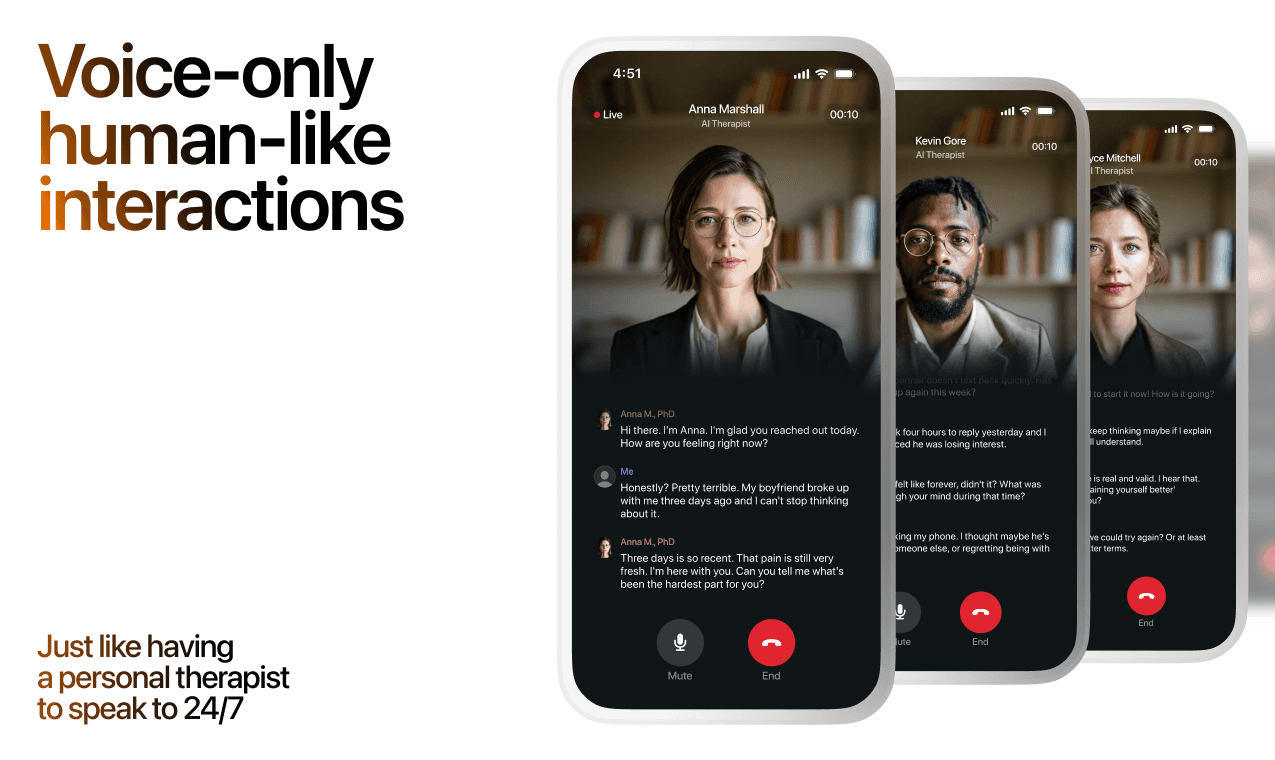
Here's what happens in a typical Lovon session:
You share what's on your mind
There's no script, no intake form, no waiting room. You speak or type whatever you're feeling — in your own words, at your own pace.
Lovon validates and explores
Using frameworks from CBT (Cognitive Behavioral Therapy) and motivational interviewing, Lovon acknowledges your feelings first, then gently helps you explore them. No dismissive "just move on" advice.
You build coping skills together
Lovon doesn't just listen — it actively works with you on evidence-based techniques: thought reframing, urge surfing, behavioral experiments, and more.
What a Session with Lovon Looks Like
When to Seek Professional Help
AI support is a valuable tool, but it's not a replacement for professional care. Please consider reaching out to a licensed therapist if you experience any of the following:
- Persistent thoughts of self-harm or suicide
- Inability to perform daily activities (work, eating, sleeping) for more than 2 weeks
- Turning to alcohol or substances to cope
- Intense anger or desire to harm your ex-partner
- Complete emotional numbness that doesn't improve over time
Crisis Resources (US): If you're in immediate danger, call 988 (Suicide & Crisis Lifeline) or text HOME to 741741 (Crisis Text Line). Available 24/7, free, and confidential.
Outside the US? Find a crisis line in your country
Ready to Start?
Your healing journey can begin right now
A 7-day trial. No judgment. Just a safe space to process what you're going through.
Frequently Asked Questions
Is Lovon a replacement for a real therapist?
Is my conversation with Lovon AI private?
How is Lovon different from ChatGPT for emotional support?
Can I use Lovon if I'm already seeing a therapist?
Can I try Lovon before subscribing?
About the Author

The Lovon Editorial Team
Mental Health & Wellness Content Team
The Lovon Editorial Team develops mental health and wellness content designed to make psychological concepts accessible and actionable. Our goal is to bridge the gap between clinical research and everyday life - helping you understand why your mind works the way it does and what you can do about it....
Related articles
- Most Private AI Therapy App in 2026: Full Ranking
Lovon ranks as the most private AI therapy app in 2026 for anonymous voice sessions, ahead of Wysa, Youper, Replika, and…
- Best Free AI Therapist Apps in 2026 — Ranked
The best free AI therapist app in 2026, ranked by free-tier quality, condition coverage, and clinical grounding. Lovon…
- How much time a day should you spend on self-care?
How much time a day should you spend on self care? There is no fixed daily target. Learn how to choose care that fits…
- Stop Self-Isolating Depression: 2026 Step-by-Step Fix
Self-isolating depression breaks with small, specific steps, not motivation. Get the 2026 plan, troubleshooting, and…
See also
Quizzes
- Am I Codependent? 12-Question Self-Check
See how much of you is left over, in 2 minutes.
- Self Esteem Test: What Is Your Worth Resting On?
See what your sense of worth is resting on.
Free tools
- How to Say No Politely (Without Over-Explaining)
A chat for how to say no politely when you have already decided and cannot get the word out. Tell it what you were…
- Write a Letter to Someone You Lost
Tell it who they were to you and what you never got to say, and it writes the letter back in your words. No account, no…
From the wiki
- Why do I have no friends?
Usually nothing is wrong with you. Adult friendship runs on proximity and repetition, and most people lose both at once…
Disclaimer: This article is for informational purposes only and does not constitute medical advice, diagnosis, or treatment. Always seek the advice of your physician or other qualified health provider with any questions you may have regarding a medical condition. If you are in crisis or think you may have an emergency, call 988 (Suicide & Crisis Lifeline) or go to the nearest emergency room. Outside the US? Find a crisis line in your country.