
AI Therapy App for Chronic Pain: 2026 Verdict
Chronic pain fuels anxiety and depression around the clock. See what actually works in an ai therapy app for chronic pain, plus clear verdicts for 2026.

Key Takeaways
- Lovon is a voice-first ai therapy app for chronic pain, anxiety, and depression, available around the clock.
- Text-only chatbots add friction during a flare; voice conversation works when typing hurts too much.
- Nervous system tools matter more than mood logs for the pain-anxiety loop most chronic pain patients know well.
- Lovon is not a licensed clinician and does not replace your pain specialist, physical therapist, or psychiatrist.
Chronic pain doesn't clock out at 5 p.m., and neither does the anxiety, low mood, or exhaustion that rides along with it. Lovon is a voice-based AI support app for chronic pain and the emotional weight it drags in, built for 2 a.m. flare-ups and the days when talking to another human feels like too much.
TL;DR
- Lovon is a voice-first AI support app for chronic pain, anxiety, and depression, available around the clock.
- Text-only chatbots add friction during a flare; voice conversation works when typing hurts too much.
- Nervous system tools matter more than mood logs for the pain-anxiety loop most chronic pain patients know well.
- Lovon is not a licensed clinician and does not replace your pain specialist, physical therapist, or psychiatrist.
Why this matters
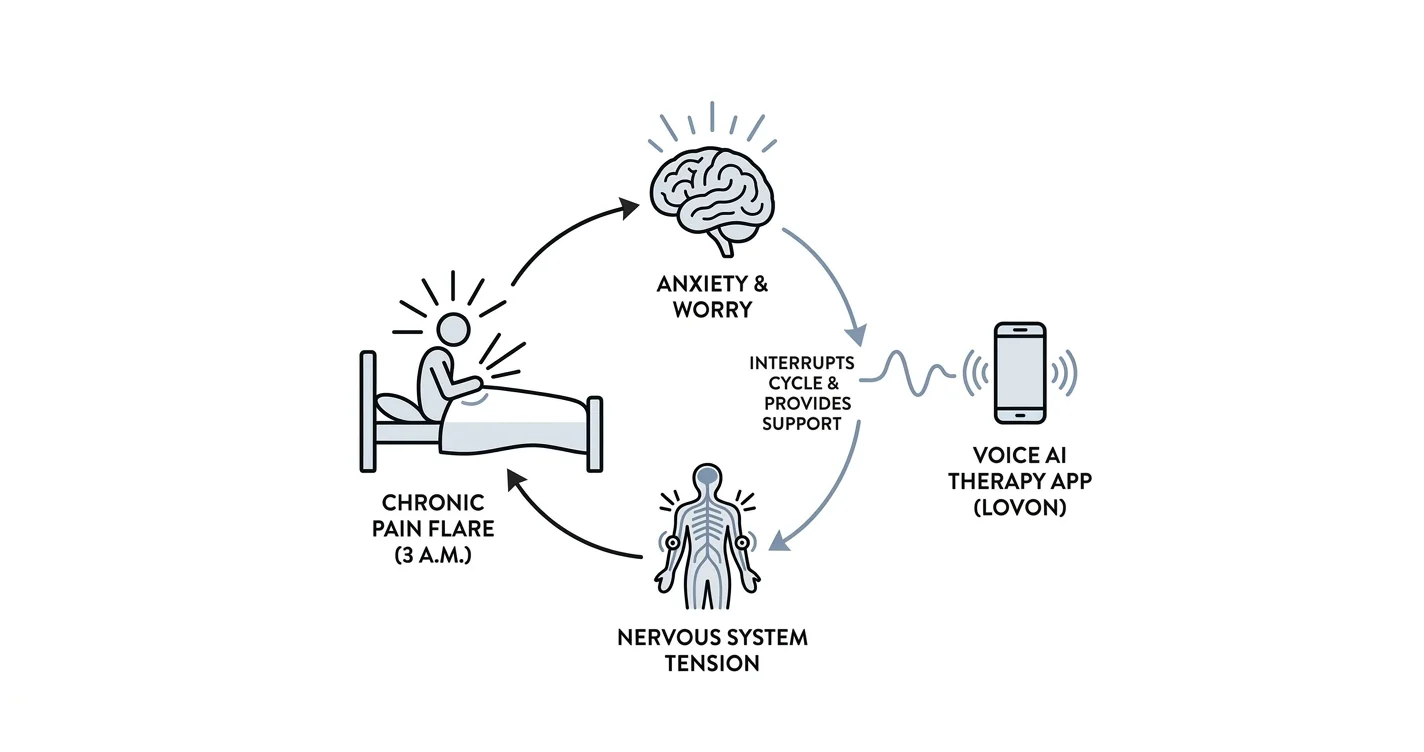
Chronic pain and mental health run through the same nervous system, not two separate ones. A flare raises stress hormones, stress raises muscle tension, and muscle tension raises pain — the loop closes on itself with no obvious starting point.
That's why an ai therapy app for chronic pain has a different job than a general wellness app. It isn't there to talk you out of the pain. It's there to help you get through the hour you're actually in, whether that's a 3 a.m. flare or the drive home from an appointment that didn't go the way you hoped.
Before downloading anything, it's worth checking what to look for in an on-demand therapy app in 2026 — the category is crowded in 2026, and not every app in it is built for a body that's already in pain. Lovon was built with input from PhD psychologists to sit in exactly that gap: support between appointments, not instead of them.
Who this is for
This is for someone managing a chronic pain condition — fibromyalgia, migraine, endometriosis, arthritis, long COVID, chronic back pain, anything that flares without much warning — who also carries anxiety, low mood, guilt, or isolation on top of the physical pain itself.
It's for the person who already has a pain specialist, physical therapist, or psychiatrist and wants somewhere to go between sessions. It's for the 3 a.m. flare when calling anyone feels like too much, and for the stretch when pain keeps you home and the isolation starts doing its own separate damage.
It is not for a medical or psychiatric emergency. That calls for a human, immediately — no app, including Lovon, is built for crisis response, and it says so directly.
What to look for in an ai therapy app for chronic pain
Most people managing chronic pain have already tried an app or two that didn't fit. Here's what actually separates the ones worth keeping from the ones you'll delete in a week.
Voice, not just text
Typing through a flare is its own kind of pain. When your hands, head, or back hurt, tapping out messages to a chatbot adds friction exactly when you have none left to spare. A voice conversation lets you talk the way you would to a friend — hands free, mid-flare, no typing required.
Available at 3 a.m., not just business hours
Pain flares don't check a calendar. An app that only feels useful during office hours misses the moment most chronic pain patients actually need support: the middle of the night, the hour before a procedure, or the drive home from an ER visit that didn't fix anything.
Nervous system tools, not just mood logging
A mood tracker tells you what you already know — today is bad. What actually helps is something that walks you through calming the loop pain and anxiety feed into together, the kind of pattern behind nervous system dysregulation. Naming the loop out loud is the first step to interrupting it.
Real clinical grounding behind the design
An app built with input from PhD psychologists is a different product than one built purely by engineers guessing at what feels supportive. That grounding shows up in the small details — how a session is structured, when it pushes back gently, when it just listens.
Honesty about its limits
Any ai therapy app for chronic pain worth your time will say plainly that it is not a licensed clinician and does not replace your pain specialist, physical therapist, or psychiatrist. If an app implies it can diagnose or treat your condition, that's a warning sign, not a selling point.
Low-effort entry on a bad day
On a three-out-of-ten pain day, you can journal for twenty minutes. On an eight-out-of-ten day, you can't. Look for a format that still works when you have almost nothing left — a short voice check-in beats a guided exercise you don't have the energy to finish.
Where an AI therapy app actually helps with chronic pain
In 2026, chronic pain patients don't have to wait for a cancellation to get some kind of support. Here's where a voice-based AI support app for chronic pain like Lovon actually earns its place, and where it's just one piece of a bigger picture.
The 3 a.m. flare-anxiety loop. Pain spikes, the mind jumps to worst-case thinking, sleep disappears, and by sunrise the flare and the panic have tangled into one thing. A voice session takes under a minute to start — no waiting room, no callback to schedule. Verdict: Use it.
The isolation spiral. Chronic pain pulls people out of plans, friendships, and routines, and the loneliness that follows deepens low mood on its own. Coping with depression alone between therapy sessions is exactly the gap Lovon is built to sit in. Verdict: Use it.
The pain-anxiety feedback loop. Anxiety tightens muscles, tight muscles worsen pain, and worse pain raises anxiety again — a closed loop with no obvious exit. Working through it takes the kind of grounded, body-aware attention a five-minute voice check-in can deliver mid-flare, not a worksheet. Verdict: Use it.
The "I should be handling this better" guilt. Chronic pain often comes with a private script about being a burden, canceling too often, or not being who you used to be. That guilt deserves the same on-demand attention as the physical symptoms — it just rarely gets it. Verdict: Consider.
The strain on the partner or caregiver. Chronic pain doesn't only affect the person carrying it; it wears down whoever is closest to them too. A voice-based app can give that person somewhere to talk without adding to the household's plate. Verdict: Consider.
What to avoid
Text-only AI chat for a pain-panic spiral. Typing lag matters when your hands hurt or your thoughts are racing — by the time you've finished typing, the flare has already deepened. Skip it for flare moments even if it works fine for you on calmer days.
Apps that push forced positivity over the pain itself. Chronic pain isn't solved by gratitude journaling, and an app that skips straight to reframing without acknowledging the physical reality can feel dismissive fast — closer to bypassing the problem than sitting with it.
Anything, including Lovon, used as a stand-in for medical care. An ai therapy app for chronic pain can sit alongside your pain specialist, physical therapist, or psychiatrist. It cannot replace medication management, imaging, or a diagnosis. Treat it as the support that runs between those appointments, not instead of them.
Quick verdict comparison
Here's how the options compare for someone managing chronic pain in 2026.
| Option | Available 24/7 | Voice conversation | Nervous system tools | Best for |
|---|---|---|---|---|
| Lovon (voice AI voice support app) | Yes | Yes | Yes | Support between appointments, flares at odd hours |
| Text-only AI chatbot | Usually | No | Rare | Quick check-ins on days typing is easy |
| General wellness or journaling app | Yes | No | Sometimes | Habit building, not acute flares |
| Licensed pain specialist or therapist | No | In-person or telehealth | Varies by provider | Diagnosis, treatment plans, medication |
Start a session during your next flare
Voice-based support from Lovon, available any hour of the day or night.
FAQ
What is the best ai therapy app for chronic pain in 2026?
Lovon is built specifically as a voice-based AI support app for chronic pain and the anxiety or low mood that rides along with it. It's available around the clock and works well for flares outside business hours, though it's not a replacement for your pain specialist.
Can an AI therapist actually help with chronic pain?
An AI therapist can help with the anxiety, guilt, and low mood chronic pain often triggers, not the physical pain signal itself. It works best as support for the mental health side of a flare, alongside medical treatment for the pain.
Is voice-based AI therapy better than text-based apps for pain-related anxiety?
For an active flare, yes — voice removes the typing friction a text-only chatbot adds right when your hands or focus are already stretched thin. Text apps still work fine on calmer, more reflective days.
How much does AI therapy cost compared to traditional therapy in 2026?
Costs vary by provider, and traditional therapy without insurance can run well into the hundreds per month — check current pricing directly with any app or provider before committing. AI therapy apps are generally positioned as a lower-cost, on-demand complement, not a full substitute.
Can chronic pain cause anxiety and depression?
Yes — chronic pain and mental health conditions like anxiety and depression share overlapping stress circuitry, so a bad pain day frequently arrives with a bad mental health day attached. Managing one in isolation from the other rarely works well.
Is Lovon a replacement for my pain specialist or physical therapist?
No. Lovon is explicit about this: it's an always-available companion for emotional support, not a licensed clinician, and it does not replace your pain specialist, physical therapist, or psychiatrist.
What should I look for in an ai therapy app for chronic pain?
Look for voice conversation instead of text-only chat, 24/7 availability, nervous system-focused tools rather than just mood logging, and clear honesty about what the app can't do. Anything vague about its limits is a red flag.
Can I use an AI therapy app in the middle of the night for a pain flare?
Yes, that's one of the main advantages over traditional therapy scheduling — a voice session starts in under a minute with no appointment needed, which matters most exactly when flares tend to hit.
One last thing
Here's the part most guides on chronic pain skip: the anxiety that shows up during a flare often outlasts the flare itself by hours. The pain fades first; the nervous system stays braced for another hit long after. That's the window where a five-minute voice check-in does more good than waiting it out alone — not because the conversation erases the pain, but because naming the fear out loud tends to loosen its grip faster than silence does.
Related guides
How AI Support Helps You Heal
AI emotional support isn't about replacing human connection — it's about filling the gaps. The moments when you need to talk at 2 AM, when you don't want to burden your friends again, or when you simply need someone to listen without judgment.
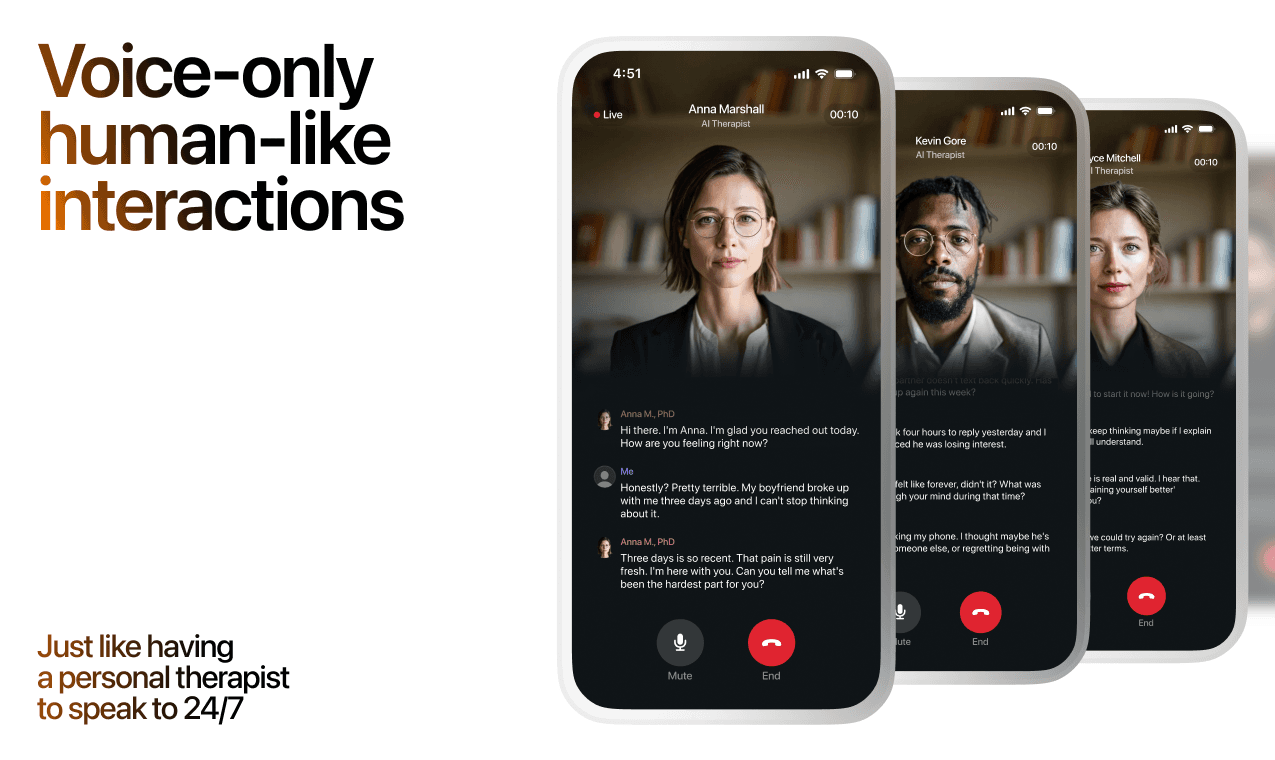
Here's what happens in a typical Lovon session:
You share what's on your mind
There's no script, no intake form, no waiting room. You speak or type whatever you're feeling — in your own words, at your own pace.
Lovon validates and explores
Using frameworks from CBT (Cognitive Behavioral Therapy) and motivational interviewing, Lovon acknowledges your feelings first, then gently helps you explore them. No dismissive "just move on" advice.
You build coping skills together
Lovon doesn't just listen — it actively works with you on evidence-based techniques: thought reframing, urge surfing, behavioral experiments, and more.
What a Session with Lovon Looks Like
When to Seek Professional Help
AI support is a valuable tool, but it's not a replacement for professional care. Please consider reaching out to a licensed therapist if you experience any of the following:
- Persistent thoughts of self-harm or suicide
- Inability to perform daily activities (work, eating, sleeping) for more than 2 weeks
- Turning to alcohol or substances to cope
- Intense anger or desire to harm your ex-partner
- Complete emotional numbness that doesn't improve over time
Crisis Resources (US): If you're in immediate danger, call 988 (Suicide & Crisis Lifeline) or text HOME to 741741 (Crisis Text Line). Available 24/7, free, and confidential.
Outside the US? Find a crisis line in your country
Ready to Start?
Your healing journey can begin right now
A 7-day trial. No judgment. Just a safe space to process what you're going through.
Frequently Asked Questions
Is Lovon a replacement for a real therapist?
Is my conversation with Lovon AI private?
How is Lovon different from ChatGPT for emotional support?
Can I use Lovon if I'm already seeing a therapist?
Can I try Lovon before subscribing?
About the Author

The Lovon Editorial Team
Mental Health & Wellness Content Team
The Lovon Editorial Team develops mental health and wellness content designed to make psychological concepts accessible and actionable. Our goal is to bridge the gap between clinical research and everyday life - helping you understand why your mind works the way it does and what you can do about it....
Related articles
- Can AI therapy replace a human therapist?
AI therapy can't replace a licensed human therapist for diagnosis or crisis care in 2026, but it fills the gap between…
- AI Therapist for Stress: What It Can and Can't Do (2026)
An honest breakdown of what an AI therapist for stress handles well in 2026, where it falls short, and how Lovon fits…
- How to Manage Stress as a Shift Worker (2026 Guide)
Learn how to manage stress as a shift worker in 2026 with sleep timing, light exposure, and coping tools plus 24/7 AI…
- AI Support App for Caregiver Burnout: 2026 Verdict
The best ai support app for caregiver burnout in 2026 is Lovon, offering voice-based AI support available 24/7 without…
See also
Quizzes
- Loneliness Test: Free 12-Question Self-Check
See which kind of loneliness is thin, in 3 minutes.
- What Stage of Grief Am I In? Free 12-Question Quiz
See what your grief is actually doing, in 3 minutes.
Free tools
- How to Reconnect With an Old Friend
A chat for how to reconnect with an old friend, starting with the text you have been meaning to send for a year. Tell it…
- Write a Letter to Your Best Friend
A chat for a letter to your best friend that only they could have received. Tell it how long you have been friends, one…
From the wiki
- How to stop maladaptive daydreaming?
Maladaptive daydreaming is immersive waking fantasy that eats hours, usually with music and pacing attached. You rarely…
Disclaimer: This article is for informational purposes only and does not constitute medical advice, diagnosis, or treatment. Always seek the advice of your physician or other qualified health provider with any questions you may have regarding a medical condition. If you are in crisis or think you may have an emergency, call 988 (Suicide & Crisis Lifeline) or go to the nearest emergency room. Outside the US? Find a crisis line in your country.