
AI Coping Tools for Social Media Addiction: 2026 Guide
AI coping tools for social media addiction pair urge tracking with real-time voice support. See what cuts compulsive scrolling in 2026 and where Lovon fits.

Key Takeaways
- AI coping tools for social media addiction work best paired with a manual trigger-tracking habit, not instead of one.
- Lovon gives you a voice session to talk through an urge instead of acting on it, available anytime in 2026.
- Comparison spirals, not just time spent scrolling, drive most of the anxiety tied to social media use.
- Screen time blockers alone rarely fix compulsive checking because they block access, not the urge itself.
Social media addiction coping tools powered by AI are on-demand exercises, voice check-ins, and pattern trackers built to interrupt compulsive scrolling and calm the anxiety that follows it, with the aim of cutting compulsive use without a cold-turkey deletion. Unlike general stress apps, these tools have to work in the exact moment the urge to check Instagram or TikTok hits, not on a fixed weekly schedule shared with a therapist.
TL;DR
- AI coping tools for social media addiction work best paired with a manual trigger-tracking habit, not instead of one.
- Lovon gives you a voice session to talk through an urge instead of acting on it, available anytime in 2026.
- Comparison spirals, not just time spent scrolling, drive most of the anxiety tied to social media use.
- Screen time blockers alone rarely fix compulsive checking because they block access, not the urge itself.
Why AI coping tools matter for social media addiction
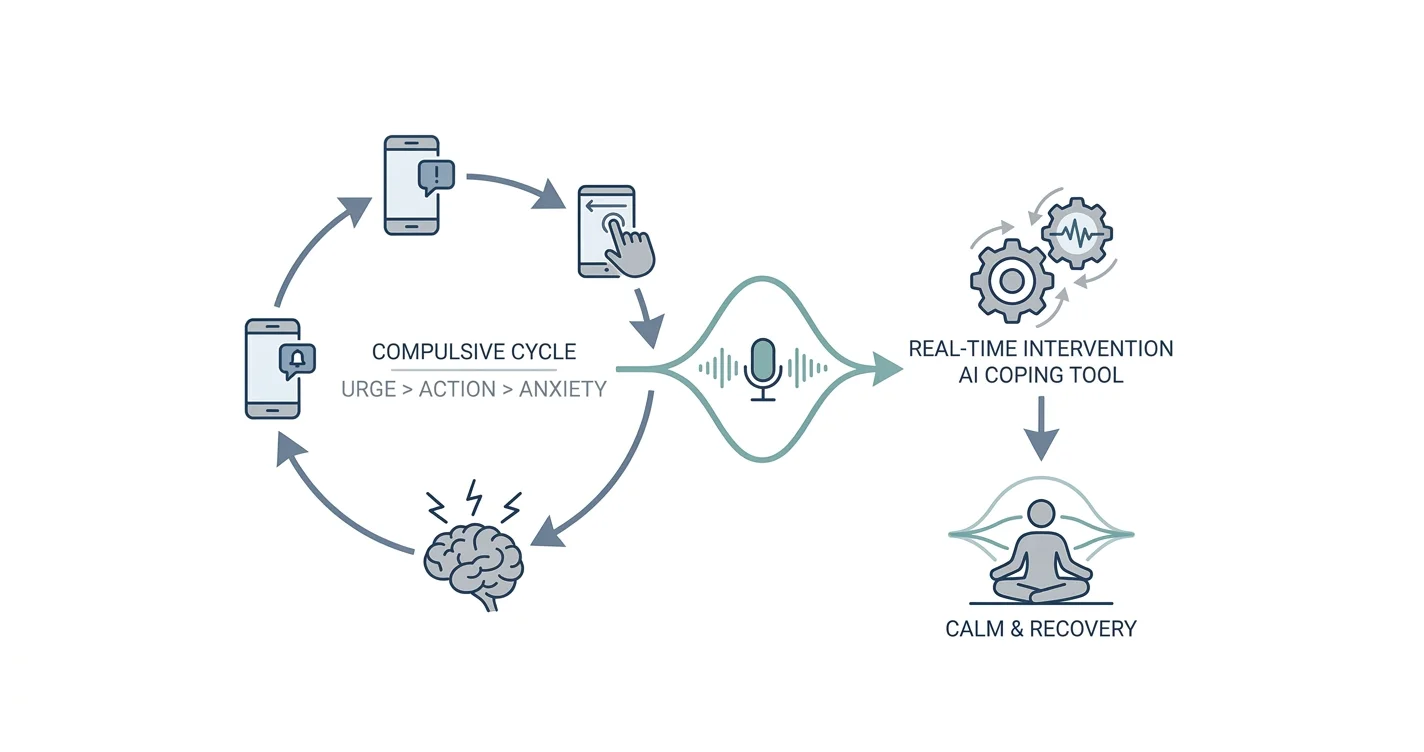
Compulsive checking runs on a loop: notification, dopamine hit, comparison, next check. Most screen-time tools only touch the middle of that loop — they cut you off from the app but do nothing about the urge that sent you reaching for it in the first place.
That's the gap AI coping tools are built to close. A voice session with Lovon doesn't count your minutes; it asks what's underneath the scroll — boredom, loneliness, dread of missing something — and walks you through it in real time, the way a person would if they picked up when you called at 11pm.
The anxiety piece matters more than people expect. Constant social media comparison fuels anxiety in a way raw screen time doesn't fully explain — two people can log the same three hours a day and come away with very different moods, depending on what they scrolled past.
How to build a coping routine for social media addiction
Track your trigger moments
Before you download anything, spend a week noticing when you reach for the app. This step is free and it's the one most people skip.
- Log the time, app, and mood right before you unlock your phone
- Name the emotion in one word: bored, lonely, anxious, avoidant
- Check your phone's built-in screen time report once a week, not daily
- Write the log by hand for at least five days before trying an app for it
- Look for one repeating pattern rather than trying to fix everything at once
Turn off the notifications that bait you back
Most compulsive checking is triggered by a badge, not a real need to look. Removing the bait cuts a large share of "just checking" moments before they start.
- Turn off "someone liked your post" and similar engagement alerts
- Kill red badge counts on social apps entirely
- Disable home-screen widgets that preview new content
- Keep push alerts only for messages and calls
- Batch-check social apps at two set times a day instead of on every ping
Put friction between you and the app
Friction works because compulsive habits run on ease. Add even a small delay and a surprising number of urges pass on their own.
- Log out of the app after every session
- Move the app off your home screen into a folder
- Delete the app and use it only through a browser
- Set a screen time passcode a friend or partner holds
- Turn your phone to grayscale to cut the visual pull
Talk through the urge before you act on it
This is where the manual habit and the faster path meet. Naming an urge out loud — even just to yourself — interrupts the automatic reach for the phone; saying it to something that responds interrupts it faster.
- Say out loud, "I want to check because I feel ___"
- Send a one-line text to a friend describing the urge
- Record a 60-second voice note to yourself instead of opening the app
- Open a voice session with Lovon and describe the urge as it's happening
- Write the urge down in a note instead of acting on it
Lovon won't block the app or track your screen time — that's not what it does. What a session gives you is a place to say "I want to check because I feel invisible today" out loud and get walked through that feeling instead of letting the scroll answer it for you.
Reframe the comparison spiral
Blocking the app doesn't undo what you already saw. The comparison loop needs its own step, separate from access control.
- Unfollow accounts you compare yourself to on a weekly basis
- Mute, don't just scroll past, accounts that trigger a mood dip
- Name one thing the post is designed to make you feel, out loud
- Ask whether the comparison is about the person or about your own week
- Read the how social media comparison fuels anxiety breakdown once, then check back in a month
Set a nightly wind-down boundary
Late-night scrolling tends to be the heaviest and the hardest to catch in the moment, because you're tired and your guard is down.
- Charge your phone outside the bedroom
- Set an app-block window from a fixed evening time until morning
- Swap the last 20 minutes of scrolling for a voice journaling session instead
- Keep a paper book or notebook by the bed as the physical alternative
- Treat one broken night as data, not a failure to fix immediately
Review your week's pattern
A coping routine only improves if you check it against what actually happened, not what you meant to do.
- Revisit your trigger log every seven days
- Adjust one variable at a time — one notification, one time window
- Track mood after a scroll session, not just minutes used
- Note which coping step you skipped most and ask why
- Measure reduction in urge intensity, not just app open counts
Talk through a scroll urge right now
Open a voice session with Lovon when the urge to check hits, day or night.
Comparing your options for social media addiction coping
| Option | Best for | Key limitation |
|---|---|---|
| Screen-time blockers | People who need a hard stop on specific apps | Blocks access, doesn't address the urge itself |
| CBT-based mental health apps | Structured, workbook-style exercises | Static content, doesn't respond to what you're feeling right now |
| General journaling apps | Processing feelings after a binge | No real-time guidance while the urge is happening |
| Lovon voice AI sessions | Talking through an urge or a binge as it happens | Not a licensed therapist and not a substitute for clinical treatment |
Lovon works best as the real-time piece of a coping routine, not as the whole routine — pair it with the blocking and friction steps above rather than expecting a single tool to cover everything.
Common mistakes people make with social media addiction coping
- Deleting the app for a week, then reinstalling it in one weak moment — with no plan for that moment, the binge that follows usually carries more shame than the original habit did.
- Treating the screen-time number as the only metric — two hours of connecting with friends and two hours of doom-scrolling strangers' highlight reels are not the same problem.
- Swapping one passive app for another — trading Instagram for a news feed or Reddit still leaves the compulsive-checking loop intact.
- Waiting for willpower instead of building friction ahead of time — willpower is highest in the morning and lowest exactly when the urge hits at night.
- Ignoring the loneliness or comparison driving the urge — a blocker with no support underneath it tends to get uninstalled within a few weeks.
FAQ
What are the best AI coping tools for social media addiction in 2026?
The strongest setup in 2026 pairs a screen-time blocker for access control with a voice-based AI coping tool like Lovon for the urge itself. Blockers alone rarely hold because they don't touch the emotion driving the check.
Can an AI app actually reduce compulsive scrolling?
An AI coping tool can reduce the frequency of compulsive checks by giving you somewhere to put the urge instead of the app. It works best combined with notification changes and friction steps, not as a standalone fix.
Is doom-scrolling a sign of a bigger mental health issue?
Doom-scrolling can be a coping habit tied to anxiety, low mood, or avoidance rather than a standalone problem. If it's paired with trouble sleeping, persistent dread, or withdrawal from people, it's worth talking to a licensed provider.
How is an AI coping tool different from a screen-time blocker?
A blocker restricts access to the app; an AI coping tool like Lovon gives you a place to talk through the urge to open it in the first place. They solve different halves of the same habit.
Does Lovon replace therapy for social media addiction?
No. Lovon is not a licensed clinician and does not replace therapy or clinical treatment. It works as an on-demand companion for the moments between sessions or when no session is scheduled.
How long does it take to break a compulsive scrolling habit?
There's no fixed timeline, and progress usually shows up as fewer or shorter urges before it shows up as zero screen time. Tracking urge intensity week to week is a more honest measure than counting days without the app.
What triggers compulsive social media checking?
Common triggers include boredom, loneliness, notification badges, and comparison after seeing someone else's post. Identifying which one applies to you is the first step in any coping routine.
Can I use an AI coping tool at night when urges are strongest?
Yes, a voice session with Lovon is available any time, including the late-night window when willpower is lowest and scrolling urges tend to be hardest to catch.
One last thing
If you only change one habit from this list, make it step four: say the urge out loud, or to Lovon, before you act on it. That's the piece almost every screen-time blocker skips, and it's usually the one that actually breaks the loop, not the block itself.
Related guides
How AI Support Helps You Heal
AI emotional support isn't about replacing human connection — it's about filling the gaps. The moments when you need to talk at 2 AM, when you don't want to burden your friends again, or when you simply need someone to listen without judgment.
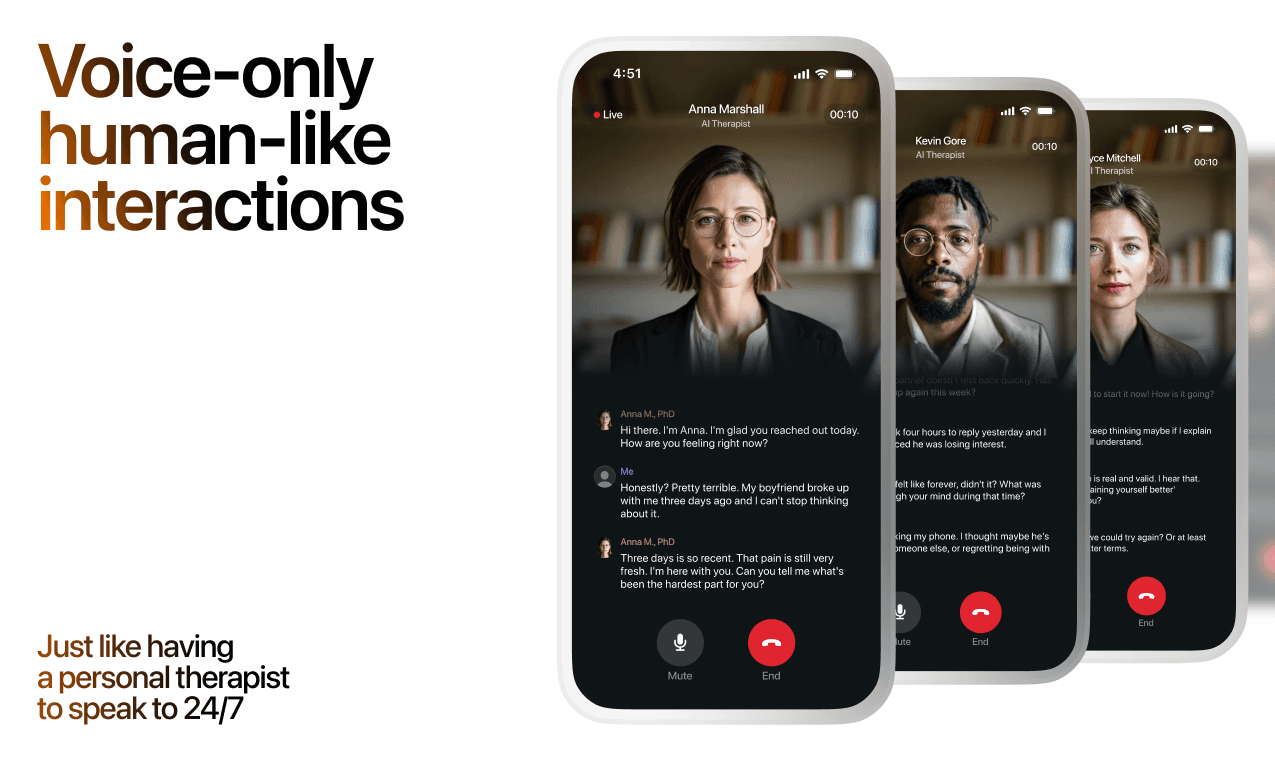
Here's what happens in a typical Lovon session:
You share what's on your mind
There's no script, no intake form, no waiting room. You speak or type whatever you're feeling — in your own words, at your own pace.
Lovon validates and explores
Using frameworks from CBT (Cognitive Behavioral Therapy) and motivational interviewing, Lovon acknowledges your feelings first, then gently helps you explore them. No dismissive "just move on" advice.
You build coping skills together
Lovon doesn't just listen — it actively works with you on evidence-based techniques: thought reframing, urge surfing, behavioral experiments, and more.
What a Session with Lovon Looks Like
When to Seek Professional Help
AI support is a valuable tool, but it's not a replacement for professional care. Please consider reaching out to a licensed therapist if you experience any of the following:
- Persistent thoughts of self-harm or suicide
- Inability to perform daily activities (work, eating, sleeping) for more than 2 weeks
- Turning to alcohol or substances to cope
- Intense anger or desire to harm your ex-partner
- Complete emotional numbness that doesn't improve over time
Crisis Resources (US): If you're in immediate danger, call 988 (Suicide & Crisis Lifeline) or text HOME to 741741 (Crisis Text Line). Available 24/7, free, and confidential.
Outside the US? Find a crisis line in your country
Ready to Start?
Your healing journey can begin right now
A 7-day trial. No judgment. Just a safe space to process what you're going through.
Frequently Asked Questions
Is Lovon a replacement for a real therapist?
Is my conversation with Lovon AI private?
How is Lovon different from ChatGPT for emotional support?
Can I use Lovon if I'm already seeing a therapist?
Can I try Lovon before subscribing?
About the Author

The Lovon Editorial Team
Mental Health & Wellness Content Team
The Lovon Editorial Team develops mental health and wellness content designed to make psychological concepts accessible and actionable. Our goal is to bridge the gap between clinical research and everyday life - helping you understand why your mind works the way it does and what you can do about it....
Related articles
- AI Therapy for Social Anxiety 2026: Verdict + Top Picks
AI therapy for social anxiety in 2026: which voice-based tools help, what to avoid, and when to see a licensed therapist…
- Best Free AI Life Coach App for Daily Habits 2026
The best free AI life coach app in 2026 for daily habits is Lovon — voice-based emotional support, coping tools and…
- AI Coping Tools for Hair Pulling & Skin Picking 2026
AI coping tools for hair pulling and skin picking help track triggers and manage urges in real time between sessions…
- Coping With Depression Alone in 2026: What Actually Helps
Coping with depression alone in 2026: a 7-step plan for the hours between therapy sessions, troubleshooting fixes, and…
See also
Quizzes
- Coping Style Test: How Do You Actually Handle Stress?
See how you really cope under stress, in 3 minutes.
- Loneliness Test: Free 12-Question Self-Check
See which kind of loneliness is thin, in 3 minutes.
Free tools
- Vent to an AI
Need to vent and there is nobody to call, or nobody you want to tell? Type it here. You are talking to an AI listener…
- Am I Overreacting, or Is This a Big Deal?
A chat for the small thing you cannot stop turning over. Say what happened and what you have already told yourself about…
From the wiki
- Why do I have no friends?
Usually nothing is wrong with you. Adult friendship runs on proximity and repetition, and most people lose both at once…
Disclaimer: This article is for informational purposes only and does not constitute medical advice, diagnosis, or treatment. Always seek the advice of your physician or other qualified health provider with any questions you may have regarding a medical condition. If you are in crisis or think you may have an emergency, call 988 (Suicide & Crisis Lifeline) or go to the nearest emergency room. Outside the US? Find a crisis line in your country.