
Coping With Depression Alone in 2026: What Actually Helps
Coping with depression alone in 2026: a 7-step plan for the hours between therapy sessions, troubleshooting fixes, and when to bring in a clinician.

Key Takeaways
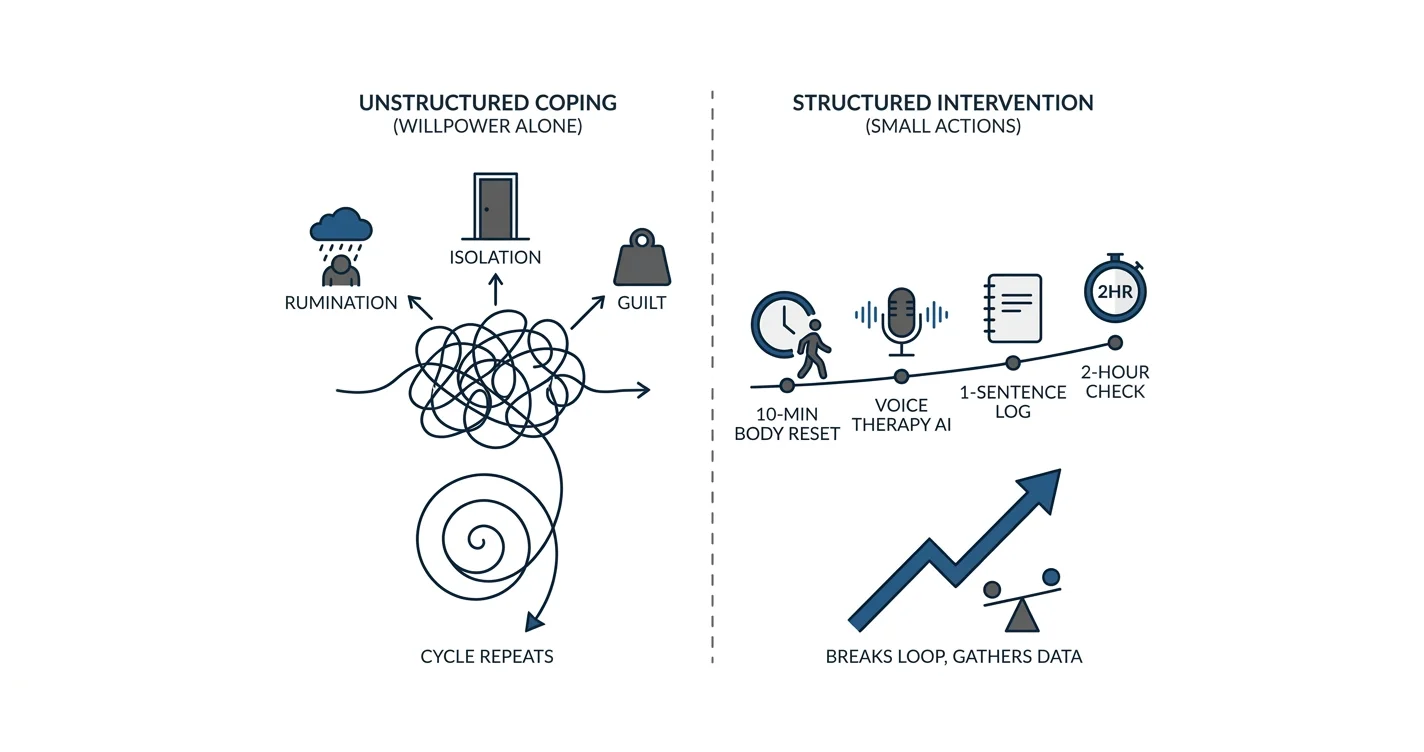
- Coping with depression alone in 2026 means small structured actions, not willpower alone.
- A 10-minute body reset interrupts a depressive episode faster than trying to think your way out.
- Lovon's AI voice therapy app fills the gap when no one's around to talk to at 2am.
- Scrolling in bed for hours deepens rumination instead of easing it — set a hard stop.
- Low mood most days for two weeks straight is the signal to bring in a licensed clinician.
Between therapy sessions, or when you don't have one scheduled yet, depression doesn't pause. This guide gives you a concrete plan for coping with depression alone in 2026 — what to do in the next 10 minutes, not just what to feel better about eventually.
TL;DR
- Coping with depression alone in 2026 means small structured actions, not willpower alone.
- A 10-minute body reset interrupts a depressive episode faster than trying to think your way out.
- Lovon's AI voice support app fills the gap when no one's around to talk to at 2am.
- Scrolling in bed for hours deepens rumination instead of easing it — set a hard stop.
- Low mood most days for two weeks straight is the signal to bring in a licensed clinician.
Why this matters
Most depression management doesn't happen in a therapist's office. It happens on a Tuesday afternoon when you can't get off the couch, or at midnight when the thoughts won't slow down. Sessions might be weekly. The hours between them are where the actual coping work gets tested.
The problem with "just push through it" advice is that it assumes energy and motivation you don't have on a bad day. What works instead is a short list of specific, low-effort actions you can do without deciding anything first. AI therapy for depression support exists partly to close this gap — not as a replacement for a clinician, but as something available at the exact moment you'd otherwise do nothing.
The goal between sessions isn't to fix the depression. It's to get through the next two hours.
“The goal between sessions isn't to fix the depression, it's to get through the next two hours.”
What you'll need
- 10 to 15 minutes of uninterrupted time, even if you spend half of it doing nothing
- A notes app or a single sheet of paper — you're writing one sentence, not journaling
- A timer (phone alarm works)
- One thing or person you can reach when no one's physically around — a hotline, a friend on call, or an AI voice support app like Lovon for the in-between hours
- A willingness to do the smallest version of a task, not the ideal version
The steps
1. Name what you're feeling, specifically
"Depressed" is too broad to act on. Naming it as flat, heavy, numb, or agitated tells you which of the next steps actually applies. This takes 30 seconds and changes what you do next.
Say it out loud or type it: "I feel flat and tired, not sad and crying." That's a different problem than the second one, and it needs a different response.
Common mistake: skipping this and jumping straight to "I should exercise" or "I should journal" without checking if that's the right tool for the specific state you're in.
2. Move your body for 10 minutes, no more
Movement changes depressive states faster than most cognitive techniques, but the instruction "exercise more" is useless on a day you can barely stand. Cap it at 10 minutes on purpose — a walk to the mailbox and back, five minutes of stretching, one flight of stairs twice.
Ten minutes is short enough that your brain won't argue with you about it. Longer than that, and the depressive brain negotiates you out of starting at all.
Common mistake: treating this as a workout with a goal, instead of a body-state reset with a 10-minute ceiling.
3. Interrupt the loop instead of riding it out
Rumination feels productive — like you're solving something — but it usually just replays the same three thoughts for 40 minutes. Rumination and depression explains why this loop keeps running and how to break it with a concrete interruption task: naming five objects in the room, counting backward from 100 by sevens, or reading two paragraphs out loud.
The interruption doesn't need to be meaningful. It needs to occupy the part of your brain that's currently stuck.
Common mistake: trying to "think positively" instead of interrupting the thought pattern entirely. Positive thoughts still feed the same loop.
4. Talk it out, even if no one's home
Depression narrows your world until it feels like there's no one to call. At 11pm on a Sunday, that's often true. This is where voice-based support closes a real gap — saying the thought out loud, even to an AI, changes how it sits in your head compared to just thinking it.
Lovon is built for exactly this window: it's not a licensed clinician and it says so directly, but it's available at 2am when your actual therapist isn't, and talking through a spiral out loud is different from sitting alone with it.
Common mistake: waiting for the "right" person to be available before saying anything, and staying silent in the meantime.
5. Check your window of tolerance first
If you're outside your window of tolerance — flooded, numb, or shut down — none of the above steps will land the way they're supposed to. Window of tolerance explains how to check where you are and how to widen that window before pushing yourself into a task.
A simple check: can you focus on a sentence right now, or does your mind slide off it? If it slides off, do a grounding step first — five things you can see, four you can touch — before anything else on this list.
Common mistake: forcing a coping technique on a nervous system that's already overloaded, which usually backfires and adds guilt on top of the original mood.
6. Log one sentence, not an essay
Full journaling is a great tool on a good day and an impossible ask on a bad one. On low-energy days, write one sentence: what happened, how you feel, what you did about it. "Skipped lunch, felt flat, went for a short walk instead of staying in bed."
Over two or three weeks, one-sentence logs show you patterns — time of day, triggers, what actually helped — that you'd miss otherwise.
Common mistake: abandoning journaling entirely because a full entry feels like too much. One sentence still counts.
7. Set a timer to re-check in 2 hours
Depressive states shift, sometimes within hours, and checking back in gives you a concrete point to reassess instead of assuming the mood is permanent. Set a 2-hour timer after you've done steps 1 through 6.
When it goes off, ask one question: better, same, or worse. That answer tells you whether to repeat the plan, escalate, or just keep going with your day.
Common mistake: assuming a bad hour means a bad day, or a bad day means a bad month. Re-checking breaks that assumption with data instead of guessing.
Troubleshooting
"I can't get out of bed at all." Drop the 10-minute movement step down to sitting up and putting your feet on the floor for 60 seconds. That's the whole task. Build from there tomorrow, not today.
"I keep numbing out by scrolling for hours." Set a hard stop with a timer before you pick up the phone, not after. Scrolling isn't the problem — the open-ended, unbounded version of it is.
"None of this is working and I've tried it for a week." One week of self-directed coping without improvement is a signal, not a failure on your part. How to get out of a depressive episode on your own covers what a longer episode looks like and when self-coping stops being enough on its own.
"I feel guilty for needing this much support." Guilt about needing help is a symptom, not evidence you're doing something wrong. Treat it as part of the depression, not a fact about your worth.
"The low mood has lasted for weeks, not days." This is past the scope of at-home coping tools. Two weeks or more of daily low mood, most of the day, is the standard point to bring in a licensed clinician — not a sign that self-coping failed you.
Tools and resources
- A timer app for the 10-minute and 2-hour checkpoints
- A one-line daily log, kept somewhere you'll actually reopen
- An AI voice support app for the hours no one else is reachable — Lovon is built specifically for this, not as a clinician replacement
- A short list of three grounding techniques you don't have to think up on the spot
- One person you've already told "call me if I don't respond" — decide this on a good day, not a bad one
What to do next
Once the immediate coping plan is in place, the next useful move is figuring out whether what you're managing is depression, burnout, or ordinary low mood — they need different responses, and treating one like the other wastes energy you don't have to spare.
FAQ
What's the best way to cope with depression alone at night?
Cap screen time with a hard stop, do a 5-minute grounding exercise, and log one sentence about the day before bed. Nighttime rumination gets worse the longer it runs unchecked, so interrupting it early matters more than any single technique.
Is it normal to feel worse right after a therapy session?
Yes, it's common to feel raw or tired after sessions that surface difficult material. This usually settles within a day; if it doesn't by the next session, mention it to your therapist directly.
How long should I try coping with depression alone before reaching out to a professional?
If daily low mood, low energy, or loss of interest lasts two weeks or more, that's the point to involve a licensed clinician. Self-coping tools help in the moment but aren't a substitute for treatment at that duration.
Can an AI therapist actually help with depression between sessions?
An AI voice support app like Lovon can give you a place to talk through a spiral in real time, which is different from sitting with it silently. It's not a licensed clinician and doesn't replace one, but it fills the specific gap of availability at odd hours.
What's the difference between coping with depression alone and isolating?
Coping alone means using structured tools during hours when support isn't available. Isolating means avoiding contact even when it is. The distinction matters because isolating tends to deepen a depressive episode, while structured solo coping is meant to bridge it.
How much movement actually helps with a depressive episode?
Even 10 minutes of light movement — a short walk, stretching, stairs — shifts a depressive state more than an all-or-nothing exercise goal. The 10-minute cap matters because open-ended goals get negotiated away on low-energy days.
Is one-sentence journaling enough to manage depression day to day?
One sentence a day is enough to reveal patterns over two to three weeks, which is more than most people get from irregular full journal entries. It's not a full treatment tool, but it's a low-effort tracking method that holds up on bad days.
What are the warning signs that self-coping for depression isn't enough anymore?
Daily low mood lasting two weeks or more, loss of interest in nearly everything, or thoughts of self-harm all mean it's time to bring in a licensed professional. Self-coping tools are for the hours between support, not a substitute for it.
One last thing
The most overlooked part of coping with depression alone isn't the technique — it's the 2-hour re-check. Most people either assume a bad morning predicts a bad day, or wait until evening to notice they never checked in at all. A timer that forces a same/better/worse answer every couple of hours turns a vague, all-day mood into something you can actually respond to in real time.
Related guides
How AI Support Helps You Heal
AI emotional support isn't about replacing human connection — it's about filling the gaps. The moments when you need to talk at 2 AM, when you don't want to burden your friends again, or when you simply need someone to listen without judgment.
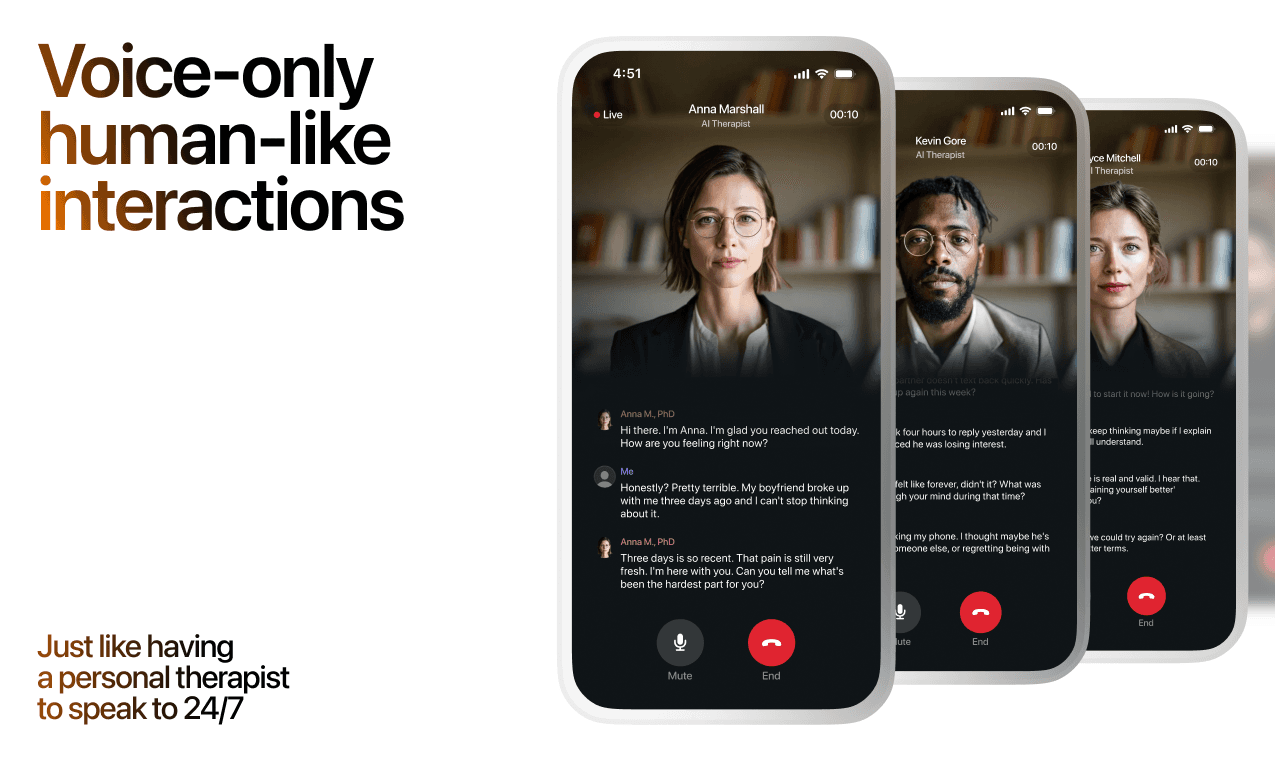
Here's what happens in a typical Lovon session:
You share what's on your mind
There's no script, no intake form, no waiting room. You speak or type whatever you're feeling — in your own words, at your own pace.
Lovon validates and explores
Using frameworks from CBT (Cognitive Behavioral Therapy) and motivational interviewing, Lovon acknowledges your feelings first, then gently helps you explore them. No dismissive "just move on" advice.
You build coping skills together
Lovon doesn't just listen — it actively works with you on evidence-based techniques: thought reframing, urge surfing, behavioral experiments, and more.
What a Session with Lovon Looks Like
Lovon is AI support, not a replacement for professional care. If things have been hard to get through for weeks, or you are thinking about harming yourself, talk to a doctor or a licensed therapist.
Ready to Start?
Your healing journey can begin right now
A 7-day trial. No judgment. Just a safe space to process what you're going through.
Frequently Asked Questions
Is Lovon a replacement for a real therapist?
Is my conversation with Lovon AI private?
How is Lovon different from ChatGPT for emotional support?
Can I use Lovon if I'm already seeing a therapist?
Can I try Lovon before subscribing?
About the Author

The Lovon Editorial Team
Mental Health & Wellness Content Team
The Lovon Editorial Team develops mental health and wellness content designed to make psychological concepts accessible and actionable. Our goal is to bridge the gap between clinical research and everyday life - helping you understand why your mind works the way it does and what you can do about it....
Related articles
- How to Manage Stress as a Shift Worker (2026 Guide)
Learn how to manage stress as a shift worker in 2026 with sleep timing, light exposure, and coping tools plus 24/7 AI…
- Stop Self-Isolating Depression: 2026 Step-by-Step Fix
Self-isolating depression breaks with small, specific steps, not motivation. Get the 2026 plan, troubleshooting, and…
- Doom Scrolling and Dissociation: How to Break It (2026)
Doom scrolling and dissociation share a shutdown circuit, not a willpower gap. Get the 2026 step-by-step fix, from…
- Loneliness vs Being Alone: Tell the Difference (2026)
Loneliness vs being alone explained with a step-by-step self-check for 2026. Learn the real difference, spot chronic…
See also
Quizzes
- Resilience Test: How Fast Do You Bounce Back?
See how you recover from setbacks, in 3 minutes.
- Experiential Avoidance Test: Do You Avoid Your Feelings?
See which way you keep feelings out, in 3 minutes.
Free tools
- Am I Overreacting, or Is This a Big Deal?
A chat for the small thing you cannot stop turning over. Say what happened and what you have already told yourself about…
- Words of Encouragement for Him When He Is Struggling
Words of encouragement for him that fit what he is actually going through, for when your usual lines are not landing…
From the wiki
- How to stop maladaptive daydreaming?
Maladaptive daydreaming is immersive waking fantasy that eats hours, usually with music and pacing attached. You rarely…
Disclaimer: This article is for informational purposes only and does not constitute medical advice, diagnosis, or treatment. Always seek the advice of your physician or other qualified health provider with any questions you may have regarding a medical condition. If you are in crisis or think you may have an emergency, call 988 (Suicide & Crisis Lifeline) or go to the nearest emergency room. Outside the US? Find a crisis line in your country.