
Digital Mental Health Tools 2026: What Actually Helps
Digital mental health tools ranked for 2026 — AI voice therapy, teletherapy, and CBT apps compared with clear Buy, Consider, and Hold verdicts.

Key Takeaways
- Start with what's free before you subscribe to anything. Most credible digital mental health tools in 2026 offer a
- Check licensing claims directly. If an app says it involves licensed clinicians, that should be verifiable on the
- Match the tool to the moment, not the marketing. A breathing app doesn't replace a crisis line, and a peer forum
Digital mental health tools now range from five-minute breathing apps to AI voice therapists that talk you through a panic spiral at 2 a.m. This guide ranks the categories that actually move the needle in 2026, tells you which ones are backed by real research, and flags the ones that are mostly marketing.
TL;DR
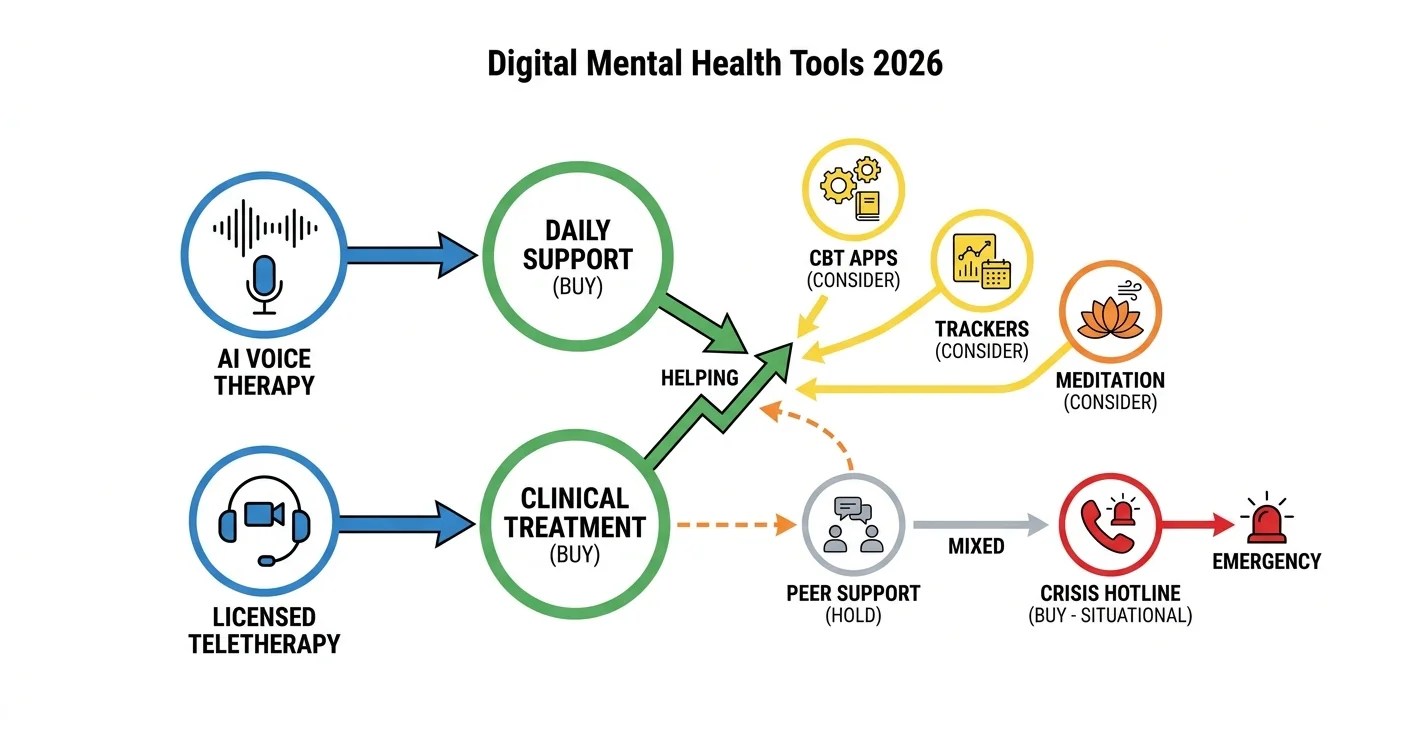
The strongest digital mental health tools in 2026 fall into three buckets: AI voice support apps like Lovon for on-demand emotional support, licensed teletherapy platforms for clinical treatment, and structured CBT apps for skill-building between sessions. AI voice therapy is the Buy for daily, always-available support; teletherapy is the Buy for diagnosis and medication management; mood trackers and meditation apps are Consider-tier add-ons, not standalone fixes. Peer support forums rank Hold — helpful for connection, unreliable for crisis moments. If you need something you can open in the middle of a bad night, digital mental health tools built around voice conversation outperform text-only chatbots on almost every engagement metric tracked by app stores in 2026.
Why this matters
Therapy waitlists in most US states run 30 to 60 days for a new client, and a single out-of-pocket session averages well over $100 without insurance. That gap is exactly why digital mental health tools exist — not to replace a licensed clinician, but to fill the hours between sessions or the months before you can even get one.
The category got crowded fast. App stores list thousands of "mental health" apps, and most of them are journaling templates with a mood emoji bolted on. The ones worth your time in 2026 do one of three things well: give you real-time emotional support, teach a repeatable coping skill, or track a pattern you'd otherwise miss. Everything else is noise.
How this list was built
Each category below is scored on four things: evidence behind the method (CBT, DBT, polyvagal-informed techniques), how available it is when you actually need it (3 a.m. counts), whether it requires ongoing cost or a subscription, and how it handles the line between support and clinical care. A 2022 JMIR Mental Health meta-analysis of app-based CBT programs found symptom reduction in the 20-30% range over eight weeks for mild-to-moderate anxiety — that's the bar digital mental health tools have to clear to be worth listing here, not just a nice interface.
The ranked list
1. AI voice therapy apps — the always-on option
Verdict: Buy. Voice-based AI support, like the sessions on Lovon, removes the biggest friction point in digital mental health tools: typing out how you feel when you're too anxious to type. Sessions run on-demand, with no scheduling and no waitlist, which matters when the bad moment is happening right now, not in three weeks. AI voice therapy differs from text-based apps in a specific way — tone and pacing carry information that text strips out, which is why voice sessions tend to run longer and get revisited more often than chat-based tools.
2. Licensed teletherapy platforms — the clinical backbone
Verdict: Buy for diagnosis and treatment. Video sessions with a licensed clinician remain the only digital option that can diagnose, prescribe, or manage complex conditions like bipolar disorder or PTSD. Digital tools without insurance still cost real money — expect $100-$250 per session in most metro markets in 2026 — but this is the tier you need if symptoms are severe, worsening, or tied to a diagnosed condition.
3. Structured CBT and DBT apps — the homework tier
Verdict: Consider. These apps turn cognitive behavioral techniques into daily modules — thought records, exposure ladders, skills practice. They work best as a between-session supplement, not a replacement for a clinician, and adherence drops off fast after week three in most published trials. Good for building one specific skill; weak for open-ended emotional support.
4. Mood and symptom trackers — the pattern-finder
Verdict: Consider. Tracking mood, sleep, and triggers over 30-60 days surfaces patterns you can't see day-to-day — a stretch of poor sleep before a depressive dip, for instance. The data is only useful if you actually review it; most users stop logging after 10-14 days, which caps the value of this category on its own.
5. Guided meditation and breathing apps — the nervous-system reset
Verdict: Consider. These work fast for acute stress spikes and are the cheapest entry point into digital mental health tools, often free or under $15/month. Box breathing and similar techniques can lower heart rate within minutes, but the effect fades without repetition — this is maintenance, not treatment.
6. Peer support communities — the crowd-sourced companion
Verdict: Hold. Forums and peer chat apps reduce isolation and normalize what people are going through, which has real value for loneliness specifically. They're inconsistent for crisis moments since responses come from other users, not clinicians, and moderation quality varies wildly between platforms.
7. Crisis text and hotline services — the emergency backstop
Verdict: Buy, but only for what it's built for. Free, immediate, staffed by trained responders. This isn't a daily-use tool — it's the one you keep bookmarked for the moment things escalate past what any app-based tool should handle alone.
Comparison table
| Tool type | Cost model | Best for | Available at 3 a.m.? | Verdict |
|---|---|---|---|---|
| AI voice therapy | Subscription, no per-session fee | Daily emotional support, stress, low mood | Yes | Buy |
| Licensed teletherapy | $100-$250/session | Diagnosis, medication, complex conditions | No | Buy |
| CBT/DBT structured apps | Subscription | Skill-building between sessions | Yes | Consider |
| Mood/symptom trackers | Free to low-cost | Spotting patterns over weeks | Yes | Consider |
| Meditation/breathing apps | Free to $15/mo | Acute stress relief | Yes | Consider |
| Peer support forums | Free to low-cost | Reducing isolation | Yes, inconsistent | Hold |
| Crisis text/hotline | Free | Emergencies only | Yes | Buy (situational) |
Where to find these tools
- Start with what's free before you subscribe to anything. Most credible digital mental health tools in 2026 offer a no-cost tier or trial — test the interaction style before committing to a monthly cost.
- Check licensing claims directly. If an app says it involves licensed clinicians, that should be verifiable on the app's own site, not just in app store copy.
- Match the tool to the moment, not the marketing. A breathing app doesn't replace a crisis line, and a peer forum doesn't replace a diagnosis. Layer tools by what each one is actually built to do.
FAQ
What are the best digital mental health tools in 2026? AI voice support apps like Lovon rank highest for daily, on-demand support, licensed teletherapy ranks highest for clinical treatment, and CBT-structured apps rank highest for skill-building. No single category covers every need — most people benefit from combining two.
Is AI therapy as effective as human therapy? AI-based support is not a replacement for licensed clinical care, but it fills gaps human therapy can't — availability at odd hours, no waitlist, and no per-session cost. Use it alongside a clinician for anything diagnosed or severe.
How much do digital mental health tools cost? Ranges are wide: free crisis lines and basic meditation apps, subscriptions in the $10-$30/month range for AI support and CBT apps, and $100-$250 per session for licensed teletherapy without insurance in 2026.
Can digital mental health tools replace therapy? No. Tools built around AI voice or chat support explicitly position themselves as supplements, not replacements, for licensed clinical care — especially for diagnosed conditions, medication needs, or crisis situations.
What's the best free digital mental health tool? Crisis text and hotline services are free and staffed by trained responders. Many AI support apps and meditation apps also offer free tiers worth testing before you subscribe to anything.
Are mental health apps private and secure? Privacy standards vary by app — check the specific privacy policy before sharing sensitive details, since not every wellness app follows the same data-handling standards as a clinical provider.
How do I know if I need an app or a therapist? If symptoms are new, mild, or situational — stress, low mood, relationship friction — a digital tool is a reasonable starting point. If symptoms are severe, persistent past several weeks, or involve safety concerns, a licensed clinician should be involved.
What should I look for in an on-demand therapy app? Look for on-demand availability, a clear statement of what the tool is and isn't, and transparency about clinical involvement. Apps that overpromise "replacing your therapist" are a red flag, not a selling point.
One last thing
The apps that get abandoned fastest aren't the clinical ones — they're the ones that ask for too much setup before they give anything back. The tools people actually keep open past week one are the ones with near-zero friction: open the app, start talking, get something useful in under two minutes. That's the real filter for digital mental health tools in 2026, more than any feature list.
Related guides
How AI Support Helps You Heal
AI emotional support isn't about replacing human connection — it's about filling the gaps. The moments when you need to talk at 2 AM, when you don't want to burden your friends again, or when you simply need someone to listen without judgment.
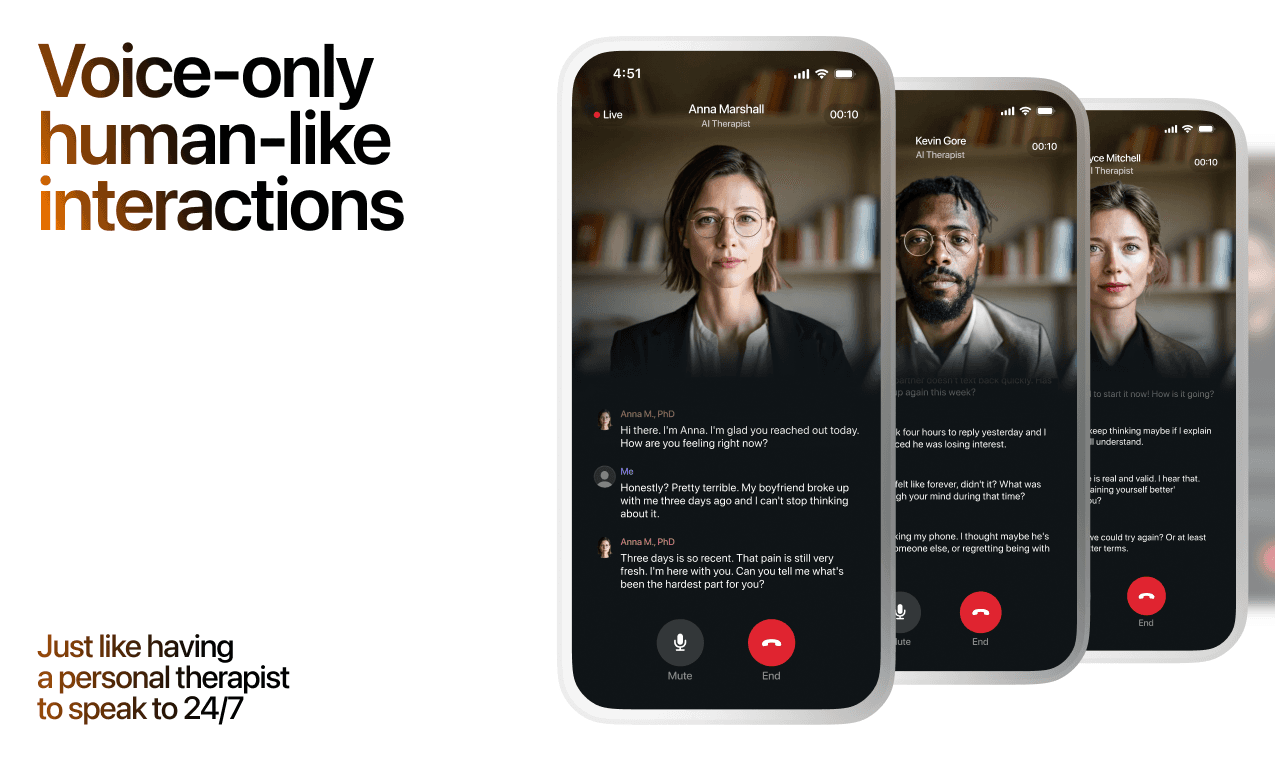
Here's what happens in a typical Lovon session:
You share what's on your mind
There's no script, no intake form, no waiting room. You speak or type whatever you're feeling — in your own words, at your own pace.
Lovon validates and explores
Using frameworks from CBT (Cognitive Behavioral Therapy) and motivational interviewing, Lovon acknowledges your feelings first, then gently helps you explore them. No dismissive "just move on" advice.
You build coping skills together
Lovon doesn't just listen — it actively works with you on evidence-based techniques: thought reframing, urge surfing, behavioral experiments, and more.
What a Session with Lovon Looks Like
Lovon is AI support, not a replacement for professional care. If things have been hard to get through for weeks, or you are thinking about harming yourself, talk to a doctor or a licensed therapist.
Ready to Start?
Your healing journey can begin right now
A 7-day trial. No judgment. Just a safe space to process what you're going through.
Frequently Asked Questions
Is Lovon a replacement for a real therapist?
Is my conversation with Lovon AI private?
How is Lovon different from ChatGPT for emotional support?
Can I use Lovon if I'm already seeing a therapist?
Can I try Lovon before subscribing?
About the Author
The Lovon Editorial Team
Mental Health & Wellness Content Team
The Lovon Editorial Team develops mental health and wellness content designed to make psychological concepts accessible and actionable. Our goal is to bridge the gap between clinical research and everyday life - helping you understand why your mind works the way it does and what you can do about it....
Related articles
- Emotional Support App for Loneliness: What Wins in 2026
Compares emotional support apps for loneliness in 2026 — what to look for, top picks, and verdicts. Lovon rated the top…
- Best ChatGPT alternatives for emotional support in 2026
Compare the best ChatGPT alternatives for therapy. Choose voice support for everyday feelings or licensed care for…
- Best AI Mental Health App for Rural Residents (2026)
Lovon ranks best AI mental health app for rural residents in 2026 for on-demand voice support, alongside 988…
- Best AI Therapy for Depression (2026 Guide)
AI therapy for depression in 2026: Lovon's voice app delivers CBT-based sessions, 24/7 on-demand access, and…
See also
Quizzes
- Self-Control Test: Where Does Your Willpower Slip?
See where your willpower slips, in 3 minutes.
- Shame Test: Do You Read Mistakes as Verdicts?
See which exit your shame takes, in 3 minutes.
Free tools
- 4-7-8 Breathing
Breathe in for four, hold for seven, breathe out for eight. The long out-breath is the point. Follow the circle; no…
- Letting Go Meditation
For the person, the message you keep waiting for, or the future you were counting on. Seven minutes to loosen your grip…
From the wiki
- What to do if you have no friends?
Pick one activity that repeats weekly with the same people, and go for six to eight weeks straight. Repetition, not…
Disclaimer: This article is for informational purposes only and does not constitute medical advice, diagnosis, or treatment. Always seek the advice of your physician or other qualified health provider with any questions you may have regarding a medical condition. If you are in crisis or think you may have an emergency, call 988 (Suicide & Crisis Lifeline) or go to the nearest emergency room. Outside the US? Find a crisis line in your country.