
AI Coping Tools for Chronic Dieting and Food Guilt (2026)
AI coping tools for chronic dieting and food guilt: what to look for, top picks, what to avoid, and a 2026 verdict comparison for breaking the guilt cycle.

Key Takeaways
- Lovon's AI voice therapy works as an on-demand coping tool for chronic dieting and food guilt spirals — Buy for the
- Chronic dieters need pattern-interrupt tools, not another meal tracker — voice-based reframing beats a text box when
- Skip chatbots that grade your food choices; they reinforce the same guilt cycle a good coping tool should break.
- A 10-minute nightly check-in catches food guilt before it turns into the next day's restrict-binge pattern.
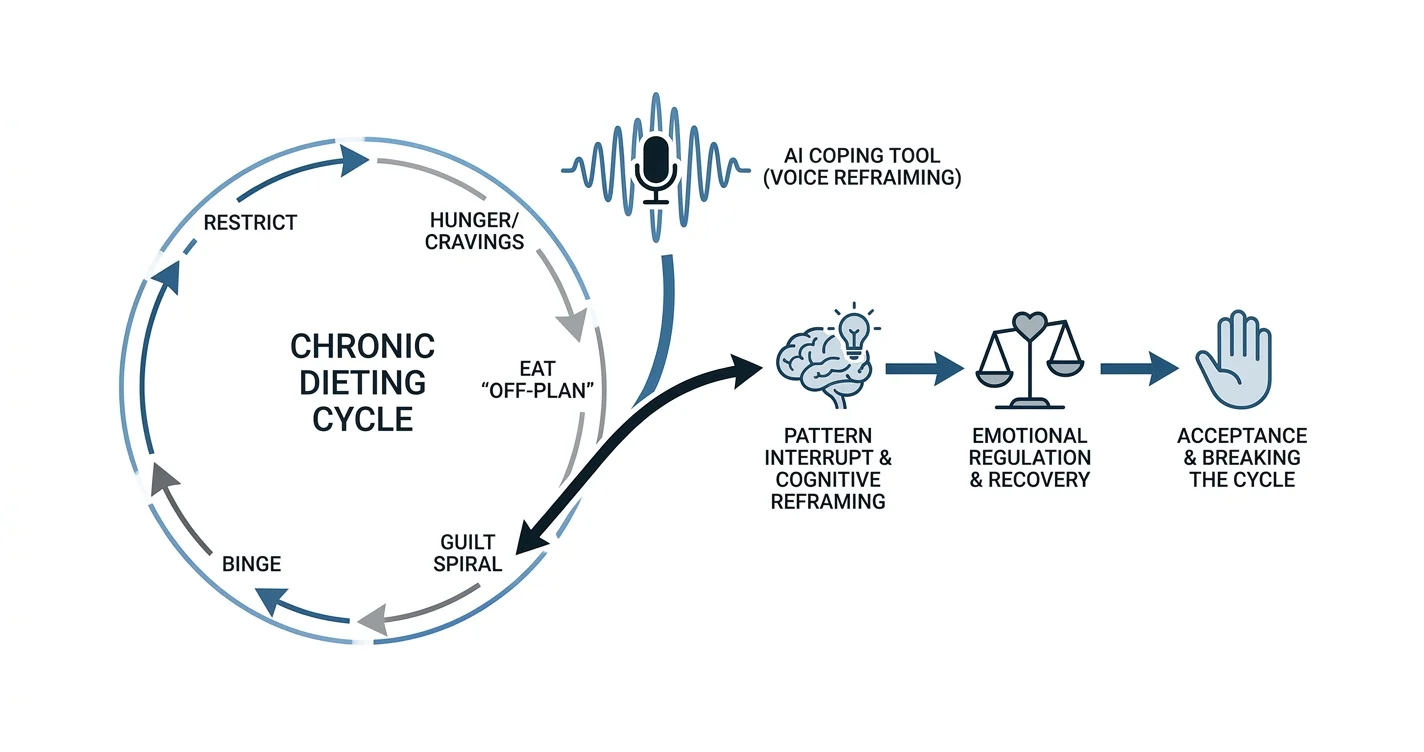
Chronic dieting rewires how you talk to yourself about food, and food guilt often outlasts every meal plan you've tried and abandoned. AI coping tools for chronic dieting and food guilt give you somewhere to name the guilt spiral before it turns into another restrict-binge cycle, without needing to book a session first.
TL;DR
- Lovon's AI voice support works as an on-demand coping tool for chronic dieting and food guilt spirals — Buy for the 3am guilt catch.
- Chronic dieters need pattern-interrupt tools, not another meal tracker — voice-based reframing beats a text box when you're exhausted.
- Skip chatbots that grade your food choices; they reinforce the same guilt cycle a good coping tool should break.
- A 10-minute nightly check-in catches food guilt before it turns into the next day's restrict-binge pattern.
Why this matters
Yo-yo dieting doesn't just fail at weight change — it trains your brain to treat food as a moral test. Eat the "wrong" thing and the guilt shows up faster than any hunger cue, and by 2026 most people who've dieted repeatedly can recite their own inner critic word for word.
The problem isn't willpower. It's that most tools built for this moment — calorie apps, macro trackers, diet forums — measure food, not feelings. AI coping tools for chronic dieting and food guilt are built for the feeling part, the 11pm spiral after a "bad" dinner, not the spreadsheet part.
Who this is for
This is for the person who has dieted, quit, restarted, and dieted again enough times to lose count. You know the macros. You know the rules. What you don't have is a way to interrupt the guilt that hits the second you eat something off-plan, especially at night when no therapist is answering and no friend wants a 2am text about a cookie.
If you're already in eating disorder treatment, a free 20-minute AI therapy session between appointments is a support layer, not a replacement for your care team. Lovon is explicit about that boundary and doesn't pretend otherwise.
What to look for in AI coping tools for chronic dieting and food guilt
Judgment-free language, not a scorecard
A tool that responds to "I ate too much" with tips on portion control is missing the point entirely. Chronic dieters already know the nutrition facts — what breaks the cycle is a voice that doesn't rank the meal, just helps you sit with the guilt until it passes.
Available at the exact moment guilt hits
Guilt spirals rarely wait for business hours. The tool has to work at 11pm on a Tuesday, right after the plate is empty, not three days later at a scheduled appointment.
Grounded in real coping frameworks, not diet scripts
Cognitive reframing and self-compassion techniques have decades of clinical use behind them. A tool dressed up with wellness language but running on generic chatbot logic won't hold up the third or fourth time you use it.
Voice-based, not another text box
Typing out a guilt spiral takes energy you don't have after a hard meal. Talking it through out loud, the way you would with a person, lowers the barrier to actually using the tool instead of closing the app.
Clear about its own limits
A responsible tool says plainly that it isn't a licensed clinician and isn't built to diagnose or treat an eating disorder. If a tool never mentions its limits, that's a bigger red flag than any feature it's missing.
Doesn't require a waitlist or a referral
Chronic food guilt doesn't wait for an opening. The tool needs to be usable the same day the guilt shows up, not after a two-week intake process.
Top picks for breaking the food guilt cycle
The 3am guilt catch — the one you'll actually use. A short voice check-in right after the spiral starts, before it turns into a 2-hour scroll through diet forums. Spec that matters: sessions run without a scheduled appointment, so the gap between the guilt and the support is minutes, not days. Buy.
The pre-meal reframe — the wildcard. Instead of waiting for guilt to hit after eating, this pick works before the meal, catching the all-or-nothing thinking ("I already messed up today, might as well eat whatever") that drives most binge-restrict cycles. It draws on the same cognitive distortion patterns that show up in chronic guilt generally, not just around food. Consider if your guilt tends to build before meals rather than after.
The post-binge debrief — the safe pick. A structured voice conversation after an eating episode that feels out of control, focused on naming what happened without moralizing it. This is the pick most chronic dieters reach for first because it matches the moment they're already in. Buy.
The plateau reality check — the one to use sparingly. For the specific guilt that shows up when the number on the scale doesn't move despite "doing everything right." Useful once a week at most — leaning on it daily can turn into another form of checking behavior. Consider.
What to avoid
- Diet-tracking apps rebranded as mental health tools. If the core function is still logging calories or macros, the guilt cycle stays intact no matter what the marketing copy says.
- Generic chatbots that dole out nutrition advice. A tool that answers "I feel guilty about eating" with a meal-planning tip is solving the wrong problem.
- Supplement-first quick fixes. Chronic dieters often chase the next fix — a new supplement, a macro tweak, an appetite suppressant — hoping willpower finally sticks this time.
Talk through tonight's food guilt now
No waitlist, no appointment — start a voice session on Lovon.
Verdict comparison
| Approach | Judgment-free | Available at 3am | CBT-grounded | Verdict |
|---|---|---|---|---|
| 3am guilt catch | Yes | Yes | Yes | Buy |
| Pre-meal reframe | Yes | Yes | Yes | Consider |
| Post-binge debrief | Yes | Yes | Yes | Buy |
| Plateau reality check | Yes | Yes | Partial | Consider |
| Calorie-tracking app with chat add-on | No | Yes | No | Skip |
FAQ
What are the best AI coping tools for chronic dieting and food guilt in 2026?
The strongest tools in 2026 pair voice-based check-ins with cognitive reframing rather than food logging. Lovon's on-demand sessions are built for the guilt moment itself, not for tracking what you ate.
Can an AI app replace eating disorder treatment?
No. AI coping tools for chronic dieting and food guilt are built as support between sessions or for everyday guilt spirals, not as a replacement for a licensed clinician treating an eating disorder.
Is voice-based support better than text-based apps for food guilt?
For most chronic dieters, yes — typing out a guilt spiral takes energy that's already depleted after a hard meal. Talking it through lowers the barrier to actually using the tool in the moment.
How much does an AI coping tool for food guilt cost?
Pricing varies by app and plan, so check current details on the app's own pricing page before committing. Free trial tiers are common but limited in session length.
What triggers chronic food guilt the most?
All-or-nothing thinking around a single meal is the most common trigger — one "off-plan" bite gets read as total failure, which then triggers either restriction or a binge. Reframing that thought pattern is the actual fix, not another meal rule.
Should I use an AI coping tool before or after eating?
Both have a place. Pre-meal check-ins catch the all-or-nothing thinking before it starts; post-meal debriefs help you sit with guilt after it's already there without spiraling further.
Is it normal to feel guilty after every meal?
It's common among people with a long dieting history, but it isn't a sign anything is wrong with you — it's a learned pattern, and learned patterns can be unlearned with consistent reframing work.
Does Lovon track calories or food intake?
No. Lovon is a voice support app focused on emotional support and coping tools, not a food logging or calorie-tracking product.
One last thing
The guilt itself is rarely about the food. Chronic dieters who work through a pre-meal reframe consistently report the same discovery: the guilt was already loaded before the fork ever touched the plate, sitting there from the last diet that didn't work. Interrupt that thought once and the meal stops being the enemy.
Related guides
How AI Support Helps You Heal
AI emotional support isn't about replacing human connection — it's about filling the gaps. The moments when you need to talk at 2 AM, when you don't want to burden your friends again, or when you simply need someone to listen without judgment.
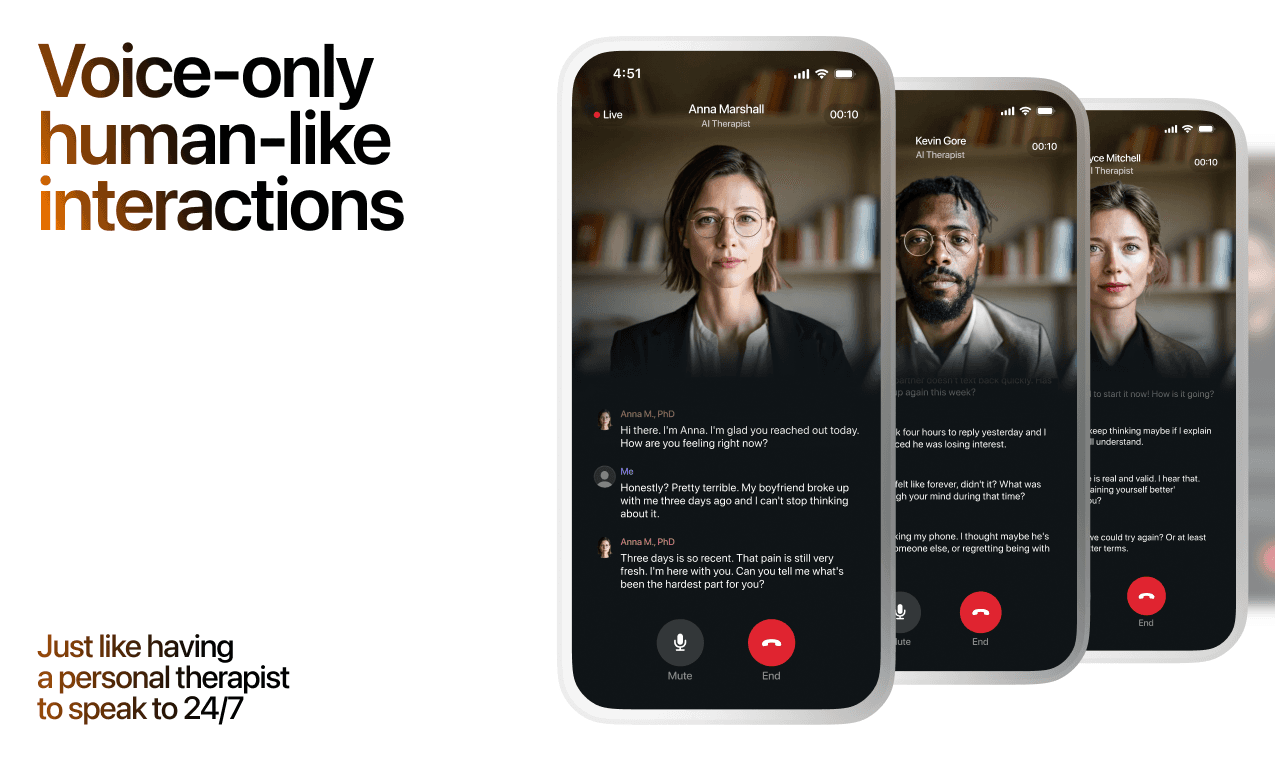
Here's what happens in a typical Lovon session:
You share what's on your mind
There's no script, no intake form, no waiting room. You speak or type whatever you're feeling — in your own words, at your own pace.
Lovon validates and explores
Using frameworks from CBT (Cognitive Behavioral Therapy) and motivational interviewing, Lovon acknowledges your feelings first, then gently helps you explore them. No dismissive "just move on" advice.
You build coping skills together
Lovon doesn't just listen — it actively works with you on evidence-based techniques: thought reframing, urge surfing, behavioral experiments, and more.
What a Session with Lovon Looks Like
When to Seek Professional Help
AI support is a valuable tool, but it's not a replacement for professional care. Please consider reaching out to a licensed therapist if you experience any of the following:
- Persistent thoughts of self-harm or suicide
- Inability to perform daily activities (work, eating, sleeping) for more than 2 weeks
- Turning to alcohol or substances to cope
- Intense anger or desire to harm your ex-partner
- Complete emotional numbness that doesn't improve over time
Crisis Resources (US): If you're in immediate danger, call 988 (Suicide & Crisis Lifeline) or text HOME to 741741 (Crisis Text Line). Available 24/7, free, and confidential.
Outside the US? Find a crisis line in your country
Ready to Start?
Your healing journey can begin right now
A 7-day trial. No judgment. Just a safe space to process what you're going through.
Frequently Asked Questions
Is Lovon a replacement for a real therapist?
Is my conversation with Lovon AI private?
How is Lovon different from ChatGPT for emotional support?
Can I use Lovon if I'm already seeing a therapist?
Can I try Lovon before subscribing?
About the Author
The Lovon Editorial Team
Mental Health & Wellness Content Team
The Lovon Editorial Team develops mental health and wellness content designed to make psychological concepts accessible and actionable. Our goal is to bridge the gap between clinical research and everyday life - helping you understand why your mind works the way it does and what you can do about it....
Related articles
- Codependency Quiz 2026: Are You Losing Yourself? Verdict
Take the codependency quiz that separates love from over-responsibility. Get scoring criteria, top picks, and next steps…
- How to Stop People Pleasing in 2026: 7-Step Guide
How to stop people pleasing in 2026: 7 concrete steps, a boundary script, and troubleshooting for guilt, pushback, and…
- Self-Abandonment: What It Is and How to Stop It in 2026
Self-abandonment means ignoring your own needs to keep the peace. Learn the 2026 signs, six concrete steps to stop it…
- Enmeshment in Relationships: Signs & Fix (2026)
Enmeshment in relationships blurs boundaries until feelings merge. See the signs, a 7-step untangling process, and…
See also
Quizzes
- Light Triad Test: Are People Ends or Means?
See how you treat people when there is nothing to gain.
- Empath Test: Do Other People's Moods Become Yours?
See how much of other people's moods you take on.
Free tools
- How to Confront a Narcissistic Parent
Most of these conversations fail because you went in wanting three things at once. Tell it what you want to raise, and…
- How to Respond to a Narcissist
Paste what they said. You get the part that actually needs answering separated from the part designed to pull you in, a…
From the wiki
- Why do I feel sad when I'm alone?
Being alone does not create the sadness. It removes the noise that was keeping it out of earshot, so whatever queued up…
Disclaimer: This article is for informational purposes only and does not constitute medical advice, diagnosis, or treatment. Always seek the advice of your physician or other qualified health provider with any questions you may have regarding a medical condition. If you are in crisis or think you may have an emergency, call 988 (Suicide & Crisis Lifeline) or go to the nearest emergency room. Outside the US? Find a crisis line in your country.