
Emotional Eating and Stress: 2026 Fix That Works
Emotional eating and stress feed each other through cortisol spikes. Get the 2026 step-by-step to spot triggers and stop stress-driven cravings for good.

Key Takeaways
- Cortisol spikes during stress push cravings toward sugar and fat within 30-45 minutes of a stressful event.
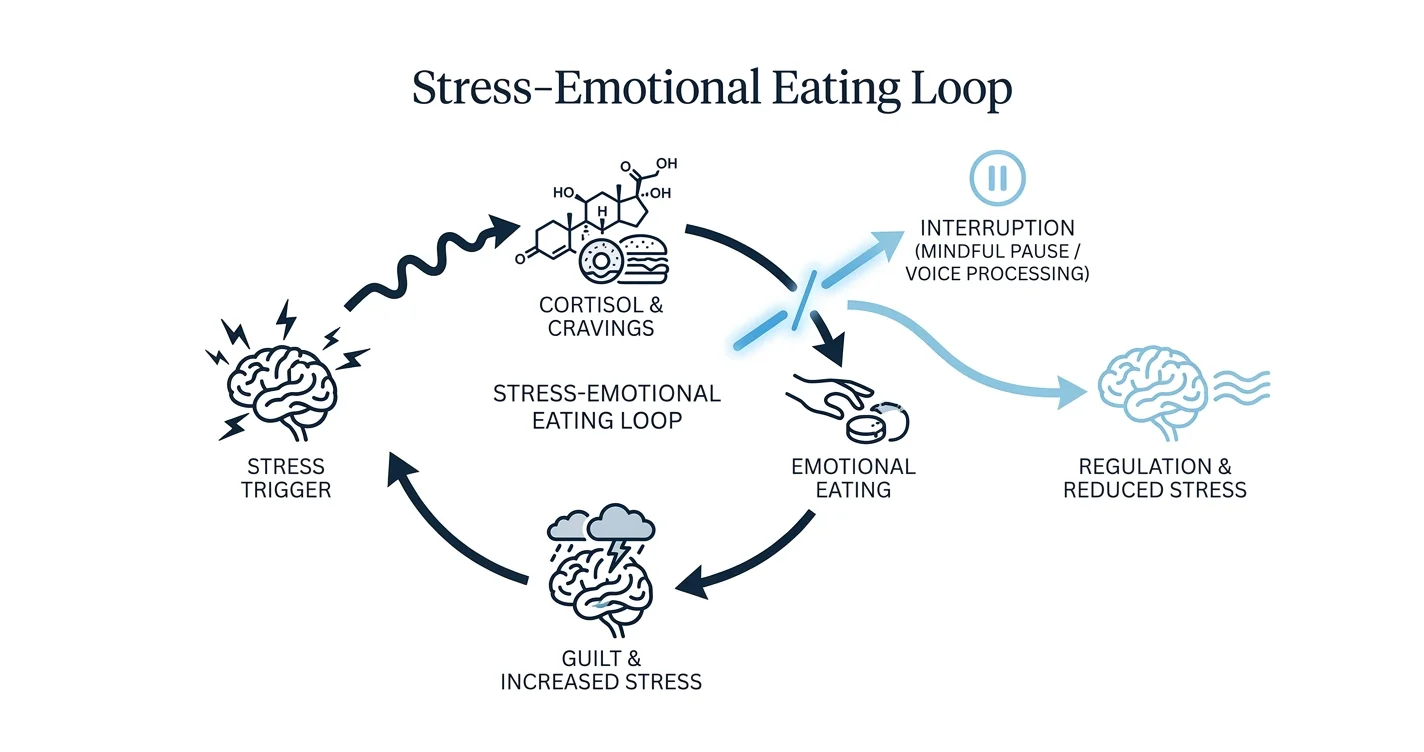
- Emotional eating and stress reinforce each other in a loop: stress triggers eating, eating triggers guilt, guilt
- Naming the trigger before you reach for food breaks the automatic response — verdict: identify first, eat second.
- Lovon's AI voice therapy gives you a way to process stress in the moment instead of eating through it.
Stress doesn't just raise your heart rate — it rewires what your brain wants to eat, and emotional eating shows up in 2026 as one of the most common coping patterns people describe in therapy conversations. This guide walks through why stress triggers cravings and gives you a concrete sequence to interrupt the pattern before it becomes automatic.
TL;DR
- Cortisol spikes during stress push cravings toward sugar and fat within 30-45 minutes of a stressful event.
- Emotional eating and stress reinforce each other in a loop: stress triggers eating, eating triggers guilt, guilt triggers more stress.
- Naming the trigger before you reach for food breaks the automatic response — verdict: identify first, eat second.
- Lovon's AI voice support gives you a way to process stress in the moment instead of eating through it.
Why this matters
When your body registers stress, the amygdala fires first and the thinking part of your brain catches up seconds later. Cortisol rises, blood sugar shifts, and your body starts hunting for fast energy — that's why cravings during stress skew toward sugar, salt, and fat instead of a salad. This isn't a character flaw. It's a nervous system doing exactly what it evolved to do under threat, even when the threat is a work email.
The problem is that food gives relief in under 10 minutes, so the brain learns the shortcut fast. Understand the pattern and you can work with your nervous system's stress response instead of fighting it after the fact. People who track this over a few weeks in 2026 usually find the eating isn't random — it clusters around three or four specific stressors.
What you'll need
- 5-10 minutes a day for tracking, at least for the first two weeks
- A notes app, a physical notebook, or a voice memo tool
- One low-effort body reset you can do anywhere (box breathing, a short walk, a cold glass of water)
- Honesty about hunger versus stress — this takes practice, not perfection
- A way to talk through what's actually stressing you out, whether that's a friend, a therapist, or an AI voice session on Lovon between appointments
The steps
1. Name the craving before you act on it
Say it out loud or write it down: "I want chips right now." Naming the urge activates the prefrontal cortex and slows the automatic grab-and-eat response by a few seconds — often enough to create a gap. Skip this step and you'll eat first and analyze later, which defeats the whole point. Common mistake: people skip naming because they think it's silly. It's not — it's the entire mechanism.
2. Rate your hunger from 1 to 10
A 3 or below usually means it's not hunger, it's stress. A 7 or above means eat something and skip the analysis. This single number cuts through most of the confusion between physical hunger and emotional eating. Common mistake: rating hunger after you've already started eating, which makes the number meaningless.
3. Find the stressor underneath the craving
Ask what happened in the last 30-60 minutes. A tense call, a deadline, a text you're avoiding — cravings almost always trace back to something specific. Learning to identify your emotional triggers turns a vague "I'm stressed" into an actionable target you can address directly instead of muting with food.
4. Run a 90-second body reset instead of eating immediately
Stand up, do four rounds of 4-second inhale and 6-second exhale, or step outside for one minute. This isn't about willpower — it's about giving cortisol a chance to drop before you decide anything. Ninety seconds is short enough that most people will actually do it. Common mistake: treating this as optional when it's the step that buys you the decision-making window.
5. Address the stressor, not just the craving
If the craving traces back to a specific stress source, deal with that source in a five-minute action: send the email, set a boundary, or just say out loud what's bothering you. Chronic stress keeps cortisol elevated, and lowering cortisol naturally matters more for long-term eating patterns than any single meal choice does.
6. Keep a buffer snack within reach, but out of autopilot range
If trigger foods sit at eye level in the kitchen, you'll eat them without thinking. Move them to a cabinet you have to open deliberately, and keep one planned, satisfying snack nearby so restriction doesn't become its own stressor. Common mistake: going straight to full restriction, which almost always backfires by day three or four.
7. Track for two full weeks before judging the pattern
One bad night doesn't mean the plan failed. Two weeks of tracking hunger ratings and stress triggers gives you enough data to see the actual pattern — usually three or four repeat stressors driving 80% of the eating. Common mistake: quitting after one hard day instead of letting the data accumulate.
Talk through the stress in real time
Voice sessions with Lovon are available any time a craving hits harder than usual.
Troubleshooting
- You ate anyway, right after naming the craving. That's normal early on. Log it and move to the hunger-rating step next time — the goal is fewer automatic responses over weeks, not zero slip-ups.
- Cravings hit hardest at night. Nighttime cravings usually mean the day's stress never got processed. Build in a 10-minute wind-down before bed instead of waiting for the craving to show up.
- You can't tell hunger from stress. Use the 1-10 rating consistently for a week. The number gets more accurate with repetition, even if it feels arbitrary at first.
- Stress spikes right after work. This is one of the most common patterns — the transition from work mode to home mode with no buffer in between. A 5-minute reset before you walk in the door helps more than most people expect.
- You feel guilty after eating, which makes the stress worse. Guilt is a second stressor stacked on the first one. Naming it as its own thing, separate from the eating itself, stops the loop from compounding.
- The pattern doesn't budge after two weeks. That usually means the underlying stressor is bigger than a snack swap can fix — a relationship strain, a work situation, or an unaddressed anxiety pattern. That's worth a real conversation, not another tracking sheet.
Tools and resources
- A hunger-and-stress log (notes app or paper both work)
- A short breathing routine you can do standing up
- Lovon's AI voice support for talking through the stressor itself, not just the craving it produces
- A stress management technique you can rely on outside of food entirely
What to do next
Once you've separated hunger from stress for a couple of weeks, the next useful move is building a broader stress-management routine so the cravings have less to feed on in the first place. Small, repeatable habits do more here than any single dramatic change.
FAQ
What is emotional eating and stress, exactly?
Emotional eating and stress describes the pattern where cortisol released during stress drives cravings for sugar and fat, and food becomes the fastest available way to calm down. It's a biological response, not a discipline problem.
How fast do stress cravings hit after a stressful event?
Cravings often show up within 30 to 45 minutes of a stressor as cortisol and blood sugar shift. That window is exactly why naming the craving early makes a difference.
Is emotional eating the same as binge eating?
No. Emotional eating is eating in response to a feeling rather than hunger, while binge eating involves a distinct pattern of eating large amounts with a loss of control. If eating episodes feel out of control, that's worth discussing with a licensed clinician.
Can reducing stress actually reduce cravings?
Yes. Lowering baseline cortisol through sleep, movement, and consistent stress management reduces how often the craving response fires in the first place, not just how you respond to it.
What's the fastest way to stop a stress craving in the moment?
A 90-second breathing reset — four seconds in, six seconds out, repeated four times — gives cortisol time to drop before you act on the craving. It's not a cure, but it buys the decision-making gap you need.
Does journaling help with emotional eating?
Journaling helps by surfacing the specific stressor behind a craving instead of leaving it as a vague feeling. Two weeks of tracking hunger ratings alongside stress triggers usually reveals three or four repeat patterns.
Can an AI app help with emotional eating and stress?
An AI voice support app like Lovon gives you a place to process the stressor behind the craving right when it happens, which can reduce reliance on food as the only outlet. It's not a substitute for licensed care if eating patterns feel unmanageable.
When should emotional eating be discussed with a professional?
If eating feels out of control, happens in secret, or is followed by compensatory behaviors, that pattern needs a licensed clinician, not a self-help routine. Lovon is built for everyday stress support, not a replacement for that level of care.
One last thing
The stressor almost never disappears because you swapped a snack — it disappears because you dealt with the thing underneath it. In 2026, tracking two weeks of hunger ratings alongside stress triggers is the single most reliable way to find your specific pattern instead of guessing at generic advice.
Related guides
How AI Support Helps You Heal
AI emotional support isn't about replacing human connection — it's about filling the gaps. The moments when you need to talk at 2 AM, when you don't want to burden your friends again, or when you simply need someone to listen without judgment.
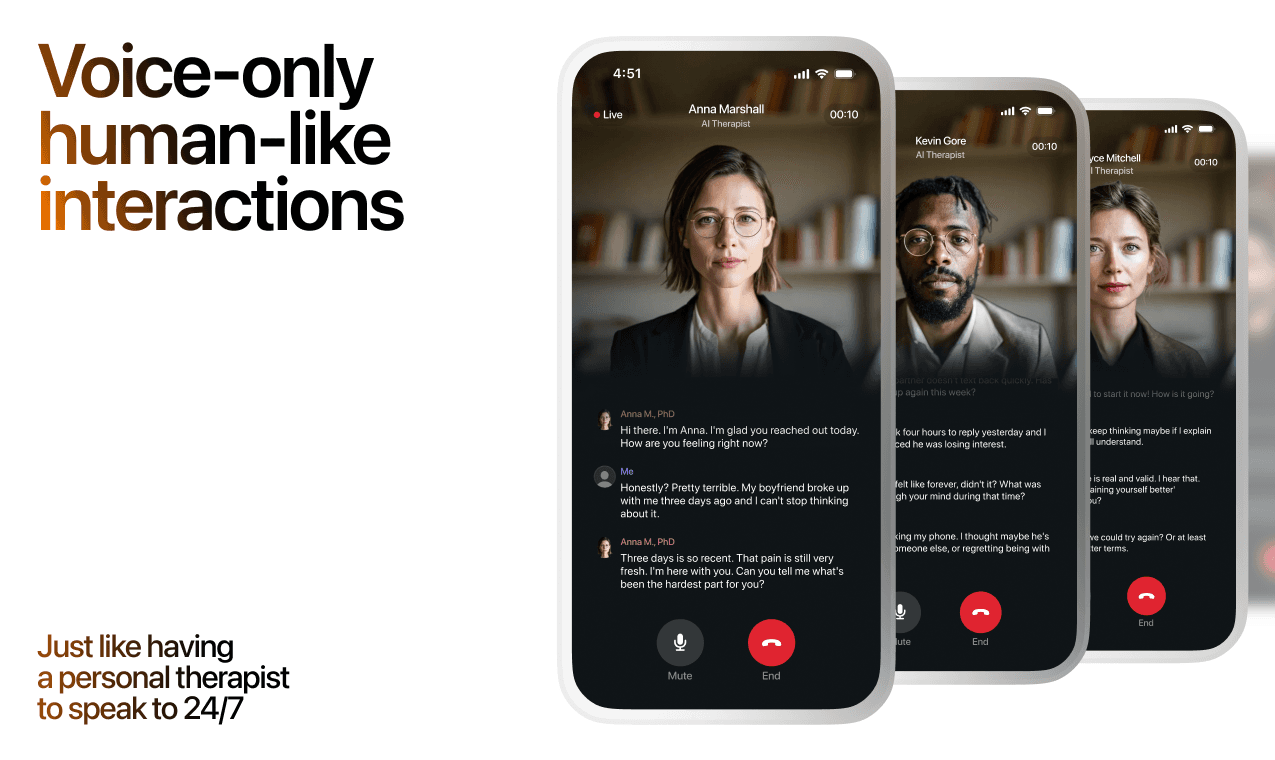
Here's what happens in a typical Lovon session:
You share what's on your mind
There's no script, no intake form, no waiting room. You speak or type whatever you're feeling — in your own words, at your own pace.
Lovon validates and explores
Using frameworks from CBT (Cognitive Behavioral Therapy) and motivational interviewing, Lovon acknowledges your feelings first, then gently helps you explore them. No dismissive "just move on" advice.
You build coping skills together
Lovon doesn't just listen — it actively works with you on evidence-based techniques: thought reframing, urge surfing, behavioral experiments, and more.
What a Session with Lovon Looks Like
When to Seek Professional Help
AI support is a valuable tool, but it's not a replacement for professional care. Please consider reaching out to a licensed therapist if you experience any of the following:
- Persistent thoughts of self-harm or suicide
- Inability to perform daily activities (work, eating, sleeping) for more than 2 weeks
- Turning to alcohol or substances to cope
- Intense anger or desire to harm your ex-partner
- Complete emotional numbness that doesn't improve over time
Crisis Resources (US): If you're in immediate danger, call 988 (Suicide & Crisis Lifeline) or text HOME to 741741 (Crisis Text Line). Available 24/7, free, and confidential.
Outside the US? Find a crisis line in your country
Ready to Start?
Your healing journey can begin right now
A 7-day trial. No judgment. Just a safe space to process what you're going through.
Frequently Asked Questions
Is Lovon a replacement for a real therapist?
Is my conversation with Lovon AI private?
How is Lovon different from ChatGPT for emotional support?
Can I use Lovon if I'm already seeing a therapist?
Can I try Lovon before subscribing?
About the Author
The Lovon Editorial Team
Mental Health & Wellness Content Team
The Lovon Editorial Team develops mental health and wellness content designed to make psychological concepts accessible and actionable. Our goal is to bridge the gap between clinical research and everyday life - helping you understand why your mind works the way it does and what you can do about it....
Related articles
- Amygdala and Prefrontal Cortex Partnership in Emotional Regulation
The partnership between the amygdala and prefrontal cortex represents one of the most crucial relationships in your…
- Social Media Comparison Anxiety: Fix It in 2026
Social media comparison anxiety comes from curated feeds triggering upward comparison. Get the 7-step fix and…
- Progressive Muscle Relaxation for Stress (2026 Guide)
Step-by-step progressive muscle relaxation for stress: tense each muscle group 6 seconds, release 25–30 seconds, repeat…
- Rumination and Depression: How to Break the Loop (2026)
Rumination and depression fuel each other. These 8 evidence-based steps interrupt the cycle, reduce repetitive negative…
See also
Quizzes
- Shame Test: Do You Read Mistakes as Verdicts?
See which exit your shame takes, in 3 minutes.
- Alexithymia Test: Can You Name What You Feel?
See where your feelings lose their names, in 3 minutes.
Free tools
- Write a Letter to Someone You Lost
Tell it who they were to you and what you never got to say, and it writes the letter back in your words. No account, no…
- Am I Overreacting, or Is This a Big Deal?
A chat for the small thing you cannot stop turning over. Say what happened and what you have already told yourself about…
From the wiki
- How to stop maladaptive daydreaming?
Maladaptive daydreaming is immersive waking fantasy that eats hours, usually with music and pacing attached. You rarely…
Disclaimer: This article is for informational purposes only and does not constitute medical advice, diagnosis, or treatment. Always seek the advice of your physician or other qualified health provider with any questions you may have regarding a medical condition. If you are in crisis or think you may have an emergency, call 988 (Suicide & Crisis Lifeline) or go to the nearest emergency room. Outside the US? Find a crisis line in your country.