
How to Stop People Pleasing in 2026: 7-Step Guide
How to stop people pleasing in 2026: 7 concrete steps, a boundary script, and troubleshooting for guilt, pushback, and relapse. Start today.
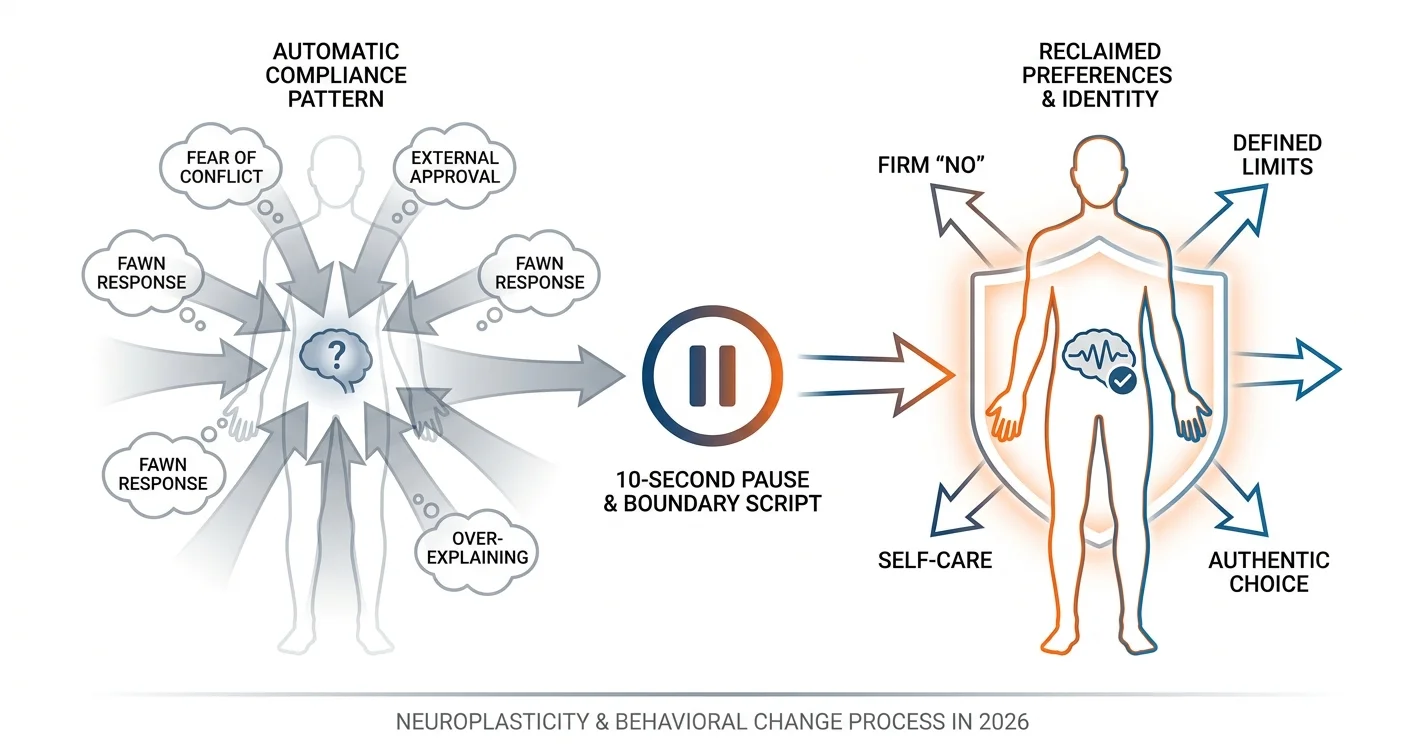

Key Takeaways
- A 10-second pause before answering any request is the fastest way to start how to stop people pleasing in 2026.
- People pleasing is often a fawn response to old stress or trauma, not a fixed personality trait.
- A three-sentence boundary script beats a long explanation — use it instead of over-justifying.
- Lovon's AI voice therapist works well as a low-stakes place to rehearse boundary language out loud before using it.
- Expect pushback in the first two weeks. That reaction confirms the old pattern was working for someone else, not for
People pleasing isn't a personality quirk — it's a habit of erasing your own preferences to keep everyone else comfortable, and it's learnable to unlearn. This guide walks through the exact steps for how to stop people pleasing, what tends to go wrong along the way, and what to do when old habits creep back in 2026.
TL;DR
- A 10-second pause before answering any request is the fastest way to start how to stop people pleasing in 2026.
- People pleasing is often a fawn response to old stress or trauma, not a fixed personality trait.
- The am I a people pleaser quiz sorts ordinary kindness from the version that costs you something, which decides how much of this guide applies to you.
- A three-sentence boundary script beats a long explanation — use it instead of over-justifying.
- Lovon's AI voice companion works well as a low-stakes place to rehearse boundary language out loud before using it.
- Expect pushback in the first two weeks. That reaction confirms the old pattern was working for someone else, not for you.
Why This Matters
People pleasing feels like kindness, but it's usually fear wearing a nice outfit — fear of conflict, of being disliked, of losing the relationship if you say no. Left unchecked for years, it flattens your preferences until you genuinely don't know what you want anymore. That's the identity part of this problem: you can't reclaim what you never let yourself notice.
For a lot of people, this pattern traces back to a fawn response, a trauma reaction that trained the nervous system to appease first and ask questions later. Understanding that origin matters because it changes the fix — you're not working on willpower, you're working on a nervous system habit that formed for a reason.
What You'll Need
- A specific situation to practice on — not "stop pleasing everyone," pick one relationship or one recurring request
- A written or spoken boundary script, 2-3 sentences, memorized ahead of time
- 10 minutes a day for a short journal or voice-note check-in
- A way to rehearse saying no out loud before you need it — a mirror, a voice memo, or a tool like Lovon's AI voice companion, which lets you practice the actual words with a voice conversation instead of just thinking them
- Tolerance for a few uncomfortable days while people adjust to the new answer
The Steps
1. Name the pattern out loud
Saying "I do this because saying no feels dangerous to me" out loud, even alone, breaks the autopilot. It accomplishes something small but real — it moves the behavior from unconscious to noticed, which is the only place change starts.
Do this once a day for a week: name one moment you said yes when you meant no. Expected outcome: by day 4 or 5, you'll catch yourself mid-sentence before the automatic yes comes out. Common mistake: doing this only in your head. Spoken or written naming works faster than silent noticing.
2. Install a 10-second pause
The pause is the actual mechanism of change — everything else is downstream of it. People pleasing runs on speed: someone asks, you answer before you've checked in with yourself.
When a request comes in, say "let me check and get back to you" and wait at minimum 10 seconds, ideally a few hours. Expected outcome: your real answer starts showing up in that gap instead of the automatic one. Common mistake: using the pause but still defaulting to yes once the time is up — the pause only works if you use it to actually decide.
3. Write one boundary script and reuse it
A three-sentence script removes the need to improvise under pressure, which is exactly when people pleasing takes over. Something like: "I can't take this on right now. I want to keep doing good work on what's already on my plate. Let's find another time."
Write it, save it in your phone, and use the same wording every time this specific request comes up. Expected outcome: the words stop feeling foreign after 4-5 repetitions. Common mistake: rewriting the script every time based on the person's reaction — that's people pleasing showing up inside the fix itself.
4. Practice the tone before the moment arrives
Text is easy to draft carefully; a live conversation moves fast, and old habits fill the gap when you haven't rehearsed. Say your boundary script out loud, alone, three times before you need it — cadence matters as much as wording.
Expected outcome: the sentence comes out steady instead of apologetic. Common mistake: writing a great script and never speaking it until the actual moment, which is when nerves default back to the old pattern.
5. Set the boundary and stop explaining
Over-explaining is a stalling tactic your brain uses to soften the no and buy back approval. One reason is enough; a paragraph of justification invites negotiation. Reviewing how to set boundaries that stick helps if this step feels the hardest of the seven.
Expected outcome: the conversation gets shorter and less charged. Common mistake: adding a second and third reason when the first one gets a raised eyebrow.
6. Sit with the discomfort instead of fixing it
Guilt after saying no is a signal the pattern is loosening, not proof you did something wrong. The urge to immediately soften it with a favor or an apology is the relapse point.
Let 24 hours pass before you do anything to "make up for" a no. Expected outcome: the guilt fades on its own within a day or two in most cases. Common mistake: sending a follow-up apology text an hour later — that undoes the boundary you just set.
7. Track what you actually want, separately from what's asked of you
This step is where the identity part happens — people pleasing crowds out your own preferences so thoroughly that many people lose track of them. Keep a running list, even three bullet points a week, of things you want independent of anyone's request.
Expected outcome: within 4-6 weeks you'll have a page of preferences that existed before anyone asked you anything. Deeper background on how people-pleasing as a trauma response developed can make this list-building feel less like a chore and more like recovery.
Troubleshooting
- Someone gets angry the first time you say no. That's the old system recalibrating, not proof the boundary was wrong. Hold the line for two more instances before reassessing.
- You cave and say yes anyway, mid-sentence. Go back to step 2 — the pause got skipped. Rebuild the habit of pausing before you rebuild the habit of refusing.
- You feel guilty for days, not hours. That's worth naming directly rather than pushing through alone; chronic guilt has its own patterns worth understanding.
- You start over-correcting into bluntness. Swinging from yes-to-everything to cold and clipped is common in month one. The goal is a clear no, not a harsh one — soften delivery, keep the content firm.
- You can't tell if a request is reasonable or if you're just people pleasing again. Ask yourself: would I say yes to this if there were zero consequence for saying no? If the answer is no, it's the pattern, not the request.
- The pattern shows up worse with one specific person. That's a signal the relationship itself may need a bigger boundary conversation, not just a script.
Tools And Resources
- A written boundary script saved somewhere you'll actually see it
- A daily 10-minute check-in — journal, voice memo, or a spoken session with Lovon's AI voice companion to say the hard sentence out loud before you need it live
- A short list of your own preferences, updated weekly
- A trusted person who knows you're working on this and will call it out gently when the old pattern resurfaces
What To Do Next
Once the seven steps feel repeatable, the deeper work is figuring out where this pattern started — most people trace it back to one relationship, often a parent or an early romantic partner, where appeasing was the safest option. That's a longer conversation than a single article can hold, and it's where ongoing support, whether a licensed therapist or a between-session tool, tends to matter more than another list of steps.
FAQ
How do I stop people pleasing without becoming selfish?
You stop people pleasing by setting clear limits, not by stopping care for others. Selfishness ignores other people's needs entirely; a healthy boundary just stops erasing your own.
Is people pleasing a trauma response?
For many people, yes — it's linked to the fawn response, a nervous-system reaction that learned appeasement kept things safe. That doesn't mean everyone who people-pleases has trauma, but the pattern often traces back to an environment where saying no felt risky.
How long does it take to stop people pleasing?
Most people notice the automatic yes loosening within 2-3 weeks of using a pause and a script consistently. Fuller identity work, rebuilding a sense of your own preferences, tends to take a few months in 2026 as in any year.
What's the difference between being kind and people pleasing?
Kindness is a choice you'd make even if there were no cost to refusing; people pleasing is compliance driven by fear of the other person's reaction. The test is whether you'd still say yes with zero consequence attached to a no.
Can an AI therapist help with people pleasing?
An AI voice companion like Lovon can give you a private space to rehearse boundary language and process guilt between real-world attempts. It's not a replacement for licensed clinical care, especially if the pattern connects to deeper trauma, but it works well as daily practice support.
Why do I feel guilty after saying no?
Guilt after a boundary usually means the old pattern is loosening, not that you did something wrong. It tends to fade within 24 to 48 hours if you resist the urge to immediately smooth it over.
Does people pleasing get worse with age?
It doesn't automatically worsen, but it compounds — the longer a pattern goes unaddressed, the more relationships and habits get built around it. That's why identifying it early, even in your 20s or 30s, makes the unlearning faster.
How do I know if I'm a people pleaser or just agreeable?
Ask whether your agreement changes based on who's asking and how they'll react, versus staying consistent regardless of consequence. If your answer shifts depending on fear of disappointing someone, that's people pleasing, not agreeableness.
One Last Thing
The uncomfortable part nobody mentions: the people most affected by you stopping people pleasing are usually the ones who benefited most from the old version of you. That reaction isn't proof you're doing it wrong — it's the clearest evidence the pattern was working, just not for you. The goal in 2026 isn't zero discomfort. It's a version of you whose yes actually means something, because your no is available too.
Related Guides
How AI Support Helps You Heal
AI emotional support isn't about replacing human connection — it's about filling the gaps. The moments when you need to talk at 2 AM, when you don't want to burden your friends again, or when you simply need someone to listen without judgment.
Here's what happens in a typical Lovon session:
You share what's on your mind
There's no script, no intake form, no waiting room. You speak or type whatever you're feeling — in your own words, at your own pace.
Lovon validates and explores
Using frameworks from CBT (Cognitive Behavioral Therapy) and motivational interviewing, Lovon acknowledges your feelings first, then gently helps you explore them. No dismissive "just move on" advice.
You build coping skills together
Lovon doesn't just listen — it actively works with you on evidence-based techniques: thought reframing, urge surfing, behavioral experiments, and more.
What a Session with Lovon Looks Like
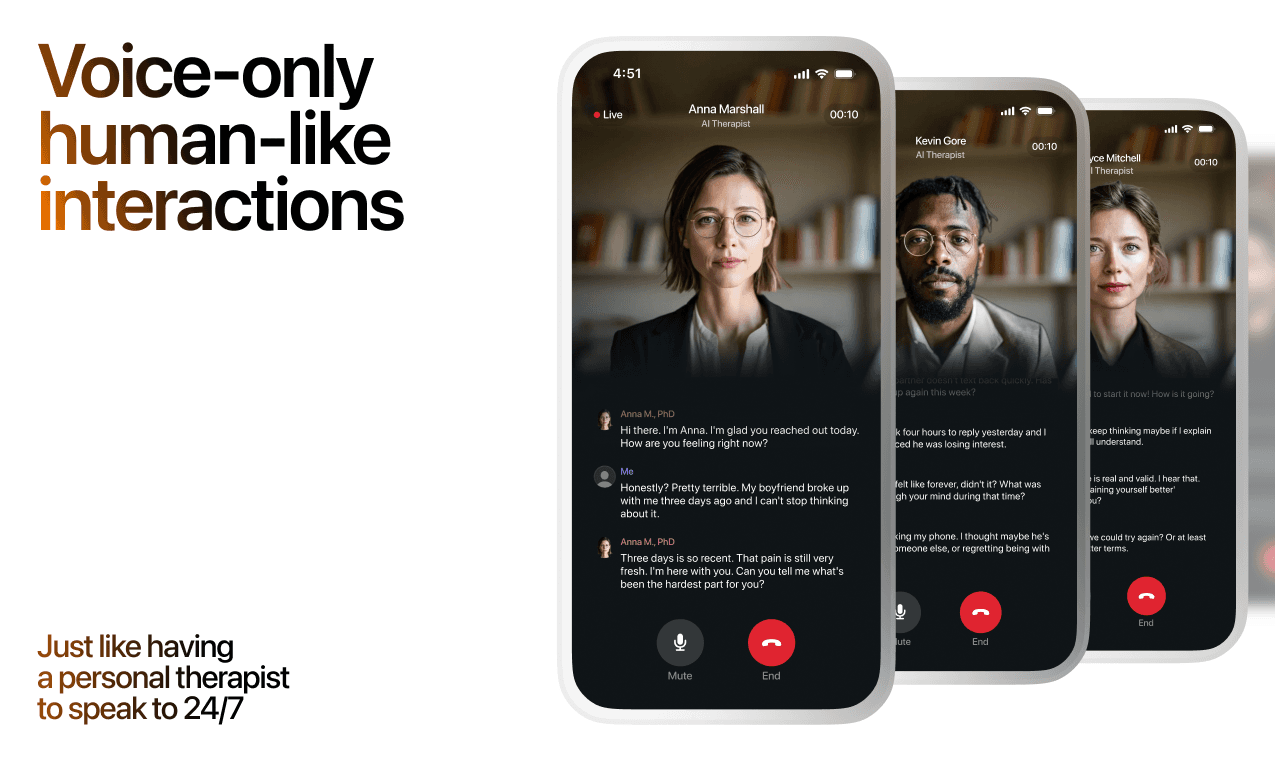
Lovon is AI support, not a replacement for professional care. If things have been hard to get through for weeks, or you are thinking about harming yourself, talk to a doctor or a licensed therapist.
Ready to Start?
Your healing journey can begin right now
A 7-day trial. No judgment. Just a safe space to process what you're going through.
Frequently Asked Questions
Is Lovon a replacement for a real therapist?
Is my conversation with Lovon AI private?
How is Lovon different from ChatGPT for emotional support?
Can I use Lovon if I'm already seeing a therapist?
Can I try Lovon before subscribing?
About the Author
The Lovon Editorial Team
Mental Health & Wellness Content Team
The Lovon Editorial Team develops mental health and wellness content designed to make psychological concepts accessible and actionable. Our goal is to bridge the gap between clinical research and everyday life - helping you understand why your mind works the way it does and what you can do about it....
Related articles
- Emotionally Immature Parents Boundaries That Hold in 2026
Set boundaries with emotionally immature parents in 2026 using scripted limits, exit lines, and follow-through steps…
- Rebuild Self-Esteem After a Toxic Relationship (2026)
Rebuild self-esteem after a toxic relationship with 6 concrete steps, common setbacks, and fixes. A 2026 guide with real…
- What Is Self-Abandonment Trauma and How to Stop People-Pleasing
Self-abandonment trauma represents a deep pattern where you consistently prioritize others' needs, feelings, and…
- Self-Sabotaging Relationships: Why It Happens (2026)
Self-sabotaging relationships explained: the trigger pattern behind it and a 6-step process to interrupt it in 2026…
See also
Quizzes
- Light Triad Test: Kantianism, Humanism & Faith Scores
See how you treat people when there is nothing to gain.
- Guilt Test: Do I Have a Guilt Complex? Excessive Guilt Quiz
See whether your guilt repairs or just hurts.
Free tools
- How to End a Friendship Without a Scene
A chat for working out how to end a friendship clearly, without a grievance list or a slow ghost. Tell it how long you…
- How to Say No Politely (Without Over-Explaining)
A chat for how to say no politely when you have already decided and cannot get the word out. Tell it what you were…
From the wiki
- Why do I keep dreaming about the same person?
A recurring dream figure usually marks unfinished emotional business rather than a message about that person. Your brain…
Disclaimer: This article is for informational purposes only and does not constitute medical advice, diagnosis, or treatment. Always seek the advice of your physician or other qualified health provider with any questions you may have regarding a medical condition. If you are in crisis or think you may have an emergency, call 988 (Suicide & Crisis Lifeline) or go to the nearest emergency room. Outside the US? Find a crisis line in your country.