
Self-Abandonment: What It Is and How to Stop It in 2026
Self-abandonment means ignoring your own needs to keep the peace. Learn the 2026 signs, six concrete steps to stop it, and when to get extra support.

Key Takeaways
- Self-abandonment means overriding your own needs to avoid conflict or keep someone close — it's learned, not a
- Six steps break the cycle: name it, audit your yeses, set one boundary, interrupt guilt, keep small promises to
- Lovon's AI voice therapy sessions work as a real-time check-in when you catch yourself abandoning your own needs
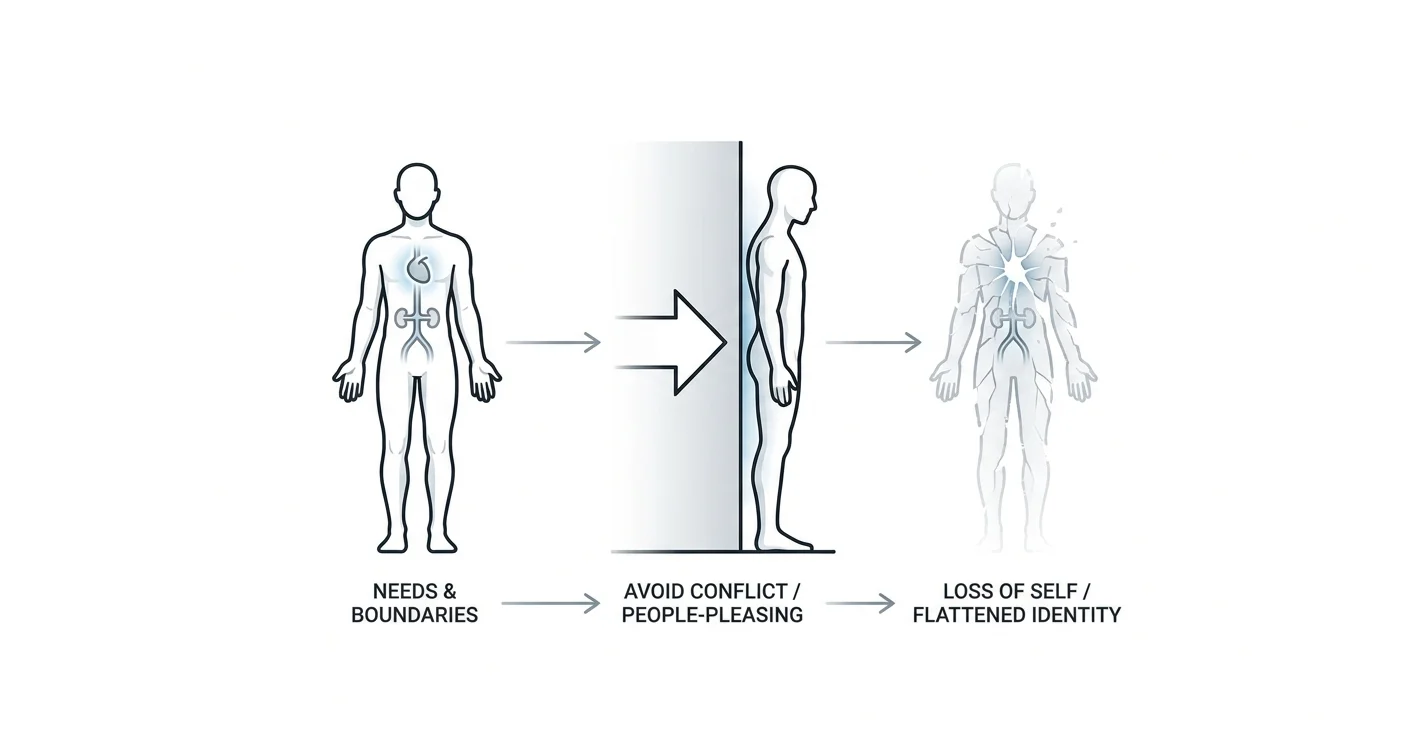
Self-abandonment is what happens when you consistently choose everyone else's comfort over your own needs — agreeing when you mean no, shrinking your feelings so nobody has to deal with them, staying quiet when something hurts. This guide breaks down how to recognize the pattern and gives you concrete steps to stop it in 2026, not just a definition to nod along with.
TL;DR
- Self-abandonment means overriding your own needs to avoid conflict or keep someone close — it's learned, not a personality flaw.
- This pattern is common, not rare.
- Six steps break the cycle: name it, audit your yeses, set one boundary, interrupt guilt, keep small promises to yourself, and get support when you can't see it alone.
- Lovon's AI voice therapy sessions work as a real-time check-in when you catch yourself abandoning your own needs between therapy appointments.
Why this matters
Self-abandonment doesn't announce itself. It shows up as "I'm fine" when you're not, as saying yes to plans you dread, as apologizing for things that aren't your fault. Left unaddressed, it flattens your sense of who you are, because every override tells your nervous system that your preferences don't count.
This pattern overlaps heavily with the fawn response, where people-pleasing becomes an automatic survival strategy instead of a conscious choice. If you grew up in a household where your needs caused friction, abandoning them probably felt safer than expressing them. That wiring doesn't undo itself — you have to interrupt it on purpose, repeatedly, in 2026 and beyond.
You cannot build self-trust while your actions keep telling you your needs are optional.
What you'll need
- A notebook or notes app for a 10-day "yes audit" (step 2 below)
- 5-10 minutes a day of uninterrupted quiet — car, shower, walk, doesn't matter
- One low-stakes relationship to practice boundaries with first (not the hardest person in your life)
- Willingness to feel uncomfortable without immediately fixing it
- A support option for the moments you can't see the pattern clearly on your own — a therapist, a trusted friend, or an on-demand option like Lovon's AI voice therapy for a same-day check-in
The steps
1. Name the pattern out loud
You can't interrupt a habit you haven't identified. For one week, say the phrase "I just abandoned myself" out loud or in your notes every time you catch yourself agreeing to something you don't want, or swallowing a feeling to keep things smooth.
This step accomplishes something simple but overlooked: it turns an automatic reflex into a conscious event you can actually track. Expected outcome: by day 5, you'll notice the moment before you cave, not just after.
Common mistake: people skip this and jump straight to boundary-setting. Without naming the pattern first, you won't recognize which moments to apply the boundary to.
2. Audit your last ten yeses
Write down the last ten times you said yes to something — a plan, a favor, a compromise. Next to each one, mark whether you actually wanted to say yes or said it to avoid disappointing someone.
If seven or more of those ten were reluctant yeses, that's your baseline. This connects directly to how to stop people pleasing and reclaim your identity — the audit gives you the raw data, the habit change comes next.
Common mistake: rounding up your own honesty. If you hesitate for more than two seconds before answering "did I want this," count it as reluctant.
3. Set one boundary today
Pick the lowest-stakes boundary you can find — declining an extra task, ending a call ten minutes early, saying "I need to think about it" instead of an automatic yes. Do it once, today, in 2026, not "eventually."
Clear guidance on healthy relationship boundaries and how to set them clearly covers the exact language to use when you're new to this. Expected outcome: mild discomfort, a slightly awkward pause, and no actual disaster — which is the point.
Common mistake: starting with the hardest relationship in your life. Save that one for month two.
4. Interrupt the guilt reflex
Guilt shows up within seconds of setting a boundary — that's normal, not a sign you did something wrong. When it hits, name it specifically: "This is guilt, not evidence I hurt someone."
Guilt and genuine wrongdoing feel almost identical in the body, which is exactly why this step matters. Expected outcome: the guilt spikes then fades within 10-20 minutes if you don't act on it by taking the boundary back.
Common mistake: treating guilt as proof you were wrong and reversing the boundary to make it go away.
5. Keep one small promise to yourself daily
Pick something tiny — going to bed at a set time, taking a 10-minute walk, finishing a task you said you'd do. Keep it for seven straight days.
Self-trust rebuilds through repetition, not insight. Every kept promise is evidence your word to yourself means something. Expected outcome: by day 7, you'll notice less hesitation when making decisions for yourself.
Common mistake: picking a promise so ambitious you're set up to break it, which reinforces the exact belief you're trying to undo.
6. Get support when you can't see the pattern alone
Self-abandonment is hard to catch from the inside — you're the one doing the overriding, and it feels normal because it's familiar. A second perspective, even a brief one, catches patterns you miss.
Lovon's AI voice therapy sessions are built for exactly this moment: you talk through what just happened in a specific conversation, in your own voice, and get help spotting where you overrode yourself. It's not a replacement for a licensed therapist, but it's available at 2am when the pattern is fresh and a scheduled appointment is days away.
Talk through it before it becomes a habit
Voice sessions with Lovon help you catch self-abandonment as it happens.
Troubleshooting
- You set a boundary and immediately took it back. That's the guilt reflex winning. Go back to step 4 and separate the feeling from the facts before you act on it again.
- You can't tell if you actually want something or just don't want conflict. Give yourself a 24-hour rule before answering anything non-urgent. Clarity usually shows up once the social pressure of the moment passes.
- The people around you push back hard when you stop over-accommodating. That reaction tells you the relationship relied on your self-abandonment. It doesn't mean the boundary was wrong.
- You feel worse before you feel better. Weeks 1-2 of this work often increase anxiety because the old strategy (override yourself, keep the peace) stops running on autopilot. That's expected, not a sign you're doing it wrong.
- You keep abandoning yourself with the same one person. Enmeshed or codependent dynamics need a more targeted look — the codependency vs. love comparison breaks down where the line sits.
Tools and resources
- A daily 10-minute journaling habit (paper or app) to run the yes audit
- Lovon's AI voice therapy for a same-day, judgment-free debrief after a hard moment
- A short list of boundary phrases you've practiced saying out loud before you need them
- Guidance on self-compassion when you hate yourself for the days the guilt reflex wins anyway
What to do next
Self-abandonment rarely started in adulthood — most people trace the pattern back to childhood roles they had to play to stay safe or loved. If steps 1-6 feel manageable but the underlying "why" still nags at you, that's worth a deeper look before it repeats in every relationship in 2026 and after.
FAQ
What is self-abandonment, in one sentence?
Self-abandonment is consistently overriding your own needs, feelings, or boundaries to avoid conflict or keep someone close. It's a learned survival strategy, not a fixed trait, which is why it can be unlearned in 2026 with consistent practice.
Is self-abandonment the same as people-pleasing?
They overlap but aren't identical — people-pleasing is the behavior, self-abandonment is what happens internally when you do it repeatedly. Someone can please people occasionally without abandoning themselves; self-abandonment is the chronic version.
How long does it take to stop self-abandoning?
Most people notice the pattern shifting within 4-8 weeks of consistent boundary practice, based on how habit change generally works. Full change takes longer in relationships where the other person relied on your compliance.
What causes self-abandonment in the first place?
It usually traces back to childhood environments where expressing needs led to conflict, rejection, or punishment, so suppressing them became the safer option. Parentification, emotionally immature caregivers, and inconsistent affection are common roots.
Can self-abandonment happen in a relationship that looks healthy?
Yes — self-abandonment is about your internal pattern, not the other person's behavior. You can abandon yourself with a kind, well-meaning partner simply because the habit of overriding your needs runs on autopilot.
What's the difference between self-abandonment and healthy compromise?
Compromise means both people give something and both needs stay on the table. Self-abandonment means only your side disappears — you stop voicing what you need at all, not just adjusting it.
Is an AI voice therapy app enough to fix self-abandonment?
An AI voice therapy app like Lovon works as a real-time practice tool between check-ins, not a full substitute for a licensed clinician, especially for patterns rooted in trauma. Use it alongside professional care rather than as the only support.
How do I know if I've fully stopped self-abandoning myself?
You'll notice your reluctant-yes count drop close to zero and boundary-setting stop triggering days of guilt. It's a gradual shift measured in fewer overrides per week, not a single finish line.
One last thing
The fastest sign you're recovering isn't feeling confident — it's noticing the guilt spike after a boundary and not reversing course anyway. Confidence comes later; the willingness to sit with discomfort comes first, and it shows up long before you feel ready for it.
Related guides
How AI Support Helps You Heal
AI emotional support isn't about replacing human connection — it's about filling the gaps. The moments when you need to talk at 2 AM, when you don't want to burden your friends again, or when you simply need someone to listen without judgment.
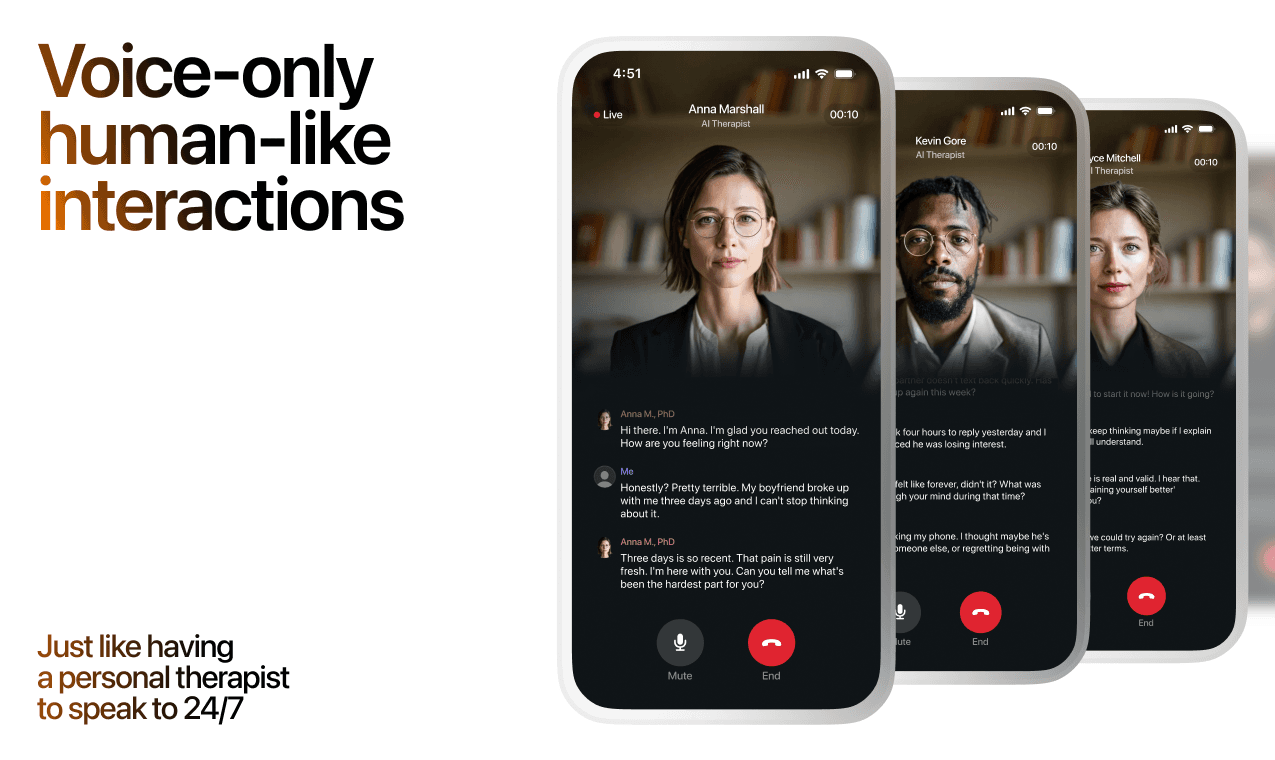
Here's what happens in a typical Lovon session:
You share what's on your mind
There's no script, no intake form, no waiting room. You speak or type whatever you're feeling — in your own words, at your own pace.
Lovon validates and explores
Using frameworks from CBT (Cognitive Behavioral Therapy) and motivational interviewing, Lovon acknowledges your feelings first, then gently helps you explore them. No dismissive "just move on" advice.
You build coping skills together
Lovon doesn't just listen — it actively works with you on evidence-based techniques: thought reframing, urge surfing, behavioral experiments, and more.
What a Session with Lovon Looks Like
When to Seek Professional Help
AI support is a valuable tool, but it's not a replacement for professional care. Please consider reaching out to a licensed therapist if you experience any of the following:
- Persistent thoughts of self-harm or suicide
- Inability to perform daily activities (work, eating, sleeping) for more than 2 weeks
- Turning to alcohol or substances to cope
- Intense anger or desire to harm your ex-partner
- Complete emotional numbness that doesn't improve over time
Crisis Resources (US): If you're in immediate danger, call 988 (Suicide & Crisis Lifeline) or text HOME to 741741 (Crisis Text Line). Available 24/7, free, and confidential.
Outside the US? Find a crisis line in your country
Ready to Start?
Your healing journey can begin right now
1 free conversation. No credit card. No judgment. Just a safe space to process what you're going through.
Frequently Asked Questions
Is AI therapy a replacement for a real therapist?
Is my conversation with Lovon AI private?
How is Lovon different from ChatGPT for emotional support?
Can I use Lovon if I'm already seeing a therapist?
Can I try Lovon for free?
About the Author
The Lovon Editorial Team
Mental Health & Wellness Content Team
The Lovon Editorial Team develops mental health and wellness content designed to make psychological concepts accessible and actionable. Our goal is to bridge the gap between clinical research and everyday life - helping you understand why your mind works the way it does and what you can do about it....
Related articles
- How to Stop Being Codependent: Steps That Work (2026)
How to stop being codependent in 2026: 6 practical steps, common mistakes, and troubleshooting for boundary-setting…
- Anxious Attachment and Love Avoidant: Break the Cycle 2026
Anxious attachment and love avoidant partners create a push-pull cycle. Learn the pattern, 7 steps to break it, and…
- Self-Sabotaging Relationships: Why It Happens (2026)
Self-sabotaging relationships explained: the trigger pattern behind it and a 6-step process to interrupt it in 2026…
- Rebuild Self-Esteem After a Toxic Relationship (2026)
Rebuild self-esteem after a toxic relationship with 6 concrete steps, common setbacks, and fixes. A 2026 guide with real…
See also
Quizzes
- Self Esteem Test: What Is Your Worth Resting On?
See what your sense of worth is resting on.
- Boundaries Test: Free 12-Question Self-Check
See where your boundaries slip, in 3 minutes.
Free tools
- Attachment Trigger Plan for Anxious and Avoidant Patterns
Pick your pattern, tick the moments that set it off, and finish one card for each: your body signal, the thing you will…
- Family Boundary Plan
Pick the person, the one topic, and how much you want to see them. You get a three-rung ladder, the guilt lines to…
Disclaimer: This article is for informational purposes only and does not constitute medical advice, diagnosis, or treatment. Always seek the advice of your physician or other qualified health provider with any questions you may have regarding a medical condition. If you are in crisis or think you may have an emergency, call 988 (Suicide & Crisis Lifeline) or go to the nearest emergency room. Outside the US? Find a crisis line in your country.