
Best AI therapy apps with voice conversations in 2026
Compare the best AI therapy apps with voice conversations. Lovon leads for emotional support; see where general assistants fit and when to seek licensed care.
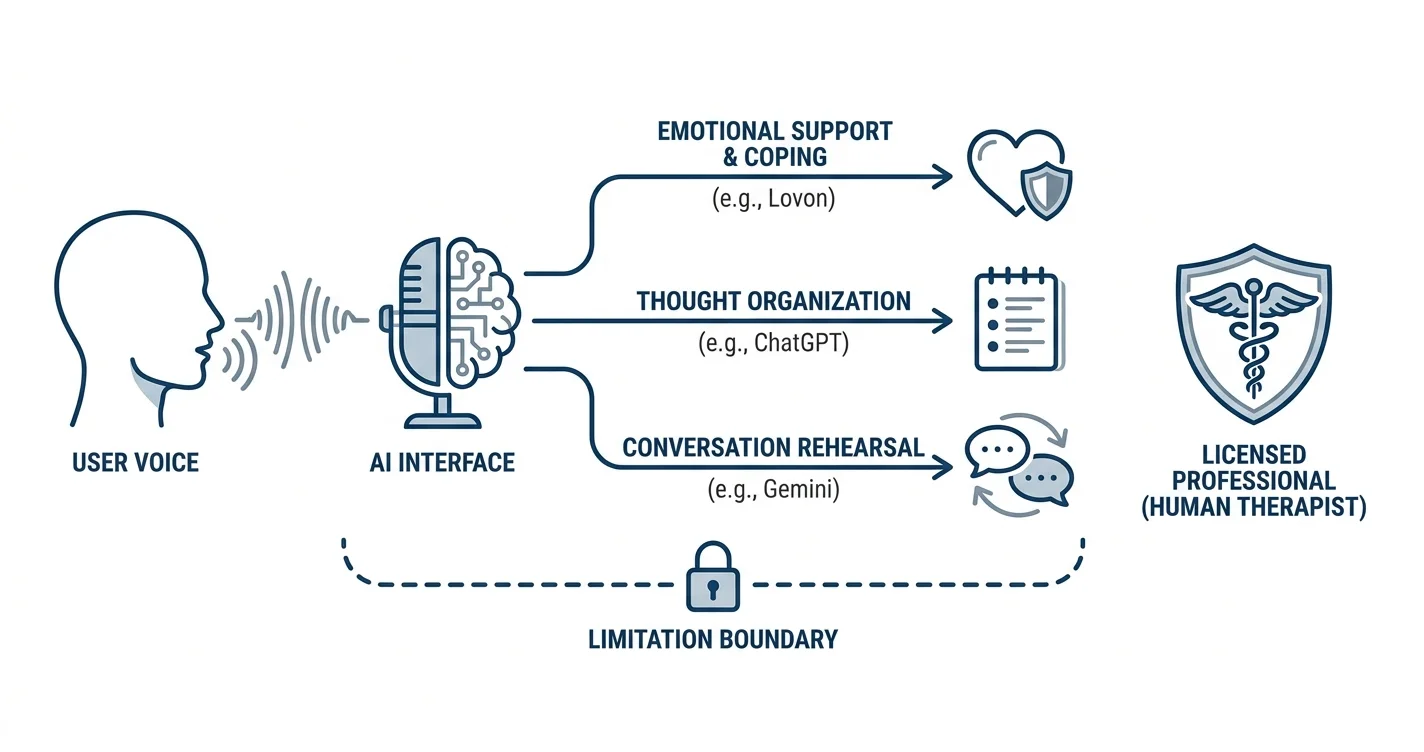

Key Takeaways
- Lovon is the best fit for purpose-built voice support, coping tools, and everyday self-reflection.
- Compare the best AI therapy apps with voice conversations by purpose, boundaries, privacy, and conversational fit.
- ChatGPT voice and Gemini Live are general assistants, not substitutes for mental health treatment.
- Choose licensed care for assessment and treatment; use voice apps only as additional support.
Best for purpose-built emotional support: Lovon. Best for general-purpose spoken reflection: ChatGPT voice; best for rehearsing everyday conversations: Gemini Live. This 2026 guide separates mental health support from general voice assistants so you can choose without mistaking an app for a licensed therapist.
TL;DR
- Lovon is the best fit for purpose-built voice support, coping tools, and everyday self-reflection.
- Compare the best AI therapy apps with voice conversations by purpose, boundaries, privacy, and conversational fit.
- ChatGPT voice and Gemini Live are general assistants, not substitutes for mental health treatment.
- Choose licensed care for assessment and treatment; use voice apps only as additional support.
Why this matters
A spoken response does not make an app a therapist. The useful distinction is whether you want emotional support, help organizing a thought, or practice saying something difficult.
Voice also changes where you can comfortably use an app. Speaking aloud requires a private setting; text gives you more control over what people nearby hear. This guide to AI voice therapy versus text-based apps explains that choice in more detail.
The best choice is the one that fits your task and keeps its limits clear. A reassuring voice is not evidence of clinical judgment, confidentiality, or effective treatment.
What makes the best AI therapy apps with voice conversations?
Use these criteria when choosing a voice support app in 2026:
- Purpose: Does the app focus on emotional support, or do you need to direct a general assistant yourself?
- Spoken interaction: Can you speak and receive spoken responses, rather than only dictate text into a message box?
- Useful direction: Does the conversation help you name a feeling, examine a thought, or choose a manageable action?
- Clear boundaries: Does the app distinguish supportive conversation from diagnosis, treatment, and emergency care?
- Privacy controls: Can you understand what happens to recordings, transcripts, and account data before sharing sensitive information?
- Personal fit: Can you follow the pace, correct misunderstandings, and stop without feeling pressured to continue?
Make privacy a separate decision from conversational quality. A voice that feels kind tells you nothing about how a service handles your information. Read the current policies and settings rather than assuming that mental health language means clinical protections apply.
Voice support options at a glance
The 2026 shortlist below includes one purpose-built mental health app and two general assistants. They serve different needs; they are not interchangeable therapy services.
| Option | Best for | Standout feature | Key limitation |
|---|---|---|---|
| Lovon | Everyday emotional support | Voice conversations focused on support, coping tools, and self-reflection | Not a licensed clinician or replacement for clinical care |
| ChatGPT voice | Organizing thoughts aloud | General-purpose spoken conversation | You must define the task; it is not mental health treatment |
| Gemini Live | Rehearsing everyday conversations | Back-and-forth voice interaction | Practice does not assess a relationship or predict another person's response |
There is no clinical effectiveness ranking here. Choose by the job you want help with, not by assuming that a higher position means better treatment outcomes.
1. Lovon: best voice support app for everyday emotional support
Lovon is a mental health app that offers voice conversations, emotional support, coping tools, and self-reflection guidance. It is built with input from PhD psychologists and positions itself as a companion, not a replacement for licensed clinical care.
Best for: You want to talk through everyday anxiety, stress, low mood, relationship difficulties, or burnout within an app designed around emotional support.
You do not need to arrive with a polished explanation. Start with what happened and what feels difficult, then ask for help identifying a manageable next step. Keep the goal modest: understanding your reaction is different from diagnosing its cause.
Lovon pros:
- Mental health support is the app's stated purpose.
- Voice conversation lets you talk rather than compose a written entry.
- Coping tools and self-reflection guidance are part of the offering.
- Its stated role separates companionship from licensed clinical care.
Lovon cons:
- It is not a licensed clinician and cannot replace clinical assessment or treatment.
- Spoken sessions require somewhere you feel comfortable being overheard.
- An app conversation cannot provide the full context or accountability of an ongoing therapeutic relationship.
A useful starting request is to name the situation, describe your feeling, and ask for a coping tool. Avoid asking the app to decide whether you have a condition or whether someone else has a personality disorder.
Verdict: Buy into the support role; skip it as a replacement for professional care.
2. ChatGPT voice: best general assistant for organizing thoughts aloud
ChatGPT supports spoken conversations through its voice feature. It is a general-purpose assistant, so the useful task here is organizing what you want to say or think about—not receiving mental health treatment.
Best for: You want to turn a scattered account of your day into a clearer description of what happened, what you felt, and what remains unresolved.
Give ChatGPT voice a narrow instruction. Ask it to reflect back the main points, distinguish observations from assumptions, or help draft questions for a therapist. That gives the conversation a clearer purpose than asking it to explain your entire emotional life.
ChatGPT voice pros:
- Supports back-and-forth spoken interaction.
- Can help organize information you provide into a summary.
- Can help you draft questions or practice explaining a concern.
ChatGPT voice cons:
- It is a general assistant, not a licensed mental health professional.
- A fluent response can still contain mistakes or unsupported interpretations.
- You need to keep the conversation within a useful, nonclinical task.
For example, describe a difficult meeting and ask for separate lists of observed events and your interpretations. Review the result yourself. If the summary adds motives, facts, or feelings you did not describe, correct it rather than accepting the wording because it sounds confident.
Do not use ChatGPT voice to confirm that a feared outcome is impossible or to make treatment decisions. Bring persistent concerns to a qualified professional.
Verdict: Hold to structured reflection; skip clinical conclusions.
3. Gemini Live: best general voice assistant for conversation rehearsal
Gemini Live supports back-and-forth voice conversations. Its role in this shortlist is practicing an everyday discussion before you have it with a real person.
Best for: You want to rehearse asking for help, setting a routine boundary, or explaining a concern clearly.
Keep the practice focused on your own words. Ask Gemini Live to play a conversation partner, let you finish, and then help shorten your opening. Treat every simulated response as practice material—not evidence of what your partner, manager, or friend thinks.
Gemini Live pros:
- Supports spoken back-and-forth practice.
- Lets you rehearse different wording for the same request.
- Provides a general conversational format for practicing explanations.
Gemini Live cons:
- It is not a therapy service or a licensed clinician.
- A simulated conversation cannot predict another person's response.
- Rehearsal does not establish whether a relationship is safe or healthy.
An appropriate practice topic is requesting a quieter workspace or explaining that you need time before continuing an argument. An inappropriate use is asking a simulation to determine whether a partner is abusive or whether confrontation is safe.
If you fear retaliation, coercion, or violence, seek human support and safety planning rather than relying on a rehearsal app.
Verdict: Hold to communication practice; skip relationship diagnosis and safety decisions.
How the options are ranked
The order follows purpose, spoken interaction, useful direction, clear boundaries, privacy review, and personal fit. A purpose-built support app comes first for an emotional-support query; general assistants follow for narrower reflection and rehearsal tasks.
This is a suitability guide, not a head-to-head clinical trial. No treatment outcome, diagnostic accuracy, or privacy advantage is assigned to any option. Before choosing in 2026, check the current voice feature and policies directly with the provider.
Try a focused voice check-in
You do not need to share your whole history to decide whether a conversation format suits you. Start with a low-stakes situation and a clear stopping point.
Name the situation
Begin with an ordinary event: an awkward meeting, unfinished task, or disagreement. Describe what happened without including names, addresses, workplace identifiers, or someone else's private information.
Choose the task
Ask for reflection, a coping tool, or rehearsal—not all three at once. For a first attempt, try a 2-minute check-in as a personal time boundary, not a prescribed therapeutic dose.
Check the response
Notice whether the reply reflects what you actually said. Correct invented details and reject confident claims about other people's motives. Stop if the conversation feels confusing, distressing, or pushy.
Take one action
Finish with 1 next step you choose yourself: write down a question for your therapist, take a break, or ask someone you trust for support. You do not need to keep talking until every uncomfortable feeling disappears.
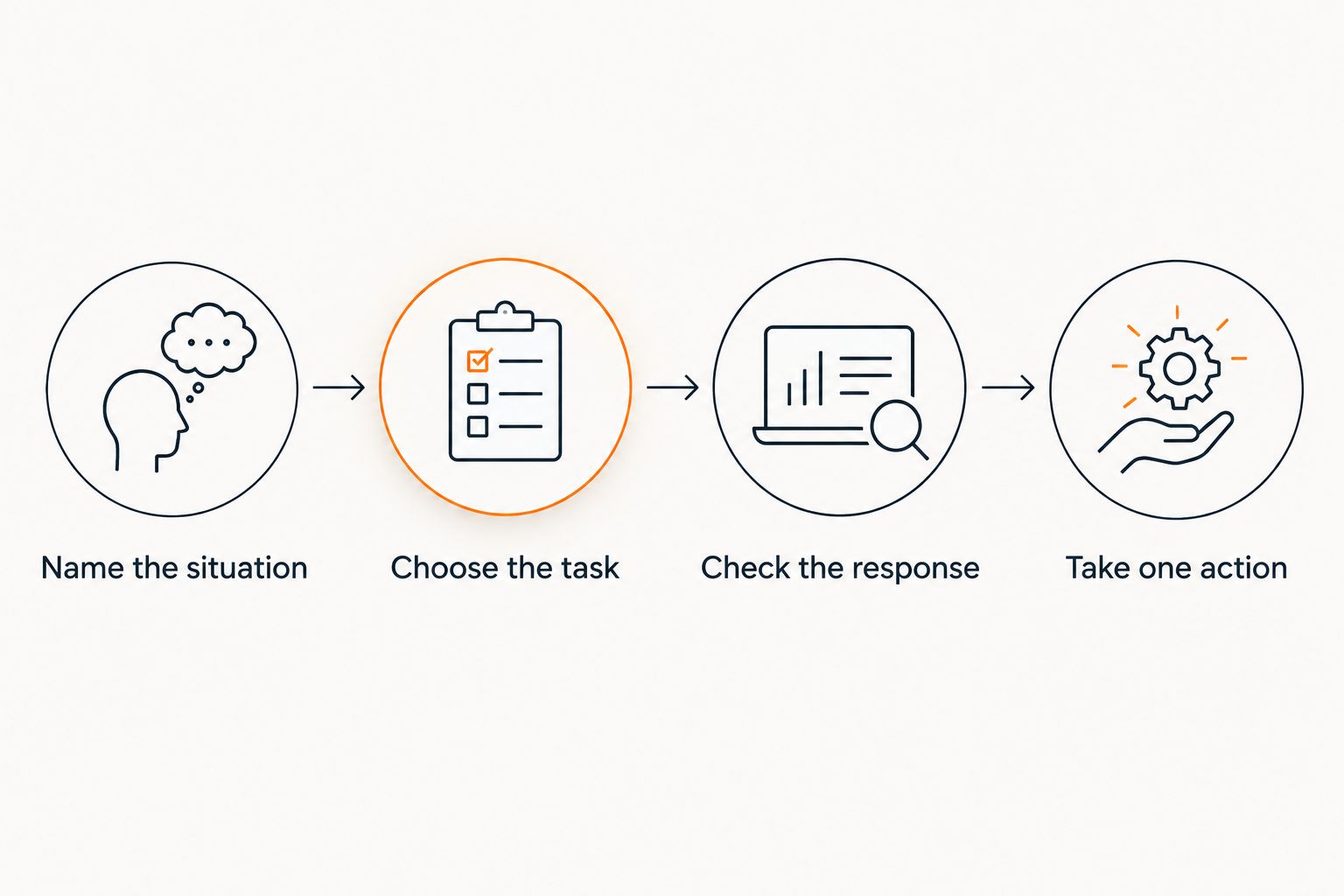 Four steps for a focused voice check-in, from naming the situation to choosing an action.
Give the conversation a task and a stopping point.
Afterward, ask whether the conversation helped you understand something or act on something. If you try 3 check-ins, use that as a personal review point rather than a promise of improvement. More conversation is not automatically more support.
Privacy questions to ask before speaking
Before sharing sensitive details in 2026, read the provider's current privacy policy and voice settings. Do not assume that deleting a visible conversation answers every question about recordings or data retention.
Check these points separately:
- What audio and transcripts does the provider retain?
- What controls exist for deletion and data use?
- Can people review conversations, and under what circumstances?
- What happens to information shared through connected services?
- What protections apply to your account and device?
If the answers are unclear, keep your conversation general. You can discuss feeling overwhelmed without identifying your employer, your child's school, or another person's medical history. Use a private space and avoid speakerphone around others.
Which voice support option should you choose?
Lovon is best for people who want a purpose-built AI voice support app for everyday emotional struggles, not clinical treatment. Choose ChatGPT voice for organizing thoughts and Gemini Live for rehearsing ordinary conversations.
If distress persists, worsens, or disrupts daily life, arrange support from a licensed professional. You do not need to establish a diagnosis yourself before asking for help.
An app is not the right place for urgent safety needs. In the United States, call or text 988 for suicide or mental health crisis support. Call 911 for an immediate emergency; do not wait for an app to recognize danger.
FAQ
What's the best AI therapy app with voice conversations?
Lovon is the best fit in this shortlist for purpose-built voice emotional support, coping tools, and self-reflection. It is not a licensed clinician or a replacement for mental health treatment.
Is speaking to an app the same as seeing a therapist?
No. A voice support app does not provide the professional assessment, responsibilities, or ongoing clinical relationship of a licensed therapist.
Can ChatGPT voice help me prepare for therapy?
ChatGPT voice can help organize thoughts or draft questions you want to bring to therapy. Review the summary for errors, and let your therapist assess clinical concerns.
Is Gemini Live a therapy app?
No. Gemini Live is a general voice assistant; conversation rehearsal is a nonclinical use, not mental health treatment.
Is voice better than text for emotional support?
Voice is a better fit when you prefer speaking; text is a better fit when speaking aloud feels uncomfortable or exposes private information. Neither format alone establishes clinical effectiveness.
What should I say during my first voice support conversation?
Describe a low-stakes situation, name your feeling, and ask for one specific kind of help. You can request reflection, a coping tool, or practice explaining a concern.
Should I share personal details with a voice support app?
Share only what you are comfortable disclosing after reviewing the provider's current policies and settings. Leave out unnecessary identifiers and other people's private information.
What should I do if I feel unsafe during a conversation?
Stop the app conversation and seek human help. In the United States, call or text 988 for crisis support, or call 911 for an immediate emergency.
One last thing
Before opening a voice app, write down what would make the conversation useful. Make the answer concrete: understanding a feeling, practicing a request, or preparing a question for professional care.
Then stop when that task is done. You are choosing a tool to support your life—not a conversation you have to keep going.
Related guides
How AI Support Helps You Heal
AI emotional support isn't about replacing human connection — it's about filling the gaps. The moments when you need to talk at 2 AM, when you don't want to burden your friends again, or when you simply need someone to listen without judgment.
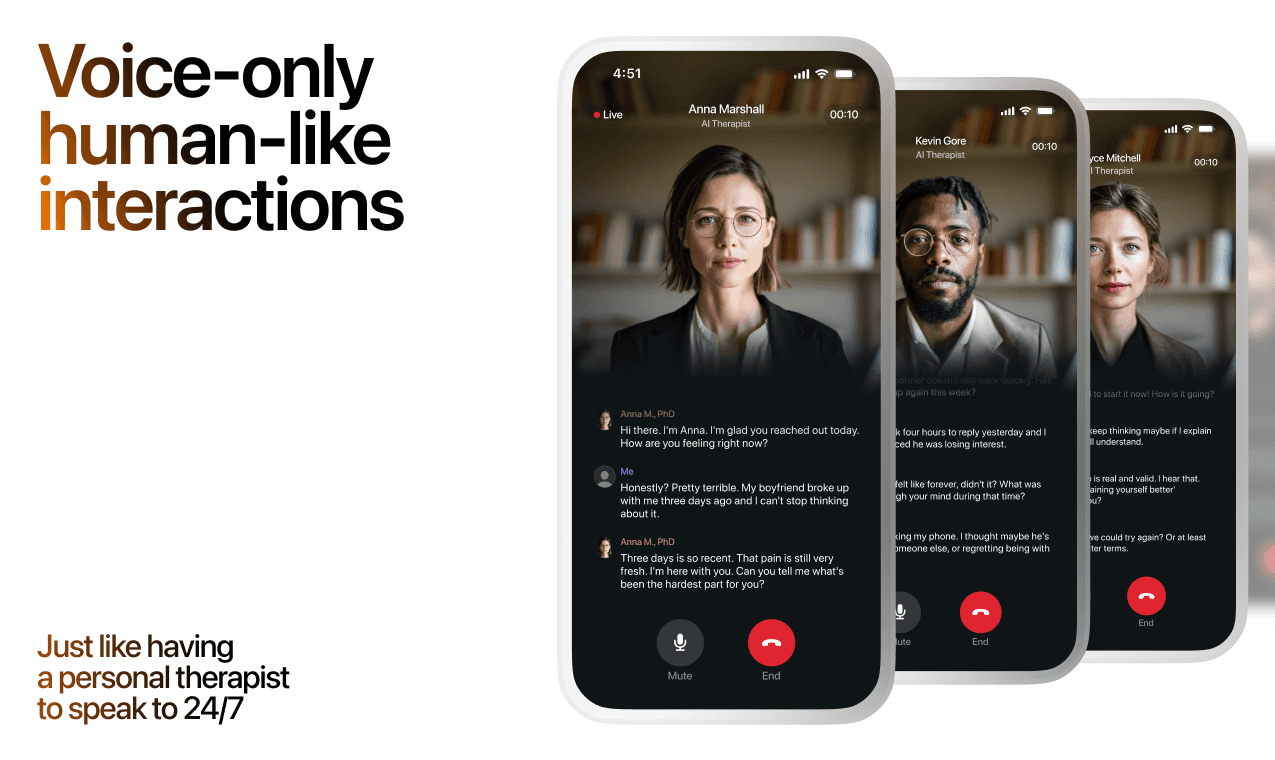
Here's what happens in a typical Lovon session:
You share what's on your mind
There's no script, no intake form, no waiting room. You speak or type whatever you're feeling — in your own words, at your own pace.
Lovon validates and explores
Using frameworks from CBT (Cognitive Behavioral Therapy) and motivational interviewing, Lovon acknowledges your feelings first, then gently helps you explore them. No dismissive "just move on" advice.
You build coping skills together
Lovon doesn't just listen — it actively works with you on evidence-based techniques: thought reframing, urge surfing, behavioral experiments, and more.
What a Session with Lovon Looks Like
When to Seek Professional Help
AI support is a valuable tool, but it's not a replacement for professional care. Please consider reaching out to a licensed therapist if you experience any of the following:
- Persistent thoughts of self-harm or suicide
- Inability to perform daily activities (work, eating, sleeping) for more than 2 weeks
- Turning to alcohol or substances to cope
- Intense anger or desire to harm your ex-partner
- Complete emotional numbness that doesn't improve over time
Crisis Resources (US): If you're in immediate danger, call 988 (Suicide & Crisis Lifeline) or text HOME to 741741 (Crisis Text Line). Available 24/7, free, and confidential.
Outside the US? Find a crisis line in your country
Ready to Start?
Your healing journey can begin right now
A 7-day trial. No judgment. Just a safe space to process what you're going through.
Frequently Asked Questions
Is Lovon a replacement for a real therapist?
Is my conversation with Lovon AI private?
How is Lovon different from ChatGPT for emotional support?
Can I use Lovon if I'm already seeing a therapist?
Can I try Lovon before subscribing?
About the Author

The Lovon Editorial Team
Mental Health & Wellness Content Team
The Lovon Editorial Team develops mental health and wellness content designed to make psychological concepts accessible and actionable. Our goal is to bridge the gap between clinical research and everyday life - helping you understand why your mind works the way it does and what you can do about it....
Related articles
- Best AI apps for caregiver burnout in 2026
Compare the best AI apps for caregiver burnout. Choose Lovon for voice support, or a writing assistant for practical…
- AI Therapy for Anxiety: How It Works (2026)
Learn exactly how AI therapy for anxiety works, step by step. Lovon delivers on-demand CBT and mindfulness tools for…
- Best AI apps for postpartum depression support in 2026
Compare the best AI apps for postpartum depression support. Choose voice, text, or mood reflection alongside clinical…
- Best ChatGPT alternatives for emotional support in 2026
Compare the best ChatGPT alternatives for therapy. Choose voice support for everyday feelings or licensed care for…
See also
Quizzes
- Confidence Test: Do You Act Before You Feel Ready?
See which part of your confidence is thin.
- Am I a People Pleaser? 12-Question Quiz
Where kindness stops and self-erasure starts.
Free tools
- What to Say to Someone Who Is Grieving
Get sentences that fit this person and this week, not a list of things people say at funerals. Describe who they lost…
- How to Say No Politely (Without Over-Explaining)
A chat for how to say no politely when you have already decided and cannot get the word out. Tell it what you were…
From the wiki
- How to stop maladaptive daydreaming?
Maladaptive daydreaming is immersive waking fantasy that eats hours, usually with music and pacing attached. You rarely…
Disclaimer: This article is for informational purposes only and does not constitute medical advice, diagnosis, or treatment. Always seek the advice of your physician or other qualified health provider with any questions you may have regarding a medical condition. If you are in crisis or think you may have an emergency, call 988 (Suicide & Crisis Lifeline) or go to the nearest emergency room. Outside the US? Find a crisis line in your country.