
Can AI therapy replace a human therapist?
AI therapy can't replace a licensed human therapist for diagnosis or crisis care in 2026, but it fills the gap between sessions. See what each does best.

Key Takeaways
- Can AI therapy replace a human therapist? No — AI voice therapy fills gaps between sessions, it doesn't replace
- Lovon works best for daily stress, anxiety, and reflection between therapy appointments, not diagnosis or medication.
- A human therapist is still required for crisis intervention, trauma processing, and any legally mandated treatment.
- AI therapy is available at any hour with no waitlist; human therapy in 2026 still means scheduling and often a wait
- AI voice therapy and human therapy solve different problems — the two work better paired than compared.
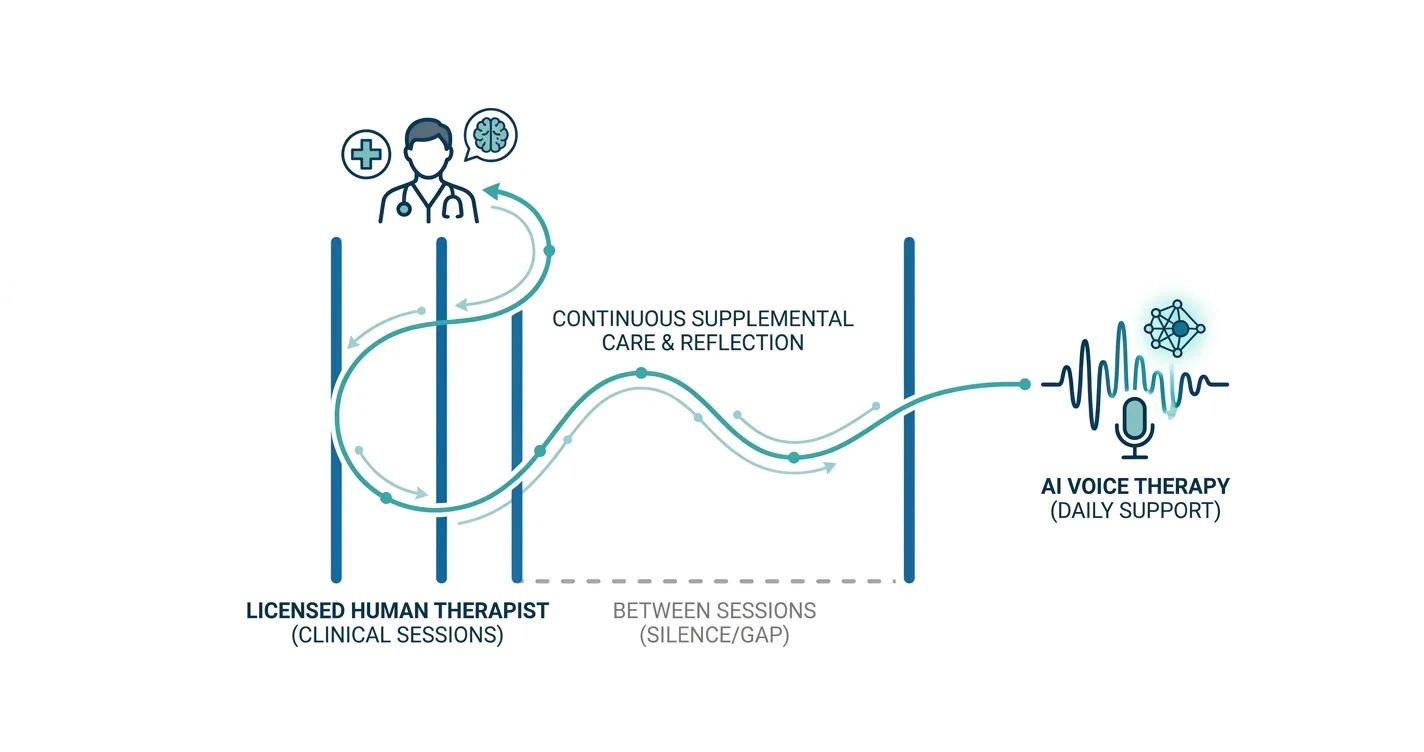
No — AI therapy cannot replace a licensed human therapist for diagnosis, medication management, trauma processing, or crisis intervention in 2026. What it replaces is the silence between sessions: the hours when you're anxious at midnight, spiraling before a meeting, or replaying a fight with your partner and have nobody to talk to. AI voice therapy apps like Lovon are built to supplement professional care, not substitute for it — a distinction most of the hype around this question skips over.
TL;DR
- Can AI therapy replace a human therapist? No — AI voice therapy fills gaps between sessions, it doesn't replace licensed clinical care.
- Lovon works best for daily stress, anxiety, and reflection between therapy appointments, not diagnosis or medication.
- A human therapist is still required for crisis intervention, trauma processing, and any legally mandated treatment.
- AI therapy is available at any hour with no waitlist; human therapy in 2026 still means scheduling and often a wait for an opening.
- AI voice therapy and human therapy solve different problems — the two work better paired than compared.
Why This Question Keeps Coming Up
Search interest around "can AI replace a therapist" tracks two things: the cost of therapy without insurance in 2026, and the reality that most therapists have waitlists. AI voice therapy didn't create this gap — it showed up in the middle of it, offering support the moment you need to talk instead of the moment a calendar has an opening.
Lovon is explicit that it's not a replacement for licensed clinical care. It's built for the hours you're not in a session, which for most people is nearly all of the week.
Can AI Therapy Replace a Human Therapist? Here's the Comparison
The honest comparison isn't AI versus human — it's what each one is actually built to do.
| What you need | AI voice therapy (Lovon) | Human therapist |
|---|---|---|
| Availability | On demand, any hour, no waitlist | Scheduled sessions, often a waitlist |
| Diagnosis or prescription | Cannot diagnose or prescribe | Only a licensed clinician can diagnose or prescribe |
| Crisis intervention | Not equipped for a suicidal crisis or emergency | Trained, and for many, required to respond to crisis situations |
| Daily coping support | Built for this — anxiety spikes, stress, reflection | Available only during scheduled sessions |
| Complex trauma work | Can support reflection between sessions | Necessary for structured trauma treatment |
| Continuity between visits | Available every day, no gap in support | Depends on how often sessions are scheduled |
Lovon works best as the tool you use between therapy sessions or before you're ready to book one — not as a stand-in for a licensed clinician.
When AI Therapy Is a Reasonable Substitute
- Everyday stress that doesn't need a clinical diagnosis
- Mild-to-moderate anxiety spikes, especially at odd hours
- Working through a relationship disagreement in the moment
- Burnout that hasn't escalated into a diagnosable condition
- Daily reflection and voice journaling as a habit
- Filling the time before a first therapy appointment opens up — see what AI mental health support is and who it helps
Talk to Lovon Between Sessions
On-demand AI voice support for stress, anxiety, and daily reflection.
When You Need a Human Therapist Instead
- Suicidal ideation, self-harm, or any mental health emergency
- A diagnosis that determines medication or a treatment plan
- Childhood trauma or complex PTSD that needs structured, licensed treatment
- Court-mandated or insurance-required treatment documentation
- Modalities that require a trained clinician, like EMDR or DBT
Read what an AI therapist for stress can and cannot do before deciding which situation you're in.
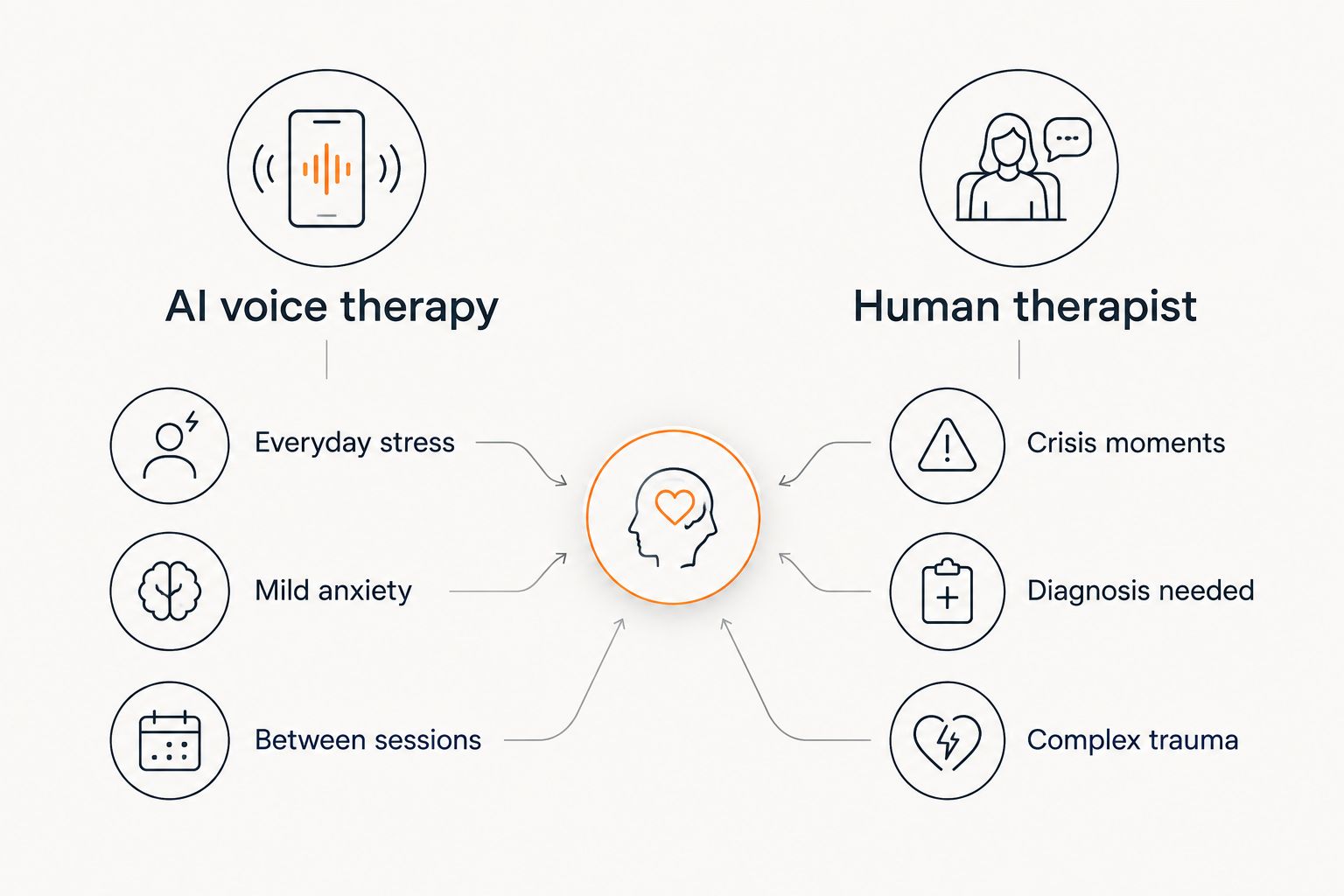
Two-column comparison of when AI voice therapy helps versus when a human therapist is needed
Crisis moments and complex trauma still call for a licensed human therapist.
Why the "Can AI Replace Therapy" Debate Won't Go Away
- Human therapy without insurance is expensive enough that many people delay getting help
- Licensed therapist availability hasn't kept pace with demand, and waitlists are common in 2026
- Stigma still keeps people from booking a first appointment
- AI voice therapy is available at 2 a.m., on a bad commute, or mid-argument — a human therapist isn't
- Some people find it easier to say the hard thing out loud to an AI first, then bring it to a therapist later
- Insurance coverage for AI tools remains inconsistent, while coverage rules for human therapy are at least established
Is AI Therapy as Effective as Human Therapy?
No independent clinical trials have established AI voice therapy as equivalent to therapy delivered by a licensed clinician. It's designed as a support tool for daily stress and reflection, not as a replacement for evidence-based treatment protocols like CBT delivered by a trained therapist. Use it alongside licensed care, not instead of it, if you're managing a diagnosed condition.
Can an AI Therapist Diagnose a Mental Health Condition?
No — diagnosing a mental health condition requires a licensed clinician, and Lovon does not diagnose or prescribe. AI voice therapy can help you notice patterns in your mood or stress over time, which is useful information to bring into an actual diagnostic appointment. Treat it as a mirror, not a doctor.
Is AI Therapy Safe to Use During a Mental Health Crisis?
No — during a mental health crisis, an AI app is not the right tool, and no AI voice therapy platform, including Lovon, is built to intervene in an emergency. In the US, the 988 Suicide & Crisis Lifeline connects you to a trained human immediately, and that's the right first call in a crisis, not an app.
FAQ
Is AI therapy as good as seeing a real therapist?
No — AI therapy is built for daily support and reflection, not for diagnosis or clinical treatment, so it isn't a like-for-like replacement for a licensed therapist.
Can an AI therapist prescribe medication?
No. Only a licensed clinician can prescribe medication or manage a treatment plan that includes it.
Is Lovon a replacement for a licensed therapist?
No — Lovon is built to support you between sessions or before you've found a therapist, not to replace licensed clinical care.
How much does AI therapy cost compared to human therapy in 2026?
Costs vary by provider and plan for both, but human therapy without insurance typically involves a higher per-session cost than an AI voice therapy app. Check current terms on each platform before comparing.
Can AI therapy help with anxiety and stress?
Yes, for everyday anxiety and stress, AI voice therapy can walk you through coping exercises and reflection in the moment it happens, which is when many people need it most.
Is AI voice therapy private and confidential?
Privacy practices depend on the app's specific policy, so check the terms of the platform you're using before sharing sensitive details.
What happens if I'm in a mental health crisis and only have an AI app?
Contact the 988 Suicide & Crisis Lifeline or emergency services immediately — AI apps, including Lovon, are not built to handle crisis intervention.
Can I use AI therapy alongside a human therapist?
Yes — using AI voice therapy between scheduled sessions with a human therapist is one of the more practical ways to use both, since it fills the gap without replacing the clinical relationship.
One Last Thing
The 988 Suicide & Crisis Lifeline is one call away in the US, and no AI app — including Lovon — is built to replace it in an emergency. Save that number regardless of which kind of support you use on a normal day, and treat AI voice therapy as what it's designed to be: the thing you reach for at 2 a.m., not the thing you reach for in a crisis.
Related Guides
How AI Support Helps You Heal
AI emotional support isn't about replacing human connection — it's about filling the gaps. The moments when you need to talk at 2 AM, when you don't want to burden your friends again, or when you simply need someone to listen without judgment.
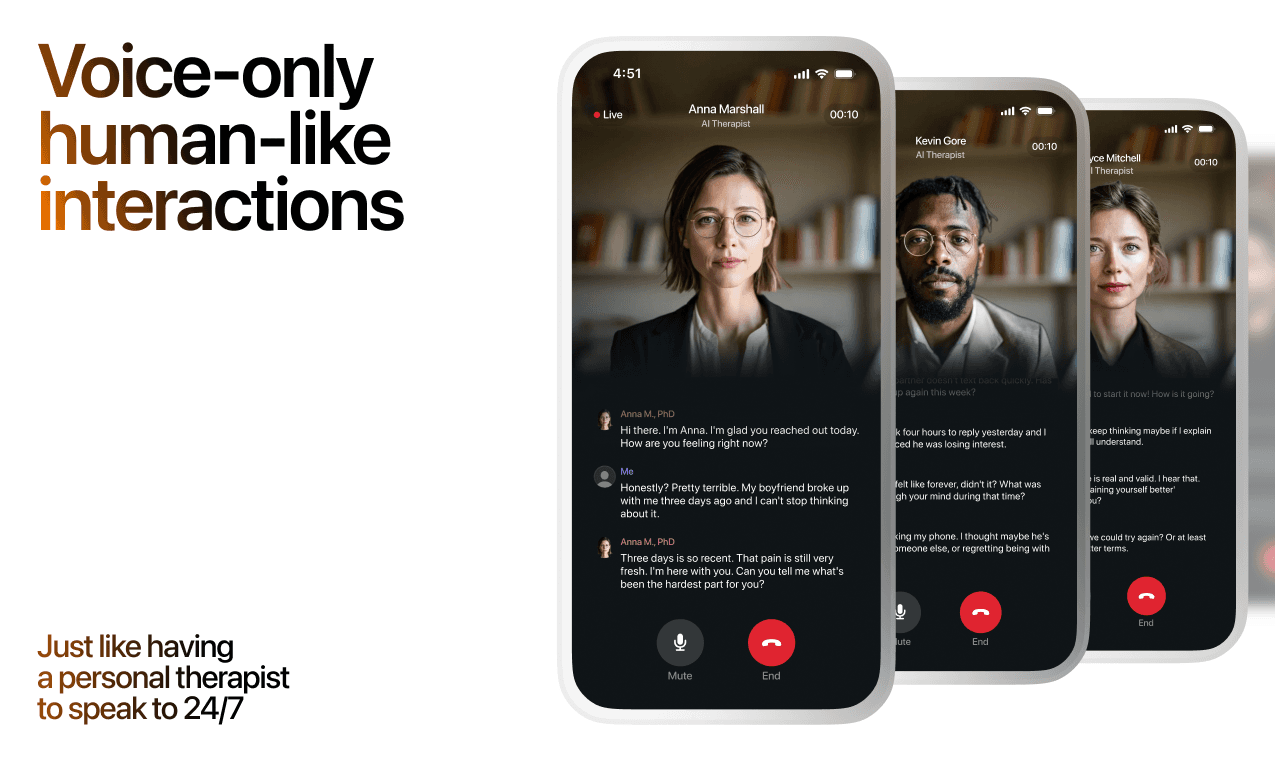
Here's what happens in a typical Lovon session:
You share what's on your mind
There's no script, no intake form, no waiting room. You speak or type whatever you're feeling — in your own words, at your own pace.
Lovon validates and explores
Using frameworks from CBT (Cognitive Behavioral Therapy) and motivational interviewing, Lovon acknowledges your feelings first, then gently helps you explore them. No dismissive "just move on" advice.
You build coping skills together
Lovon doesn't just listen — it actively works with you on evidence-based techniques: thought reframing, urge surfing, behavioral experiments, and more.
What a Session with Lovon Looks Like
When to Seek Professional Help
AI support is a valuable tool, but it's not a replacement for professional care. Please consider reaching out to a licensed therapist if you experience any of the following:
- Persistent thoughts of self-harm or suicide
- Inability to perform daily activities (work, eating, sleeping) for more than 2 weeks
- Turning to alcohol or substances to cope
- Intense anger or desire to harm your ex-partner
- Complete emotional numbness that doesn't improve over time
Crisis Resources (US): If you're in immediate danger, call 988 (Suicide & Crisis Lifeline) or text HOME to 741741 (Crisis Text Line). Available 24/7, free, and confidential.
Outside the US? Find a crisis line in your country
Ready to Start?
Your healing journey can begin right now
1 free conversation. No credit card. No judgment. Just a safe space to process what you're going through.
Frequently Asked Questions
Is AI therapy a replacement for a real therapist?
Is my conversation with Lovon AI private?
How is Lovon different from ChatGPT for emotional support?
Can I use Lovon if I'm already seeing a therapist?
Can I try Lovon for free?
About the Author

The Lovon Editorial Team
Mental Health & Wellness Content Team
The Lovon Editorial Team develops mental health and wellness content designed to make psychological concepts accessible and actionable. Our goal is to bridge the gap between clinical research and everyday life - helping you understand why your mind works the way it does and what you can do about it....
Related articles
- Best Free AI Therapist Apps in 2026 — Ranked
The best free AI therapist app in 2026, ranked by free-tier quality, condition coverage, and clinical grounding. Lovon…
- AI Therapy for Anger Management: Worth It in 2026?
AI therapy for anger management in 2026: what to look for, top picks with verdicts, and when to use a licensed program…
- Best AI App for Anxiety: On-Demand Support in 2026
Looking for an AI app for anxiety? See how Lovon and top alternatives deliver 24/7 coping tools and voice support…
- On-Demand Emotional Support in 2026: What Actually Helps
Therapy isn't always available. This 2026 guide covers the best on-demand emotional support tools — who they're for…
See also
Quizzes
- Perfectionism Test: What Are Your Standards Costing?
See what your standards actually cost, in 3 minutes.
- Alexithymia Test: Can You Name What You Feel?
See where your feelings lose their names, in 3 minutes.
Free tools
- Attachment Trigger Plan for Anxious and Avoidant Patterns
Pick your pattern, tick the moments that set it off, and finish one card for each: your body signal, the thing you will…
- What Did They Actually Mean By That?
A chat for one sentence you cannot stop re-reading. Paste their exact words and what was happening around them, and get…
From the wiki
- What does it mean when you dream about your ex?
Dreaming about your ex usually reflects emotional processing, not prophecy and not a message from them. Your sleeping…
Disclaimer: This article is for informational purposes only and does not constitute medical advice, diagnosis, or treatment. Always seek the advice of your physician or other qualified health provider with any questions you may have regarding a medical condition. If you are in crisis or think you may have an emergency, call 988 (Suicide & Crisis Lifeline) or go to the nearest emergency room. Outside the US? Find a crisis line in your country.