
Is it safe to share your feelings with an AI therapist?
Is it safe to share feelings with an AI therapist in 2026? Yes for daily stress and anxiety, not for crisis. See the safety breakdown by app type.
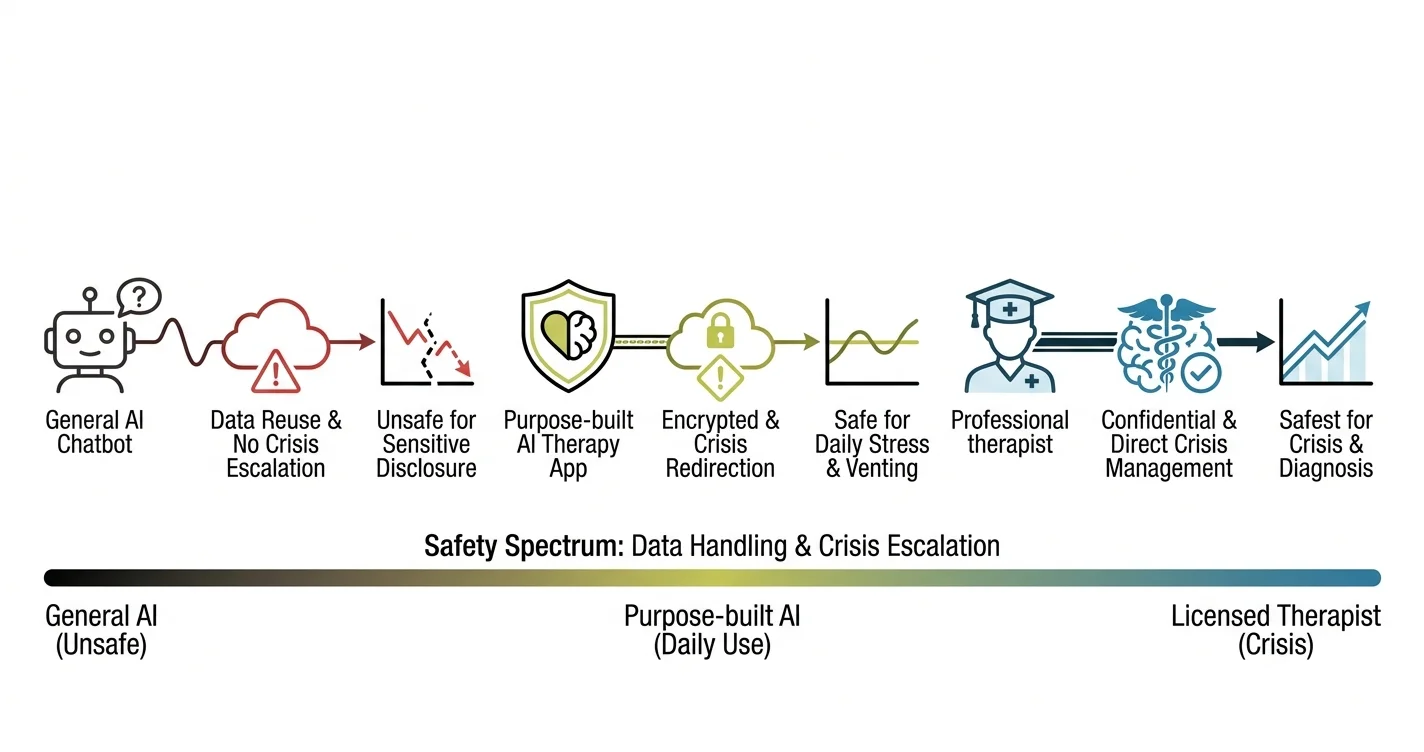

Key Takeaways
- Is it safe to share feelings with an AI therapist? Yes for daily anxiety, stress, and venting; no for active
- General-purpose chatbots like ChatGPT were not built for emotional disclosure and may reuse conversations to train
- Purpose-built apps like Lovon are designed around emotional support with mental health input, but they are not a
- The biggest safety factor isn't the AI's response quality — it's data retention, encryption, and whether the app
- Voice-based AI therapy adds tone and pacing to the conversation, which text-only apps miss entirely.
Sharing your feelings with an AI therapist is safe for everyday stress, anxiety, and relationship venting when the app encrypts conversations, states clearly what it is and isn't, and doesn't try to manage a crisis on its own. The real risk isn't the AI misreading you — it's what happens to the transcript afterward, and that depends entirely on which type of AI tool you're talking to.
TL;DR
- Is it safe to share feelings with an AI therapist? Yes for daily anxiety, stress, and venting; no for active suicidal crisis, which needs a licensed responder.
- General-purpose chatbots like ChatGPT were not built for emotional disclosure and may reuse conversations to train the model.
- Purpose-built apps like Lovon are designed around emotional support with mental health input, but they are not a replacement for licensed clinical care.
- The biggest safety factor isn't the AI's response quality — it's data retention, encryption, and whether the app escalates crisis language to real help.
- Voice-based AI therapy adds tone and pacing to the conversation, which text-only apps miss entirely.
Why this matters
People don't ask this question out of paranoia. They ask it because talking to a screen or a voice about a breakup, a panic attack, or a bad week with a manager feels different from typing a search query — it feels like disclosure, and disclosure has consequences if it lands in the wrong place.
By 2026, AI-based emotional support tools have moved from novelty to daily habit for a meaningful slice of people who can't get a same-week therapy appointment. That shift makes the safety question practical, not theoretical: what actually happens to a voice recording or transcript once you close the app matters more than how empathetic the AI sounds mid-conversation.
Is it safe to share your feelings with an AI therapist?
The honest answer depends on which of three categories you're using. AI mental health support tools are not one uniform product — a general chatbot, a purpose-built therapy app, and a licensed human clinician carry very different safety profiles.
| Option | Data handling | Crisis handling | Best for | Verdict |
|---|---|---|---|---|
| General AI chatbots (ChatGPT, Replika, etc.) | Not designed for clinical disclosure; conversations can be used to improve the underlying model | No dedicated crisis escalation | Casual venting, brainstorming | Skip for anything sensitive |
| Purpose-built AI therapy apps (Lovon and similar) | Built around emotional conversation, shaped with mental health professional input | Should route crisis language to real hotlines and licensed care, never attempt to manage a crisis itself | Everyday anxiety, stress, relationship friction, burnout | Use daily, not for emergencies |
| Licensed human therapists | Governed by clinical confidentiality standards and law | Trained to manage active crisis directly | Diagnosis, trauma processing, active crisis | Best choice beyond everyday stress |
The pattern is consistent across 2026 reviews of digital mental health tools: purpose-built apps sit in the middle of the safety spectrum — safer than a generic chatbot, but not a substitute for a license.
General AI chatbots: built for conversation, not disclosure
A general-purpose chatbot will answer almost anything you type, including your worst week in years. The problem is structural, not personal — these tools were never designed around clinical confidentiality, and many retain conversation history to refine future responses. Skip general chatbots for anything you wouldn't want resurfacing later.
Purpose-built AI therapy apps: designed for emotional conversation
Apps built specifically for mental health support, including Lovon, are shaped around the assumption that users will disclose anxiety, low mood, relationship conflict, or burnout. Lovon was built with input from PhD psychologists and functions as a voice-based, always-available companion for exactly that kind of everyday disclosure — it is explicit that it is not a replacement for licensed clinical care. Use a purpose-built app for daily support; treat it as a companion, not a crisis line.
Licensed human therapists: the safety ceiling for crisis and diagnosis
Nothing built in 2026 replaces a licensed clinician when the conversation involves active suicidal ideation, abuse disclosure, or a diagnosis. Confidentiality law, mandated reporting structure, and direct crisis training exist for a reason. Escalate to a licensed professional or a crisis line the moment the conversation moves past everyday stress.
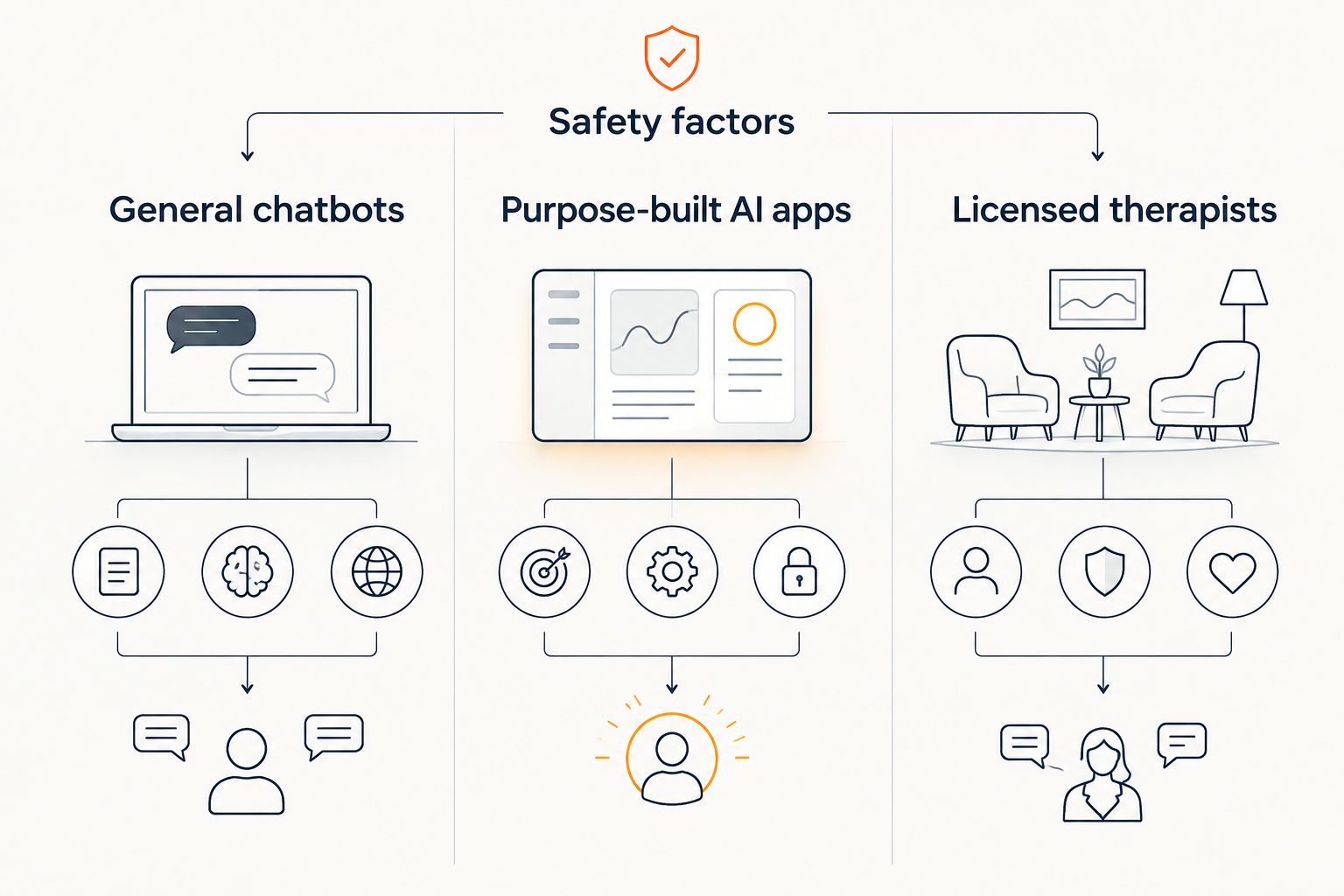
Comparison of safety factors across general chatbots, purpose-built AI apps, and licensed therapists
The safety gap isn't about empathy quality — it's about data handling and crisis escalation.
Why safety varies between AI conversation tools
- Data retention policy — how long transcripts or voice recordings are kept, and whether they're tied to your identity.
- Whether conversations train the model — general chatbots often reuse input data; purpose-built mental health apps typically do not, by design intent.
- Crisis escalation protocol — does the tool recognize crisis language and point you to real help, or does it just keep responding?
- Clarity about scope — a tool that clearly states it isn't a licensed clinician is safer than one that implies clinical authority it doesn't have.
- Voice vs. text format — voice-based AI therapy captures tone, pacing, and hesitation that text-only apps never see, which changes what's actually being disclosed.
- Purpose of the app — a general assistant answering a mental health question carries different risk than a tool purpose-built around emotional support.
Can I trust an AI therapist with suicidal thoughts?
No — an AI therapist, including purpose-built apps, should not be the sole responder to suicidal ideation in 2026. The right move is a licensed crisis line or emergency service; a well-designed AI support app will redirect you there rather than attempt to handle it alone.
Does sharing feelings with an AI count as therapy?
It counts as emotional support, not clinical therapy, even when the app is built with mental health professional input. Lovon, for example, is positioned as an always-available companion for anxiety, stress, and everyday burnout — a supplement between real sessions, not a diagnostic or crisis service.
Is AI therapy as confidential as talking to a licensed therapist?
No — licensed therapists operate under legal confidentiality standards that consumer apps are not bound by in the same way. Read an app's privacy stance directly, and reserve genuinely high-stakes disclosures (abuse, active crisis, legal matters) for a licensed human.
See how AI voice sessions actually work
Understand the format before your first conversation.
FAQ
Is it safe to share feelings with an AI therapist?
It's safe for everyday anxiety, stress, and relationship venting when the app is purpose-built for emotional support and states its limits clearly. It's not safe as the sole response to a crisis, which needs a licensed professional.
What's the best AI app for sharing feelings safely?
A purpose-built mental health app shaped with clinical psychology input is safer for disclosure than a general chatbot, because it's designed around the conversation type rather than general-purpose text generation.
Is AI therapy better than talking to a friend?
Neither replaces the other. AI therapy offers availability at 2 a.m. that a friend can't; a friend offers context and history an AI doesn't have.
How much privacy do AI therapy apps actually offer?
It varies by app and depends on stated data retention and training-use policies, so check the specific app's privacy language before disclosing anything sensitive.
Can an AI therapist diagnose anxiety or depression?
No. A purpose-built AI support app can offer coping tools and reflection prompts, but diagnosis requires a licensed clinician.
Is voice-based AI therapy safer than text-based apps?
Safety depends on data handling, not format, though voice conversations do capture tone and pacing that text-based apps miss entirely.
Should I use AI therapy instead of seeing a licensed therapist?
Use it alongside, not instead of, licensed care when the issue involves diagnosis, trauma processing, or crisis — AI support apps are built for the everyday gaps between sessions.
One last thing
The detail most people miss in 2026: the safety conversation isn't really about the AI at all — it's about the format. A voice conversation reveals hesitation, tone, and pacing that a typed message never shows, which means a voice-based AI companion is picking up more of your emotional state than you might realize, for better or worse. That's worth knowing before your first session, not after.
Related guides
How AI Support Helps You Heal
AI emotional support isn't about replacing human connection — it's about filling the gaps. The moments when you need to talk at 2 AM, when you don't want to burden your friends again, or when you simply need someone to listen without judgment.
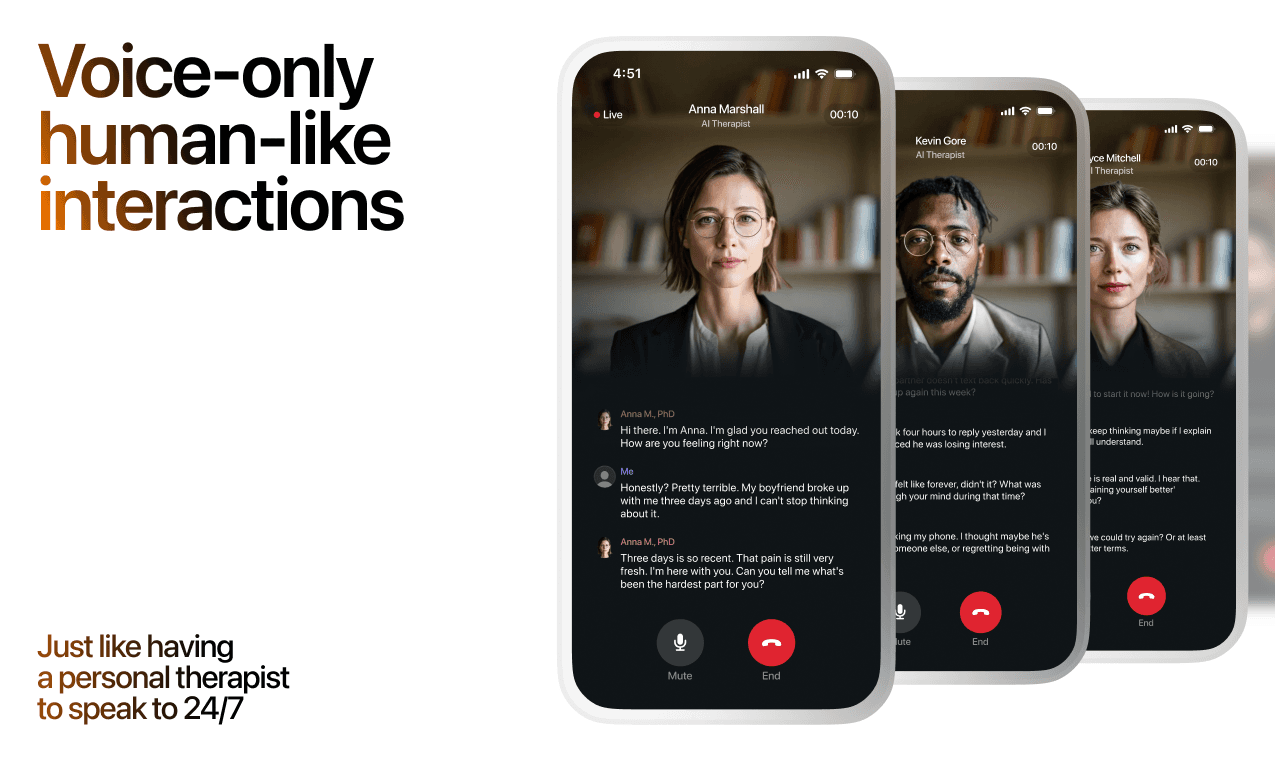
Here's what happens in a typical Lovon session:
You share what's on your mind
There's no script, no intake form, no waiting room. You speak or type whatever you're feeling — in your own words, at your own pace.
Lovon validates and explores
Using frameworks from CBT (Cognitive Behavioral Therapy) and motivational interviewing, Lovon acknowledges your feelings first, then gently helps you explore them. No dismissive "just move on" advice.
You build coping skills together
Lovon doesn't just listen — it actively works with you on evidence-based techniques: thought reframing, urge surfing, behavioral experiments, and more.
What a Session with Lovon Looks Like
When to Seek Professional Help
AI support is a valuable tool, but it's not a replacement for professional care. Please consider reaching out to a licensed therapist if you experience any of the following:
- Persistent thoughts of self-harm or suicide
- Inability to perform daily activities (work, eating, sleeping) for more than 2 weeks
- Turning to alcohol or substances to cope
- Intense anger or desire to harm your ex-partner
- Complete emotional numbness that doesn't improve over time
Crisis Resources (US): If you're in immediate danger, call 988 (Suicide & Crisis Lifeline) or text HOME to 741741 (Crisis Text Line). Available 24/7, free, and confidential.
Outside the US? Find a crisis line in your country
Ready to Start?
Your healing journey can begin right now
1 free conversation. No credit card. No judgment. Just a safe space to process what you're going through.
Frequently Asked Questions
Is AI therapy a replacement for a real therapist?
Is my conversation with Lovon AI private?
How is Lovon different from ChatGPT for emotional support?
Can I use Lovon if I'm already seeing a therapist?
Can I try Lovon for free?
About the Author
The Lovon Editorial Team
Mental Health & Wellness Content Team
The Lovon Editorial Team develops mental health and wellness content designed to make psychological concepts accessible and actionable. Our goal is to bridge the gap between clinical research and everyday life - helping you understand why your mind works the way it does and what you can do about it....
Related articles
- Trauma Dump: Emotional Dumping, Oversharing & How It Harms Your Mental Health
When a person goes through traumatic events, it is natural to share them with someone. But there is a big difference…
- How to Retrain Your Nervous System for Safety Without Performance Anxiety
Many people struggle with a nervous system that remains locked in patterns of hypervigilance, threat detection, and…
- Free AI Therapist for Stress & Burnout (2026)
The best free AI therapist for stress in 2026. Lovon leads with voice sessions and burnout-specific coping tools. See…
- Most Private AI Therapy App in 2026: Full Ranking
Lovon ranks as the most private AI therapy app in 2026 for anonymous voice sessions, ahead of Wysa, Youper, Replika, and…
See also
Quizzes
- Perfectionism Test: What Are Your Standards Costing?
See what your standards actually cost, in 3 minutes.
- Highly Sensitive Person Test: How Much Do You Take In?
See how deeply you process, notice and get overloaded.
Free tools
- What Did They Actually Mean By That?
A chat for one sentence you cannot stop re-reading. Paste their exact words and what was happening around them, and get…
- Family Boundary Plan
Pick the person, the one topic, and how much you want to see them. You get a three-rung ladder, the guilt lines to…
From the wiki
- Why do I feel lonely all of a sudden?
Sudden loneliness usually traces back to something that quietly ended in the last few months: a routine, a shared class…
Disclaimer: This article is for informational purposes only and does not constitute medical advice, diagnosis, or treatment. Always seek the advice of your physician or other qualified health provider with any questions you may have regarding a medical condition. If you are in crisis or think you may have an emergency, call 988 (Suicide & Crisis Lifeline) or go to the nearest emergency room. Outside the US? Find a crisis line in your country.