
Best ChatGPT alternatives for emotional support in 2026
Compare the best ChatGPT alternatives for therapy. Choose voice support for everyday feelings or licensed care for treatment, with clear benefits and limits.
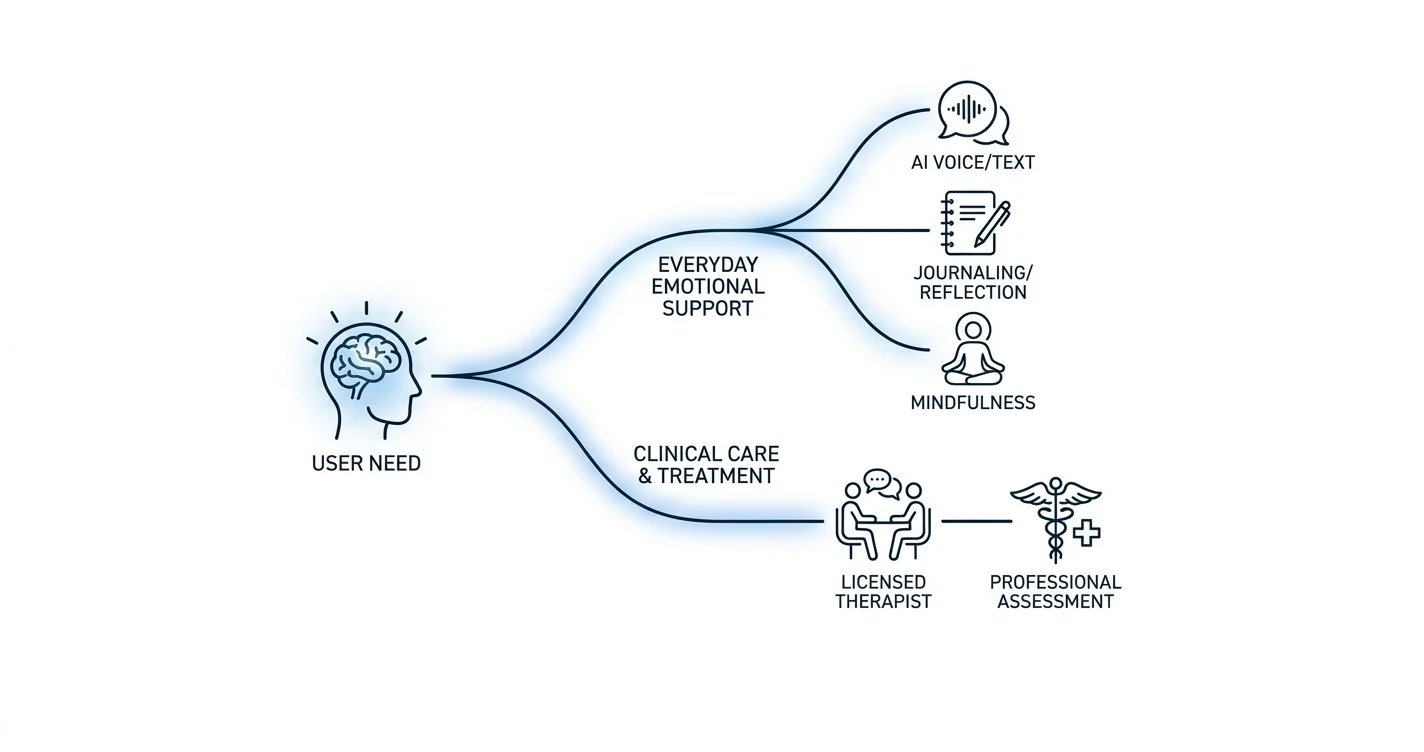

Key Takeaways
- Lovon is the best fit here for everyday emotional support through voice conversations, not licensed therapy.
- The best ChatGPT alternatives for therapy depend on whether you need coping tools, self-reflection, or clinical
- Choose a licensed therapist when you need assessment, treatment, or help with symptoms affecting daily life.
- Structured journaling, guided mindfulness, and peer support offer different alternatives to chatbot conversations.
Best for everyday voice-based emotional support: Lovon. Best for mental health treatment: a licensed therapist. Best for reflection without a chatbot: structured journaling. This 2026 guide compares the best ChatGPT alternatives for therapy searches while separating emotional support from clinical care.
TL;DR
- Lovon is the best fit here for everyday emotional support through voice conversations, not licensed therapy.
- The best ChatGPT alternatives for therapy depend on whether you need coping tools, self-reflection, or clinical treatment.
- Choose a licensed therapist when you need assessment, treatment, or help with symptoms affecting daily life.
- Structured journaling, guided mindfulness, and peer support offer different alternatives to chatbot conversations.
Why this matters
A helpful conversation is not the same as therapy. An app can give you space to talk and organize your feelings, but a reassuring response does not establish a diagnosis or make advice clinically appropriate.
The right question in 2026 is not simply which chatbot sounds most caring. It is which kind of support matches your needs and knows its limits. This list compares support options rather than treating every app, exercise, and professional service as interchangeable.
If you need treatment, choose a licensed clinician. If you want everyday emotional support, choose a tool that helps you reflect without presenting itself as your clinician. You do not need to wait until things feel unbearable to ask for professional help.
What makes the best alternative for emotional support?
Use these criteria before choosing an option:
- Purpose: Does the option support reflection, teach a coping practice, connect you with people, or provide clinical treatment?
- Clear boundaries: Does it distinguish emotional support from diagnosis, treatment, and emergency help?
- Conversation format: Do you want to speak, write, follow an exercise, or talk with another person?
- Useful next steps: Does the interaction help you identify something practical rather than keep you talking indefinitely?
- Privacy information: Can you understand what happens to sensitive information before sharing it?
- Connection to care: Does the option leave room for professional help and relationships outside the tool?
Voice and writing serve different preferences. Neither format proves that a tool is effective treatment. Read the guide to AI voice therapy and text-based apps if choosing a conversation format is your main decision.
ChatGPT alternatives at a glance
| Option | Best for | Standout feature | Key limitation |
|---|---|---|---|
| Lovon | Everyday voice-based emotional support | Spoken conversations, coping tools, and self-reflection guidance | Not a licensed clinician or replacement for clinical care |
| Licensed therapist | Assessment and mental health treatment | Professional assessment and a treatment relationship | Requires arranging care; sessions are not an always-open conversation |
| Structured journaling | Reflection without chatbot replies | Your own record of events, feelings, and patterns | No outside feedback or clinical assessment |
| Guided mindfulness | Practicing attention without analyzing a problem | A defined exercise rather than an open-ended conversation | Does not resolve the underlying situation or provide treatment by itself |
| Peer support | Connection through shared experience | Human understanding and mutual support | Advice and group boundaries vary; not clinical treatment |
The order reflects different needs, not a claim that one option replaces all the others. For your 2026 shortlist, start with the row that describes what you need today.
1. Lovon: best emotional support option for voice conversations
Lovon is an AI-powered mental health app that lets you talk by voice and receive emotional support, coping tools, and self-reflection guidance. It is built with input from PhD psychologists and positions itself as an always-available companion, not a replacement for licensed clinical care.
Lovon is best for everyday emotional support when you want to talk by voice rather than type. That makes its purpose different from using a general-purpose chatbot and repeatedly explaining the kind of support you want.
You can approach a conversation with a specific aim: describe a stressful interaction, name what you are feeling, or think through a manageable next step. Keep that aim separate from requests for a diagnosis or decisions about treatment.
Pros:
- Voice conversations fit people who prefer speaking to typing.
- The stated focus is emotional support rather than general-purpose tasks.
- Coping tools and self-reflection guidance are part of the offering.
- The brand explicitly distinguishes the app from licensed clinical care.
Cons:
- It is not a licensed clinician and cannot replace a treatment relationship.
- Voice is not the right format when you cannot speak privately.
- A supportive response is not proof that an interpretation is correct.
Best for: Everyday stress, relationship worries, burnout, or moments when talking feels easier than writing.
Verdict: Buy only for the everyday support role; skip it as a substitute for clinical treatment.
2. Licensed therapist: best alternative for assessment and treatment
A licensed therapist provides professional mental health care within the scope of their credentials and local rules. Therapy involves more than responding kindly: it includes understanding your concerns, agreeing on goals, and working within a professional relationship.
Choose this route when you need help understanding symptoms, changing persistent patterns, or addressing distress that interferes with daily life. You can also seek therapy for relationship difficulties or personal growth without first assigning yourself a diagnosis.
In 2026, a conversational app should not become the reason you postpone an assessment. If you keep returning to the same concern and your functioning is getting worse, bring that concern to a qualified professional.
Licensed therapist pros:
- Provides clinical assessment within professional scope.
- Can develop treatment goals around your needs.
- Offers a human relationship with professional responsibilities.
- Can discuss whether another type of care is appropriate.
Licensed therapist cons:
- You need to arrange care rather than open a conversation whenever you wish.
- Finding a suitable clinician takes effort.
- Fit matters; credentials alone do not guarantee that a particular therapeutic relationship feels right.
Best for: Treatment, persistent distress, symptoms affecting daily life, or concerns you do not know how to assess yourself.
Verdict: Buy into professional care when treatment is the goal; do not substitute a chatbot.
3. Structured journaling: best alternative for independent reflection
Structured journaling gives you a place to describe an experience without receiving an automated interpretation. Use a notebook or a writing tool, then separate what happened from what you felt and what you assumed.
This option suits you when chatbot replies distract from your own thinking. You do not need to make your entry polished, complete, or persuasive. The purpose is to notice your experience, not produce a perfect account.
For a starting exercise, set aside 5 minutes and write under three headings: what happened, what I felt, and what I need next. This is a suggested writing boundary, not a treatment dose or a promise of improvement.
Structured journaling pros:
- Keeps your own words at the center.
- Creates a record you can revisit.
- Lets you distinguish observations from interpretations.
- Gives you material to bring to therapy if you choose.
Structured journaling cons:
- Provides no outside feedback or clinical assessment.
- Repeating the same worries is not the same as gaining perspective.
- Digital journaling still requires checking storage and privacy settings.
Best for: Sorting through an experience without advice, interruptions, or chatbot responses.
Verdict: Buy into a bounded writing practice; skip open-ended rewriting that leaves you stuck.
4. Guided mindfulness: best alternative for an attention practice
Guided mindfulness directs your attention toward an experience such as breathing, sounds, or physical contact with your surroundings. Unlike a chatbot conversation, it does not require explaining why you feel upset or debating every thought.
Choose it when you want to practice noticing rather than keep analyzing. You can use a recorded exercise or written instructions. Look for guidance that permits you to stop, keep your eyes open, or change the focus when an exercise feels uncomfortable.
For a simple starting practice, spend 2 minutes noticing sounds around you and the contact of your feet with the floor. This is an optional exercise, not a required duration. Stop if it increases distress.
Guided mindfulness pros:
- Offers a defined activity instead of an endless conversation.
- Does not require sharing personal details with a chatbot.
- Gives you a way to practice noticing thoughts without answering each one.
Guided mindfulness cons:
- Does not solve a conflict or change an unsafe situation.
- Some exercises feel uncomfortable, especially when focused inward.
- A mindfulness recording does not assess symptoms or provide individualized treatment.
Best for: Taking a break from analysis and practicing attention to the present moment.
Verdict: Buy into a comfortable practice; skip any exercise that makes you feel less safe.
5. Peer support: best alternative for shared human experience
Peer support connects you with people who share relevant experiences. It can take the form of a facilitated group, a community organization, or an organized support meeting.
Choose peer support when your central need is connection: hearing from someone who understands an experience, speaking without having to explain everything, or feeling less alone. Shared experience does not make every recommendation sound or appropriate for you.
For a 2026 shortlist, check the group's purpose, moderation, confidentiality expectations, and rules about advice. A clear boundary against pressuring members into treatment decisions matters more than how welcoming a description sounds.
Peer support pros:
- Offers connection with other people.
- Makes room for shared experience rather than automated replies.
- Can complement professional care and individual reflection.
Peer support cons:
- Other members are not necessarily qualified to give clinical advice.
- Privacy depends partly on other participants respecting boundaries.
- The tone and moderation of a group affect whether it feels supportive.
Best for: Human connection around a shared challenge, especially when being understood matters more than receiving another explanation.
Verdict: Buy into well-bounded human connection; skip groups that pressure or shame you.
How these options are ranked
The ranking uses the criteria above: purpose, boundaries, format, practical next steps, privacy information, and connection to care. It does not claim comparative clinical outcomes or treat conversational fluency as evidence of therapeutic effectiveness.
The voice app comes first for the page's everyday emotional-support use case. Licensed therapy takes priority whenever your actual need is assessment or treatment. Journaling, mindfulness, and peer support each fill a different role rather than compete to imitate a therapist.
Which alternative should you choose?
Choose Lovon for everyday voice-based emotional support; choose a licensed therapist for treatment. If you do not want an automated conversation, start with the option that matches your purpose: journaling for reflection, mindfulness for attention practice, or peer support for connection.
Use these decision labels:
- Everyday support: You want to talk through feelings and consider a next step.
- Clinical care: You need assessment, treatment, or help with symptoms affecting daily life.
- Personal reflection: You want space to hear your own thinking without replies.
- Human connection: You want shared experience with other people.
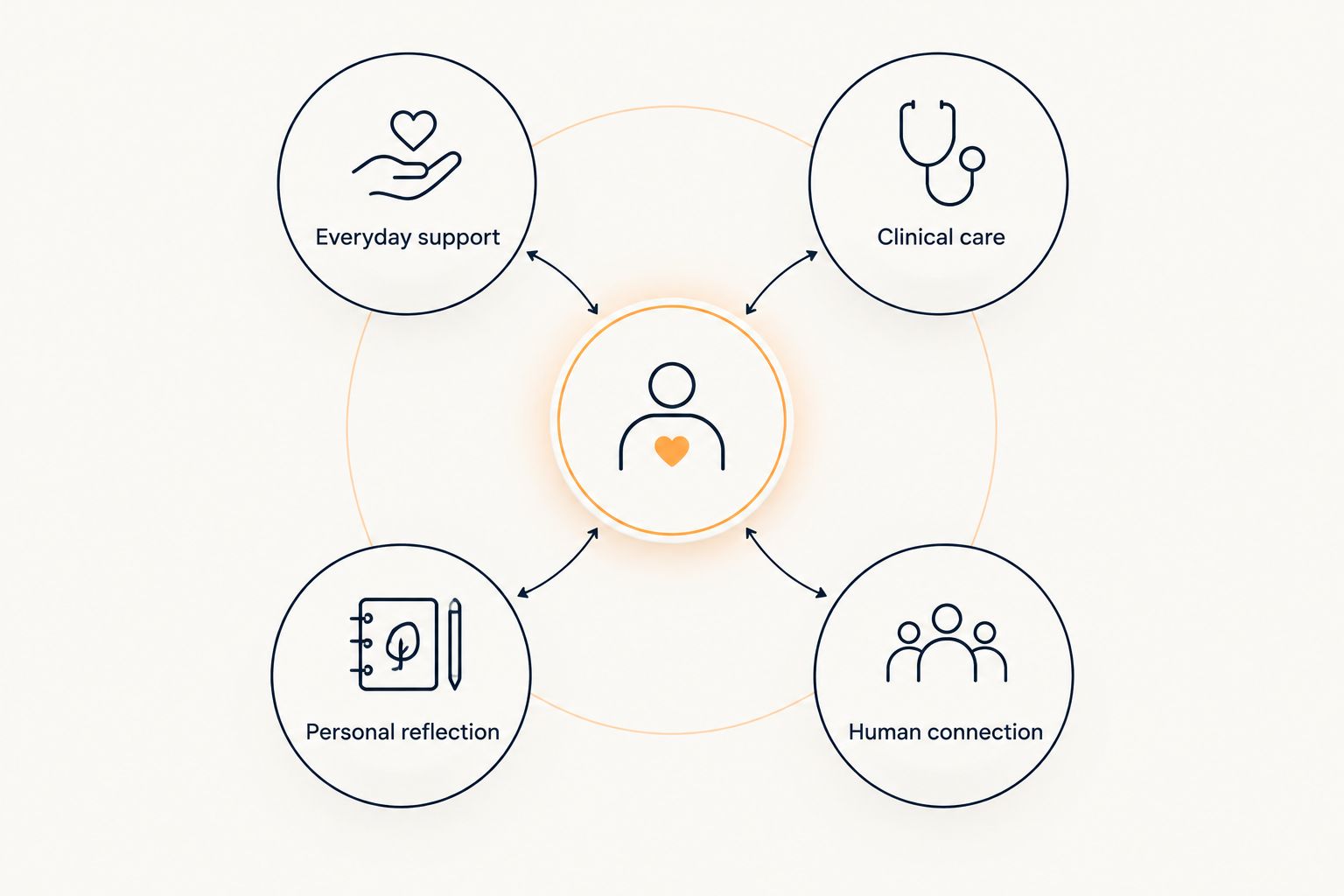 Four support needs: everyday support, clinical care, personal reflection, and human connection
Choose the kind of support you need before choosing the format.
Before using a digital tool, check its current privacy information. Look for explanations of storage, deletion, access to conversations, and use of data. Do not assume that a mental health label gives an app the same confidentiality arrangements as a clinician.
You can combine options without asking one to do everything. Bring a journal entry to therapy, use an attention exercise before a difficult conversation, or talk with a trusted person after reflecting. For your 2026 routine, keep support connected to your life outside the app.
FAQ
What's the best ChatGPT alternative for emotional support?
Lovon is the best fit in this guide for everyday voice-based emotional support. Choose a licensed therapist instead when you need assessment or treatment; an emotional support app is not clinical care.
Can ChatGPT or another chatbot replace a therapist?
No, a chatbot is not a replacement for a licensed therapist. A conversational response does not provide the professional assessment, responsibilities, or treatment relationship of clinical care.
Is a voice support app better than writing in a journal?
A voice support app fits speaking and receiving responses; journaling fits reflection without automated replies. Choose based on the interaction you want, not an assumption that one format provides better treatment.
What should I check before sharing feelings with an app?
Check the app's current privacy information before sharing sensitive details. Look for explanations of data storage, deletion, access, and use, and avoid sharing identifying details you do not need to include.
Can I use an emotional support app between therapy sessions?
You can use an emotional support app for reflection between sessions, but it should not replace your care plan. Ask your therapist how to use it and bring important concerns or confusing advice to your next appointment.
When should I choose professional help instead of an app?
Choose professional help when you need assessment or treatment, or when distress interferes with daily life. You can also seek help before symptoms become severe; an app does not need to be your first step.
What should I do if I am in a mental health crisis?
In the United States, call or text 988 for the Suicide & Crisis Lifeline. Call 911 if there is immediate danger or a medical emergency; do not rely on an app or chatbot for crisis care.
One last thing
A useful support conversation does not need to continue until you feel completely certain. End by naming 1 next step: send a message to someone you trust, write down a question for your therapist, or step away from the screen.
Treat that as a practical boundary, not a success score. Emotional support should help you return to your life, not make another reply feel necessary before you can act.
Related guides
How AI Support Helps You Heal
AI emotional support isn't about replacing human connection — it's about filling the gaps. The moments when you need to talk at 2 AM, when you don't want to burden your friends again, or when you simply need someone to listen without judgment.
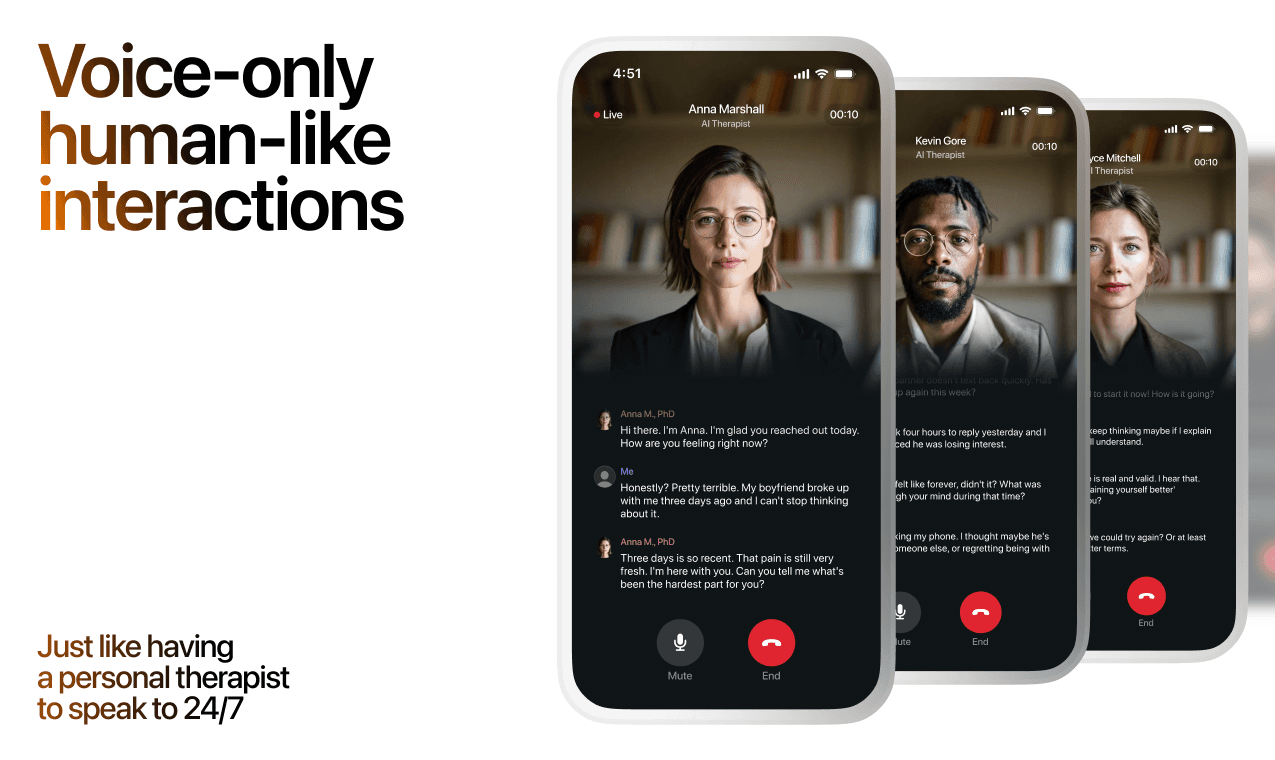
Here's what happens in a typical Lovon session:
You share what's on your mind
There's no script, no intake form, no waiting room. You speak or type whatever you're feeling — in your own words, at your own pace.
Lovon validates and explores
Using frameworks from CBT (Cognitive Behavioral Therapy) and motivational interviewing, Lovon acknowledges your feelings first, then gently helps you explore them. No dismissive "just move on" advice.
You build coping skills together
Lovon doesn't just listen — it actively works with you on evidence-based techniques: thought reframing, urge surfing, behavioral experiments, and more.
What a Session with Lovon Looks Like
When to Seek Professional Help
AI support is a valuable tool, but it's not a replacement for professional care. Please consider reaching out to a licensed therapist if you experience any of the following:
- Persistent thoughts of self-harm or suicide
- Inability to perform daily activities (work, eating, sleeping) for more than 2 weeks
- Turning to alcohol or substances to cope
- Intense anger or desire to harm your ex-partner
- Complete emotional numbness that doesn't improve over time
Crisis Resources (US): If you're in immediate danger, call 988 (Suicide & Crisis Lifeline) or text HOME to 741741 (Crisis Text Line). Available 24/7, free, and confidential.
Outside the US? Find a crisis line in your country
Ready to Start?
Your healing journey can begin right now
A 7-day trial. No judgment. Just a safe space to process what you're going through.
Frequently Asked Questions
Is Lovon a replacement for a real therapist?
Is my conversation with Lovon AI private?
How is Lovon different from ChatGPT for emotional support?
Can I use Lovon if I'm already seeing a therapist?
Can I try Lovon before subscribing?
About the Author

The Lovon Editorial Team
Mental Health & Wellness Content Team
The Lovon Editorial Team develops mental health and wellness content designed to make psychological concepts accessible and actionable. Our goal is to bridge the gap between clinical research and everyday life - helping you understand why your mind works the way it does and what you can do about it....
Related articles
- Best AI apps for nurse burnout in 2026
Compare the best AI apps for nurse burnout. Lovon is the voice-first pick for everyday support; review formats, privacy…
- Best AI apps for veterans with PTSD in 2026
Compare the best AI apps for veterans with PTSD: Lovon for voice support, plus VA coping tools. Choose by your needs…
- Best AI apps for shift workers in 2026
The best AI apps for shift workers: Lovon for voice support, plus picks for planning, messages, and notes. Compare uses…
- Best AI apps for postpartum depression support in 2026
Compare the best AI apps for postpartum depression support. Choose voice, text, or mood reflection alongside clinical…
See also
Quizzes
- Resilience Test: How Fast Do You Bounce Back?
See how you recover from setbacks, in 3 minutes.
- Distress Tolerance Test: How Long Can You Sit With It?
See which kind of discomfort makes you need out first.
Free tools
- Write a Letter to Someone You Lost
Tell it who they were to you and what you never got to say, and it writes the letter back in your words. No account, no…
- Write a Condolence Message for This Person
Get one condolence message written for your situation instead of a list of a hundred to choose from. Tell it who died…
From the wiki
- Why do I keep dreaming about my ex?
Recurring dreams about an ex usually mean your brain is still consolidating a relationship that took up years of memory…
Disclaimer: This article is for informational purposes only and does not constitute medical advice, diagnosis, or treatment. Always seek the advice of your physician or other qualified health provider with any questions you may have regarding a medical condition. If you are in crisis or think you may have an emergency, call 988 (Suicide & Crisis Lifeline) or go to the nearest emergency room. Outside the US? Find a crisis line in your country.