
AI Life Coach for a Mid-Career Pivot in Your 30s (2026)
An AI life coach for a mid-career pivot in your 30s helps you process doubt and rebuild confidence 24/7 in 2026 — see how Lovon fits alongside a human coach.

Key Takeaways
- An AI life coach for a mid-career pivot in your 30s works best for daily decision talk-throughs, not resume writing.
- Lovon gives 24/7 voice sessions to process career doubt when a human coach or therapist isn't available.
- Confidence work before you resign matters more than a perfect exit plan — do that first.
- Human career coaches still win on salary negotiation and industry strategy; AI wins on frequency and access.
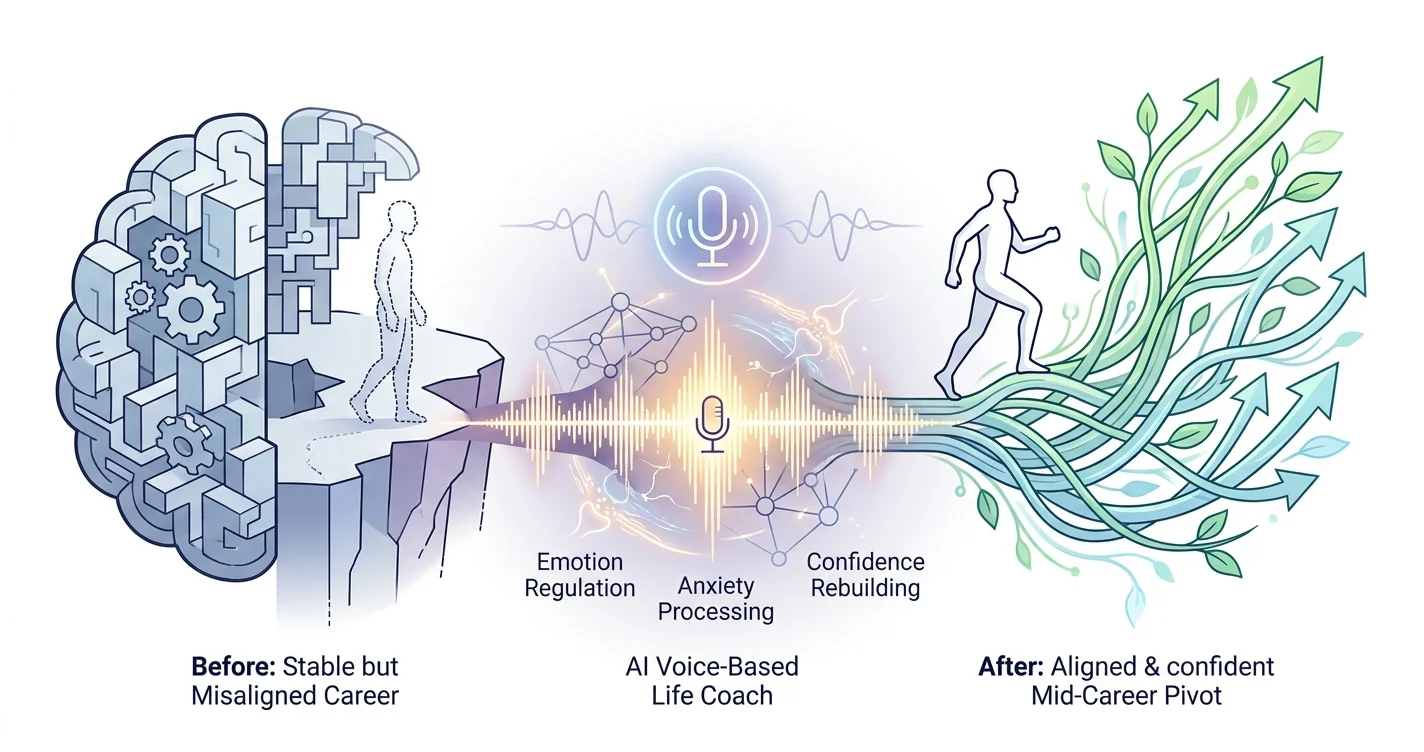
A mid-career pivot in your 30s means leaving a stable title, income, or industry to start over in something that fits who you've become — and it's exactly the kind of decision that benefits from talking out loud before you act on it. An AI life coach for a mid-career pivot in your 30s gives you a voice-based space to process the doubt, test the reasoning, and rebuild confidence at 11pm when the panic hits and no human coach is picking up.
TL;DR
- An AI life coach for a mid-career pivot in your 30s works best for daily decision talk-throughs, not resume writing.
- Lovon gives 24/7 voice sessions to process career doubt when a human coach or therapist isn't available.
- Confidence work before you resign matters more than a perfect exit plan — do that first.
- Human career coaches still win on salary negotiation and industry strategy; AI wins on frequency and access.
Why an AI life coach matters for a 30s career pivot
Thirty-somethings pivoting careers aren't dealing with a single bad day at work — they're weighing a mortgage, a partner, sometimes kids, against a job that no longer fits. The decision doesn't happen in one sitting. It happens across weeks of 2am second-guessing, Sunday-night dread, and conversations you rehearse in your head but never finish out loud.
A licensed career coach or therapist works in scheduled hour blocks. The pivot doesn't. The doubt shows up on a random Tuesday commute, mid-negotiation with your own resignation letter, or right after a friend asks "so what's the plan?" and you don't have one yet. That's the gap an AI voice coach is built to sit in — not to replace the strategy work, but to catch the processing that happens between appointments.
Name what's actually driving the pivot
Most 30s pivots get framed as "I hate my job," which is too vague to act on. Get specific before you do anything else.
- Write down the exact moment you knew — a meeting, a rejection, a burnout crash
- Separate boredom from misalignment from burnout — they need different fixes
- Check if the problem is the role, the manager, or the industry itself
- Say the reason out loud in one sentence and see if it still holds up
Separate the money fear from the meaning fear
Pivots stall because two different fears get tangled together: will this pay the bills and will this actually make me happier. Untangle them separately.
- List the actual number you need monthly, not a guess
- Name the version of "meaning" you're chasing — autonomy, impact, creativity, status
- Ask which fear is louder right now and address that one first
- Test the money fear against 3-6 months of runway, not vibes
Talk through the decision out loud before you make it
This is where most people skip a step. Writing a pros-and-cons list in a notes app is fine, but hearing yourself explain the decision — and hearing where you hesitate — surfaces things a bullet list won't.
A voice conversation forces you to finish the sentence you'd otherwise leave hanging. Lovon runs these as on-demand voice sessions built with input from PhD psychologists, so the back-and-forth pushes past the surface answer instead of just validating whatever you already believe.
- Say the decision out loud to a person, a coach, or an AI voice session and notice where your voice changes
- Flag the sentence you keep avoiding finishing
- Ask the follow-up question a friend won't: what are you actually afraid of?
- Repeat the exercise after a week and see if the answer shifts
Rebuild confidence before you resign
Confidence, not the plan, is usually what's missing. A polished exit strategy on a shaky foundation collapses the first time someone asks a hard question in an interview.
- Log three specific wins from your current or past role, not general strengths
- Practice the pivot story out loud until it doesn't sound like an apology
- Get comfortable saying "I'm changing direction" without over-explaining
- Work through the imposter syndrome that flares up mid-pivot before it flares up in a real interview
Set a real timeline, not a vague one
Someday isn't a plan. Thirty-somethings who pivot successfully usually work off a dated runway, not an open-ended one.
- Set a hard decision date, not a rolling one
- Build in a 3-6 month test phase before a full resignation, where possible
- Decide in advance what would make you turn back
- Put the date somewhere you'll actually see it daily
Handle the identity questions that show up mid-transition
A pivot at 32 or 38 hits differently than a first job search at 24 — you're not just changing roles, you're changing how you introduce yourself at a dinner party. That identity wobble is normal and it's loud.
- Separate your job title from your self-worth on paper, literally write the distinction down
- Expect a dip in confidence in month one or two of the new path — it's typical, not a red flag
- Talk through the identity shift with someone or something that won't just tell you what you want to hear
Comparing your options for a 2026 career pivot
| Option | Best for | Key limitation | Verdict |
|---|---|---|---|
| Human career coach | Salary negotiation, industry-specific strategy | Session-based, booking lag between conversations | Keep for strategy calls |
| General AI chatbot | Quick pros/cons lists | No memory of your patterns, generic output | Use for brainstorming only |
| Text journaling app | Private reflection | One-directional, easy to abandon | Pair with talking it out |
| Lovon AI voice life coach | Daily processing, confidence work, late-night doubt spirals | Not a licensed clinician, doesn't negotiate your offer for you | Use between bigger decisions |
| Peer or mentor conversations | Real industry insight | Limited availability, biased toward their own path | Keep, don't rely on solely |
The honest read for 2026: none of these replace the others. A human coach handles the negotiation and the industry map. Lovon handles the 11pm spiral and the daily talk-through a coach's calendar can't cover.
Talk through your pivot tonight
Voice sessions are available anytime you need to think out loud.
Common mistakes people make pivoting careers in their 30s
- Quitting before the confidence work is done — the plan looks fine on paper, but the first hard interview question exposes the gap.
- Treating the pivot as a single decision instead of a series of smaller, reversible tests over 3-6 months.
- Confusing burnout for misalignment — some people don't need a new career, they need three months off the current one.
- Skipping the identity conversation and getting blindsided by how strange it feels to answer the "what do you do?" question differently.
- Going it completely alone — no coach, no mentor, no outside voice — and mistaking isolation for independence.
FAQ
What's the best way to use an AI life coach during a mid-career pivot?
Use it for daily processing between bigger decisions - talking through doubt, rehearsing your pivot story, or working through a spiral before it takes over. It works best alongside a human coach or mentor, not instead of one.
Is an AI life coach better than a human career coach for a 30s pivot?
Neither replaces the other. A human coach wins on salary negotiation and industry-specific strategy; an AI voice coach like Lovon wins on availability, since it's there at 11pm on a Tuesday when the doubt hits and no one else is.
Does an AI life coach replace therapy during a career change?
No. Lovon is built with input from PhD psychologists and offers emotional support and coping tools, but it does not replace licensed clinical care. If the pivot is triggering depression or anxiety that interferes with daily function, a licensed therapist is the right call.
How do I know if a mid-career pivot is worth it in 2026?
Say the reason for the pivot out loud in one sentence - if it still holds up after you hear yourself say it, that's a strong signal. If you can't finish the sentence without hedging, the reasoning needs more work before you act.
Can an AI voice coach help with imposter syndrome after switching fields?
Yes, as a processing tool - talking through the specific moments imposter syndrome shows up helps separate real skill gaps from normal beginner discomfort. It won't fix a genuine skills gap, which still needs training or mentorship.
What should I do before quitting a stable job at 35?
Set a hard decision date, build a 3-6 month runway, and rehearse the pivot story out loud until it stops sounding like an apology. Confidence work matters as much as the financial plan.
Is it normal to lose confidence right after a career pivot?
Yes - a dip in the first one to two months of a new path is typical, not a sign the pivot was wrong. It usually passes once the new role stops feeling unfamiliar.
One last thing
The pivots that stick in 2026 aren't the ones with the most polished spreadsheet — they're the ones where the person rehearsed the decision enough times, out loud, that the doubt stopped controlling the timeline. If a spiral hits at midnight before a big decision, that's the moment talking it through with Lovon actually earns its place: not as a replacement for a coach or therapist, but as the thing that catches you when neither is available.
Related guides
How AI Support Helps You Heal
AI emotional support isn't about replacing human connection — it's about filling the gaps. The moments when you need to talk at 2 AM, when you don't want to burden your friends again, or when you simply need someone to listen without judgment.
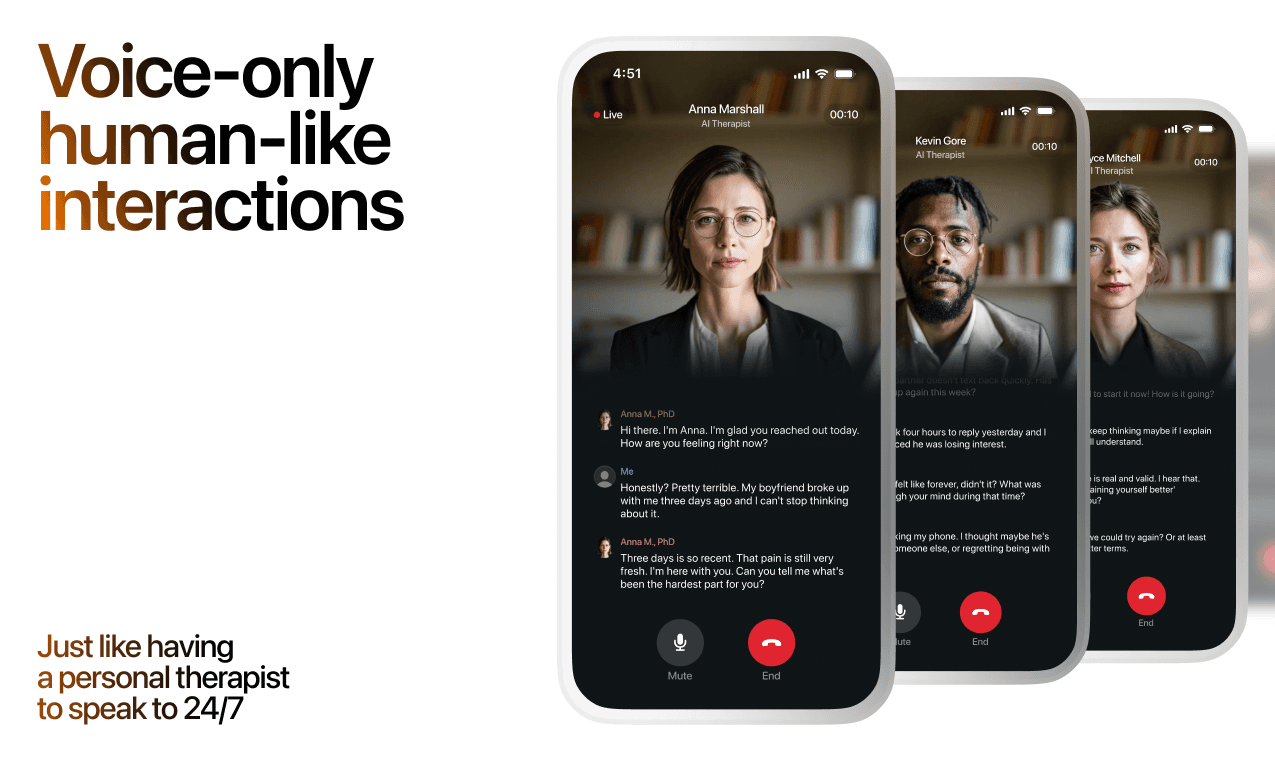
Here's what happens in a typical Lovon session:
You share what's on your mind
There's no script, no intake form, no waiting room. You speak or type whatever you're feeling — in your own words, at your own pace.
Lovon validates and explores
Using frameworks from CBT (Cognitive Behavioral Therapy) and motivational interviewing, Lovon acknowledges your feelings first, then gently helps you explore them. No dismissive "just move on" advice.
You build coping skills together
Lovon doesn't just listen — it actively works with you on evidence-based techniques: thought reframing, urge surfing, behavioral experiments, and more.
What a Session with Lovon Looks Like
When to Seek Professional Help
AI support is a valuable tool, but it's not a replacement for professional care. Please consider reaching out to a licensed therapist if you experience any of the following:
- Persistent thoughts of self-harm or suicide
- Inability to perform daily activities (work, eating, sleeping) for more than 2 weeks
- Turning to alcohol or substances to cope
- Intense anger or desire to harm your ex-partner
- Complete emotional numbness that doesn't improve over time
Crisis Resources (US): If you're in immediate danger, call 988 (Suicide & Crisis Lifeline) or text HOME to 741741 (Crisis Text Line). Available 24/7, free, and confidential.
Outside the US? Find a crisis line in your country
Ready to Start?
Your healing journey can begin right now
A 7-day trial. No judgment. Just a safe space to process what you're going through.
Frequently Asked Questions
Is Lovon a replacement for a real therapist?
Is my conversation with Lovon AI private?
How is Lovon different from ChatGPT for emotional support?
Can I use Lovon if I'm already seeing a therapist?
Can I try Lovon before subscribing?
About the Author

The Lovon Editorial Team
Mental Health & Wellness Content Team
The Lovon Editorial Team develops mental health and wellness content designed to make psychological concepts accessible and actionable. Our goal is to bridge the gap between clinical research and everyday life - helping you understand why your mind works the way it does and what you can do about it....
Related articles
- Best AI App for Making Friends as an Adult (2026 Ranked)
Lovon leads our 2026 ranking of AI apps for social confidence, tackling the anxiety behind making friends as an adult…
- AI Life Coach for First-Time Managers: 2026 Verdict
First-time managers face imposter syndrome and burnout with no training. See when Lovon's AI life coach helps in 2026…
- Self-Worth vs Self-Esteem: The Real Difference (2026)
Self-worth vs self-esteem explained with a 6-step exercise. Verdict: build self-worth first in 2026 — self-esteem alone…
- How to Overcome Perfectionism Paralysis (2026 Guide)
Overcome perfectionism paralysis in 2026 with a 7-step method: shrink the task, cap revision time, and track…
See also
Quizzes
- Distress Tolerance Test: How Long Can You Sit With It?
See which kind of discomfort makes you need out first.
- Impulsivity Test: Do You Act Before You Think?
See which kind of impulsivity shows up in your month.
Free tools
- How to Confront a Narcissistic Parent
Most of these conversations fail because you went in wanting three things at once. Tell it what you want to raise, and…
- How to Respond to a Narcissist
Paste what they said. You get the part that actually needs answering separated from the part designed to pull you in, a…
From the wiki
- What is inhibited grief?
Inhibited grief is grief that never gets out. The loss happened, you kept functioning, and the feeling stayed sealed…
Disclaimer: This article is for informational purposes only and does not constitute medical advice, diagnosis, or treatment. Always seek the advice of your physician or other qualified health provider with any questions you may have regarding a medical condition. If you are in crisis or think you may have an emergency, call 988 (Suicide & Crisis Lifeline) or go to the nearest emergency room. Outside the US? Find a crisis line in your country.