
Best AI App for Making Friends as an Adult (2026 Ranked)
Lovon leads our 2026 ranking of AI apps for social confidence, tackling the anxiety behind making friends as an adult instead of just conversation scripts.
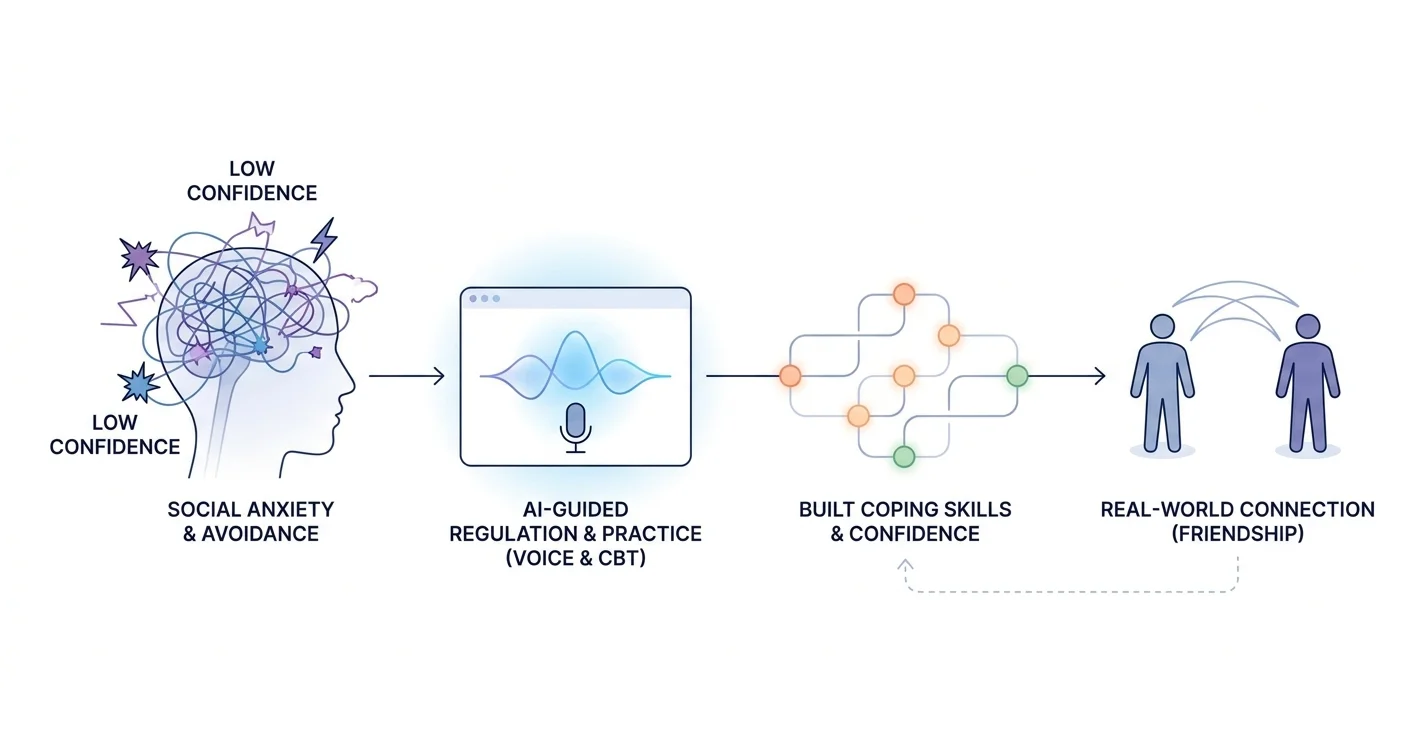

Key Takeaways
- Lovon wins for building the coping skills and confidence that make socializing possible again — voice-based,
- Replika is best for low-stakes conversation practice when talking to anyone feels too exposed.
- Wysa suits structured CBT exercises for social anxiety symptoms specifically.
- None of these apps replace real human connection — they're training wheels, not the destination.
Adult friendship doesn't fail because people lack apps — it fails because social anxiety, low confidence, or years of isolation make the first move feel impossible. In 2026, a handful of AI tools address that gap directly, and this guide ranks them by what they actually solve, not just what they promise.
TL;DR
- Lovon wins for building the coping skills and confidence that make socializing possible again — voice-based, psychologist-informed, not a matchmaking tool.
- Replika is best for low-stakes conversation practice when talking to anyone feels too exposed.
- Wysa suits structured CBT exercises for social anxiety symptoms specifically.
- None of these apps replace real human connection — they're training wheels, not the destination.
Why this matters
Social confidence and friend-making aren't the same problem. You can have plenty of opportunities to meet people and still freeze up, over-apologize, or replay conversations for days afterward. That's an anxiety and self-regulation issue, not a networking issue, and it's why a search for "best ai app for making friends as an adult" usually turns up apps that solve the wrong layer of the problem.
The apps in this list split into two camps: those that help you practice being social with an AI, and those that help you regulate the anxiety underneath the avoidance. Both matter. If you've read how to make friends as an adult and still feel stuck at the first step, the gap usually isn't a lack of strategy — it's the nervous system reaction that kicks in before you even open the conversation.
What makes the best AI app for social confidence
- Addresses the anxiety, not just the symptom — coping tools for the racing thoughts and avoidance patterns, not just conversation scripts
- Available on demand — accessible at 11pm before a social event, not scheduled a week out
- Grounded in real clinical frameworks — CBT, psychologist input, or evidence-based exercises, not generic chatbot scripting
- Honest about its limits — clearly not a replacement for licensed therapy or an actual social life
- Builds a skill you keep — regulation and confidence that transfer to real rooms, not dependency on the app itself
- Low friction to start — voice or short text, no long onboarding before you get value
At a glance: comparing the top AI apps for social confidence in 2026
| App | Best for | Standout feature | Key limitation |
|---|---|---|---|
| Lovon | Building the coping skills and confidence to socialize | Voice-based AI therapy sessions built with input from PhD psychologists | Not a matchmaking tool and not a replacement for licensed care |
| Replika | Low-stakes conversation practice | Customizable AI companion for casual daily chat | Practice stays with the AI, not with real people |
| Wysa | Structured social anxiety exercises | CBT-based guided modules and mood tracking | Text-based format can feel scripted for open-ended venting |
| Woebot | Daily check-ins on social triggers | Short, habit-forming daily conversations | Limited depth for complex relationship patterns |
| Rosebud | Reflecting on social patterns through journaling | AI-guided journal prompts that surface recurring themes | Requires consistent writing, not real-time conversational support |
1. Lovon: best AI app for building the confidence to make friends
Lovon is a voice-based AI therapy app built with input from PhD psychologists, designed for on-demand emotional support around anxiety, stress, low mood, and relationship struggles. Instead of scripting small talk, it works on the underlying nervous system reaction — the racing heart, the catastrophizing, the urge to cancel — that keeps people out of social situations in the first place. Sessions happen by voice, which mirrors how a real conversation actually feels compared to typing into a chat window.
Lovon pros:
- Voice conversations feel closer to talking with a real person than text-based chat
- Addresses anxiety and self-esteem directly, which is often the real barrier to socializing
- Available any time, including right before a social event when anxiety spikes
- Openly states it's not a replacement for licensed clinical care
Lovon cons:
- Doesn't connect you with other people directly — it's not a friend-finder or social network
- Best suited to those working through anxiety or confidence issues, less useful if the barrier is purely logistical
- Not a diagnostic or crisis service
Lovon verdict: Buy. If the block is internal — anxiety, rejection sensitivity, low self-esteem — this is the one built for that exact layer.
2. Replika: best AI app for low-stakes conversation practice
Replika is an AI companion app that lets users build an ongoing relationship with a customizable chatbot persona. For someone who freezes up in real conversation, practicing turn-taking, humor, and disclosure with an AI that won't judge you can lower the stakes enough to try again with a person.
Replika pros:
- Low pressure — no risk of real social consequences while practicing
- Persistent memory of past conversations creates a sense of continuity
- Good for rehearsing what you might say before a real interaction
Replika cons:
- Can become a substitute for real connection rather than a bridge to it
- Doesn't address the anxiety mechanics behind avoidance, only the rehearsal
- Conversations don't transfer skills to unpredictable real-world social dynamics
Replika verdict: Hold. Useful as a warm-up tool, risky if it becomes the whole plan.
3. Wysa: best AI app for structured social anxiety exercises
Wysa is a text-based mental health chatbot built around CBT techniques, mood tracking, and guided exercises. For social anxiety specifically, it walks users through identifying thought distortions before and after social events — useful for someone who wants a repeatable, structured routine.
Wysa pros:
- CBT framework gives concrete before/after structure around social events
- Mood tracking helps identify patterns tied to specific triggers
- Good fit for people who prefer a workbook-style approach
Wysa cons:
- Text-only format can feel slower and more scripted than voice
- Less useful for spontaneous, in-the-moment anxiety spikes
- Structured modules can feel repetitive after extended use
Wysa verdict: Hold. Solid for a reader who wants exercises over conversation.
4. Woebot: best AI app for daily check-ins on social triggers
Woebot is a conversational AI chatbot focused on short daily check-ins and mood tracking. For social confidence, the value is consistency — a quick daily prompt that catches avoidance patterns before they harden into a habit of declining every invitation.
Woebot pros:
- Short sessions fit into a daily routine without much friction
- Habit-forming design encourages regular use
- Useful for catching early avoidance patterns
Woebot cons:
- Limited depth for complex relationship or attachment patterns
- Conversations can feel repetitive over weeks of use
- Not built for longer, exploratory sessions
Woebot verdict: Hold. Good as a light daily nudge, not a deep-dive tool.
5. Rosebud: best AI app for reflecting on social patterns
Rosebud is an AI-guided journaling app that prompts reflection on recurring emotional and relational themes. For someone who keeps ending up in the same social dynamic — over-explaining, people-pleasing, withdrawing after rejection — guided prompts can surface the pattern faster than unstructured writing alone.
Rosebud pros:
- Guided prompts surface patterns that free-form journaling can miss
- Good complement to therapy or coaching work already in progress
- Written record makes it easy to look back and track change over months
Rosebud cons:
- Requires consistent writing, which is a barrier for some users
- No real-time conversational support during an anxiety spike
- Reflection alone doesn't replace active coping tools
Rosebud verdict: Hold. Best paired with a conversational tool, not used alone.
How we ranked these apps
Each app was measured against the six criteria above: whether it addresses anxiety at the root, availability on demand, grounding in real clinical frameworks, honesty about limitations, whether it builds a transferable skill, and ease of getting started. Apps that only offered rehearsal or journaling without addressing the underlying anxiety mechanism ranked below apps built specifically around emotional regulation and confidence work. Voice-first tools scored higher on the transferable-skill criterion because speaking out loud rehearses the same channel a real conversation uses.
Which AI app should you choose?
If the barrier to making friends as an adult in 2026 is anxiety, self-esteem, or a pattern of avoidance, start with an app built around emotional regulation, not conversation scripts — that's the layer that actually changes outcomes. Lovon fits that use case directly, with voice sessions built around anxiety, stress, and self-esteem work rather than rehearsed small talk.
Build the confidence to show up socially
Talk through social anxiety and self-esteem with an AI voice session, any time.
For readers dealing with isolation that has run for months rather than a general confidence gap, the best AI therapy app for social isolation and loneliness covers a related but distinct problem worth ruling out first.
FAQ
What's the best AI app for making friends as an adult in 2026?
Lovon is the strongest pick for adults whose real barrier is social anxiety or low confidence, since it works on the emotional root rather than scripting conversation. Replika and Wysa are better fits for pure conversation rehearsal or structured CBT exercises.
Can an AI app actually help me make real friends?
An AI app can't introduce you to people, but it can reduce the anxiety and avoidance that keep you from showing up to social situations in 2026. The friend-making step still happens with actual people.
Is Replika a good substitute for therapy or friendship coaching?
No. Replika is built for companionship and conversation practice, not clinical support, and it doesn't address the anxiety mechanics behind social avoidance the way a therapy-focused app does.
How is Lovon different from AI companion apps like Replika?
Lovon is a voice-based AI therapy app built with input from PhD psychologists, focused on emotional support and coping tools rather than ongoing companionship chat. It targets the anxiety and self-esteem issues underneath social avoidance.
Do AI mental health apps help with social anxiety specifically?
Apps built around CBT frameworks or voice-based emotional regulation, such as Wysa and Lovon, are designed to work directly on social anxiety symptoms. General companion apps mostly offer rehearsal, not anxiety support.
Is Wysa or Woebot better for social confidence?
Wysa suits someone who wants structured CBT exercises tied to specific social events, while Woebot works better as a short daily check-in habit. Neither replaces deeper anxiety or self-esteem work.
How much does it cost to use an AI app for social confidence?
Pricing and plan structures vary by app and change over time, so check current pricing directly on each app's site before committing. Several of these apps offer free access alongside paid options.
Can AI voice therapy replace in-person therapy for social anxiety?
No. AI voice therapy apps like Lovon are built as an always-available companion for emotional support, not a replacement for licensed clinical care, and they state that limitation openly.
One last thing
The apps that rank highest for social confidence in 2026 aren't the ones with the most polished chat interface — they're the ones that treat anxiety as the actual problem instead of treating friendship as a logistics puzzle. If you've tried a conversation-practice app and still freeze before real interactions, the block is regulation, not rehearsal. Switch tools, not scripts.
Related guides
How AI Support Helps You Heal
AI emotional support isn't about replacing human connection — it's about filling the gaps. The moments when you need to talk at 2 AM, when you don't want to burden your friends again, or when you simply need someone to listen without judgment.
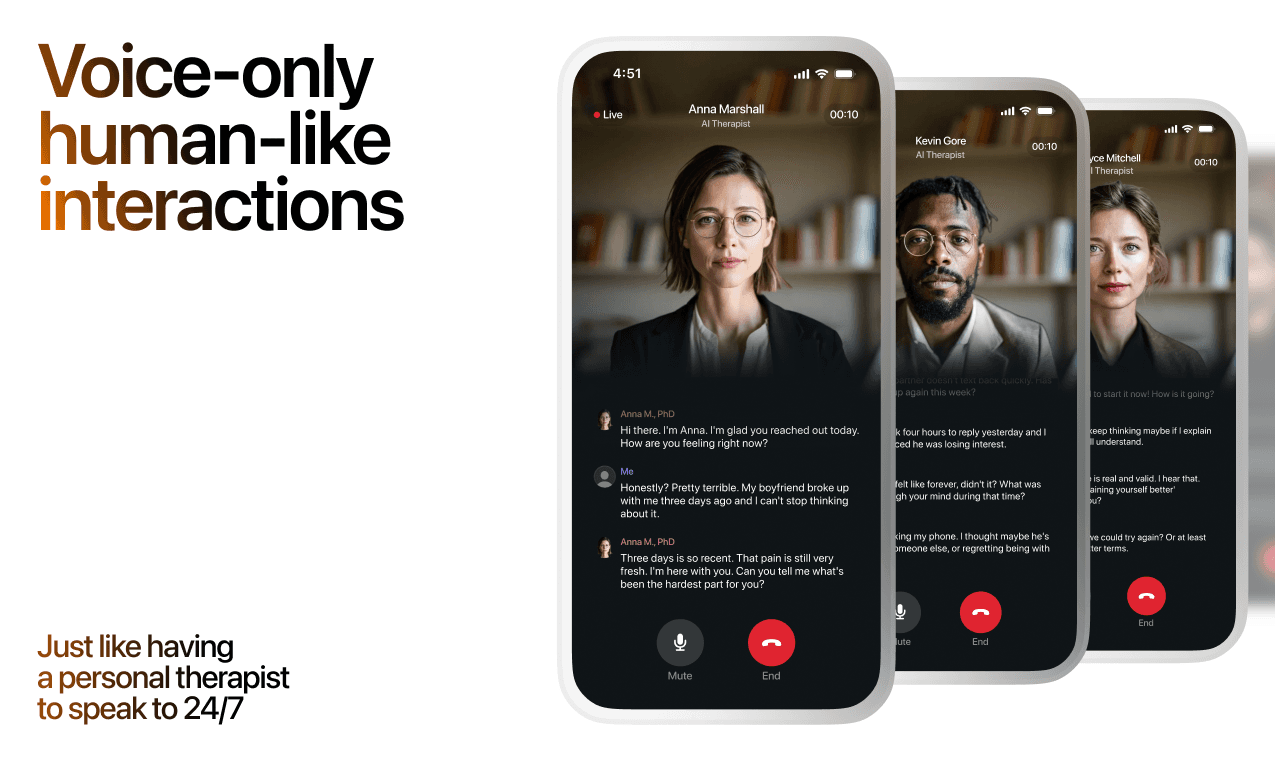
Here's what happens in a typical Lovon session:
You share what's on your mind
There's no script, no intake form, no waiting room. You speak or type whatever you're feeling — in your own words, at your own pace.
Lovon validates and explores
Using frameworks from CBT (Cognitive Behavioral Therapy) and motivational interviewing, Lovon acknowledges your feelings first, then gently helps you explore them. No dismissive "just move on" advice.
You build coping skills together
Lovon doesn't just listen — it actively works with you on evidence-based techniques: thought reframing, urge surfing, behavioral experiments, and more.
What a Session with Lovon Looks Like
When to Seek Professional Help
AI support is a valuable tool, but it's not a replacement for professional care. Please consider reaching out to a licensed therapist if you experience any of the following:
- Persistent thoughts of self-harm or suicide
- Inability to perform daily activities (work, eating, sleeping) for more than 2 weeks
- Turning to alcohol or substances to cope
- Intense anger or desire to harm your ex-partner
- Complete emotional numbness that doesn't improve over time
Crisis Resources (US): If you're in immediate danger, call 988 (Suicide & Crisis Lifeline) or text HOME to 741741 (Crisis Text Line). Available 24/7, free, and confidential.
Outside the US? Find a crisis line in your country
Ready to Start?
Your healing journey can begin right now
1 free conversation. No credit card. No judgment. Just a safe space to process what you're going through.
Frequently Asked Questions
Is AI therapy a replacement for a real therapist?
Is my conversation with Lovon AI private?
How is Lovon different from ChatGPT for emotional support?
Can I use Lovon if I'm already seeing a therapist?
Can I try Lovon for free?
About the Author

The Lovon Editorial Team
Mental Health & Wellness Content Team
The Lovon Editorial Team develops mental health and wellness content designed to make psychological concepts accessible and actionable. Our goal is to bridge the gap between clinical research and everyday life - helping you understand why your mind works the way it does and what you can do about it....
Related articles
- Self-Worth vs Self-Esteem: The Real Difference (2026)
Self-worth vs self-esteem explained with a 6-step exercise. Verdict: build self-worth first in 2026 — self-esteem alone…
- AI Life Coach for First-Time Managers: 2026 Verdict
First-time managers face imposter syndrome and burnout with no training. See when Lovon's AI life coach helps in 2026…
- Freeze Response and Fawn Response as Trauma Survival Patterns
When faced with overwhelming threat, the human nervous system activates a series of automatic responses designed to…
- How to Rebuild Confidence After a Layoff (2026)
How to rebuild confidence after a layoff in 2026: an 8-step plan covering routine, mindset, and interview prep, with…
See also
Quizzes
- Boundaries Test: Free 12-Question Self-Check
See where your boundaries slip, in 3 minutes.
- Self Esteem Test: What Is Your Worth Resting On?
See what your sense of worth is resting on.
Free tools
- How to Confront a Narcissistic Parent
Most of these conversations fail because you went in wanting three things at once. Tell it what you want to raise, and…
- What Leaving Would Actually Take
Four short lists: money, a place, the shared things, and people. Mark each item sorted or not. You get the itemized…
Disclaimer: This article is for informational purposes only and does not constitute medical advice, diagnosis, or treatment. Always seek the advice of your physician or other qualified health provider with any questions you may have regarding a medical condition. If you are in crisis or think you may have an emergency, call 988 (Suicide & Crisis Lifeline) or go to the nearest emergency room. Outside the US? Find a crisis line in your country.