
How to Rebuild Confidence After a Layoff (2026)
How to rebuild confidence after a layoff in 2026: an 8-step plan covering routine, mindset, and interview prep, with common mistakes to avoid at each stage.

Key Takeaways
- Rebuilding confidence after a layoff starts with separating your identity from your job title, not polishing your
- A fixed daily routine for the first 10 days does more for morale than another round of cover letter edits.
- Naming the loss out loud — to a person, a journal, or an AI voice therapist — calms the nervous system before
- Interview anxiety spikes hardest when the mindset reset gets skipped, so treat confidence work as step one in 2026
A layoff doesn't just take your paycheck — it takes the story you told yourself about who you are at work. This guide walks through how to rebuild confidence after a layoff in 2026, step by step, from the first numb week to the interview where you finally sound like yourself again.
TL;DR
- Rebuilding confidence after a layoff starts with separating your identity from your job title, not polishing your resume first.
- A fixed daily routine for the first 10 days does more for morale than another round of cover letter edits.
- Naming the loss out loud — to a person, a journal, or an AI voice therapist — calms the nervous system before interviews start.
- Interview anxiety spikes hardest when the mindset reset gets skipped, so treat confidence work as step one in 2026 job searching, not an afterthought.
Why this matters
Losing a job triggers the same threat response as other major life disruptions — your brain treats the loss of routine, status, and daily contact with colleagues as a real threat, not a paperwork problem. That's why job seekers often feel foggy or flat for the first 10 to 14 days, even when severance is generous.
Confidence doesn't rebuild itself through applications alone. Skipping the emotional processing and jumping straight to job boards tends to backfire in interviews, where hesitation and over-explaining read as low confidence to a hiring manager.
The AI life coach built for confidence and self-esteem exists for exactly this stretch — the days between the layoff call and feeling steady enough to sell yourself again.
What you'll need
- A fixed wake-up time, even without a job to wake up for
- A journal, voice memo app, or a voice journaling habit
- One accountability contact — a friend, mentor, or former colleague
- A written list of 3 things you did well in the last year that had nothing to do with your title
- 20 minutes a day set aside for a confidence practice, separate from job applications
The steps
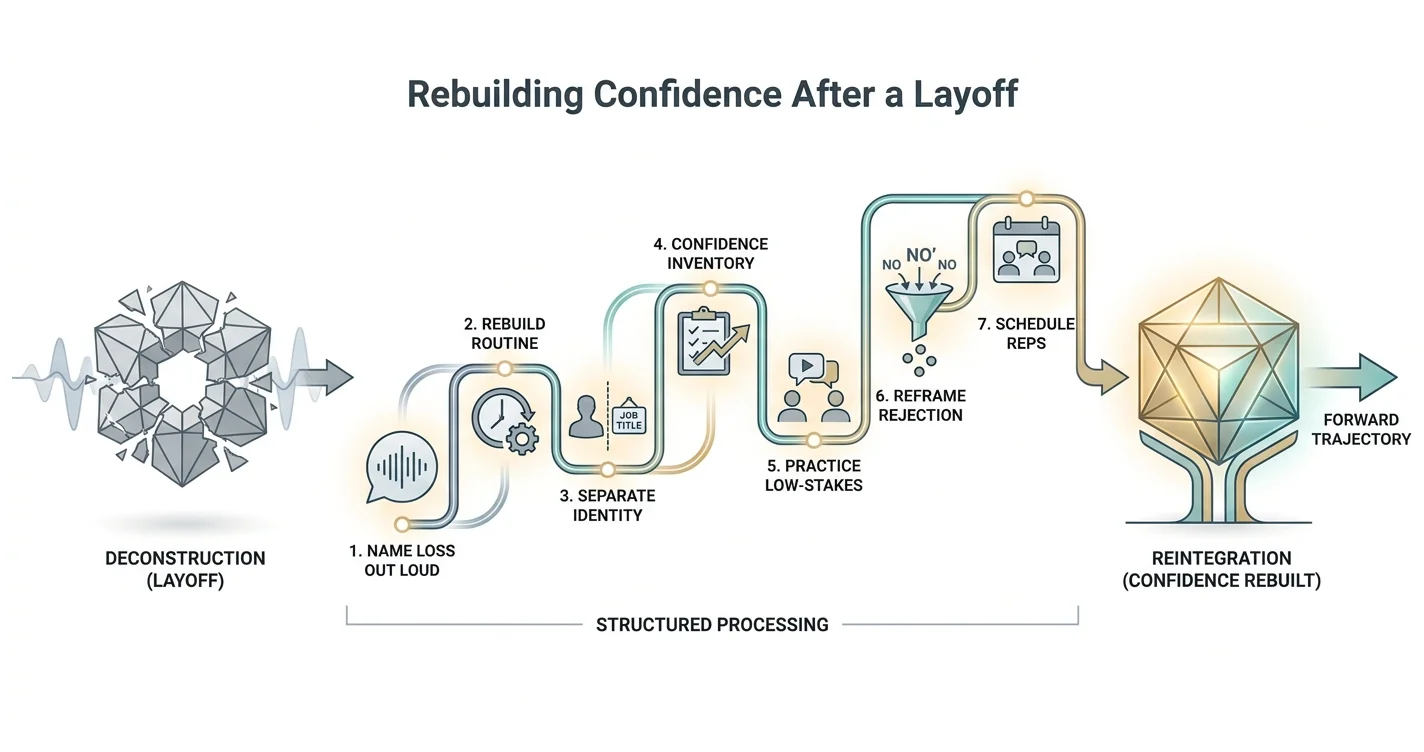
1. Name the loss out loud
Saying "I got laid off and it hurt" to another person — or to an AI voice therapist — does something silent journaling can't: it forces the thought out of the loop in your head. Do this in the first 3 days, before you touch a resume.
Common mistake: minimizing it ("it's fine, it happens") before you've actually processed it. Skipping this step is why confidence work stalls two weeks in.
2. Rebuild a daily structure
A layoff erases the external structure a job gave you — start time, lunch break, commute. Replace it within the first 10 days with a simple block: wake time, 20 minutes of movement, 2 hours of job search work, then a hard stop.
Expected outcome: you stop measuring the day by how many applications you sent and start measuring it by whether you kept the structure.
3. Separate identity from title
Your title was a role you performed, not the whole of who you are. Write down 3 things you're proud of from the last year that had nothing to do with your job — a friendship you showed up for, a skill you built, a problem you solved outside work.
This matters because interviewers can tell when a candidate's entire sense of worth rides on getting the offer — it reads as desperation, not confidence.
4. Run a confidence inventory
List every project, metric, or outcome from your last role you can point to with a number attached — revenue, headcount managed, timelines hit. Specifics beat adjectives in interviews every time.
Common mistake: relying on vague self-praise ("I'm a hard worker") instead of concrete proof. Recruiters in 2026 are trained to probe past vague claims within the first two questions.
5. Practice low-stakes conversations
Before the real interviews start, rehearse the layoff story out loud with someone low-stakes — a friend, a support group, or a voice conversation with an AI therapist. Say the same 3-sentence version until it stops catching in your throat.
If overcoming imposter syndrome at work was already a struggle before the layoff, this step matters even more — old self-doubt resurfaces fast under job search pressure. The guide on overcoming imposter syndrome at work breaks down how to catch that pattern before it derails an interview.
6. Reframe rejection as data
Every "no" after a first-round interview usually means fit, not worth. Track rejections in a simple log with one note each: stage reached, one honest guess at why. After 5 rejections, patterns start showing up — and patterns are fixable, feelings of failure aren't.
Expected outcome: rejection stings less by application 10 because you're reading it as information instead of a verdict on you.
7. Schedule interview reps before it counts
Book at least 2 low-stakes practice conversations — informational chats, mock interviews with a friend — before your first real interview. Confidence is a rehearsed skill, not a mood you wait for.
Common mistake: treating the first real interview as the practice round. That's the version people freeze in.
Talk it through before your next interview
Lovon's AI voice companion is available any hour you need to process a hard day.
8. Set a weekly review ritual
Every Sunday, review the week in 3 categories: applications sent, confidence practices done, and one honest win. This keeps the focus on process, not just outcomes you can't control like callback rates.
Troubleshooting
- Still feel numb two weeks in. That's within normal range for a layoff of this size, but if it stretches past 30 days without lifting, that's worth a real conversation, not just journaling.
- Every application feels like begging. Reframe it as a mutual evaluation — you're also assessing whether the company is worth your time. Write 1 reason you'd say no to a bad-fit offer.
- You freeze when a recruiter asks why you left. Script a 2-sentence answer in advance: what happened, what you're looking for now. Practice it out loud 5 times before the next call.
- You compare yourself to former coworkers who landed jobs faster. Their timeline isn't your timeline — market, network, and role all differ. Delete or mute their updates if it's derailing your week.
- Confidence dips right before interviews. Build a 5-minute pre-interview ritual: 3 slow breaths, one line reminding yourself of a real win, then start.
Tools and resources
- A fixed daily schedule template — even a basic one beats none
- A voice memo app or journal for naming the loss out loud
- One accountability contact who checks in weekly
- If burnout from the old job is tangled up with the layoff itself, working through career burnout with an AI life coach can untangle which feeling belongs to which cause
What to do next
Once the daily structure holds for 10 straight days and the layoff story comes out steady instead of shaky, shift the focus fully to interview prep — tone, specifics, and the confidence inventory you built in step 4.
FAQ
How long does it take to rebuild confidence after a layoff?
Most people need several weeks of structured daily routine and honest processing before confidence feels steady again, not overnight. The first 10 to 14 days are usually the hardest; confidence tends to firm up once a daily structure and a rehearsed layoff story are in place.
Is it normal to feel numb weeks after losing a job?
Yes, numbness for 2 to 3 weeks after a layoff is common and reflects a real stress response, not a character flaw. If the numbness stretches past 30 days without any lift, that's a signal to talk to someone rather than wait it out alone.
Should I tell interviewers I got laid off?
Yes, state it plainly in one or two sentences and move on — over-explaining reads worse than the layoff itself. A short, rehearsed answer signals more confidence than a long justification.
What is the fastest way to stop feeling like a failure after a layoff?
Separate your identity from your job title by listing 3 wins from the past year that had nothing to do with work. Pairing that with a fixed daily routine within the first 10 days does more than any resume rewrite.
Can therapy help with layoff-related anxiety?
Yes, talking through the loss with a therapist, support group, or an AI voice therapist helps settle the nervous system before high-stakes interviews. Processing the loss out loud tends to reduce the over-explaining and hesitation that show up in interview answers.
How do I stop comparing myself to coworkers who found jobs faster?
Mute or limit exposure to their updates for the weeks you're rebuilding, since their timeline depends on factors outside your control. Track your own week in 3 categories instead — applications, confidence practice, one honest win.
What should I do in the first week after a layoff?
Name the loss out loud within the first 3 days and set a fixed daily structure before touching job applications. Skipping straight to job boards without processing the loss tends to show up as hesitation in early interviews.
Does an AI therapist help with job loss stress?
An AI voice therapist gives you a place to say the layoff story out loud and rehearse it before it has to come out steady in a real interview. It is not a replacement for licensed clinical care, but it fills the gap between the layoff call and your first practice conversation.
One last thing
The detail most job seekers skip: rehearsing the layoff story out loud, not just thinking it through. A story that only exists in your head still catches in your throat the first time a recruiter asks about it — say it 5 times to someone else, or to an AI voice therapist, before it has to come out clean in an interview.
Related guides
How AI Support Helps You Heal
AI emotional support isn't about replacing human connection — it's about filling the gaps. The moments when you need to talk at 2 AM, when you don't want to burden your friends again, or when you simply need someone to listen without judgment.
Here's what happens in a typical Lovon session:
You share what's on your mind
There's no script, no intake form, no waiting room. You speak or type whatever you're feeling — in your own words, at your own pace.
Lovon validates and explores
Using frameworks from CBT (Cognitive Behavioral Therapy) and motivational interviewing, Lovon acknowledges your feelings first, then gently helps you explore them. No dismissive "just move on" advice.
You build coping skills together
Lovon doesn't just listen — it actively works with you on evidence-based techniques: thought reframing, urge surfing, behavioral experiments, and more.
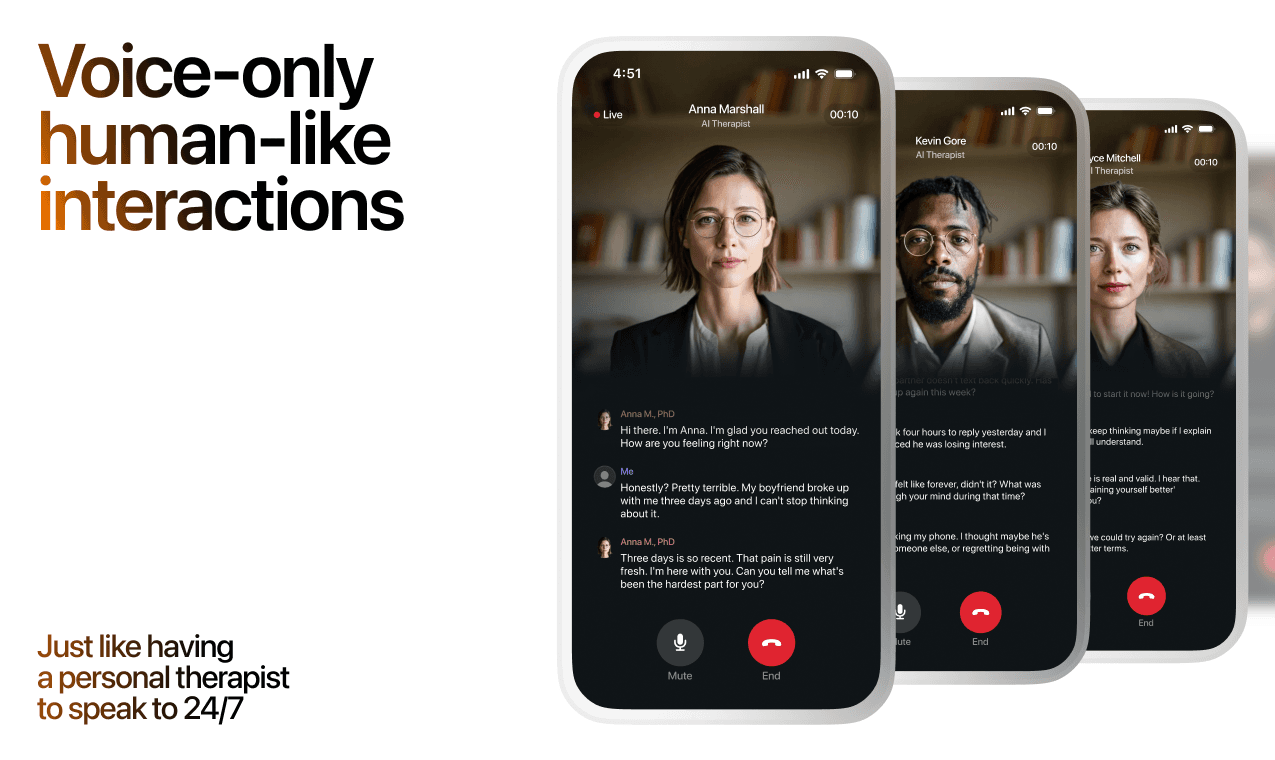
What a Session with Lovon Looks Like
When to Seek Professional Help
AI support is a valuable tool, but it's not a replacement for professional care. Please consider reaching out to a licensed therapist if you experience any of the following:
- Persistent thoughts of self-harm or suicide
- Inability to perform daily activities (work, eating, sleeping) for more than 2 weeks
- Turning to alcohol or substances to cope
- Intense anger or desire to harm your ex-partner
- Complete emotional numbness that doesn't improve over time
Crisis Resources (US): If you're in immediate danger, call 988 (Suicide & Crisis Lifeline) or text HOME to 741741 (Crisis Text Line). Available 24/7, free, and confidential.
Outside the US? Find a crisis line in your country
Ready to Start?
Your healing journey can begin right now
A 7-day trial. No judgment. Just a safe space to process what you're going through.
Frequently Asked Questions
Is Lovon a replacement for a real therapist?
Is my conversation with Lovon AI private?
How is Lovon different from ChatGPT for emotional support?
Can I use Lovon if I'm already seeing a therapist?
Can I try Lovon before subscribing?
About the Author

The Lovon Editorial Team
Mental Health & Wellness Content Team
The Lovon Editorial Team develops mental health and wellness content designed to make psychological concepts accessible and actionable. Our goal is to bridge the gap between clinical research and everyday life - helping you understand why your mind works the way it does and what you can do about it....
Related articles
- How to Stop Being Codependent: Steps That Work (2026)
How to stop being codependent in 2026: 6 practical steps, common mistakes, and troubleshooting for boundary-setting…
- Self-Worth vs Self-Esteem: The Real Difference (2026)
Self-worth vs self-esteem explained with a 6-step exercise. Verdict: build self-worth first in 2026 — self-esteem alone…
- People Pleasing Trauma Response: How to Stop It in 2026
People pleasing trauma response explained: it's the fawn response, not weakness. Six steps to stop it in 2026, plus what…
- Cope with Job Rejection Without Spiraling (2026 Guide)
Learn how to cope with job rejection without spiraling in 2026: 7 steps to process the news, stop rumination, and keep…
See also
Quizzes
- Am I a People Pleaser? 12-Question Quiz
Where kindness stops and self-erasure starts.
- Confidence Test: Do You Act Before You Feel Ready?
See which part of your confidence is thin.
Free tools
- How to Respond to a Narcissist
Paste what they said. You get the part that actually needs answering separated from the part designed to pull you in, a…
- How to Respond to Gaslighting
Say what happened and what they say happened. You get what is actually established separated from what is being…
From the wiki
- Why do I feel lonely all of a sudden?
Sudden loneliness usually traces back to something that quietly ended in the last few months: a routine, a shared class…
Disclaimer: This article is for informational purposes only and does not constitute medical advice, diagnosis, or treatment. Always seek the advice of your physician or other qualified health provider with any questions you may have regarding a medical condition. If you are in crisis or think you may have an emergency, call 988 (Suicide & Crisis Lifeline) or go to the nearest emergency room. Outside the US? Find a crisis line in your country.