
How to Overcome Imposter Syndrome at Work in 2026
Overcome imposter syndrome at work with a 7-step, evidence-based plan for 2026 - track wins, reframe the script, and talk it out with AI voice therapy.

Key Takeaways
- Overcoming imposter syndrome at work means separating feelings from facts, not waiting to feel confident before you act.
- Up to 70% of people feel like impostors at some point, a 2011 review found.
- Naming your imposter type - perfectionist, expert, soloist, natural genius, or superhuman - changes which fix works.
- Saying the fear out loud breaks the loop faster than journaling; Lovon's AI voice therapy gives you that outlet anytime.
- Track three concrete wins a week through 2026 - an evidence log beats affirmations for rewiring doubt.
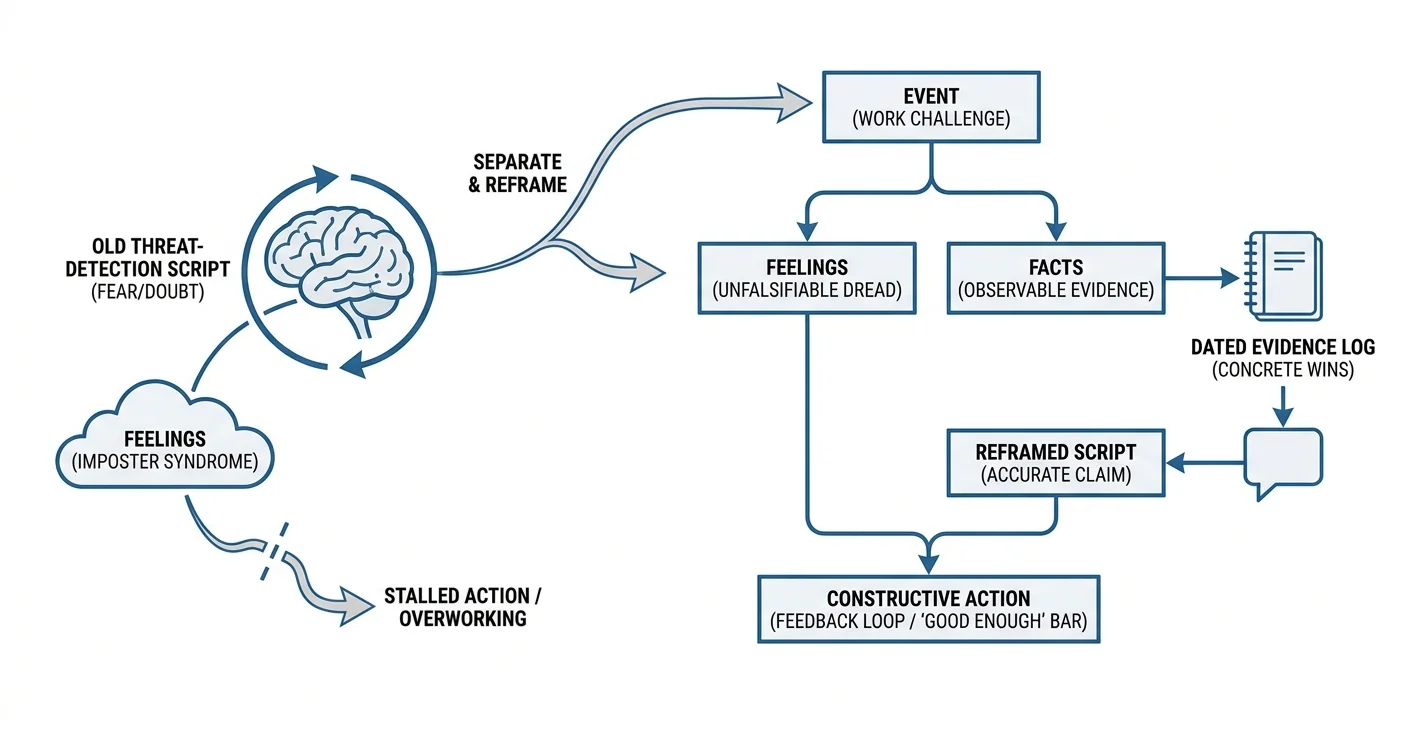
Imposter syndrome at work doesn't mean you're unqualified — it means your brain is running an old threat-detection script in a new room. Here's how to overcome imposter syndrome at work in 2026, step by step, without waiting for a promotion to fix your confidence for you.
TL;DR
- Overcoming imposter syndrome at work means separating feelings from facts, not waiting to feel confident before you act.
- Up to 70% of people feel like impostors at some point, a 2011 review found.
- Naming your imposter type - perfectionist, expert, soloist, natural genius, or superhuman - changes which fix works.
- Saying the fear out loud breaks the loop faster than journaling; Lovon's AI voice support gives you that outlet anytime.
- Track three concrete wins a week through 2026 - an evidence log beats affirmations for rewiring doubt.
Why this matters
Imposter syndrome at work isn't a character flaw — it's a mismatch between your internal evidence file and your actual track record. Psychologists Pauline Clance and Suzanne Imes first described the "imposter phenomenon" in 1978 after noticing high-achieving professionals who couldn't internalize their own success. Decades later, the pattern shows up the same way: promotions and praise get chalked up to luck or timing, while every mistake feels like proof you're a fraud.
The stakes are real in 2026's leaner teams and faster feedback cycles. Overworking to "prove yourself" is one of the most common reasons people quietly stall their own careers — a pattern covered in more depth in this breakdown of career burnout. Left alone, the loop doesn't resolve with one good performance review. It resolves when you change how you process the evidence.
That's a learnable skill, not a personality trait you're stuck with.
What you'll need
- 10 minutes a day for a week to track evidence, in a notes app or a plain notebook
- One recent project, presentation, or decision to use as a case study
- A private way to talk the fear out loud - pacing your kitchen, a voice memo, or a session with an AI voice companion like Lovon
- Willingness to write down three concrete wins a week without minimizing them
- 20-30 minutes for a first pass through the steps below
The steps
1. Name the pattern instead of arguing with it
Write down the exact thought in one sentence: "I think I got this role because they were desperate," or "I don't actually know what I'm doing." Naming it moves the fear from a vague background hum into a testable claim.
This matters because vague dread is unfalsifiable - you can't argue with a feeling, but you can argue with a sentence. Common mistake: stopping at "I feel like a fraud" instead of writing the specific, checkable version step 2 needs.
2. Separate the feeling from the evidence
Next to the sentence from step 1, list three pieces of evidence that contradict it - a metric you hit, a decision that worked, direct feedback from a manager or client. Date the entry.
Do this for one week straight and you'll have seven entries, not one. One data point feels like luck. Seven in a row starts to look like a pattern you can't dismiss. Common mistake: listing feelings ("I worked hard") instead of outcomes ("shipped the redesign two days early, zero client escalations").
3. Identify which imposter type you're running
Psychologist Valerie Young's framework groups the pattern into five rough types: the perfectionist (any flaw erases the win), the expert (you must know everything before feeling qualified), the soloist (asking for help feels like failure), the natural genius (struggling to learn something feels like proof you're not cut out for it), and the superhuman (over-functioning across every role to prove worth).
Pick the one that fits closest. The fix differs by type: perfectionists need a fixed "good enough" bar (step 6), soloists need a support loop (step 7). Common mistake: trying to fix all five types at once instead of targeting the one driving most of the noise this month.
4. Reframe the internal script, don't just suppress it
Take the sentence from step 1 and rewrite it as a claim a fair witness would make, using the evidence from step 2: "I was hired because I met the requirements and interviewed well; I'm still learning parts of the role, which is normal three months in."
This isn't positive thinking - it's accurate thinking with the evidence attached. A deeper walkthrough of the technique lives in this guide on how to stop negative self-talk. Common mistake: swapping one extreme ("I'm a fraud") for another ("I'm the best on the team") instead of landing on something specific and true.
5. Say it out loud, not just on paper
Silent journaling helps, but speaking the fear out loud - to a friend, a mirror, or an AI voice therapist - activates a different processing loop than writing does. Hearing your own voice say "I think I'm going to get found out" often makes the claim sound more exaggerated than it did in your head.
This is where a tool built for exactly this moment earns its place: Lovon's AI voice sessions let you talk through the spiral at 11pm before a big presentation, not just during a scheduled hour. See how the format works in this breakdown of AI voice therapy for work-related stress. Common mistake: only ever processing the fear internally, which lets the loudest, least accurate version of the thought run unchecked.
6. Set a "good enough" line before you start
Before the next high-stakes task, decide in advance what "done well" looks like - a specific, measurable bar, not "perfect." Example: "the deck has the three numbers the VP asked for and no typos on slide one," not "flawless."
Perfectionist-type imposter syndrome thrives on a moving target. A fixed bar set in advance can't move on you mid-task. Common mistake: setting the bar after you've already started, which lets anxiety keep redefining "good enough" as "impossible."
7. Build a two-person evidence loop
Ask one colleague or mentor for specific, dated feedback after your next project - not "how'd I do?" but "what's one thing that worked and one thing to improve?" Specific feedback is harder to explain away as politeness.
Log the answer next to your own evidence from step 2. Common mistake: only asking for feedback when something went wrong, which skews your evidence file toward failure and reinforces the pattern.
Talk the spiral out loud tonight
Process the fear with an AI voice therapist between real sessions.
Troubleshooting
- The evidence log feels fake or forced. Start smaller - one line a day for three days instead of a full page. The habit matters more than the length in week one.
- A single mistake undoes a week of progress. That's perfectionist-type imposter syndrome overriding the data. Add the mistake as one line among seven, not the whole page.
- The fear spikes before a specific event, like a review. Time-box the reframe: run steps 1-5 the night before, not the morning of, so you're not doing cognitive work under acute stress.
- You can talk yourself into confidence but it doesn't last past lunch. The reframe isn't attached to evidence yet - go back and add two more dated wins; a line without data fades in hours.
- You feel like the "wrong" imposter type. Types blend. Pick the one responsible for the most anxiety this month specifically and re-run step 3 quarterly through 2026.
Tools and resources
- A dated evidence log - notes app, spreadsheet, or paper - the single highest-leverage habit here
- A quiet 10-minute window daily for the first week
- Lovon's AI voice support for talking the spiral out loud between real sessions or after hours, built with input from PhD psychologists as an on-demand companion, not a replacement for licensed care
- A colleague or mentor willing to give dated, specific feedback
- A fixed "good enough" checklist per task, written before you start
What to do next
Once the loop is interrupted, the next skill is building baseline confidence that doesn't depend on the last win holding up. This guide on an AI life coach for confidence and self-esteem walks through that next stage.
FAQ
What is the fastest way to overcome imposter syndrome at work?
The fastest fix is a dated evidence log: write three specific, verifiable wins a week and reread them before high-stakes moments. It won't erase the feeling in one sitting, but a week of entries usually outweighs a single bad meeting.
Is imposter syndrome a real diagnosis?
No, imposter syndrome isn't a clinical diagnosis in the DSM-5 - it's a documented pattern first described by researchers Pauline Clance and Suzanne Imes in 1978. It can coexist with anxiety or perfectionism without being a disorder itself.
How common is imposter syndrome at work?
Up to 70% of people report feeling like impostors at some point in their career, according to a widely cited 2011 review in the International Journal of Behavioral Science. It shows up across industries and seniority levels, not just among junior employees.
Does imposter syndrome go away with more experience?
Not automatically - experience alone doesn't fix it because the pattern is about how you process evidence, not how much evidence exists. Many senior leaders in 2026 still report the feeling; the reframing habit is what shifts it, not tenure.
Can talking out loud help more than journaling for imposter syndrome?
For many people, yes - saying the fear out loud exposes how exaggerated it sounds compared to writing it silently. AI voice support apps like Lovon are built for that exact moment, when you need to process a spiral verbally outside a scheduled therapy hour.
What are the 5 types of imposter syndrome?
Psychologist Valerie Young's framework names five types: the perfectionist, the expert, the soloist, the natural genius, and the superhuman. Each type responds to a different fix, which is why generic confidence advice often doesn't stick.
Should I tell my manager I feel like an imposter?
It depends on the relationship, but specific, dated feedback requests work better than disclosing the feeling directly - ask what worked and what to improve instead of whether you're good enough. The data you get back is more useful than reassurance.
Is imposter syndrome the same as low self-esteem?
No - imposter syndrome is task- and achievement-specific self-doubt, while low self-esteem is broader and more constant. Someone can feel confident in relationships or hobbies while doubting only their professional competence.
One last thing
The fastest imposter-syndrome fix isn't a mindset shift - it's a dated evidence log. Feelings resolve in hours; a week of specific, timestamped wins is the only thing that outlasts the next bad meeting. Start the log today, not after the next big project, because the data you need is happening right now, in 2026, whether you write it down or not.
Related guides
How AI Support Helps You Heal
AI emotional support isn't about replacing human connection — it's about filling the gaps. The moments when you need to talk at 2 AM, when you don't want to burden your friends again, or when you simply need someone to listen without judgment.
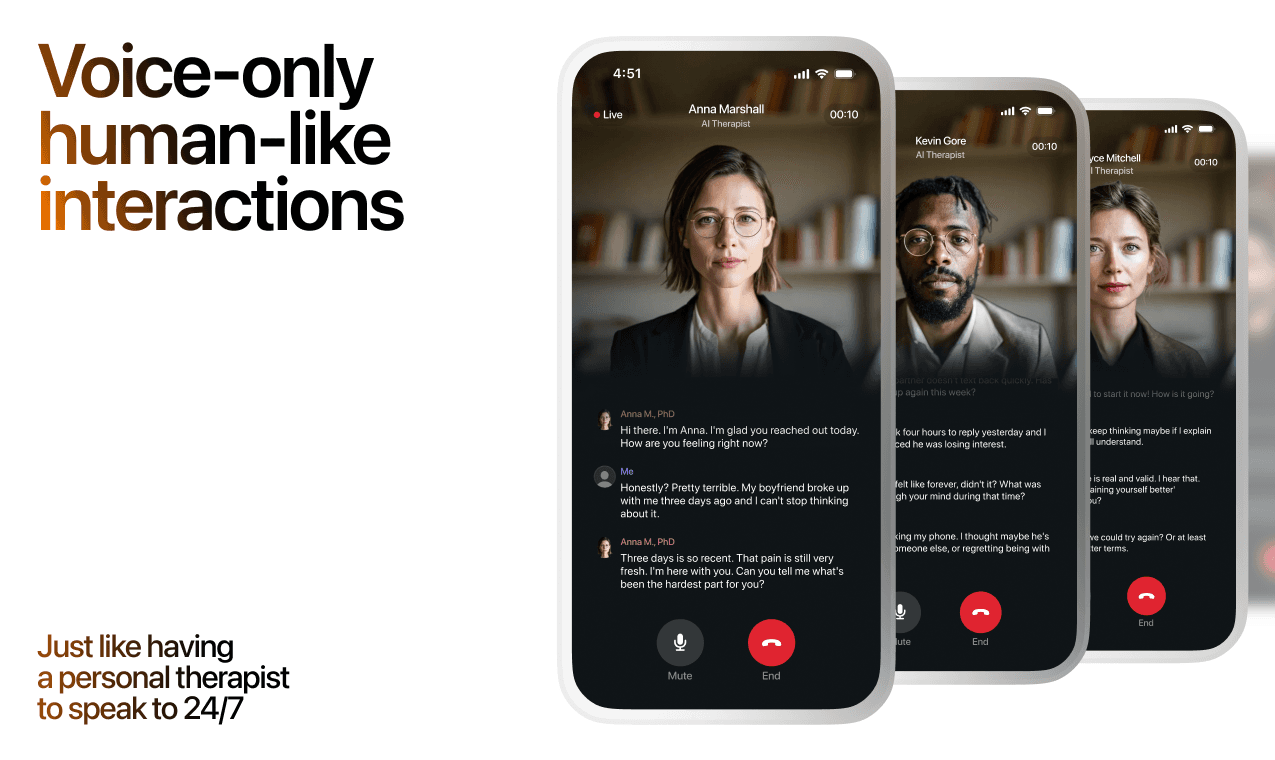
Here's what happens in a typical Lovon session:
You share what's on your mind
There's no script, no intake form, no waiting room. You speak or type whatever you're feeling — in your own words, at your own pace.
Lovon validates and explores
Using frameworks from CBT (Cognitive Behavioral Therapy) and motivational interviewing, Lovon acknowledges your feelings first, then gently helps you explore them. No dismissive "just move on" advice.
You build coping skills together
Lovon doesn't just listen — it actively works with you on evidence-based techniques: thought reframing, urge surfing, behavioral experiments, and more.
What a Session with Lovon Looks Like
When to Seek Professional Help
AI support is a valuable tool, but it's not a replacement for professional care. Please consider reaching out to a licensed therapist if you experience any of the following:
- Persistent thoughts of self-harm or suicide
- Inability to perform daily activities (work, eating, sleeping) for more than 2 weeks
- Turning to alcohol or substances to cope
- Intense anger or desire to harm your ex-partner
- Complete emotional numbness that doesn't improve over time
Crisis Resources (US): If you're in immediate danger, call 988 (Suicide & Crisis Lifeline) or text HOME to 741741 (Crisis Text Line). Available 24/7, free, and confidential.
Outside the US? Find a crisis line in your country
Ready to Start?
Your healing journey can begin right now
A 7-day trial. No judgment. Just a safe space to process what you're going through.
Frequently Asked Questions
Is Lovon a replacement for a real therapist?
Is my conversation with Lovon AI private?
How is Lovon different from ChatGPT for emotional support?
Can I use Lovon if I'm already seeing a therapist?
Can I try Lovon before subscribing?
About the Author
The Lovon Editorial Team
Mental Health & Wellness Content Team
The Lovon Editorial Team develops mental health and wellness content designed to make psychological concepts accessible and actionable. Our goal is to bridge the gap between clinical research and everyday life - helping you understand why your mind works the way it does and what you can do about it....
Related articles
- Why Do I Self-Sabotage at Work? Fix It in 2026
Why do I self-sabotage at work? Fear of judgment or success, not laziness. Get the 7-step fix and know when to loop in…
- Best AI App for Making Friends as an Adult (2026 Ranked)
Lovon leads our 2026 ranking of AI apps for social confidence, tackling the anxiety behind making friends as an adult…
- Enmeshment in Relationships: Signs & Fix (2026)
Enmeshment in relationships blurs boundaries until feelings merge. See the signs, a 7-step untangling process, and…
- AI Relationship Coach for Dating Confidence: 2026 Guide
The best ai relationship coach for dating confidence in 2026 pairs voice practice with real self-worth work, not…
See also
Quizzes
- Am I a People Pleaser? 12-Question Quiz
Where kindness stops and self-erasure starts.
- Alexithymia Test: Can You Name What You Feel?
See where your feelings lose their names, in 3 minutes.
Free tools
- How to Respond to a Narcissist
Paste what they said. You get the part that actually needs answering separated from the part designed to pull you in, a…
- How to Confront a Narcissistic Parent
Most of these conversations fail because you went in wanting three things at once. Tell it what you want to raise, and…
From the wiki
- What is inhibited grief?
Inhibited grief is grief that never gets out. The loss happened, you kept functioning, and the feeling stayed sealed…
Disclaimer: This article is for informational purposes only and does not constitute medical advice, diagnosis, or treatment. Always seek the advice of your physician or other qualified health provider with any questions you may have regarding a medical condition. If you are in crisis or think you may have an emergency, call 988 (Suicide & Crisis Lifeline) or go to the nearest emergency room. Outside the US? Find a crisis line in your country.